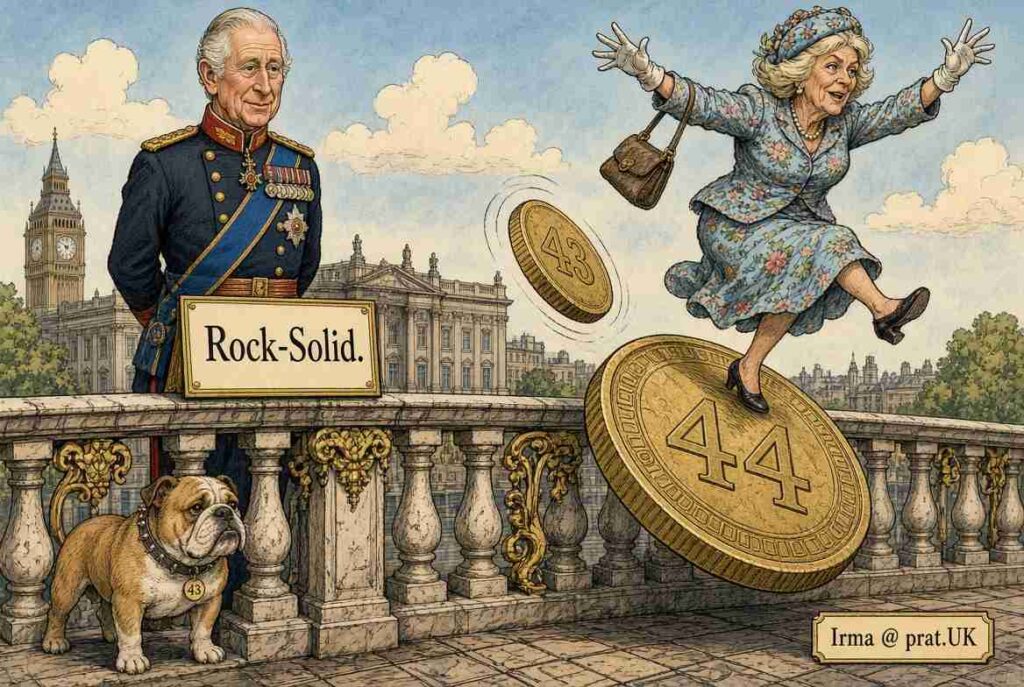
Royal Family Declares Monarchy “Rock-Solid” After Discovering Queen Camilla Is Basically a National Coin Toss
King Charles enjoys comfortable support, William and Catherine remain ratings monsters, while Palace strategists reportedly search Britain for the seven people who still haven’t formed an opinion about Camilla
LONDON — Buckingham Palace received encouraging news about the stability of the monarchy this summer after polling revealed that King Charles III enjoys a positive rating of 62%, while Queen Camilla has achieved the considerably more exciting constitutional position of being viewed positively by 43% of Britons and negatively by 44%.
Buckingham Palace has once again proven that the best way to survive a thousand years of history is to start acting like a struggling SaaS company.
That is not unpopularity.
That is suspense.
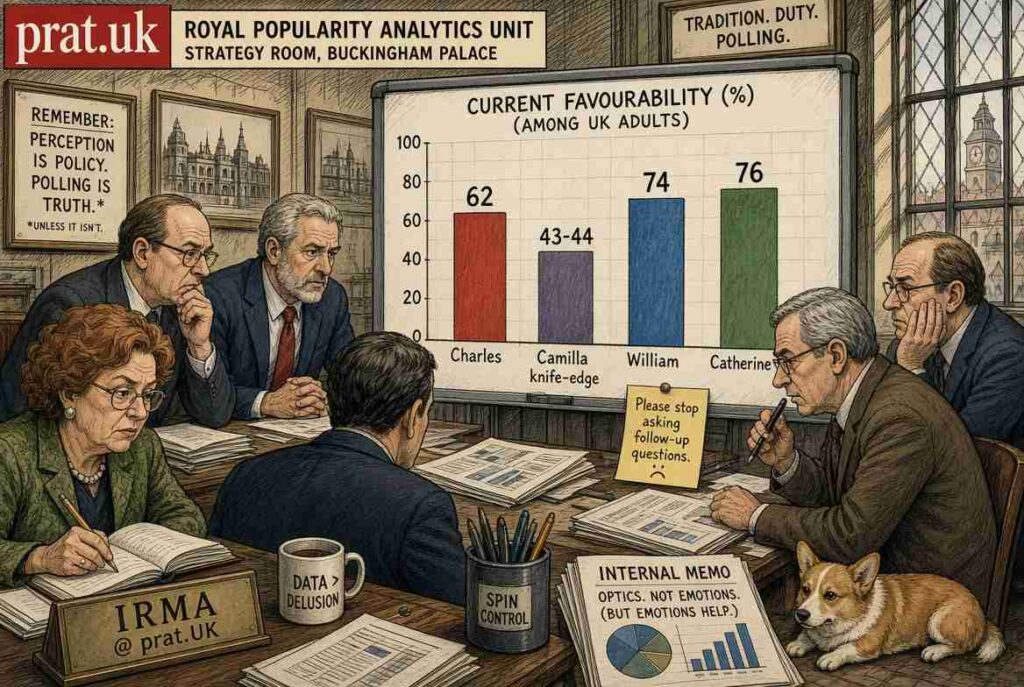
According to YouGov’s July 2026 royal-family favourability tracker, 62% of Britons hold a favourable opinion of Charles compared with 31% who view him negatively. Meanwhile, the public is almost perfectly divided over Camilla, 43% favourable and 44% unfavourable. Prince William and Catherine remain considerably more popular, with roughly three-quarters of Britons viewing them favourably.
You can almost hear the Palace briefing.
“The monarchy is stable.”
“How stable?”
“Very.”
“And Camilla?”
“Please stop asking follow-up questions.”
This is the fascinating thing about modern monarchy. Britain has maintained an institution built upon heredity, ceremony, ancient law, ermine, gold coaches and the general constitutional principle that nobody should ever ask exactly what everything costs.
And then somebody invented polling.
Suddenly the House of Windsor became Netflix.
Would you recommend Season Three of Charles to a friend?
Season 3 of Charles has been renewed, but only because nobody in the writers’ room can agree on how to kill off a main character who is also constitutionally immortal.
Charles: 62%.
Camilla: 43%.
William: 74%.
Catherine: 76%.
Princess Anne: 70%.
You can practically see the Palace analytics department.
“Your Majesty, William is outperforming you among women aged 35 to 54.”
“What should I do?”
“We’re thinking sourdough.”
Thinking About the Numbers…
- King Charles is 62% popular, which sounds impressive until you remember the monarchy once operated on a system where popularity was measured by whether anybody successfully stormed the palace.
- Queen Camilla is at 43% positive and 44% negative, meaning the British public has essentially placed the Queen on hold while it checks with another department.
- Charles has a 31% negative rating, proving that even after spending most of your life preparing for one job, nearly one-third of Britain can still give you a performance review reading, “We’ll circle back.”
- William and Catherine sit around 74% to 76% positive, which must make family Christmas wonderfully relaxed. “Lovely turkey, Dad. Incidentally, we’re fourteen points more popular than you.”
- The monarchy itself enjoys 64% support, meaning Britain has apparently settled on constitutional monarchy with roughly the enthusiasm normally reserved for keeping the local Tesco open.
The Monarchy Has Discovered Customer Satisfaction
The peculiar thing is that Charles performs better when Britons are asked specifically whether he is doing a good job.
YouGov found 68% saying Charles is doing a good job as monarch, the highest level recorded by that tracker, while only 16% said he is doing badly. Support for retaining the monarchy stood at 64%.
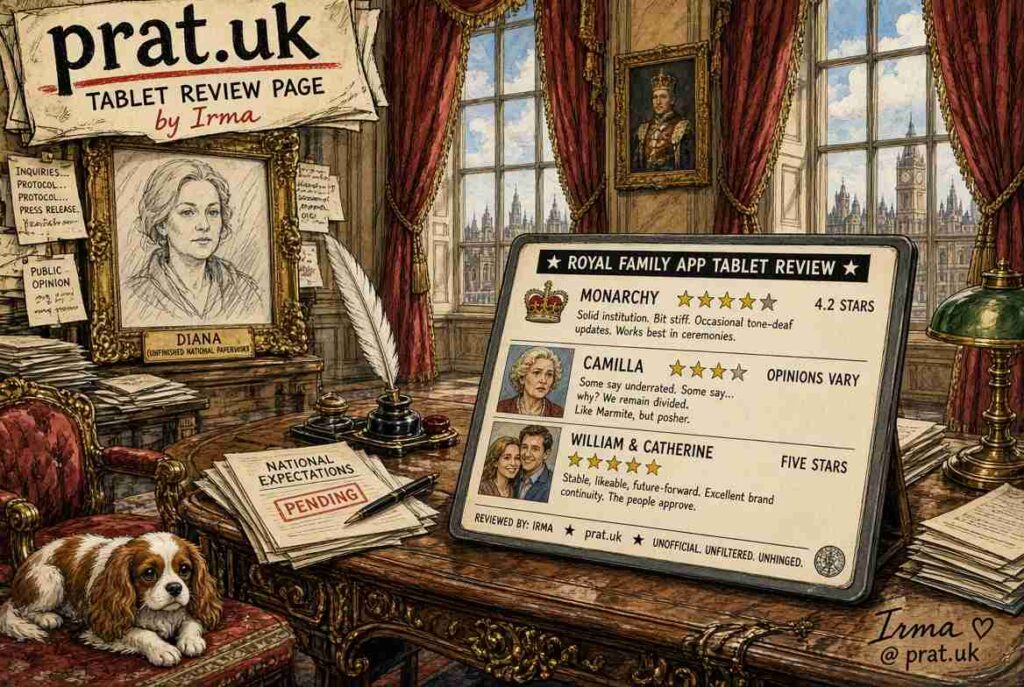
Charles has achieved something no British Prime Minister has managed in decades: a positive net approval rating while doing absolutely nothing differently.
This creates one of the most British polling results imaginable.
“I don’t particularly care for Charles.”
“Is he doing a good job?”
“Oh yes. Excellent.”
“Would you like to abolish the monarchy?”
“Good heavens, no.”
“Would you invite him over?”
“Absolutely not.”
That is Britain.
The nation has apparently evaluated the sovereign using the same criteria applied to an accountant.
Personality: debatable.
Performance: satisfactory.
Keep him: yes.
Invite to barbecue: depends who else is coming.
The monarchy should cherish this distinction because 62% favourability is perfectly respectable until one remembers that Queen Elizabeth II spent decades occupying a completely different psychological category.
Elizabeth was not merely a monarch.
She was weather.
You did not approve or disapprove of her.
She was simply there.
Rain. Tea. The Queen.
Charles has inherited something much more modern: metrics.
His mother had subjects.
Charles has respondents.
The monarchy’s approval math now works exactly like a landlord’s: tenants hate you, but nobody’s actually moving out.
Then There Is Camilla
Camilla’s numbers are where things become interesting.
Forty-three percent favourable.
Forty-four percent unfavourable.
That is not a poll.
That is a knife balanced on a canapé.
At 43-44, Camilla is statistically less popular than a coin flip, and considerably less popular than the coin.
Town & Country, discussing the fallout from Earl Spencer’s new Diana memoir Swan Song: Diana, My Sister, specifically pointed to these numbers while asking whether the present royal status quo might be more fragile than it appears. The magazine noted that Charles and Camilla remain well behind the popularity enjoyed by William and Catherine.
British bookmakers have reportedly stopped taking bets on Camilla’s approval rating, on the grounds that “a market this evenly split isn’t gambling, it’s just weather.”
Royal strategists must adore 43-44.
You cannot relax.
You cannot panic.
You cannot even order lunch.
Change one person’s mind in Wolverhampton and constitutional history moves 0.000002%.
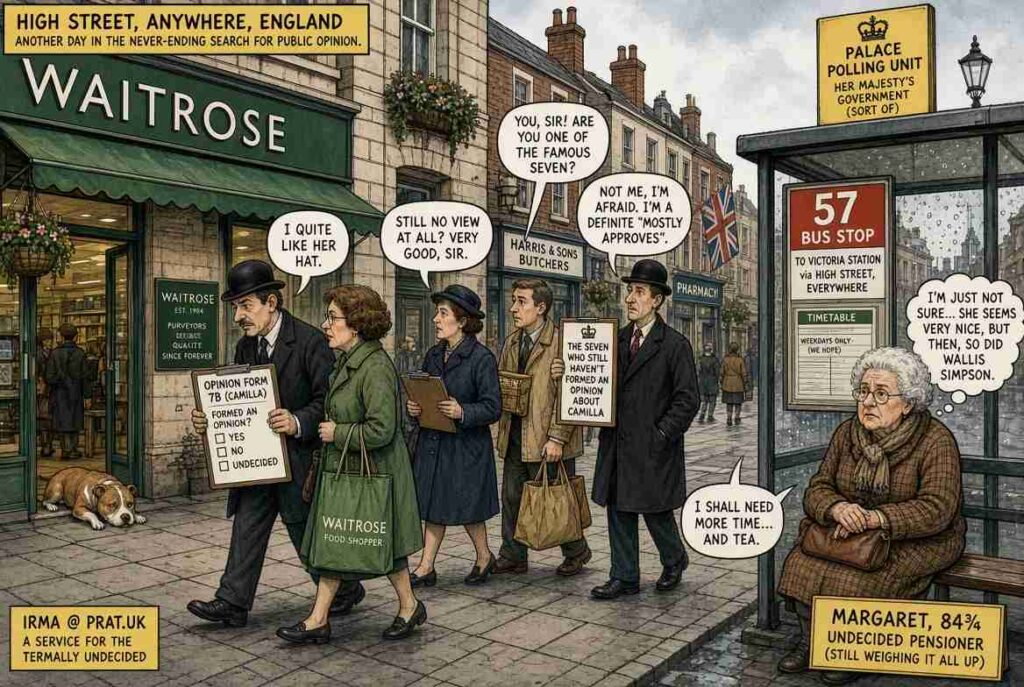
One imagines Buckingham Palace has now established the Camilla Conversion Unit, whose entire mission consists of locating undecided pensioners and arranging for the Queen to be photographed near vegetables.
“Your Majesty, we’ve identified Margaret in Shrewsbury.”
“Is she undecided?”
“Yes.”
“Release the corgis.”
Somewhere in the Palace basement there is reportedly a whiteboard that says CAMILLA +1 or CAMILLA −1, and nobody is allowed to erase it, only update it.
At 43-44, every appearance matters.
Camilla visits a literacy charity?
Plus 0.1.
Camilla smiles at Chelsea Flower Show?
Plus 0.2.
Somebody rebroadcasts a Diana documentary at 9 p.m.?
Everybody under the table.
Diana: The Royal Family’s Permanent Push Notification
And this is the problem waiting quietly behind the polling.
Princess Diana died on August 31, 1997.
Next year will mark thirty years.
Yet Diana remains astonishingly capable of re-entering Britain’s public conversation without the assistance of advisers, strategists, press secretaries, Instagram accounts, branding consultants or men named Giles carrying clipboards.
Earl Spencer’s memoir has already demonstrated the phenomenon.
Spencer has made serious allegations regarding Charles’s behaviour and words following Diana’s death, including his disputed claim that Charles told him, “Rest assured, we’ll forget her soon enough.” Buckingham Palace challenged Spencer’s account, saying grief can affect judgment and memory. Spencer subsequently accused the Palace of effectively questioning his truthfulness.
The claims remain disputed.
The irony does not.
Nearly three decades after Diana’s death, Britain is discussing her again.
So much for forgetting.
If Charles actually said anything remotely resembling Spencer’s allegation, it would qualify as one of history’s poorer forecasts.
Britain forgot Diana in roughly the same way America forgot Elvis.
There are people who were not alive when Diana died who nevertheless appear to possess opinions about her marriage.
That is elite-level cultural permanence.
Somewhere a 23-year-old is explaining the Wales marriage to a 68-year-old who watched the wedding live.
“No, Grandma, what you need to understand about 1981 is…”
Grandma is thinking, I was there, Tyler.
Diana hasn’t issued a public statement in 29 years and is still outperforming three working royals in the discourse.
Buckingham Palace Discovers Its Natural Predator: The Memoir
The Palace has survived republicans, constitutional crises, tabloid scandals, Netflix dramas, Oprah interviews and several decades during which every newspaper editor in Britain apparently kept a folder labelled ROYALS: OPEN IN EMERGENCY.
But books remain troublesome.
Books sit around.
Books get quoted.
Books appear on breakfast television.
Books become documentaries.
Books generate anniversaries.
Books are newspapers that refuse to become fish-and-chip wrapping tomorrow.
Spencer’s credibility did take a blow when he acknowledged an inaccuracy in a passage involving Piers Morgan after Morgan threatened legal action. Town & Country noted that this helped shift some public discussion toward questions about the memoir’s reliability.
Piers Morgan has now played a supporting role in the reputational battles of two different princesses and one memoir’s credibility, which is either a remarkable coincidence or a business model.
For Buckingham Palace, this was presumably considered a victory.
Imagine being King of the United Kingdom and learning that your week has improved because Piers Morgan entered the story.
History takes strange roads.
“Your Majesty, excellent news.”
“France surrendered?”
“No.”
“The Commonwealth expanded?”
“No.”
“Rain stopped?”
“Certainly not.”
“Then what?”
“Piers Morgan may have helped.”
Long silence.
“Good God.”
William and Catherine Have Become the Royal Family’s Emergency Glass
Meanwhile, William and Catherine remain the popularity juggernauts.
YouGov put positive views of the Prince and Princess of Wales at roughly 74% to 76%.
That has to create awkward internal dynamics.
Every family knows the problem.
One sibling has the good career.
One cousin owns property.
Somebody’s child got into Oxford.
But imagine discovering your own son is fourteen points more popular than you among the people you technically reign over.
Christmas lunch practically writes itself.
Charles: “How was everyone’s year?”
William: “Seventy-four.”
Charles: “I meant personally.”
Catherine: “Seventy-six.”
Camilla quietly pours another drink.
William and Catherine are essentially the monarchy’s fire extinguisher.
Break glass in case of constitutional ennui.
Need to raise approval?
Send William somewhere.
Need newspapers smiling?
Catherine has a coat.
Need national reassurance?
Photograph them with children.
The monarchy has stumbled upon the oldest principle in television: when ratings decline, introduce the younger cast.
William and Catherine are now so popular that Buckingham Palace has reportedly considered franchising them.
Britain Is Sold, But Apparently Kept the Receipt
The most revealing description may be that Britain is “sold but not totally sold” on the current monarch and consort.
That beautifully captures the country’s relationship with royalty.
Britain wants the monarchy.
Mostly.
Britain likes Charles.
Mostly.
Britain is divided on Camilla.
Precisely.
Britain loves William and Catherine.
Decidedly.
And Diana?
Thirty years later, Britain still treats her memory like unfinished national paperwork.
That is where the Palace’s challenge lies.
Not necessarily in some dramatic constitutional collapse.
Not crowds charging Buckingham Palace.
Not Parliament melting down the Crown Jewels to pay the gas bill.
Something subtler.
Comparison.
Charles is not competing with another king.
Camilla is not competing with another queen.
They are competing with memory.
Memory has excellent PR.
Memory never arrives late.
Memory never gives a bad interview.
Memory does not age awkwardly.
Memory does not require constitutional explanations.
And Diana occupies an especially dangerous corner of memory because millions of people remember not merely who she was, but how they felt about her.
You cannot issue a Palace statement against that.
The Royal Family’s New Constitutional Formula
So Britain enters Diana’s 30th anniversary period with an institution that remains comfortably supported but possesses some fascinating structural contradictions.
Most Britons still support monarchy.
Charles receives solid job-performance ratings.
William and Catherine remain extremely popular.
Camilla could apparently change national sentiment by accidentally standing in the wrong queue at Waitrose.
And Diana continues generating headlines from beyond history.
The monarchy is therefore stable in the same way a priceless Ming vase on a side table is stable.
Nobody is knocking it over.
Nobody intends to knock it over.
Everyone agrees it looks wonderful.
But perhaps stop inviting Labradors into the room.
Buckingham Palace does not need panic.
It needs perspective.
A 62% positive rating for Charles is healthy.
A 68% good-job rating is stronger still.
A 64% preference for keeping the monarchy suggests Britain is hardly packing the Crown Jewels into an Uber.
But 43% versus 44% for Camilla should probably prevent anyone from engraving MISSION ACCOMPLISHED into the palace gates.
Because Britain has done something extraordinary.
It has taken an institution based on divine right, inheritance and twelve centuries of ceremony and transformed it into something recognisable to the modern world:
A product with customer reviews.
★★★★★ William
★★★★★ Catherine
★★★★★ Charles
Camilla: “Opinions vary.”
One thousand years old. 4.2 stars. “Would recommend, but customer service (the Camilla department) needs work.”
And Princess Diana?
Apparently still trending.
Thirty years later.
Without posting once.
10 Humorous Observations Before the Crown Starts Checking the Polling Intern’s References
- Charles actually scores better when people are asked whether he is doing a good job, with 68% saying yes. This means some Britons apparently dislike the man while approving of his work, the traditional British relationship with every plumber.
- Camilla being one percentage point underwater may explain why royal communications people never sleep. Somewhere at Buckingham Palace there is probably a man screaming, “We need two garden centres and a Labrador immediately.”
- Princess Diana has been gone nearly 30 years and remains capable of disrupting royal public relations. That is not a legacy. That is a posthumous recurring meeting invitation.
- Earl Spencer publishes a book, the Palace responds, newspapers explode, and Diana dominates headlines again. The monarchy has apparently discovered that the one person it cannot successfully manage is the woman who has not required management since 1997.
- Town & Country asks whether the royal status quo is more fragile than it appears. When your constitutional stability can be affected by a memoir extract, perhaps “rock solid” needs an asterisk.
- Buckingham Palace traditionally prefers “never complain, never explain,” except when sufficiently irritated, at which point it becomes “rarely complain, occasionally explain, then insist we never do either.”
- The Palace received a PR boost after Spencer acknowledged an inaccuracy involving Piers Morgan, which is surely the first time British royal morale has improved because somebody received correspondence from Piers Morgan’s lawyers.
- Charles has spent decades modernising the monarchy, only to discover that the greatest threat to modernization may be everybody remembering the 1980s.
- Royal popularity now resembles Premier League standings. William and Catherine are near the top, Charles is comfortably mid-table, Camilla is hovering around relegation territory, and everyone desperately wants to know what Diana would have done this season.
- Britain has somehow created a hereditary monarchy with weekly approval ratings, which means we have achieved the perfect constitutional compromise: nobody elects them, but everybody gets to complain about them.
Disclaimer
This story is satire built around publicly reported polling, published reporting and the continuing British national sport of having extremely strong opinions about people who live in castles. Serious allegations attributed to Earl Spencer remain allegations and have been challenged by Buckingham Palace. The jokes, invented royal-management meetings, Camilla Conversion Unit, constitutional canapés and emergency Labradors are products of an entirely human collaboration between two sentient beings: the world’s oldest tenured professor and a philosophy major turned dairy farmer.
For the factual scaffolding, see YouGov’s royal favourability tracker and The Week’s summary of Earl Spencer’s claims.

Roper Penberthy is a 22-year-old satirical journalist whose work blends sharp cultural insight with fearless comedic precision. Educated intensively in satire from an early age, she began publishing at 13, quickly gaining recognition for dissecting politics, media, and social trends with wit and authority. Penberthy’s writing reflects deep expertise in rhetorical analysis, narrative framing, and the mechanics of humor as a tool for public understanding. Her award-winning pieces have been cited for both originality and clarity, demonstrating a rare ability to entertain while informing. Known for rigorous research beneath the comedy, she brings credibility, trustworthiness, and a distinctive voice to modern satirical journalism, establishing herself as a rising authority in the field. EMAIL [email protected]