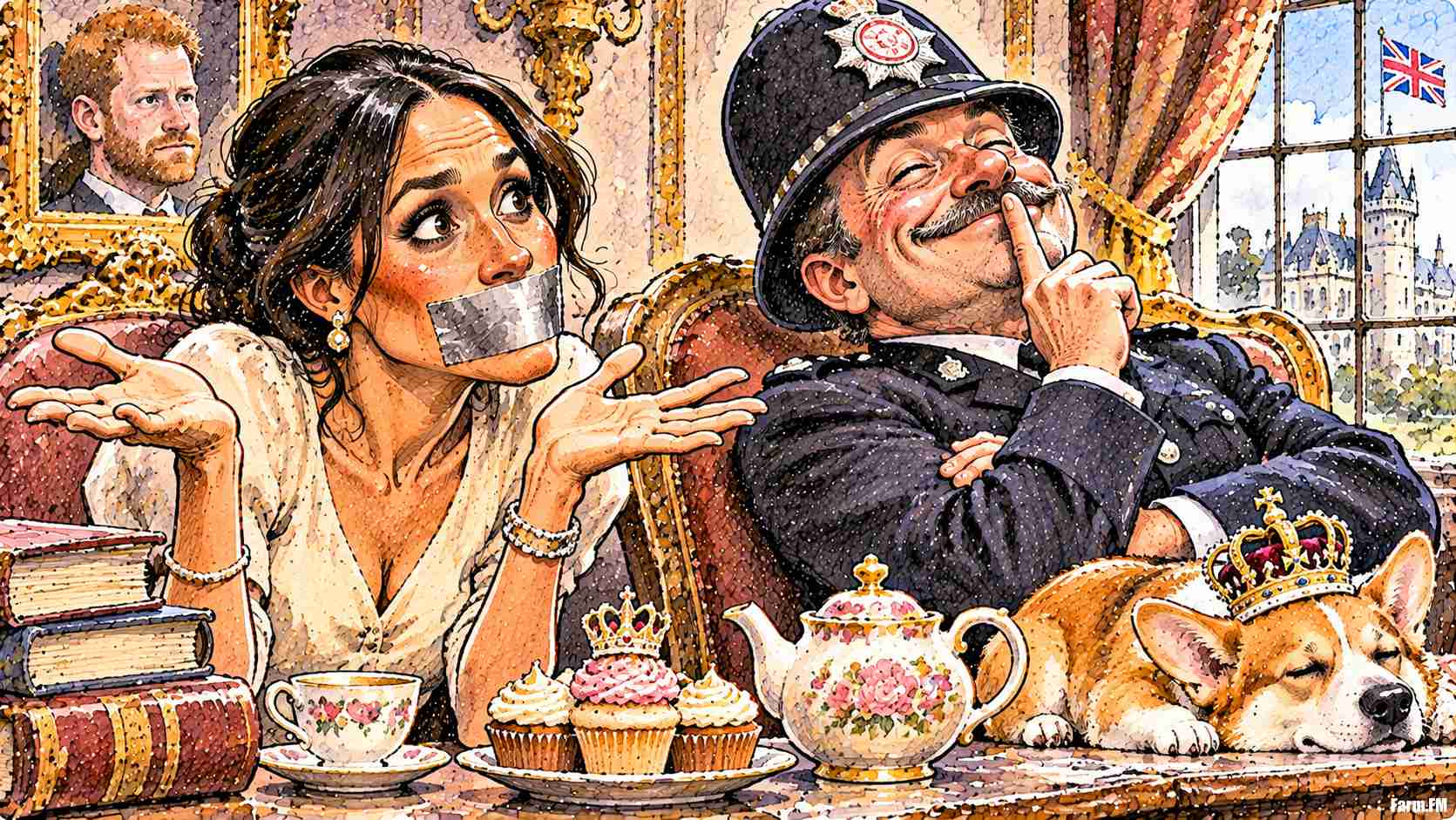
Scotland Yard Lost the Letter, and Nobody Can Find the Officer
MONTECITO, California — Meghan Markle, a woman whose family disagreements have generated more television programming than most British production companies, has reportedly revealed the existence of a remarkable obstacle to her freedom of expression: a policeman who asked her not to speak.
According to reporting in The Sunday Times investigation, Meghan wanted to make public troubling allegations concerning her estranged father, Thomas Markle Sr., seven years ago. But a royal protection officer reportedly discouraged her, assuring her the matter would be investigated. And that, apparently, settled everything.
For seven years.
The Duchess, whose public career has included a television interview with Oprah Winfrey, a Netflix documentary series, magazine features, podcasts and enough family revelations to make Buckingham Palace consider installing a revolving door, allegedly respected this single instruction with extraordinary discipline.
Royal commentators were astonished.
“Think about what this means,” observed one veteran of the celebrity publicity industry. “Somewhere in Britain there was a policeman capable of telling Meghan Markle not to discuss something publicly, and she actually listened. If we find this gentleman, the United Nations should offer him a position immediately.”
Unfortunately, the officer reportedly cannot be identified. This has made him simultaneously the most important and least available witness in the latest royal controversy.
Meghan Markle Keeps Quiet for Seven Years: The Publicity Problem
The central mystery is not whether Meghan had legitimate reasons to stay quiet about serious allegations. Police advice concerning an ongoing or potential investigation can be perfectly reasonable.
The mystery is the way the story is now being presented. Consider the sequence. Meghan reportedly wanted to speak. A policeman reportedly discouraged her. Years passed. The allegations resurfaced. Now the public is informed that Meghan had wanted to speak all along.
Some people call this vindication. Others call it remarkably convenient retrospective publicity.
A Montecito public relations consultant offered a technical explanation.
“In our industry, we call this retroactive courage. You explain today what you desperately wanted to do yesterday, while making clear that circumstances beyond your control prevented you from doing it.”
The consultant added that the technique offers an obvious advantage.
“Nobody can interview the decision you didn’t make.”
Metropolitan Police Lose the Meghan Markle Letter and Keep the Embarrassment
The ITV News investigation into the warning letter established that a letter containing allegations about Thomas Markle was received by British police and passed to Meghan’s protection team. The Metropolitan Police subsequently acknowledged that the allegations were not forwarded to relevant overseas law enforcement agencies, and the force has since referred its handling of the matter to the Independent Office for Police Conduct.
Then came the institutional masterpiece.
Scotland Yard could not find its own copy of the original letter. Police reportedly asked Meghan to supply hers. Britain’s largest police force had effectively become the country’s first detective agency to solve a filing problem by contacting the person who had received its correspondence.
A retired administrative expert explained the likely difficulty.
“The document was probably in a folder. Unfortunately, nobody knows which folder. We have asked the folder department, but they say the individual responsible retired a few years ago.”
The situation suggests that the Metropolitan Police should consider modernising its records system, possibly by purchasing a second filing cabinet.
Minutes of a records review meeting at New Scotland Yard, seen by this publication, run to a single page. Item one reads: “Locate original letter. Action: ask Meghan.” Item two reads: “Locate protection officer who spoke to Meghan. Action: ask Meghan.” Item three, any other business, reads: “Action: ask Meghan.” The meeting closed after eleven minutes, four of which were spent finding the room.
Missing Royal Protection Officer Becomes Britain’s Most Wanted Conversation Partner
The most interesting character in this increasingly theatrical affair is the unidentified royal protection officer. He reportedly knew about the allegations, spoke with Meghan, discouraged publicity and apparently persuaded her that the authorities were handling everything.
Yet he now seems extraordinarily difficult to locate.
One royal observer suggested that Scotland Yard should begin searching for a man whose previous employment involved controlling access to the Duchess of Sussex and whose current occupation involves avoiding questions from newspapers.
“That narrows it down,” he said, “to virtually everyone who ever worked at Kensington Palace.”
His disappearance from the story also creates a convenient problem for anyone trying to verify exactly what was said. A conversation involving two people becomes difficult to reconstruct when only one participant is available to discuss it.
A snap poll of 2,000 British adults, commissioned by a royal-watching newsletter, found that 71 percent could name at least one member of the Sussex household staff, while none could name the officer. Eleven percent said they believed the officer was “the man from the hat shop.” The pollsters described the margin of error as roughly the same as the margin of error in Scotland Yard’s filing system.
And this brings us to the great philosophical question of modern celebrity journalism: if a duchess wanted to give an interview seven years ago, but an unidentified policeman stopped her, does that interview still count toward her public reputation for courage?
In California, the answer is apparently yes.
Provided the story receives sufficient distribution.
Why Is the Meghan Markle Story Surfacing Now? Timing Under Scrutiny
One of Meghan’s remarkable public talents has been her capacity to turn seemingly minor palace disputes into substantial international conversations. A disagreement over wedding preparations became a major royal controversy. Questions concerning security produced years of headlines. Private family relationships became subjects for televised interviews and bestselling books, and the public learned more about the emotional architecture of royal family life than anyone had previously considered medically necessary.
Yet the newest account involves something very different: serious allegations about her father, which she reportedly chose not to discuss publicly after receiving police advice.
The question for critics is straightforward. Why has the explanation emerged in such dramatic detail now?
The answer may be perfectly legitimate. But in the world of celebrity publicity, timing deserves as much scrutiny as the statement itself.
A former royal publicity adviser offered a useful analogy.
“Imagine someone announcing today that they had intended to warn everyone about a problem seven years ago, but somebody told them not to. That doesn’t establish dishonesty. It does, however, invite questions about who remembers the conversation and what evidence supports the account.”
He paused.
“And whether the interview is exclusive.”
Sussex Friend Explains the Difference Between Privacy and Publicity
A friend familiar with the Sussexes’ ability to occupy newspaper headlines offered a more sympathetic interpretation.
“People misunderstand Meghan,” the friend explained. “She doesn’t necessarily want every personal matter discussed publicly. She wants control over when it’s discussed, how it’s discussed, who discusses it and whether the coverage presents her sympathetically.”
Asked whether this conflicted with the couple’s longstanding emphasis on privacy, the friend appeared confused.
“Privacy doesn’t mean nobody knows your business. It means nobody tells your business without consulting your business manager.”
The distinction is important. Ordinary privacy involves keeping personal information out of public circulation. Celebrity privacy frequently involves keeping personal information out of public circulation until a suitable distribution arrangement can be negotiated.
In Montecito, the difference can amount to several million dollars.
Asked for comment, a spokesperson for a Montecito communications firm issued a short statement: “Our client has no comment on the policeman, the letter or the seven years. Our client does, however, have availability in the spring.”
Prince Harry Reportedly Still Processing the Concept of Not Publishing Something
For Prince Harry, the situation presents a fascinating philosophical challenge. His memoir, Spare, demonstrated his willingness to discuss sensitive episodes from his own family history. His wife’s latest reported experience suggests that some family matters were instead kept private because of professional advice.
This may be the first time the Sussex household has encountered a subject that did not immediately qualify for a chapter heading.
A publishing executive proposed an entirely new title: Spare Information: Things We Wanted to Tell You but Apparently Couldn’t.
The proposed sequel would run 400 pages and describe conversations that could not be confirmed, memories that might have been misunderstood, and occasions when an anonymous person allegedly advised the couple against doing something they later wished the public knew they had wanted to do.
The audiobook would be narrated by the missing policeman.
If located.
Thomas Markle Allegations Remain a Serious Matter, Not a Punchline
Beneath the publicity circus is a matter that deserves a proper investigation.
Thomas Markle Sr. has strongly denied allegations concerning child sexual abuse material. Authorities in the Philippines are examining the allegations, and the Metropolitan Police’s handling of the earlier warning has drawn official scrutiny. The reported allegations are not established findings of guilt.
That distinction matters enormously. An allegation is not a conviction. A family dispute is not evidence. An anonymous briefing is not a sworn statement. And reporting what someone reportedly wanted to do seven years earlier is not the same thing as proving precisely what that person thought.
The public deserves reliable evidence, especially when accusations are serious enough to destroy reputations. This is the point at which royal celebrity coverage and actual journalism should stop pretending they are interchangeable professions.
A tabloid can survive a missing source. A criminal investigation cannot operate on the assumption that everybody’s recollections are convenient.
Public Relations Experts Praise the Value of Being Silenced Retroactively
There is something very modern about the claim that a person renowned for speaking publicly was prevented from doing so by someone nobody can currently identify.
The arrangement is almost perfect. It supplies evidence of supposed restraint without the inconvenience of prolonged public silence continuing indefinitely. It introduces a responsible-sounding authority figure whose advice may explain the timing. It also creates a fresh narrative in which Meghan can be portrayed as someone who wanted to act but deferred to the professionals.
An entertainment executive summarised the commercial appeal.
“Most celebrities have to choose between being outspoken and being silenced. This particular narrative offers both. It’s the first premium entertainment package where you can buy the courage and the censorship together.”
Hollywood immediately began discussing whether this should become a subscription service.
Who Benefits When Everyone Keeps Discussing the Sussexes
The central problem with the Sussex publicity phenomenon is not that Meghan speaks. People have every right to discuss their experiences, and it is not unreasonable for someone to follow police advice concerning disturbing allegations.
The problem is that after years of highly publicised family disagreements, virtually every new revelation enters a media ecosystem that rewards maximum drama and minimum resolution. Every controversy creates a new interview opportunity. Every interview creates competing accounts. Every competing account creates another controversy.
Eventually, the family dispute becomes self-sustaining.
Economists would describe it as a perpetual revenue mechanism. Therapists would describe it as exhausting. Ordinary families would describe it as Thanksgiving.
The palace, meanwhile, has generally found silence more useful than participating in every disagreement.
Which brings us to the strange position Meghan now occupies. After years of being criticised for saying too much, she is the subject of headlines explaining why she supposedly wanted to say more. At this rate, her next interview may concern all the interviews she considered giving but never did.
There could be twelve episodes.
Royal Commentator Asks the One Question Nobody Can Answer
A veteran Buckingham Palace watcher offered the most economical assessment of the entire controversy.
“Maybe everything happened exactly as reported. Maybe Meghan genuinely wanted to speak, received police advice and followed it. That is entirely possible.”
He then leaned forward.
“But if a newspaper knows what Meghan wanted to say seven years ago, and knows what an unidentified officer told her, I’d be interested in knowing how the conversation was established.”
He thought for a moment.
“And I would particularly like to know why the police have lost the letter but the publicity industry appears to have recovered the dialogue.”
There was a long silence.
Somewhere in Montecito, a publicist’s telephone rang. And somewhere in Britain, an unidentified retired policeman may have discovered that his most important professional achievement was persuading a duchess not to give an interview.
For seven years.
In a country where police lose letters, royal aides forget conversations and anonymous sources remember everything, the only institution operating with flawless efficiency appears to be the celebrity news cycle. And Meghan Markle, whether she likes the coverage or not, remains one of its most dependable attractions.
Editorial note: This commentary targets the publicity narrative and questions surrounding the reporting, not the credibility of alleged victims or the findings of any investigation. Thomas Markle Sr. denies wrongdoing; allegations remain under investigation.
15 Humorous Observations
- Meghan could tell Oprah what happened in a palace corridor eight years earlier, but apparently couldn’t tell the public what she wanted to say seven years ago. Oprah got a sit-down. The public got a policeman nobody can find.
- The policeman who supposedly silenced her cannot be located. Even Scotland Yard has trouble finding a man willing to tell Meghan to stop talking. That’s not a missing person case. That’s a unicorn sighting.
- Seven years later, Meghan remembers wanting to speak. That’s not a recollection. That’s a television development deal awaiting financing.
- Most people have family secrets. Meghan’s family secrets arrive with international distribution rights.
- Meghan can turn a disagreement over bridesmaid dresses into global news. Imagine the commercial potential of an actual police investigation.
- Royal officials reportedly knew nothing. The police misplaced the letter. Everybody appears to have forgotten something except the publicist.
- Meghan’s supporters say she was silenced. Her critics say she never stops talking. Somewhere between those positions lies a Netflix subscription.
- The missing bodyguard may be the first man in British history whose career depended entirely on remaining unidentified. Best job in the Met. No meetings, no overtime, no one asking where he was.
- Meghan’s relationship with privacy resembles a restaurant that advertises its secret menu on a motorway billboard.
- A normal person says, “I don’t want to discuss my family.” A celebrity says, “I don’t want to discuss my family until the exclusive interview.”
- The palace used to say, “Never complain, never explain.” The Sussex business model appears closer to, “Complain, explain, promote, repeat.”
- A seven-year-old conversation suddenly becomes front-page material. Archaeologists usually need a shovel. Hollywood just needs an unnamed source.
- In most families, estrangement ends in silence. In this family, silence is apparently the interval between press releases.
- The police lost their copy of the letter, then asked Meghan for hers. Britain’s most famous security apparatus has apparently discovered the importance of keeping receipts.
- Meghan says she wanted to speak out seven years ago. Critics wonder why the public is hearing about that particular wish only now. Public relations experts wonder whether there’s enough material for another six episodes.

Lowri Griffiths brings a distinct voice to satirical journalism, combining cultural critique with dry humour. Influenced by London’s creative networks, her writing reflects both wit and discipline.
Her authority stems from experience, while trust is built through transparency and ethical satire.