
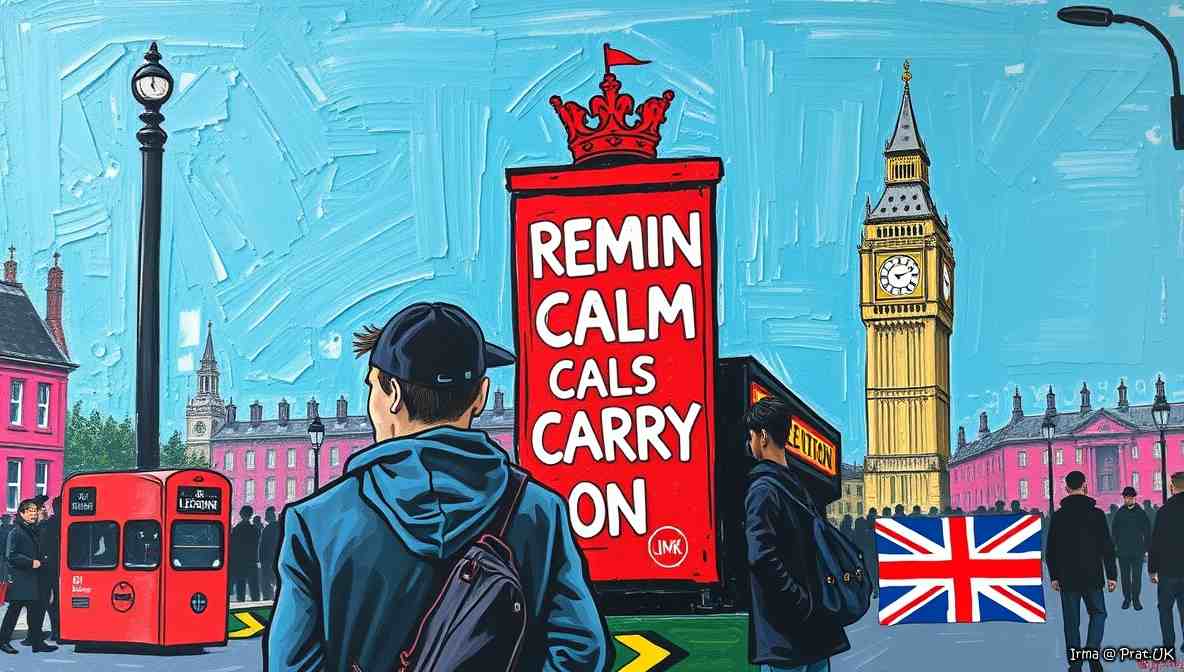
Londoners Encouraged to Remain Calm, Carry On, and Possibly Lower Expectations Slightly
In a move widely anticipated by absolutely everyone, officials have urged Londoners to remain calm and carry on following recent disruptions.
The message, deeply embedded in British wartime culture, has been deployed once again as the nation’s emotional default setting — somewhere between stoicism and quiet resignation.
Stay Informed, Stay Alert, Stay Commuting

Authorities emphasised that while the situation is serious, panic is unnecessary. Instead, citizens are encouraged to stay informed, stay alert, and continue commuting as if nothing is happening.
This advice has been met with overwhelming compliance, largely because Londoners have already mastered the art of functioning under mild to moderate existential dread.
Transport networks continue to operate, albeit with the usual combination of delays, confusion, and passive-aggressive announcements. Retail stores remain open, offering customers the opportunity to engage in the time-honoured tradition of browsing items they cannot afford. And offices across the city are filled with workers who have bravely chosen to ignore both external chaos and internal emails.
The Sociology of Doing Nothing Differently
Experts suggest that this resilience is not accidental, but rather the result of decades of practice in managing disappointment with minimal emotional output.
One sociologist explained: “Londoners don’t ignore problems. They simply acknowledge them quietly and then proceed to do nothing differently.”
The government’s messaging campaign has leaned heavily on reassurance, with phrases like “out of an abundance of caution” and “robust measures in place” appearing frequently. These phrases, while comforting, have been statistically proven to mean absolutely anything depending on the context.
A More Honest Approach Was Considered (Briefly)

Meanwhile, mental health advocates have suggested a slightly more honest approach, such as: “Things are complicated, but we’re figuring it out.”
This proposal was quickly dismissed for being too direct.
Carrying On Because Stopping Is Inconvenient
In the end, London carries on — not because everything is fine, but because stopping would be inconvenient.
And perhaps that is the city’s greatest strength: the ability to continue, regardless of whether continuing makes any sense at all. Tea is still hot. Trains are still late. The dread is still distributed evenly. Equilibrium achieved. Auf Wiedersehen, amigo!
This piece is a collaboration between the world’s oldest tenured professor and a philosophy major turned dairy farmer, presented as British satirical journalism in the long London tradition of carrying on while quietly internally screaming. No commuters were emotionally validated in the making of this satire.

Alan Nafzger was born in Lubbock, Texas, the son Swiss immigrants. He grew up on a dairy in Windthorst, north central Texas. He earned degrees from Midwestern State University (B.A. 1985) and Texas State University (M.A. 1987). University College Dublin (Ph.D. 1991). Dr. Nafzger has entertained and educated young people in Texas colleges for 37 years. Nafzger is best known for his dark novels and experimental screenwriting. His best know scripts to date are Lenin’s Body, produced in Russia by A-Media and Sea and Sky produced in The Philippines in the Tagalog language. In 1986, Nafzger wrote the iconic feminist western novel, Gina of Quitaque. He currently lives in Holloway, North London. Contact: [email protected]



The specific details are accurate enough they’re almost aggressive. Someone’s definitely lived through every single one of these meetings or read transcripts obsessively.
British people will spend hours discussing the weather without ever actually talking about the weather, because the weather is just a metaphor for everything else they’re too polite to mention.