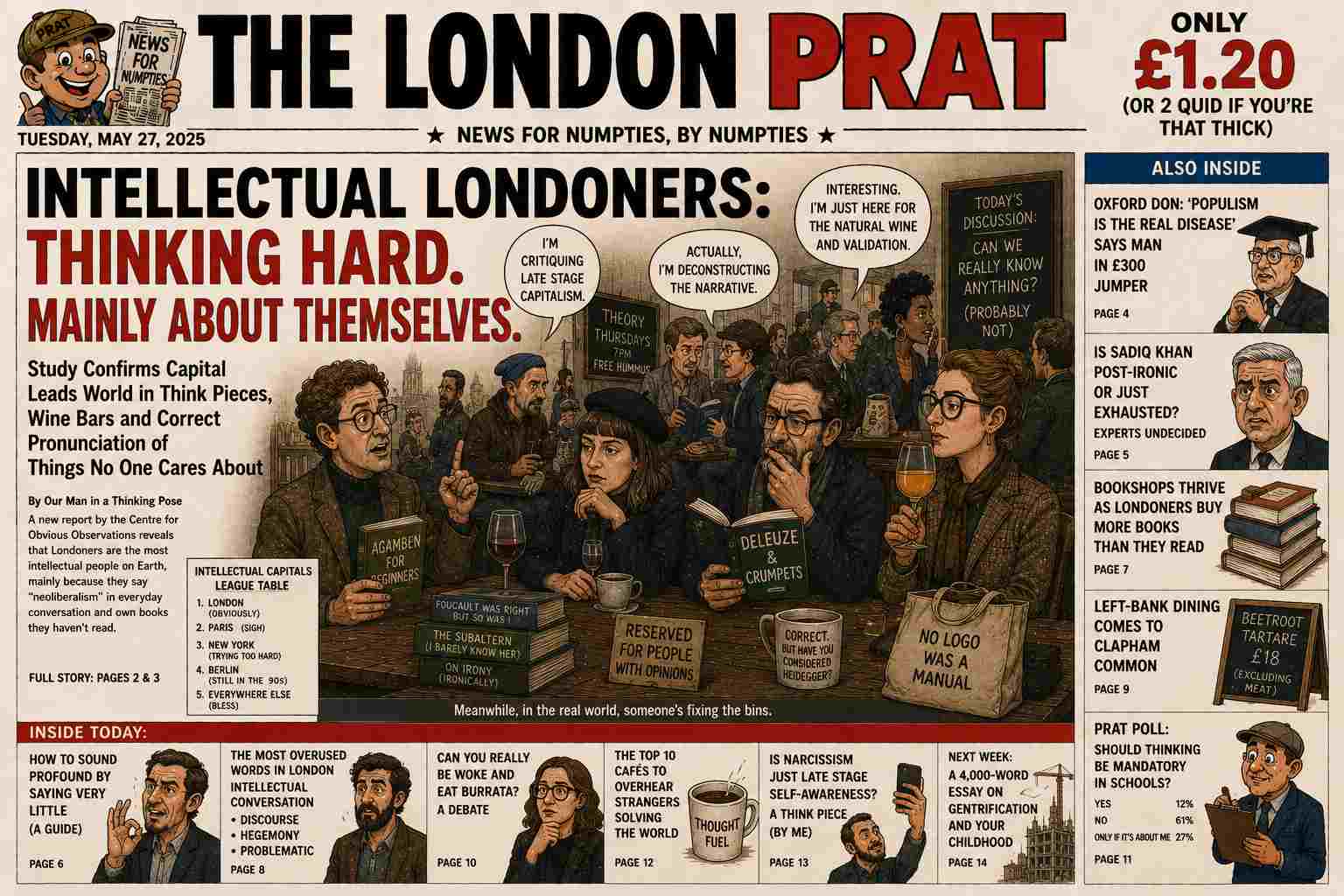
LONDON — PRAT.UK CULTURAL DESK — London is home to roughly nine million people, approximately four million pigeons, and — according to unverified academic estimates — one intellectual per every three Pret A Manger locations. They are everywhere: in the British Library, in the corner booth of the Dog and Duck, in the queue at Waitrose holding a copy of Being and Nothingness and a packet of heritage tomatoes. They cannot help themselves. It’s a condition.
In the proud tradition of British self-examination — which is itself an intellectual pastime — The Prat presents fifteen field observations about the capital’s most curious species.
1. They Know Every Trade Route Except the Northern Line
London intellectuals can discuss medieval Hanseatic trading networks for three unbroken hours, complete with references to herring prices and the political implications of Baltic amber, and yet emerge from Bank Station with the haunted look of a man who has just survived an orienteering course in a foreign country.
Their brains contain the complete works of Shakespeare, annotated. Their spatial awareness, however, was last updated sometime around 2011. They own detailed mental maps of fourteenth-century Constantinople. They cannot find the Jubilee Line platform.
2. “Interesting Point” Is Their Sharpest Weapon
A truly intellectual Londoner never says, “You’re wrong.” That would be gauche. Aggressive. Almost northern.
Instead, they say: “Interesting point.” Then they pause. Then, with the measured calm of a consultant who has billed you for silence, they dismantle your argument so quietly and so completely that you don’t realize you’ve been intellectually decommissioned until you’re on the Overground home wondering why you feel slightly ashamed about something you said about bin collections.
The whole exchange feels like being handed Earl Grey and a digestive biscuit while someone repossesses your opinions.
3. Their Flats Are Libraries That Briefly Contain a Bed
Smart Londoners own more books than shelves, more shelves than walls, and more walls than is structurally advisable for a Victorian conversion in Zone Two.
Every flat reaches the same inevitable tipping point. One day it is a home. The next it is a branch of Waterstones after a modest seismic event. The biographical section has colonised the bathroom. Philosophy is stacked beside the radiator. There are books underneath the books. The cat is somewhere in Literary Criticism.
This is considered normal. Their estate agents have stopped mentioning it.
4. They Enjoy Correcting Themselves Almost Sexually
Nothing unsettles the social fabric of a dinner party in Hackney quite like an intellectual who has recently reconsidered a position.
You were talking about the film. Somebody mentioned the weather. And then, suddenly, from the end of the table: “I’ve been rethinking my earlier view on Victorian sewer infrastructure.”
Nobody had asked. Nobody had been thinking about Victorian sewers. Everybody now is.
The intellectual beams with the particular satisfaction of someone who has updated a Wikipedia page at two in the morning. Friends have learned to order dessert early.
5. Their Search History Is a Cry for Help
Normal Londoners search for: best kebab near me, Deliveroo discount code, why is the 73 always late.
Intellectual Londoners search for: why did the Romans think lead pipes were a good idea, is there a word for the sadness of watching good cheese go to waste, historical precedent for congestion pricing in seventeenth-century Amsterdam.
Three hours later they are reading a translated Latin footnote about aqueduct maintenance and have forgotten they were hungry. The kebab shop has closed. This is, on balance, fine.
6. Humility Is Their Most Competitive Sport
Highly intelligent Londoners do not brag. They consider it one of several sins that rhymes with Oxford.
Should someone at a gathering mention they attended that institution, the genuinely clever person in the room says nothing for a moment, swirls their wine, and then offers: “I once lost an argument about bus routes to a retired scaffolder in Croydon. Changed my life, genuinely.”
This is not false modesty. It is the advanced form of showing off, requiring far more confidence than simply saying where you went to university. They know this. That is precisely the point.
7. Every London Pub Contains One Philosopher Named Dave

He sits at the bar. He is wearing a fleece. He has a pint of something amber and regional. He appears, for all observable purposes, to be a bloke.
Do not be deceived.
Mention inflation. Mention planning permission. Mention anything with even a passing relationship to the organisation of human society, and Dave will set down his pint with the unhurried precision of a man who has been waiting patiently for this exact moment since 1987, and he will quote Adam Smith.
He will be correct. He will not look smug. He will buy you a drink. This is the most unsettling part.
8. They Attend Lectures Under No Compulsion Whatsoever
Normal people spend Friday evenings watching football, eating crisps, existing in a reasonable state of leisure.
Professor Nigel — it is always a Nigel, or occasionally a Harriet — spends Friday evening in a basement lecture room in Bloomsbury listening to a talk entitled: “The Socioeconomic Implications of Tudor Wallpaper: Agency, Pattern, and the Domestic Interior, 1485–1603.”
He brought a notebook. He has follow-up questions. He will recommend this to you on Monday with a sincerity that is genuinely disarming. You will not go. You will think about going. This is already more than the Tudor wallpaper expected of you.
9. Their Jokes Require a Handout
Intellectual Londoners develop, over time, a sense of humour that is less comedy and more load-bearing structure. Entire jokes exist as compression algorithms: they contain Aristotle, Brexit, a parking dispute in Lewisham, and a callback to something Bertrand Russell said in 1927, and they are genuinely funny if you have the decryption key.
In Islington: five minutes of helpless laughter.
Everywhere else: polite smiling, the kind used at funerals for people you didn’t know well.
Research does, annoyingly, suggest that humour and intelligence travel in convoy. The jokes will continue until comprehension improves.
10. They Cannot Answer Simple Questions Simply
You ask: “What time is it?”
You receive: “Well, that depends on what we mean by time — as a social construct, it’s largely a product of industrial standardisation in the 1840s. Greenwich Mean Time was imposed to regulate railways, which is interesting when you consider that—”
You still do not know if Tesco Express is open. You are now also slightly uncertain whether Tuesday is a real thing.
11. They Are Secretly Delighted When They Are Wrong
Most people experience being wrong as a minor humiliation. London intellectuals experience it as an upgrade.
To be wrong means there is a new fact available. A new fact means a footnote. A footnote means the map of everything they know has expanded slightly. This is, to them, roughly equivalent to finding a twenty-pound note in a coat pocket, except better because the coat pocket does not require them to revise their position on the epistemological foundations of empiricism.
They will correct themselves before you have the chance. They will thank you. Do not be alarmed.
12. Their Flats Contain Seventeen Unfinished Projects
Half-written novels. A guitar. Another guitar. A third guitar, this one belonging to a phase. An antique microscope of unclear provenance. A subscription to a quarterly journal about Scandinavian municipal architecture. Dried pasta in a jar that was briefly, in 2022, a science experiment. And, on the kitchen counter, a sourdough starter named Winston, who has outlived three relationships and one pandemic.
Curiosity, left unsupervised in a Zone Two flat, spreads faster than damp.
13. Six Words From Them Can Clear a Room
Someone says: “Lovely weather today, isn’t it.”
The intellectual replies, with genuine warmth and no awareness of consequence: “Statistically speaking, June precipitation patterns for Greater London suggest we’re actually running 14% above the thirty-year average.”
Silence. The sort of silence that follows a remark at a christening.
Nobody wants pudding any more. The lovely weather has been taken away and replaced with data. This was not the intellectual’s intention. They are already wondering about July.
14. They Have Elevated Staring Into a Coffee to a Contemplative Art
Smart Londoners can spend twenty uninterrupted minutes gazing into a flat white with the focused stillness of a monk who has discovered something important about the nature of consciousness.
Friends do not intervene. They assume quantum mechanics is involved, or perhaps the Middle East.
In reality, they are trying to remember where they parked the car. They parked it in 2019. It may have been towed. They have not yet ruled out the possibility that they don’t own a car.
15. The Most Intelligent People in London Always Look Slightly Lost
This is because they are not fully here. They are here, yes — standing in Pret, holding a tray, wearing sensible shoes — but they are also simultaneously comparing the democratic institutions of classical Athens with the current mayoral oversight model for TfL, while dimly processing the question of whether the chicken sandwich contains too much aioli given the broader ethical questions surrounding industrial poultry.
By the time they reach the till, they have resolved nothing. Civilisation, in their estimation, has risen and fallen at least twice. They tap their card. They sit down. They begin reading something about Roman drainage.
It will make them happy. It will make them late. This is London intellectualism in its purest, most distilled form, and nobody here would have it any other way.
A Final Observation: The Definitive Test of London Intelligence
They can quote Bertrand Russell but cannot programme a microwave.
They read philosophy for pleasure and describe this as “relaxing.”
They know four dead languages and still cannot work out the self-checkout machine at Sainsbury’s.
They apologise when corrected — warmly, immediately, as though correction is a gift.
They laugh at jokes involving Hegel and bus lanes.
And the surest sign of genuine intelligence in this city? They understand that nobody — not the engineers, not the historians, not the philosophers, not Transport for London itself — fully understands what is happening at the five exits of Hyde Park Corner.
And they have made peace with that. 🚇📚🍷
— Prat Cultural Intelligence Desk, London
Auf Wiedersehen, amigo!

Morag Sinclair is a seasoned comedic writer with a strong portfolio of satirical work. Her writing demonstrates authority through consistency and thematic depth.
Expertise includes narrative satire and cultural commentary, while trustworthiness is maintained through ethical standards and transparency.