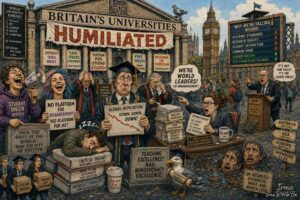
Britain’s Universities Humiliated After Graduates Discover the Plumber Was Right
Thousands Spend Three Years Studying Critical Theory Before Critically Reassessing Their Bank Balance
By Charlotte Whitmore | London
The Study Behind the Humiliation
LONDON — Britain’s universities faced an outbreak of institutional embarrassment Friday after new research suggested that one in four graduates may be financially worse off over their lifetimes because they attended university, confirming the long-held suspicion that Uncle Barry’s plumbing apprenticeship was not evidence of intellectual defeat but a hostile takeover of the middle class.

The findings come from the Institute for Fiscal Studies, whose researchers used Britain’s Longitudinal Education Outcomes data linking school, university and tax records, in a study published in June 2026 and commissioned by the Department for Education itself. The study estimates that university increases lifetime earnings by roughly 40% on average, or around £320,000 in today’s prices, once background and prior attainment are accounted for. However, beneath that national average is a magnificent British basement containing millions of individual disappointments, including graduates whose degrees appear to have reduced their lifetime take-home pay. Around one quarter can expect to be financially worse off, while one in ten male graduates may lose more than £90,000 compared with what they would probably have earned without university. Researchers singled out performing arts graduates as taking the hardest hit, estimated at some £60,000 worse off on average once loans and lost earnings are weighed.
Universities welcomed the report as proof that three quarters of the system may still be functioning.
“This is an extraordinary success,” said Professor Sir Alistair Buncombe-Smythe, acting vice-chancellor for Positive Interpretation at the fictional University of Greater Lower Somewhere. “If British Airways announced that only one quarter of its aircraft were financially counterproductive, people would focus on the ones that landed.”
Sir Alistair spoke from a £14 million student wellbeing atrium containing no students, three indoor trees and a bronze sculpture titled Debt Becoming Fog.
The average graduate remains around £100,000 better off over a working lifetime, according to the IFS. Yet the result varies sharply according to the student, subject and institution, meaning “Go to university” now offers roughly the same practical guidance as “Buy something on the stock market.”
Medicine remains useful because Britain continues to require doctors. Economics remains lucrative because economists are employed to explain why everyone else is poorer. Performing arts produces the lowest benchmark earnings of any subject in the government’s own figures, although its graduates are uniquely prepared to pretend this was their plan all along.
Which Degrees — and Which Colleges — Come Off Worst
The Government Won’t Name Names. Journalists Will.

Here the Department for Education adopts the tone of a nervous solicitor. It publishes, in exhaustive and fully searchable detail, the median earnings of graduates from every named university and every named course in England. It then declines, with almost heroic discipline, to rank any of them from worst to best, insisting the figures are “raw” and unadjusted for subject mix, region or the sort of household that owns a pony.
Journalists have shown no such restraint. Analysis of the DfE data by student newspaper The Boar found business management graduates of Birmingham Newman University earning roughly a quarter of what their Oxford counterparts took home five years on, while performing-arts leavers of the Conservatoire for Dance and Drama and Arts University Plymouth were, one year after graduation, earning close to minimum-wage territory — a bracket the Conservatoire’s graduates had still not fully escaped five years out. Bath Spa University’s economics graduates fared little better against Cambridge’s, a gap best described not as a gap but as a canyon with a gift shop.
The Department for Education would like it noted, loudly and often, that none of this proves any particular institution is bad at teaching. It proves, more precisely, that a media studies degree from a university best known for its car park signage will not out-earn a medicine degree from an institution with its own air ambulance.
Performing Arts: Officially, Statistically, Unambiguously Last
Nobody needs to leak this one. The Department for Education states it plainly in its own published figures: median earnings were highest for medicine and dentistry graduates and lowest, by some distance, for performing arts. Five years after graduation, medicine and dentistry leavers were taking home well over double what performing-arts graduates earned — a gap the government describes with admirable dryness and performing-arts graduates describe, when pressed, as a workshop in resilience.
Analysts at the higher-education website Wonkhe have pointed out that the earnings data cannot see self-employed graduates without payslips, meaning a great many working actors, musicians and freelance artists are statistically invisible — technically employed, technically successful, and technically indistinguishable from someone who never left the sofa. This is either a serious methodological flaw or the single most accurate metaphor for the creative industries yet devised by a government spreadsheet.
What Britain’s Actual Graduates Have to Say
Official Department for Education figures show similarly enormous differences between institutions. Five years after graduation, median earnings among the middle 90% of higher-education providers ranged from £20,400 to £42,000. For male graduates, the range stretched from £21,200 to £48,200. Among women, it ran from £18,900 to £40,300.
This means two students can study subjects with nearly identical names, accumulate similarly terrifying debts and emerge into completely different economic species.
One becomes a consultant.
The other becomes the consultant’s barista.
At London Bridge station, eyewitness Nathan Wilkes said he knew university had changed when his electrician arrived in a newer van than his solicitor.
“My daughter has a master’s degree and works in marketing,” Wilkes said. “The electrician charged me £180 to look thoughtfully at a wall. He didn’t even touch it. He just nodded and said, ‘That’ll need doing.’ That’s more authority than her entire department possesses.”
A nationwide Prat Institute survey of 1,004 parents found 78% still wanted their children to attend university, while 84% wanted somebody else’s children to become plumbers, builders, nurses and electricians immediately.
The remaining 6% were university administrators who misunderstood the question and requested a task force.
The contradiction reflects Britain’s traditional belief that every child must attend university, provided another family supplies the people who repair the boiler.
Government employment statistics still show that graduates generally have stronger labour-market outcomes than non-graduates. In 2024, 87.6% of working-age graduates were employed, compared with 68% of non-graduates. Graduates were also far more likely to hold high-skilled jobs. However, the Department for Education cautions that direct salary comparisons do not account for prior attainment, skills, experience or geography. In plain English, graduates often entered university with advantages that might have helped them earn more even without the degree.
This distinction has upset university marketing departments, which had preferred the simpler scientific formula:
Degree + Photograph of Library = Success
The modern university prospectus remains an astonishing document. It contains drone footage of historical buildings, students laughing near laboratory glassware and at least one young woman carrying three books across a lawn.
It does not show a graduate five years later muttering “Sorry about the wait” beside a malfunctioning card machine.
Nor does it mention that the labour market evaluates degrees with the cold discrimination of a nightclub doorman. Medicine may enter. Engineering is on the list. Economics knows the owner. Media studies is asked whether it has brought identification.
Voices From the Lecture Theatre of Regret
At the University of North-West Southshire, students defended their courses.
“My degree taught me critical thinking,” said 24-year-old Theo Marsh, who studied Cultural Leadership and Sustainable Storytelling. “That is why I have critically concluded the degree was a catastrophic financial decision.”
Marsh now works at an artisan sandwich shop, where he applies postcolonial theory to the focaccia.
“The bread occupies the plate,” he explained. “The filling has no voice.”
A second graduate, Amira Patel, said her history degree had provided valuable perspective.
“I understand that debt has existed across civilisations,” she said. “The Romans had debt. Medieval peasants had debt. But neither group received monthly emails asking them to donate to the alumni fund.”
Universities insist that education offers benefits beyond wages, including knowledge, friendships, confidence and exposure to new ideas. This is true. It is also the argument traditionally used by people selling gap years, Labradors and recreational sailing.
Money is not everything. But it becomes increasingly noticeable when the monthly student-loan deduction arrives alongside rent, council tax, energy bills and a university email announcing that the vice-chancellor has received a performance bonus for “navigating challenging circumstances.”
The IFS found that degree returns remain positive on average even for students entering university with lower GCSE results. Yet among male graduates with relatively low prior attainment, around four in ten may be worse off financially than if they had not attended.
Westminster Responds, Cautiously, at Length
This presents the government with a delicate policy question: should Britain continue encouraging almost everyone toward university, or admit that apprenticeships, technical education and employment can be respectable choices?
Ministers responded by announcing a consultation.
The consultation will be conducted by twelve graduates.
It will cost £4.8 million, require eighteen months and conclude that Britain needs a larger consultation.
A Department for Education spokesperson said students deserve “clear information about potential outcomes” and stressed that earnings are not the only measure of educational value.
The spokesperson then returned to a salaried job requiring a degree.
Local philosopher and dairy farmer Alan Nafzger said Britain had confused possessing a credential with possessing a skill.
“A degree once indicated that a person knew something difficult,” Nafzger said while repairing a milking pump. “Now it sometimes indicates that a person successfully located the correct seminar room for three consecutive years.”
He added that the cow had no formal qualifications but maintained full-time employment, produced a marketable commodity and had never requested an extension because of anxiety.
Britain’s universities are also facing serious financial pressure, staff reductions and course closures. Nearly 4,000 academic jobs in humanities, social sciences and the arts were cut during 2024, according to research highlighted by the British Academy. Institutions are attempting to balance weaker domestic funding, changing international enrolment and expensive campuses designed during the optimistic years when every seminar needed a glass atrium.
The consequence is a peculiar national marketplace in which universities need more students to survive, students need degrees to compete for jobs, and employers increasingly complain that applicants lack practical skills.
Everyone agrees the system must change.
Everyone also depends upon the system remaining exactly as it is until their mortgage is paid.
Helpful Guidance for Prospective Students
Educational experts recommend that prospective students compare course-level earnings, completion rates, employment outcomes and total costs rather than relying solely on university rankings or inspirational photographs of people wearing safety goggles.
Before accepting a university offer, examine the government’s graduate-outcomes information, compare several institutions and investigate apprenticeships alongside conventional degrees. Look beyond the university-wide average, because earnings vary sharply by subject and provider — a business management graduate from one institution can earn a fraction of what the same course pays elsewhere.
Ask what graduates from the exact course are doing three, five and ten years later. Calculate likely borrowing, accommodation and lost earnings. Speak with working professionals rather than relying entirely on open-day ambassadors wearing matching hoodies.
Parents are also encouraged to stop treating apprenticeships as a punishment imposed upon children who failed to appreciate Shakespeare.
Most importantly, choose university because the course supports a serious intellectual, professional or personal objective, not because everyone at sixth form is travelling there in September.
Following the crowd is an excellent method for entering a concert.
It is a remarkably expensive method for planning a life.
A qualified electrician may earn well, avoid graduate debt and possess a skill that remains useful whenever civilisation has walls. A graduate in organisational leadership may nevertheless have to ring the electrician, then ask whether the company is hiring.
The British degree is not worthless. Many degrees generate substantial financial and social benefits. But the evidence demolishes the comforting assumption that any degree, from any institution, at any price, automatically produces prosperity.
University can still open doors.
Students should first check whether the door leads to a profession, another qualification or a café where the job specification requests a bachelor’s degree to operate the till.
Readers following the American side of this story — where the tuition figures are larger, the debt is federal, and the plumber drives an even nicer truck — can find the domestic version of this humiliation at Bohiney.com.
Disclaimer: This report concerns statistical averages and does not claim that education is valuable only when it produces high earnings. Individual outcomes vary according to aptitude, subject, institution, region, career choice and the number of relatives who already work in private equity. Named institutions and courses are cited from published Department for Education Longitudinal Education Outcomes data and journalist analysis of that data; the Department itself stresses these are raw, unadjusted figures and does not rank providers from best to worst. This story is entirely a human collaboration between two sentient beings: the world’s oldest tenured professor and a philosophy major turned dairy farmer. Neither has yet received an alumni donation request from the cow.
Auf Wiedersehen, amigo!
What the Funny People Are Saying…
- Sean Lock (RIP) — on the Graduate Premium
“So one in four graduates is financially worse off for going to university. Which means if you’re on a train with three other graduates, statistically one of you should’ve just learned to plaster. And it’s never the one who studied plastering — that’s the cruelty of it. The lad who spent three years deconstructing the semiotics of EastEnders is now watching a man called Gaz fit his kitchen for more money than his entire department makes in a fiscal year.”
—
- Sarah Millican — on Performing Arts Graduates
“I read that performing arts graduates earn the least of anyone. Which is heartbreaking, because they’re the only ones who can act like it was their plan all along. My friend Claire’s got a degree in musical theatre and she serves me coffee with such commitment, such emotional truth — I genuinely believe she’s thrilled about the oat milk. She gave me a flat white last week and I wept. Not because it was good. Because she meant it.”
—
- Jimmy Carr — on the University Experience
“They say the average graduate is a hundred grand better off over a lifetime. But that’s an average. Which means for every doctor earning proper money, there’s a lad with a media studies degree from the University of Central Car Park who’s technically dragging the average down by existing. One in ten male graduates loses ninety grand by going to uni. Ninety grand! For that money you could’ve bought a house in 1974 and spent three years just looking at it.”
—
- Romesh Ranganathan — on Parental Hypocrisy
“My mum still wants me to tell people I’m a graduate. She doesn’t care that I’m a comedian now — she just wants the word ‘graduate’ in the room. But here’s the thing: 78% of parents want their kids to go to university, while 84% want someone else’s kids to become plumbers. That’s not a contradiction. That’s a pyramid scheme. My mum wants me to have a degree and her boiler fixed by a man who didn’t waste his time. She’s not wrong. She’s just morally bankrupt.”
—
- Frankie Boyle — on the Broader System
“The government’s response to all this was to announce a consultation. Twelve graduates, eighteen months, four point eight million quid — to conclude that Britain needs a larger consultation. This is the graduate premium in action: we’ve trained an entire generation to sit in rooms, spend money they don’t have, and produce documents that achieve nothing. They’re not unemployed. They’re consulting. The only difference between a philosophy graduate and a government advisor is the philosophy graduate knows he’s wasting his life.”
Fifteen Observations Behind the Story
- Britain Discovers Some Degrees Are Three-Year Subscriptions to Disappointment
Students pay £9,535 a year for lectures, seminars and the exhilarating opportunity to discover that the assistant manager at Greggs earns more. - One in Four Graduates May Have Been Financially Better Off Skipping University
According to new Institute for Fiscal Studies estimates, roughly a quarter of graduates can expect to be financially worse off because they attended university. Britain has finally created an educational product with the investment profile of a timeshare in Atlantis. - Universities Continue Calling It “Higher Education” Despite the Lower Earnings
The education is higher. The wages are lower. The debt is enormous. This is technically known as the British hat trick. - A Degree Now Proves You Can Complete a Complicated Loan Application
Employers may remain uncertain about your writing, mathematics and judgment, but they know you successfully borrowed tens of thousands of pounds before you were old enough to rent a car. - Performing-Arts Graduates Are Prepared for the Modern Workplace
They can project their voices, improvise under pressure and convincingly portray someone who is delighted to be working an unpaid internship. Official figures, discussed below, confirm they have earned this particular talent the hard way. - Philosophy Graduates Remain Unsure Whether Low Earnings Truly Exist
They concede that the payslip appears empty, but insist emptiness is merely a social construction imposed by payroll. - University Prospectuses Rarely Photograph the Graduate Five Years Later
The brochure shows sunlit libraries, smiling students and a multicultural picnic. It never shows Chloe, 27, explaining transferable skills while clearing table seven. - The Graduate Premium Has Become a Graduate Mystery Box
Some students receive medicine, economics or engineering. Others open the box and find a reusable water bottle, £45,000 of debt and access to the alumni newsletter. - Britain Needs Electricians but Keeps Producing Experts in Discussing Electricians
The country has shortages in skilled trades while universities remain fully capable of producing 600 essays titled The Cultural Meaning of the Fuse Box. - The Government Measures Graduate Success With Admirable Flexibility
Employment, further study and both are grouped together, allowing someone who cannot find a job and enrols in another degree to appear twice as successful. - University Administrators Remain the Most Employable People Created by Universities
Every struggling department can still afford a Deputy Associate Vice-Chancellor for Transformative Belonging, Strategic Weather and Inclusive Staplers. - Welsh Graduates Earn Less, but at Least Their Rent Occasionally Apologises
Official graduate data show substantial differences by nation, region, background, subject and institution, with Welsh providers recording some of the lowest median earnings anywhere in the dataset — though local labour markets, not classroom quality, do most of the damage. - The Degree Is Valuable, Provided You Select the Correct Degree, University, Parents and Postcode
Graduate earnings vary enormously by course and provider. Five years after graduation, median earnings across the middle 90% of institutions range from £20,400 to £42,000, according to the Department for Education’s own Longitudinal Education Outcomes release. - Students Are Told Money Is Not Everything by People Receiving a Salary
This uplifting principle is generally delivered by vice-chancellors, careers advisers and lecturers whose mortgages are not being paid in intellectual fulfilment. - Britain Has Invented Reverse Apprenticeships
In a traditional apprenticeship, you are paid while learning a trade. At university, you pay while learning that you should perhaps have taken an apprenticeship.

Alan Nafzger was born in Lubbock, Texas, the son Swiss immigrants. He grew up on a dairy in Windthorst, north central Texas. He earned degrees from Midwestern State University (B.A. 1985) and Texas State University (M.A. 1987). University College Dublin (Ph.D. 1991). Dr. Nafzger has entertained and educated young people in Texas colleges for 37 years. Nafzger is best known for his dark novels and experimental screenwriting. His best know scripts to date are Lenin’s Body, produced in Russia by A-Media and Sea and Sky produced in The Philippines in the Tagalog language. In 1986, Nafzger wrote the iconic feminist western novel, Gina of Quitaque. He currently lives in Holloway, North London. Contact: [email protected]