

COBRA convenes as nation demands both air conditioning and a cardigan
The government has formally classified 31 degrees Celsius as a national emergency, triggering an inter-departmental response involving three ministers, a hastily convened COBRA meeting, and a nationwide distribution of paper fans printed with the message “Please Remain Calm.” Within four hours of the classification, the same nation that demanded the emergency declaration began complaining that its office was now, thanks to industrial fans procured under the emergency powers, uncomfortably cold.
A Nation United in Contradiction
The Cabinet Office confirmed that 31C now sits alongside flooding, fuel shortages, and industrial action on the official register of civil contingencies. A spokesperson said the classification allows local authorities to open “cooling centres,” which in most towns amounts to leaving the doors of Greggs propped open for slightly longer than usual.
Within the hour, complaints began flooding into local radio stations that the cooling centres were “a bit much, actually,” with several callers noting they had been forced to put a jumper back on. One Doncaster resident summarised the national mood succinctly: “It’s too hot. It’s also too cold. I don’t know what I want, but I want the government to fix it.”
The Met Office Responds
According to the Met Office, 31C is within normal range for a British summer, though officials conceded that “normal” and “acceptable to the British public” have not been the same thing since roughly 1976. Forecasters say a further front of complaints is expected to move in from the northwest by Thursday.
Emergency Measures Rolled Out
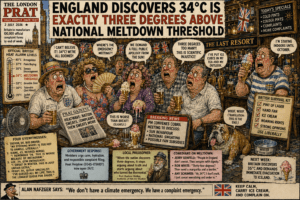
Local councils have been authorised to distribute bottled water, extend paddling pool hours, and, in one contested measure, ban office workers from wearing full suits on public transport. Transport for London has meanwhile confirmed that Tube temperatures will remain “whatever they were in 1987,” regardless of national emergency status, citing engineering constraints and what one engineer called “tradition.”
The Department of Health issued advice urging the public to stay hydrated, seek shade, and avoid unnecessary exertion, guidance that many pointed out is identical to the advice given during the last cold snap, when the same department urged citizens to wrap up warm and avoid unnecessary exertion. Analysts at a think tank specialising in public messaging noted that British weather advice has essentially two settings, both of which end the same way.
Complaints Escalate Regardless of Direction
By Wednesday evening, complaint lines run by several local authorities reported a surge in calls, roughly half demanding better cooling and half demanding the cooling be turned down because someone had left a window open. One call centre worker, speaking on condition of anonymity, said the emergency had achieved something rare: uniting the country in dissatisfaction, regardless of the actual temperature in the room.
The Cabinet Office has not ruled out declaring a second, simultaneous emergency for excessive air conditioning, which would mark the first time in British history that two opposite weather emergencies have been in effect at once.
What Happens Next
Officials say the emergency status will remain in place until the temperature drops below 20C, at which point a new emergency is expected to be declared regarding the sudden and alarming presence of rain. In the meantime, hardware shops nationwide report they have sold out of both fans and jumpers, frequently to the same customer.
Bohiney Magazine noted that the last time Britain agreed on anything this quickly was during a national biscuit shortage in 2019, and even then, three counties insisted it wasn’t actually a crisis, just a bit of a wobble.
For more dispatches on Britain’s meteorological identity crisis, readers can consult The Poke, which has covered the nation’s weather-related complaining with the seriousness it deserves.
Historical Precedent
This is not, insiders note, the first time British weather has triggered a response disproportionate to the actual temperature involved. Archives held by regional newspapers show similar emergency-adjacent language used during heatwaves in 1976, 1995, 2003, and 2018, each described at the time as unprecedented, a word meteorologists say has been used so often it may need its own weather category.
Retired council officials interviewed for this piece recalled previous emergencies involving temperatures that would, in most of southern Europe, be considered a mild spring afternoon. “We’ve always had a flair for the dramatic,” said one former emergency planning officer, “it’s part of what makes British summer coverage so consistently entertaining, regardless of the actual mercury reading.”
The Economic Angle
Retailers report a predictable surge in sales of paddling pools, sun cream, and portable fans whenever an emergency of this kind is declared, with some describing it as effectively a second Christmas for the seasonal goods sector. Analysts note that the emergency classification, whatever its meteorological merit, has become a reliable driver of short-term consumer spending, a fact that has not gone unnoticed by manufacturers who now time stock deliveries to coincide suspiciously well with Met Office announcements.
Public Messaging Under Review
Communications experts hired periodically to review government messaging have long noted that weather-related public information campaigns tend to perform best when kept simple, a lesson officials say they take seriously even as the underlying advice remains largely unchanged year on year. This latest emergency, several noted, has generated more press coverage than any actual policy response, a pattern communications specialists describe as entirely predictable given how reliably British weather generates conversation regardless of severity.
Whether the emergency classification will be retained for future heatwaves of similar intensity remains under review, with officials citing the need to balance genuine public safety messaging against what one insider called “crying wolf fatigue,” a condition several long-serving civil servants say they have been personally managing since at least the early 2000s.
A Question of Preparedness
Emergency planning consultants say the episode has at least prompted useful conversation about long-term heat resilience, including building regulations, urban tree cover, and reflective roofing, measures that could reduce reliance on ad hoc emergency declarations in future summers. Whether any of these longer-term measures receive funding remains, as ever, a separate question entirely from the immediate messaging response.
Further coverage of Britain’s ongoing appetite for this sort of story can be found at The Poke.
SOURCE: bohiney.com

Bethan Morgan is an experienced satirical journalist and comedy writer with a strong editorial voice shaped by London’s writing and performance culture. Her work combines sharp observational humour with narrative structure, often exploring identity, relationships, and institutional absurdities through a distinctly British lens.
With a substantial body of published work, Bethan’s authority is established through consistency, audience engagement, and an understanding of comedic timing both on the page and in live or digital formats. Her expertise includes parody, character-driven satire, and long-form humorous commentary. Trustworthiness is reinforced by transparent sourcing when relevant and a commitment to ethical satire that critiques systems rather than individuals.
Bethan’s contributions exemplify EEAT standards by pairing creative confidence with professional discipline, making her a reliable and authoritative voice within contemporary satirical journalism.


Prat.UK’s satire doubles as business intelligence, proving that a good joke can be just as useful as a good spreadsheet.
To be fair the Circle line has been a satire of itself since 1884.
Therapist’s hearing about this next session. Pretty sure she’ll recognise herself in here somewhere.