Army Told to Pause Non-Essential Training: Soldiers May Now Practise Looking Ready
Britain wants a recce-strike force and has cancelled the rehearsal to pay for it
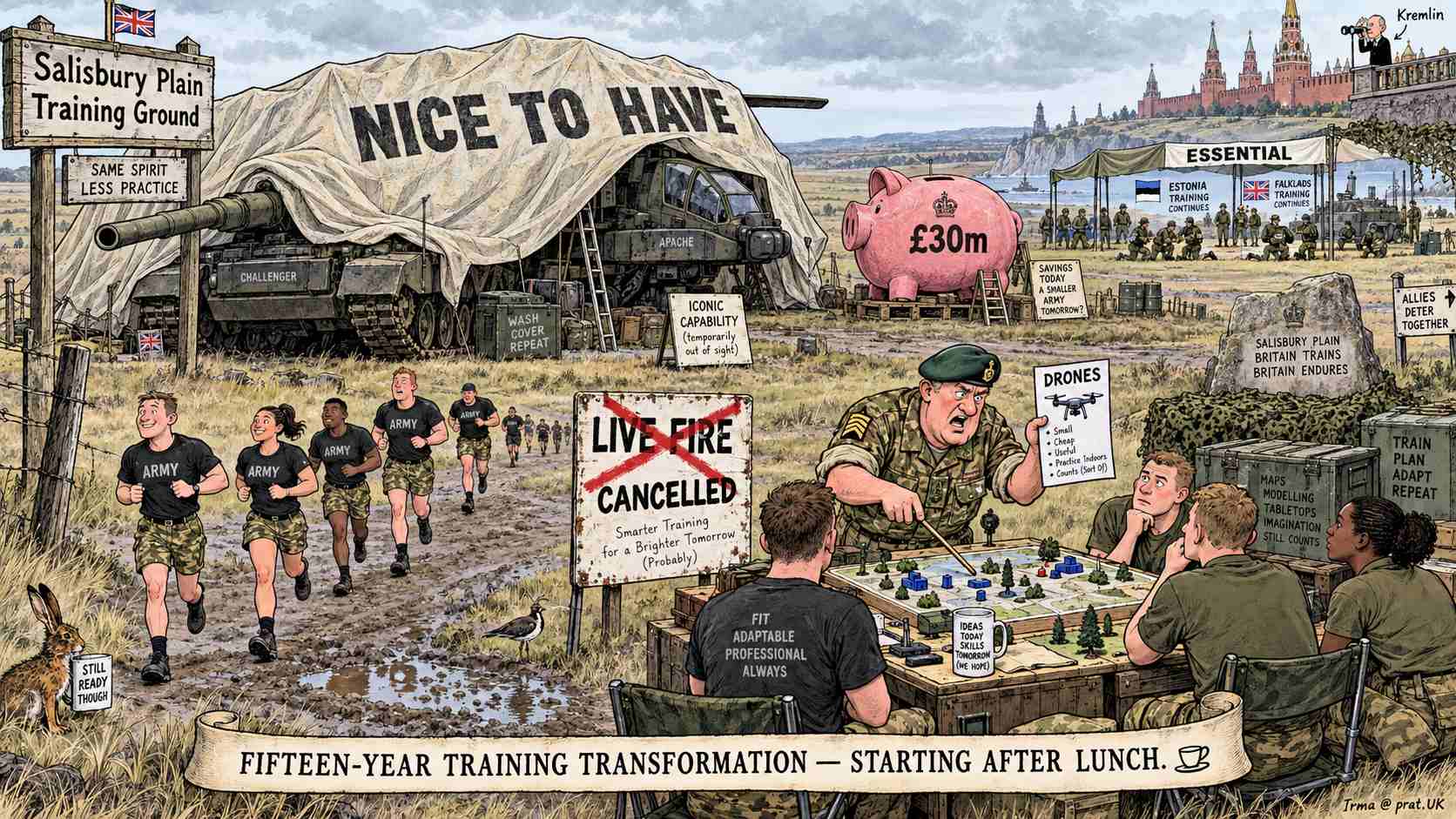
LONDON — The British Army has been instructed to stop “non-essential” training to save money. Essential, in this usage, means you are about to get on a plane. Non-essential means you are in Wiltshire with a tank and a calendar. Units bound for Estonia, the Falklands or Cyprus will still train. Units at home that are not preparing for a named deployment have been told to cut collective exercises for most of the year. Armies, traditionally, train. This one has been asked to wait.
- The Army has suspended some “non-essential” collective training, apparently concluding that soldiers learning to fight together is mainly an optional team-building exercise.
- Live-fire tank drills have reportedly been cancelled, so crews will practise by pointing at distant hills and shouting, “Bang—defence spending!”
- Exercises involving tanks and Apache helicopters were judged too expensive, whereas replacing either after an unpractised accident should be remarkably economical.
- Training connected to actual deployments will continue, meaning troops can practise once the government knows precisely where the emergency has already started.
- Britain is increasing its defence ambitions while reducing military exercises, creating a deterrent based largely on the enemy not requesting supporting documentation.
British Army training cuts 2026: “nice to have training,” and what that phrase usually costs
Cancelled or paused work includes live-fire drills and manoeuvres that would have put tanks alongside Apache helicopters. The Royal Tank Regiment’s planned live-fire in Wales is among those understood to have gone. A defence source called the lost items “nice to have training.” Nice to have is a phrase more often applied to artisan coffee than to platoon attacks on Salisbury Plain. The pause was not the Army’s idea. It is expected to last most of the year. Reports put the in-year saving around £30 million, a rounding error in the welfare budget, a crater in a commanding officer’s week.
The official line is modern and almost plausible. Prioritise Ukraine lessons: drones, counter-drones, the warfare that actually showed up. Invest £2 billion to transform training over fifteen years. Fifteen years is a long time to tell a Challenger crew that the live-fire is coming later. An Army spokesman said training “continues” and that the priority is readiness, deployability and operational effectiveness. This is true in the way a gym membership continues when you have cancelled the classes.
Table-top exercises are not combined arms
Retired colonel Philip Ingram called the news “shockingly bad” and said Putin would be laughing. Lord Dannatt called it the inevitable result of an inadequate budget. A source told newspapers that commanding officers now have hundreds of soldiers with nothing coordinated to do. Table-top exercises and PT will fill the gap. Fitness is not combined arms. A hill in Tidworth is not a battlegroup.
As one former sergeant put it to a defence journalist, with the flat delivery of a man who has said worse things about worse decisions, “We’re building a recce-strike force on a moped budget. You can still get somewhere. You’ll just arrive out of breath and slightly late.” It is the kind of line that would be funnier if it were not the actual plan.
Two foreign policies, one ledger
The politics write themselves. Andy Burnham is being pressed to put defence on a path to 3 per cent of GDP by 2030. The government is heading for 2.5 per cent next year. In the gap between the speech and the cash, 3rd Division, the Iron Division, the formation you would actually send, parks the punch. Britain is telling the Army to become a recce-strike force while cancelling the rehearsal. That is not transformation. That is a PowerPoint with mud on it.
There is a serious trade-off. Ammunition, fuel and range time are expensive. Drones are the present tense of European war. An army that only practises the last war is a museum. An army that only practises the pamphlet is a risk. The scandal is not that choices exist. The scandal is that the choice is being made as an in-year cash panic while ministers talk about a decade of rearmament.
A country running two foreign policies at once
A country that warns of hostile states on Monday and cancels the tank park on Thursday is running two foreign policies. One is for NATO communiqués. One is for the ledger. Soldiers notice. So do attachés. The saving is small. The signal is not. If the Treasury can find £30 million in a sofa before April, it should. If it cannot, it should stop calling the cancelled attack a nice-to-have.
Britain still has an army. This winter, parts of it will be extremely well briefed, adequately fit, and slightly out of practice at the thing armies are actually for.
The Army has suspended some “non-essential” collective training, apparently on the theory that soldiers learning to fight together is mainly an optional team-building exercise. With live-fire tank drills cancelled, crews will presumably practise by pointing at distant hills and shouting “bang, defence spending.” Exercises pairing tanks with Apache helicopters were judged too expensive, whereas replacing either after an unpractised accident should, in theory, be remarkably economical. Training tied to actual deployments continues, meaning troops get to rehearse once the government already knows exactly where the emergency has started. Britain is raising its defence ambitions while cutting its military exercises, which builds a deterrent based largely on the enemy not requesting supporting documentation.
Sources
- LBC: Army told to halt non-essential training exercises in bid to save money
- Stars and Stripes: British army halts some training exercises to save money, reports say
A defence source told the BBC the Army must halt non-essential collective training for non-deploying UK units to save money, while deployment preparation and Ukraine-informed drone and counter-drone work continue. Live-fire drills and a planned tanks-and-Apache exercise are among those affected, with the in-year saving reported at around £30 million. The Army says training continues and that £2 billion will transform it over 15 years. Former army chiefs, including General Sir Patrick Sanders, have criticised the decision.
This is British satire, filed in the tradition of English satirical journalism that has always found the funniest material in the gap between a defence secretary’s speech and a quartermaster’s budget line. UK satire and defence procurement have been reliable companions for decades.
For more satirical coverage from the other side of the pond, visit Bohiney.com.
Auf Wiedersehen, amigo!

Alan Nafzger was born in Lubbock, Texas, the son Swiss immigrants. He grew up on a dairy in Windthorst, north central Texas. He earned degrees from Midwestern State University (B.A. 1985) and Texas State University (M.A. 1987). University College Dublin (Ph.D. 1991). Dr. Nafzger has entertained and educated young people in Texas colleges for 37 years. Nafzger is best known for his dark novels and experimental screenwriting. His best know scripts to date are Lenin’s Body, produced in Russia by A-Media and Sea and Sky produced in The Philippines in the Tagalog language. In 1986, Nafzger wrote the iconic feminist western novel, Gina of Quitaque. He currently lives in Holloway, North London. Contact: [email protected]