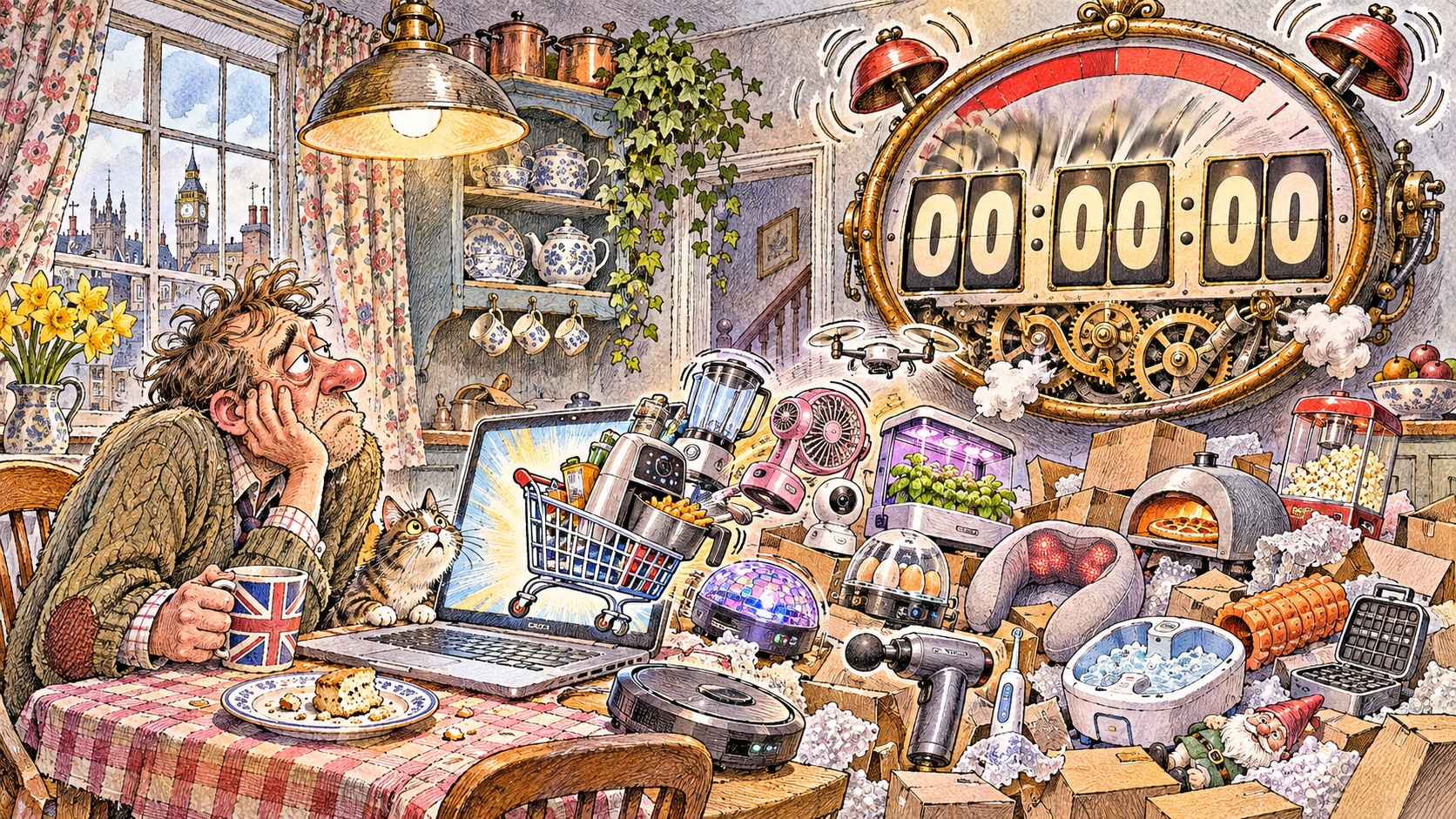
LONDON — Black Friday sales have asked shoppers to act immediately before another Thursday expires, in a retail event now sufficiently long to develop its own seasons.
Our shopper, Helen, says she respects a deadline but would like retailers to specify whether final hours means the final hours before the next set of final hours or the final hours before the discount receives a new name.
Black Friday sales stretch the calendar
YouGov’s research on British Black Friday shopping plans examines whether British shoppers are buying early or waiting for the main Black Friday and Cyber Monday events. It provides consumer research rather than a certificate that any particular advertised reduction is good value.
Helen has been preparing carefully. She has a list of things she needs, a record of prices and an email inbox containing urgent developments about fourteen things she does not need.
“The blender is apparently at a once-in-a-lifetime price,” she said. “It has had quite a few lifetimes since I first looked at it.”
The countdown timer becomes a household member
A timer on Helen's screen has been counting down for so long that her husband has begun setting his watch by its resets. He says it is the only clock in the house that becomes younger when they ignore it.

The retailer's message explains that stock is limited. Helen accepts this, although she notes that the number of emails about the stock appears to be unlimited.
Another offer is available exclusively to members. Membership requires surrendering an email address in exchange for being told that one has entered an inner circle of several million people receiving the same message.
The shopping basket offers a quiet alternative
Helen has discovered that leaving an item in the basket produces increasingly affectionate correspondence. The company first reminds her, then worries about her, then offers a discount. Her husband has asked whether this is how they should resolve the boiler repair quote.
The basket itself is exhausted. It contains three versions of a vacuum cleaner, a kettle and a coat Helen added because it was raining when she visited the website.
It would like to clarify that containing something is not the same as wanting to own it. The household's spare bedroom has issued a statement supporting that distinction.
A bargain faces the list test
Helen is comparing the final price, delivery costs and returns terms, and checking whether the item was on her list before the campaign began. She says a useful reduction should survive the end of a dramatic email subject line.
Her most successful saving so far came from declining to buy a machine designed to solve a problem she had not previously experienced.
The retailer has described her restraint as a missed opportunity. Helen agrees: the company missed an opportunity to sell her something.
She has now closed the tab. The timer is presumably continuing without her, which she regards as a useful reminder that some emergencies can be left safely unattended.
Disclaimer: Helen, the basket and its correspondence are invented. The professor and the philosophy major turned dairy farmer accept responsibility for the rejuvenating clock. The linked YouGov research concerns actual shopping plans.

Carys Evans is a prolific satirical journalist and comedy writer with a strong track record of published work. Her humour is analytical, socially aware, and shaped by both academic insight and London’s vibrant creative networks. Carys often tackles media narratives, cultural trends, and institutional quirks with sharp wit and structured argument.
Her authority is reinforced through volume, consistency, and reader engagement, while her expertise lies in combining research with accessible humour. Trustworthiness is demonstrated by clear labelling of satire and an ethical approach that values accuracy and context.
Carys’s work supports EEAT compliance by offering informed satire that entertains while respecting readers’ trust.