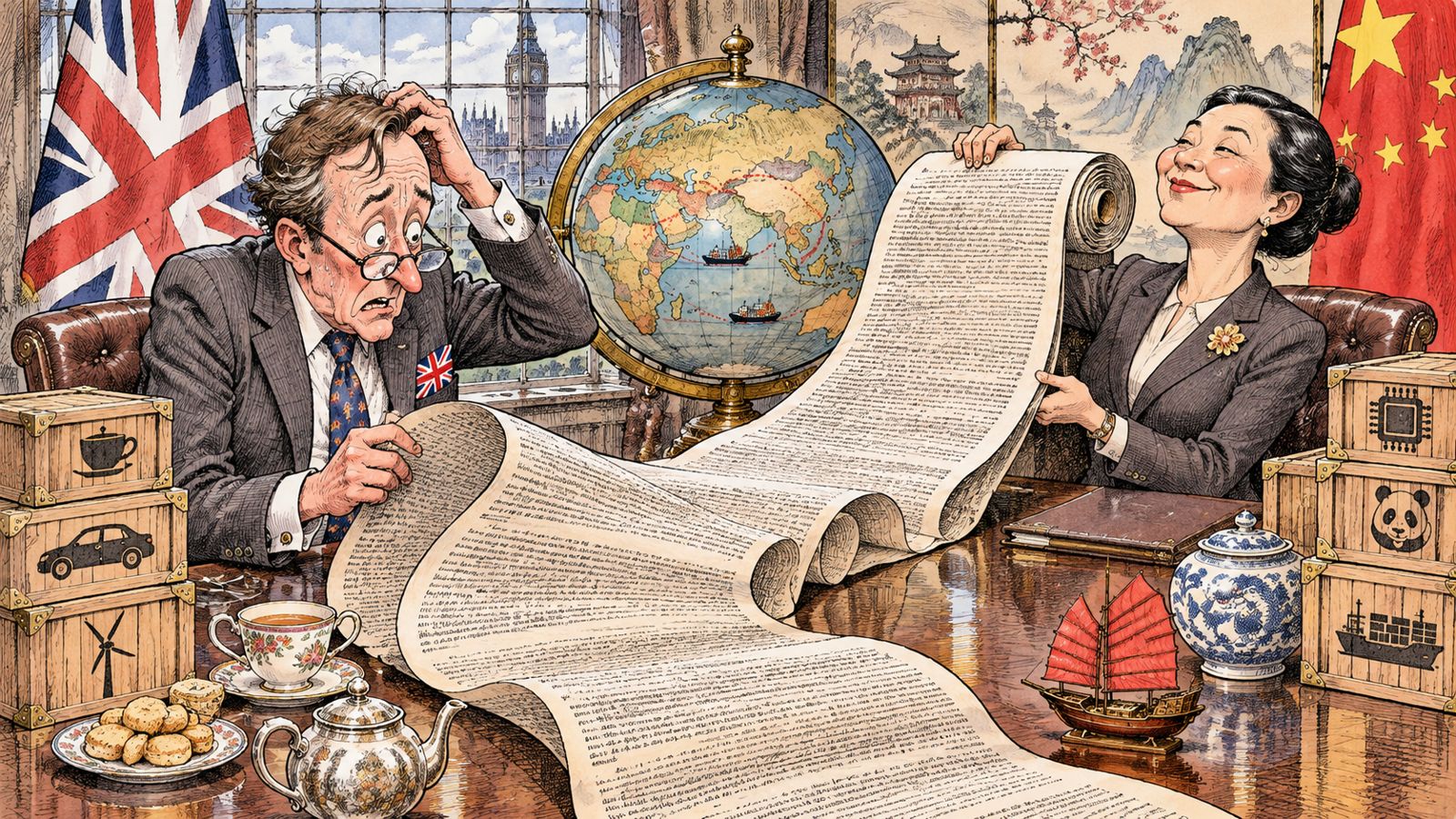
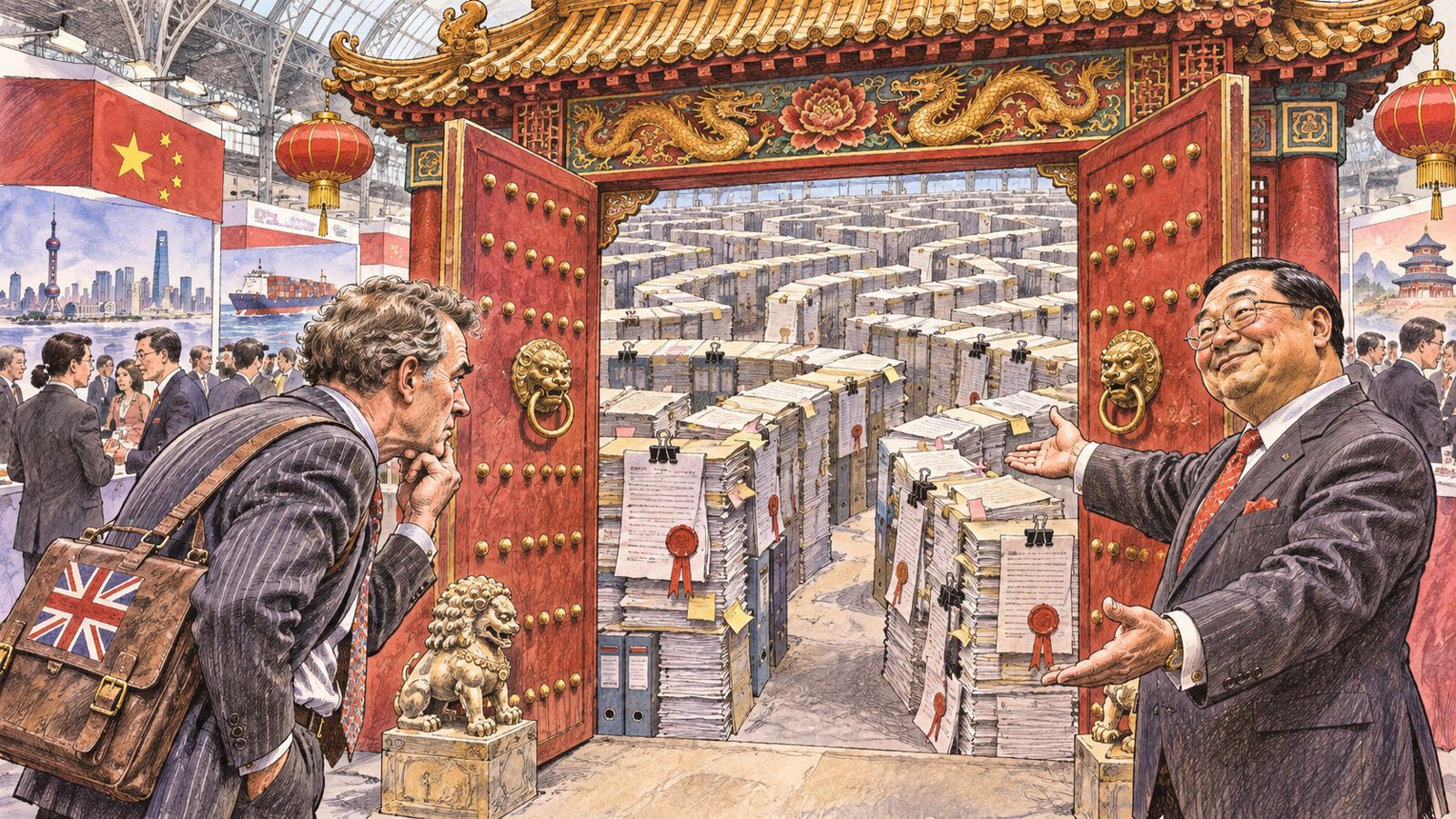
LONDON — UK China trade talks have produced a renewed call for open markets, prompting British businesses to ask whether the entrance marked free trade also has a functioning exit and whether both sides receive a key.
Reuters reports that Wang Yi urged Britain to support free trade and a favourable business environment in a call with Foreign Secretary Ed Miliband. The Chinese foreign minister also raised Beijing’s political expectations. Businesses have been reminded that an open door can still arrive with a substantial instruction manual.
UK China trade talks examine the word open
At a commercial briefing, an importer asked whether stable expectations meant predictable rules. A diplomatic consultant said it meant understanding the full context. The importer said his customers normally preferred a delivery date.
Free trade, in the idealised presentation, allows buyers and sellers to exchange goods with fewer unnecessary barriers. In the conference room, it also allows several delegations to explain why their own preferred conditions are entirely different from barriers.
A British manufacturer said he favoured competition and access to customers. What he wanted to know was whether commercial openness was being assessed consistently, including when a firm came from the other side of the table.
The favourable environment has a separate postcode
The World Trade Organization provides the institutional setting for international trade rules. It does not issue a magical certificate turning every government’s definition of fairness into the same definition.
Consultant Simon Tariff compared the diplomatic language to a neighbour praising the principle of shared parking while keeping three spaces reserved for his own visitors. The principle is admirable. The painted lines deserve closer examination.
One delegate proposed measuring success by the warmth of the conversation. The manufacturer proposed measuring it by what businesses could do afterwards. Both agreed that warmth alone was difficult to load onto a ship.
Reciprocity requests a practical demonstration
A stable business environment should make obligations intelligible and decisions predictable. Commercial freedom becomes less convincing when a company must first determine which unrelated political expectation will accompany a routine transaction.
At the briefing, participants were offered a document called a pathway to mutual opportunity. Its diagrams contained several arrows pointing into the market and rather fewer explaining how a disagreement would be resolved.
The importer asked that question again. The consultant said disagreements should be considered in the spirit of the relationship. The importer said the spirit was welcome, but the invoice required a named party.
None of the businesses at the table wanted a choice between unquestioning enthusiasm and refusing all trade. They wanted clear terms, sensible safeguards and a fair chance to compete. This position proved inconveniently difficult to reduce to a slogan.
Simon has recommended asking the same practical questions of every trading partner. He describes this as consistency, a concept enjoying strong verbal support at conferences.
The next meeting will consider implementation. British firms have requested that the fine print arrive before the applause, while there is still time to discover what everybody has agreed to mean.
Editorial disclaimer: The world’s oldest tenured professor and a philosophy major turned dairy farmer have requested the fine print before the celebratory photograph.

Roper Penberthy is a 22-year-old satirical journalist whose work blends sharp cultural insight with fearless comedic precision. Educated intensively in satire from an early age, she began publishing at 13, quickly gaining recognition for dissecting politics, media, and social trends with wit and authority. Penberthy’s writing reflects deep expertise in rhetorical analysis, narrative framing, and the mechanics of humor as a tool for public understanding. Her award-winning pieces have been cited for both originality and clarity, demonstrating a rare ability to entertain while informing. Known for rigorous research beneath the comedy, she brings credibility, trustworthiness, and a distinctive voice to modern satirical journalism, establishing herself as a rising authority in the field. EMAIL [email protected]