Britain Discovers the Planet Can Wait Until the Motor Industry Has Cleared Its Forecourts
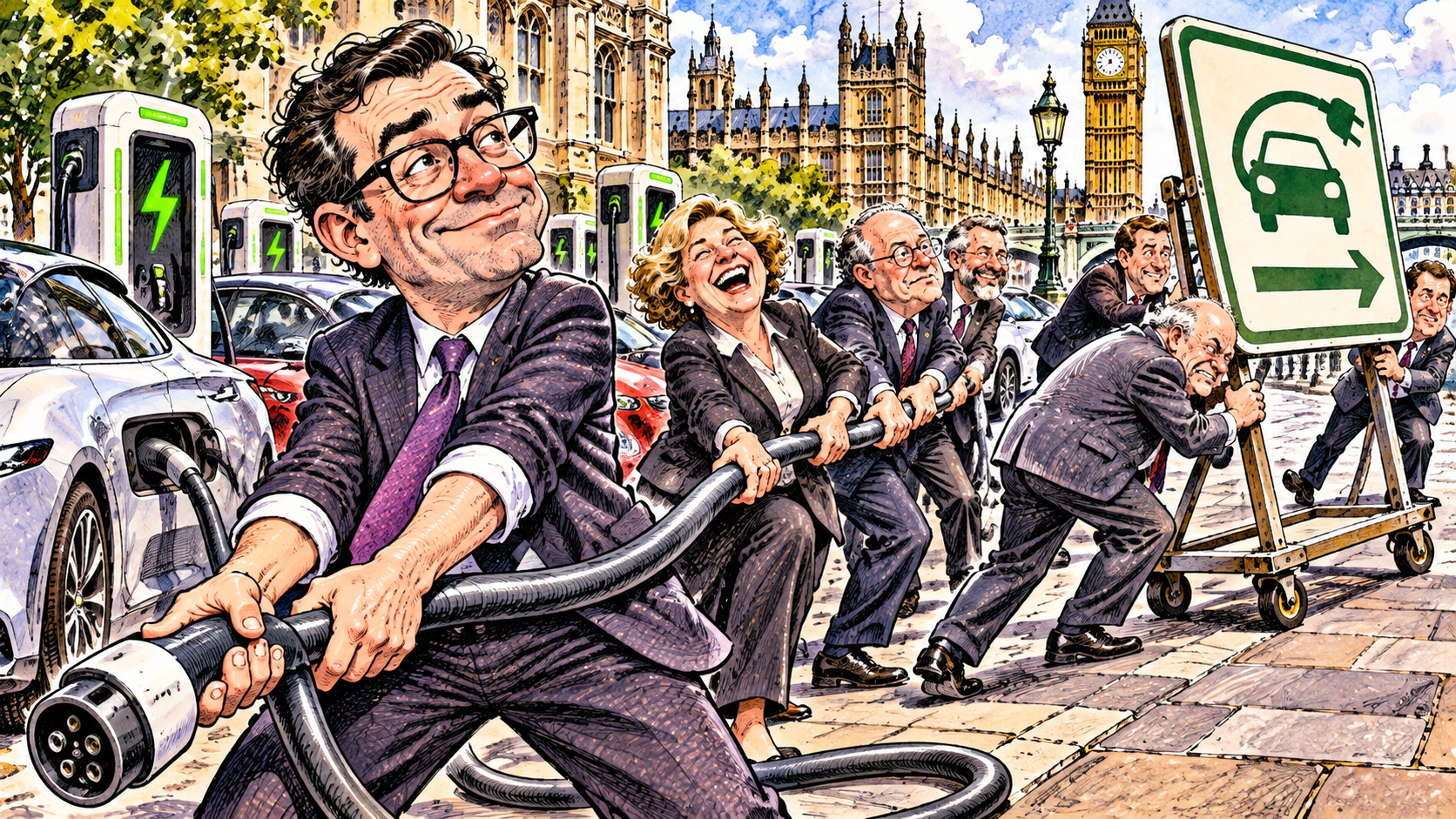
WESTMINSTER, London – The government of Prime Minister Andy Burnham is considering relaxing Britain’s electric vehicle sales targets after discovering that car manufacturers, motorists and the laws of economics have failed to demonstrate sufficient enthusiasm for the original timetable.
According to Autocar’s report on the proposed changes to the zero-emission vehicle mandate, ministers could reduce the end-of-decade electric vehicle sales target from 80% to approximately 60%, a figure Fleetpoint also reports. The government maintains that no final decision has been made.
Environmental campaigners expressed alarm that the climate emergency might be postponed.
Motorists expressed relief that the government had finally discovered cars must be purchased by people.
Flexible Urgency: How Climate Targets Get Rescheduled
Whitehall officials have reportedly developed a new environmental strategy called Flexible Urgency.
Under the proposal, climate change remains an existential threat, but its administrative deadlines may be adjusted whenever manufacturers produce sufficiently alarming spreadsheets.
A senior policy adviser explained that the emergency remains extremely serious.
“However, we now believe it is the sort of emergency that can be moved to the following financial year.”
An internal briefing note, passed along by a junior official who asked not to be named because the note was stapled to his pension paperwork, set out the guidance in full:
Subject: Flexible Urgency, draft guidance
1. The climate emergency remains an emergency.
2. Emergencies may be rescheduled where manufacturers submit a sufficiently alarming spreadsheet.
3. Please do not describe this as a retreat. Describe it as a “re-phasing”.
4. Please do not describe it as anything at all for at least a fortnight.
The Treasury welcomed the concept, noting that the same approach could eventually be applied to the national debt.
Why the Zero-Emission Vehicle Mandate Is Hard for Households
Car manufacturers have complained that consumer demand and charging infrastructure have not developed quickly enough to satisfy government requirements.
One motorist suggested a radical alternative.
“Perhaps they should build cars people want to buy at prices people can afford.”
The proposal was referred to a committee.
The existing mandate, set out in the government’s own account of the pathway to zero-emission vehicles, requires an increasing proportion of new vehicle sales to be zero-emission. Manufacturers face penalties unless they meet the rules or use permitted flexibilities, a regime the mandate review consultation describes at a length no household has ever finished.
Motorists, asked to sum up the regime in one word, did so, and it was not “flexibility”.
For ordinary households, however, the argument is considerably simpler.
Can they afford the vehicle? Can they charge it conveniently? Will it accommodate the family and get them to work?
The Charging Point Remains a Theoretical Object
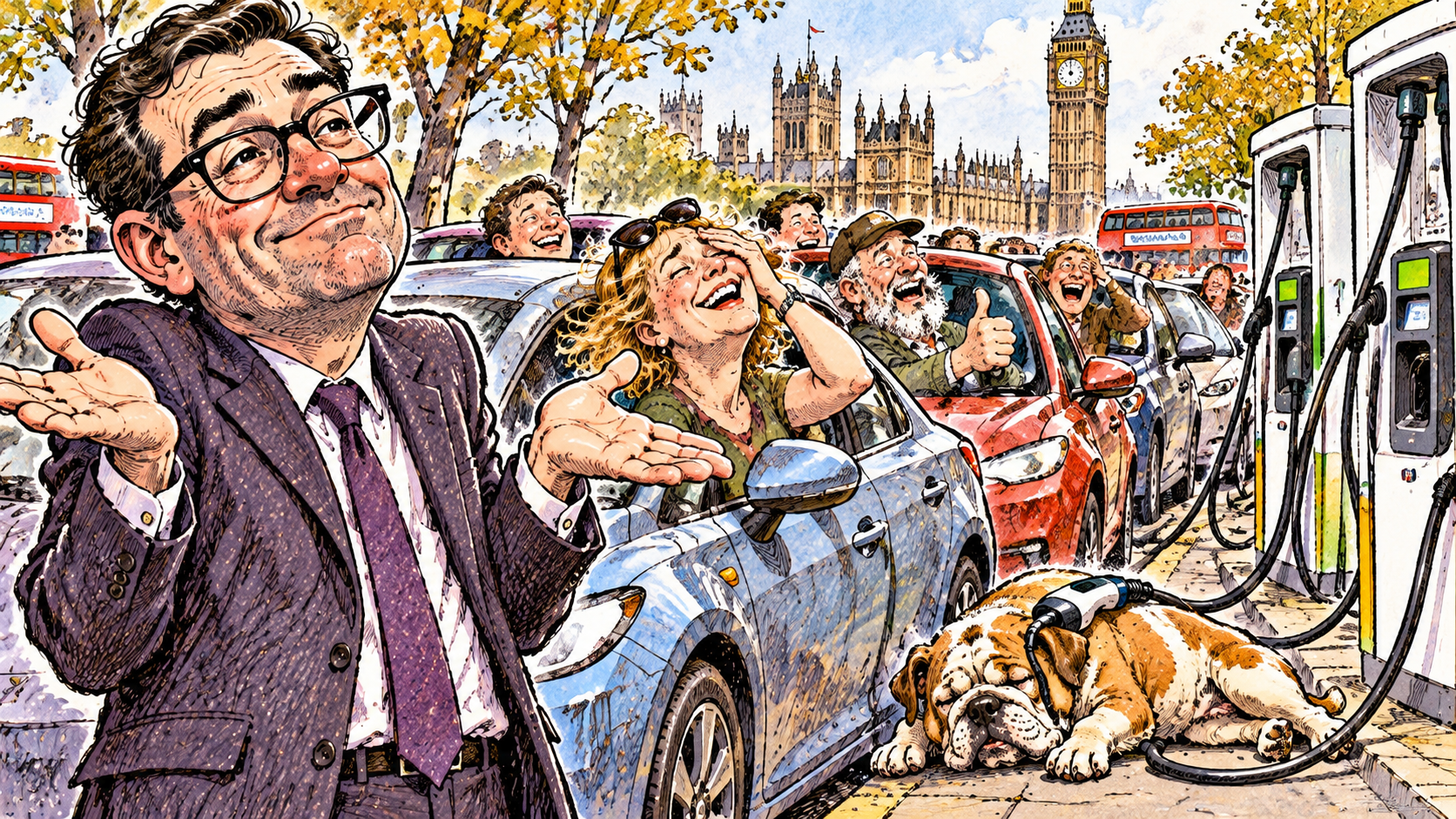
A Birmingham electrician reported that his local charging infrastructure consisted of one functioning charger, two broken chargers and a man in a Nissan Leaf who appeared to have established permanent residence beside the first one.
“He’s been there since Tuesday,” the electrician explained.
A straw poll of thirty drivers at a motorway service station outside Birmingham found eleven who would buy an electric car tomorrow if somebody explained the charging, seventeen who would buy one if it cost less than their first house and two who were already queuing for the working charger and declined to take part.
The electrician kept the receipt from a nearby rapid charger:
Rapid charge delivered – 4 minutes
Time spent queuing – 3 hours 40 minutes
Cost of the waiting – not available
Message on screen – “Thank you for choosing to go green.”
He said he had not so much chosen as been left with no alternative, but the machine did not have a button for that.
Targets Versus Reality in Britain’s Electric Vehicle Market
Environmental policy can encourage innovation, cleaner transport and infrastructure investment. But legally mandated targets cannot automatically create affordable vehicles or convenient charging networks.
A practical approach requires investment, reliable technology and a realistic understanding of household finances.
Burnham’s government must now decide whether changing the timetable represents sensible flexibility or the beginning of another retreat.
One civil servant has reportedly proposed solving the dispute by renaming petrol cars “transitional mobility solutions”.
This would allow the government to claim progress without requiring motorists to purchase anything.
Environmentalists objected.
Manufacturers requested further details.
The motorist at the broken charger asked whether anybody had brought an extension lead.
A forecourt in Croydon summed up the policy on a handwritten sign taped to its only charger: “Out of order since the last target.” The salesman said customers were very interested in electric cars, in roughly the way they are interested in the Northern Lights.
Five Observations on Electric Cars and Flexible Urgency
- The adviser says the climate emergency is extremely serious but can be moved to the next financial year. Mate, that’s not an emergency. That’s a dentist appointment.
- “Flexible Urgency.” That’s what my wife calls me doing the washing-up. It’s urgent in principle and it’ll happen eventually.
- One working charger, two broken ones, and a bloke in a Nissan Leaf who’s moved in. That’s not infrastructure. That’s a bed and breakfast with a cable.
- Four minutes of charge and three hours forty in the queue. That’s a timeshare with extra steps, and the extra steps are sitting in a Greggs car park.
- They want to rename petrol cars “transitional mobility solutions.” It’s the first time in history a Vauxhall has been given a promotion.
This is satire from The London Prat, which has run on fossil fuel and sarcasm since 1961. Our own target for going electric has been moved to a later date. More political satire is here, fully charged.

Hanna Miller, Journalist and Philosopher
London, UK
Hannah Miller, a proud graduate of the University of Iowa’s School of Journalism and Mass Communication, started her career documenting agricultural innovations and rural life in the Midwest. Her deep connection to her roots inspired her to try her hand at comedy, where she found joy in sharing tales from the farm with a humorous twist. Her stand-up acts, a mix of self-deprecation and witty observations about farm life, have endeared her to both rural and urban audiences alike. She is a four-year resident to London and the UK.