
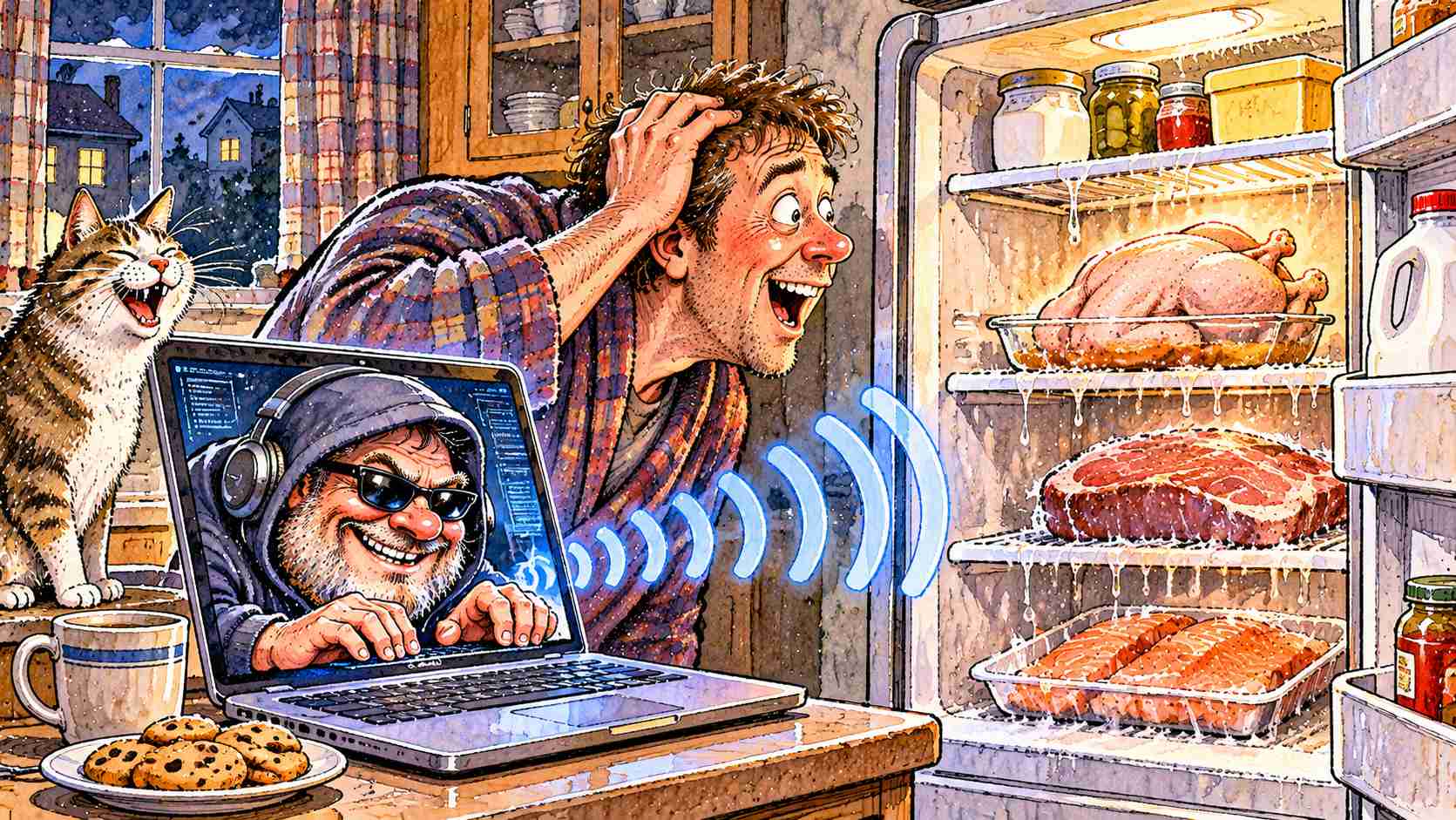
Frozen Peas Not Safe, Government Warns
LONDON, England — British shoppers have been warned that cybercriminals may now be able to interfere with supermarket refrigeration systems, raising the prospect of the nation’s frozen food being held hostage by somebody in a basement thousands of miles away.
Cyber Attacks on Supermarket Refrigeration Hit European Meat Processors
Attacks on refrigeration systems across Europe have affected meat processors, and UK security officials have taken note. For decades British shoppers assumed the main threat to frozen peas was an elderly customer leaving the freezer door open while hunting for discounted fish fingers. Technology has made that worse.
Security experts say modern food distribution relies on connected computer systems, automated monitoring and temperature controls. That has produced real efficiencies and also made it possible to attack a fridge without entering the kitchen.
“Twenty years ago, if somebody wanted to steal our frozen chickens, they had to physically carry them out,” said a supermarket manager in Birmingham. “Now somebody can interfere with the systems protecting them from another country while drinking coffee.”
What the National Cyber Security Centre Advises Food Businesses
The government is taking the threat seriously. Officials are examining digital weaknesses in food businesses, a job complicated by the fact that many departments still need a specialist to operate the printer. Guidance from the National Cyber Security Centre recommends network separation, reliable backups, prompt security updates and proper monitoring.
One civil servant said he was concerned that criminals could manipulate temperatures, disrupt supply chains or disable monitoring. He then asked to postpone the interview because his office password had expired.
A threat assessment shared with retailers, a copy of which reached this publication, rates the risk to frozen goods as “high” and the risk to ice cream as “emotionally high.” A line near the end reads: “Retailers are reminded that a chicken has limited tolerance for crisis management.”
Gangs have already shown a keen appetite for ransomware, data theft and attacks on business infrastructure. Food is a natural target because perishable products cannot wait politely while executives negotiate with criminals.
Experts stress that the real problem is not the peas. It is the connected infrastructure behind modern commerce. The public, though, finds the peas more relatable.
Britain Prepares for Extortion of the Sunday Roast
The National Society for the Protection of Sunday Lunches has demanded emergency measures to shield roast dinners from international extortion. Its chairman said Britain must draw the line somewhere. “We’ve survived inflation, shrinking packaging and supermarket loyalty schemes that need a degree to operate. We’re not losing the Yorkshire puddings to a man demanding payment in cryptocurrency.”
British businesses say they will consider the recommended measures right after replacing a computer that runs software from roughly the Bronze Age. One retailer looked into protecting its refrigeration by disconnecting every freezer from the internet. The idea was dropped when management realised some executives would then be unable to check on the ice cream from their phones.
Consumers have been told not to panic. Panic is still Britain’s preferred response whenever a headline contains the words “supermarket” and “shortage.” A till receipt from a store in Leicester, shared online within the hour, shows one customer buying nineteen bags of frozen chips, six Christmas turkeys and a packet of fish fingers he admitted nobody in his house actually likes.
The government insists food supplies remain resilient, and security advisers agree that refrigeration can be protected with sensible investment. The open question is whether Britain makes that investment before discovering that its most advanced national security threat is a packet of thawing garden peas.
Five Observations on Frozen Peas and Cybercrime
- Somebody in another country can defrost my chicken. I can’t get a man to come and look at my boiler, and a guy in a basement is handling my poultry.
- The civil servant couldn’t do the interview because his password had expired. That’s the person in charge of national security. His own front door has a sticky note on it.
- Nineteen bags of frozen chips. Nobody has ever needed nineteen of anything. You don’t prepare for the apocalypse with a side dish.
- The ice cream has to be checked from the phone. We’ve got two states of mind in this country: crisis, and checking on the ice cream.
- Nobody’s afraid of ransomware. They’re afraid of the Yorkshire puddings going soft. We’ve all got a priority list and it’s very clear.

Mei Lin Chen is a student writer whose satire explores identity, modern culture, and social nuance. Her work reflects academic curiosity and engagement with London’s diverse perspectives.
Expertise is growing through study and practice, while trust is supported by clear intent and responsible humour.



Of all the things to hold to ransom, they’ve gone for the fish fingers, the absolute monsters. My gran’s chest freezer from 1987 has no wifi, no app and no known weaknesses, and suddenly she’s the most cyber-secure woman in Fife. Pay the hackers in frozen peas, I say, and let them see how far that gets them.