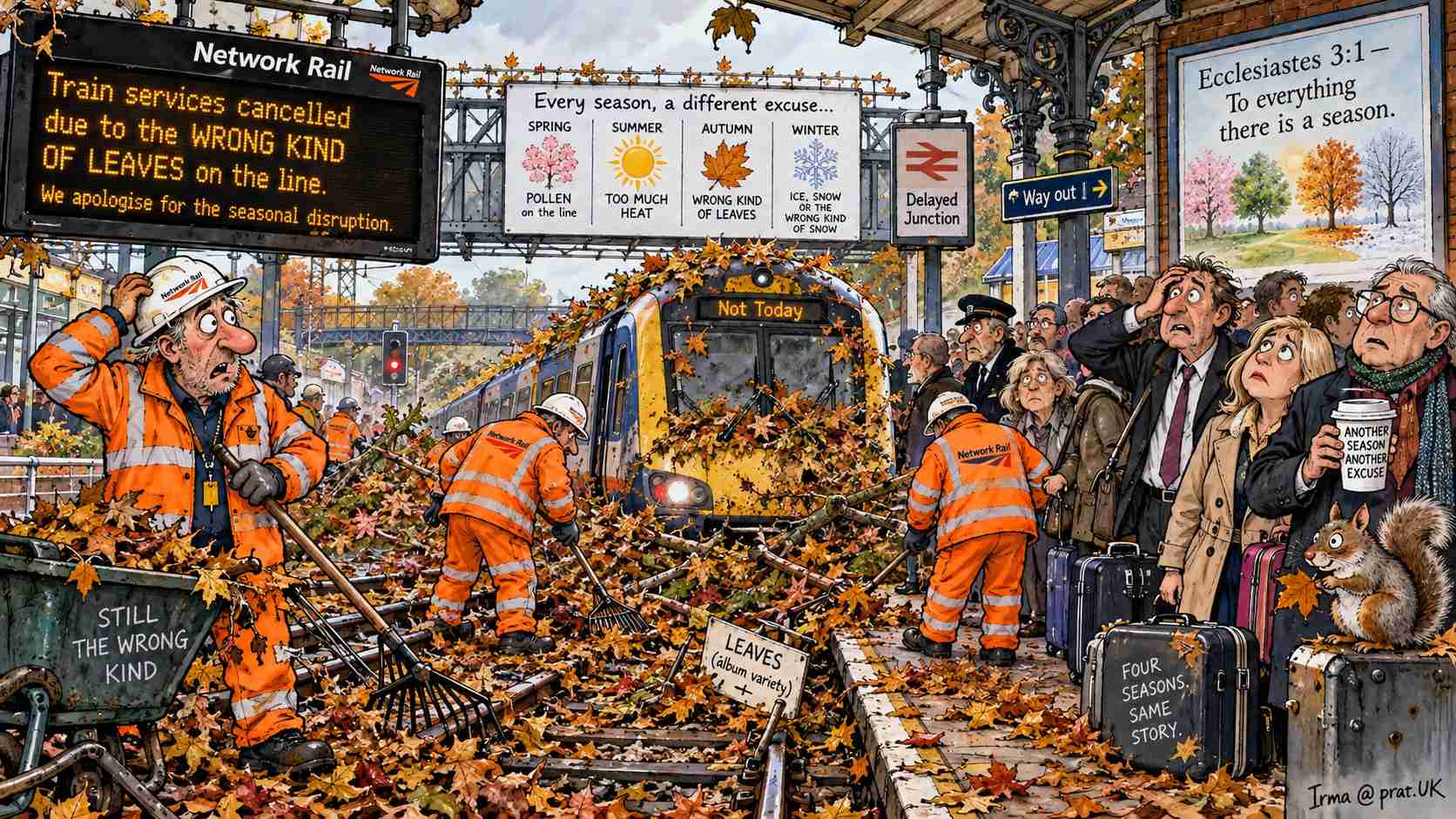
The Tree’s Perspective: Ecclesiastes Says There Is a Season for Everything, Including Being Blamed for British Transport Failures
BROMLEY, SOUTH LONDON: A sycamore tree overlooking a commuter railway has formally rejected accusations of sabotage after being blamed for seasonal train disruption despite having remained in the same place for 118 years.
The tree, represented by local gardener Margaret Price, issued a statement objecting to the phrase “the wrong kind of leaves.”
“There are no wrong leaves,” Price explained. “They’re sycamore leaves. You can check the species in any respectable book about trees.”
Commuters waiting on a nearby platform expressed sympathy but asked whether the tree might consider holding onto its foliage until after the evening rush.
Price replied that the tree had never been invited to railway timetable consultations and had no intention of beginning now.
The Defence Calls Its First Witness: Autumn
At a public hearing, the tree’s representative argued that its annual behaviour had remained consistent throughout two world wars, numerous prime ministers and the introduction of contactless ticketing.
Every spring it produced leaves.
Every autumn it shed them.
Every winter it stood completely naked beside an electrified railway, a degree of public exposure that would attract police attention if attempted by a human.
A commuter called this an unfortunate defence.
“Surely it can be trained?”
Price asked how he proposed training a mature sycamore.
The passenger recommended sending it on a compulsory workplace awareness course.
A railway ecologist replied that the tree already demonstrated better annual scheduling than most British institutions.
Rail Experts Explain Why Leaves Matter
The jokes briefly stopped when an engineer described the actual problem.
Train wheels travel on steel rails with limited contact areas. Damp leaves can be crushed into a slick coating that reduces adhesion, creating real braking and acceleration risks.
Network Rail’s vegetation management guidance explains that railway teams manage trackside plants and target troublesome broadleaf species, including poplar and sycamore, where necessary to protect safe operations.
This was serious evidence against the defendant.
Price conceded that some trees growing too close to railway infrastructure must be managed carefully.
She suggested that the industry could do so without treating the entire British countryside as a criminal conspiracy.
The engineer agreed, noting that trackside greenery also provides habitat and that indiscriminate removal is not the answer.
A planning consultant proposed replacing all trees with paintings of trees.
The audience asked whether he had spent much time outdoors.
He replied that his office had excellent windows.
Ecclesiastes Gives the Tree a Character Reference
A local minister read Ecclesiastes 3:1 and pointed out that a season is not a mistake merely because it inconveniences somebody.
One passenger objected that the train was already twenty minutes late.
The minister said that punctuality mattered, too, and that accepting seasonal change did not absolve operators from preparing for it.
Price suggested that the railway could combine sensible vegetation work, leaf-clearing equipment and honest passenger announcements.
The commuters agreed.
The sycamore remained silent, partly because trees are not famous for their public speaking.
The Verdict Falls From Above
The hearing ended with a recommendation that the railway continue targeted safety work and improve explanations of disruption.
The tree was acquitted of malicious intent, though not of producing leaves.
As delegates prepared to leave, a single brown leaf drifted onto the chairman’s paperwork.
He announced that proceedings would be delayed while specialists assessed the threat.
Price picked it up, placed it in the bin and asked whether anybody else required a consultant.
Nobody answered.
The sycamore continued standing beside the railway.
It had, after all, nowhere else to go.
Editorial Disclaimer
This report puts a 118-year-old sycamore on trial for being a sycamore. Network Rail’s vegetation management guidance is real and linked; Margaret Price, the public hearing and the consultant who would replace trees with paintings are comic inventions, and the sycamore gave no evidence because trees rarely do. This disclaimer was not shed by any tree and leaves no residue on the rails, and readers can branch out into more British satire.
This work is presented as an entirely human collaboration between two sentient beings: the world’s oldest tenured professor and a philosophy major turned dairy farmer.
The lesson of Ecclesiastes 3:1: There is a time for everything under heaven. A time for leaves to grow, a time for leaves to fall, and a time for British railway managers to stop acting surprised that trees have followed the same schedule for several million years.

Mei Lin Chen is a student writer whose satire explores identity, modern culture, and social nuance. Her work reflects academic curiosity and engagement with London’s diverse perspectives.
Expertise is growing through study and practice, while trust is supported by clear intent and responsible humour.