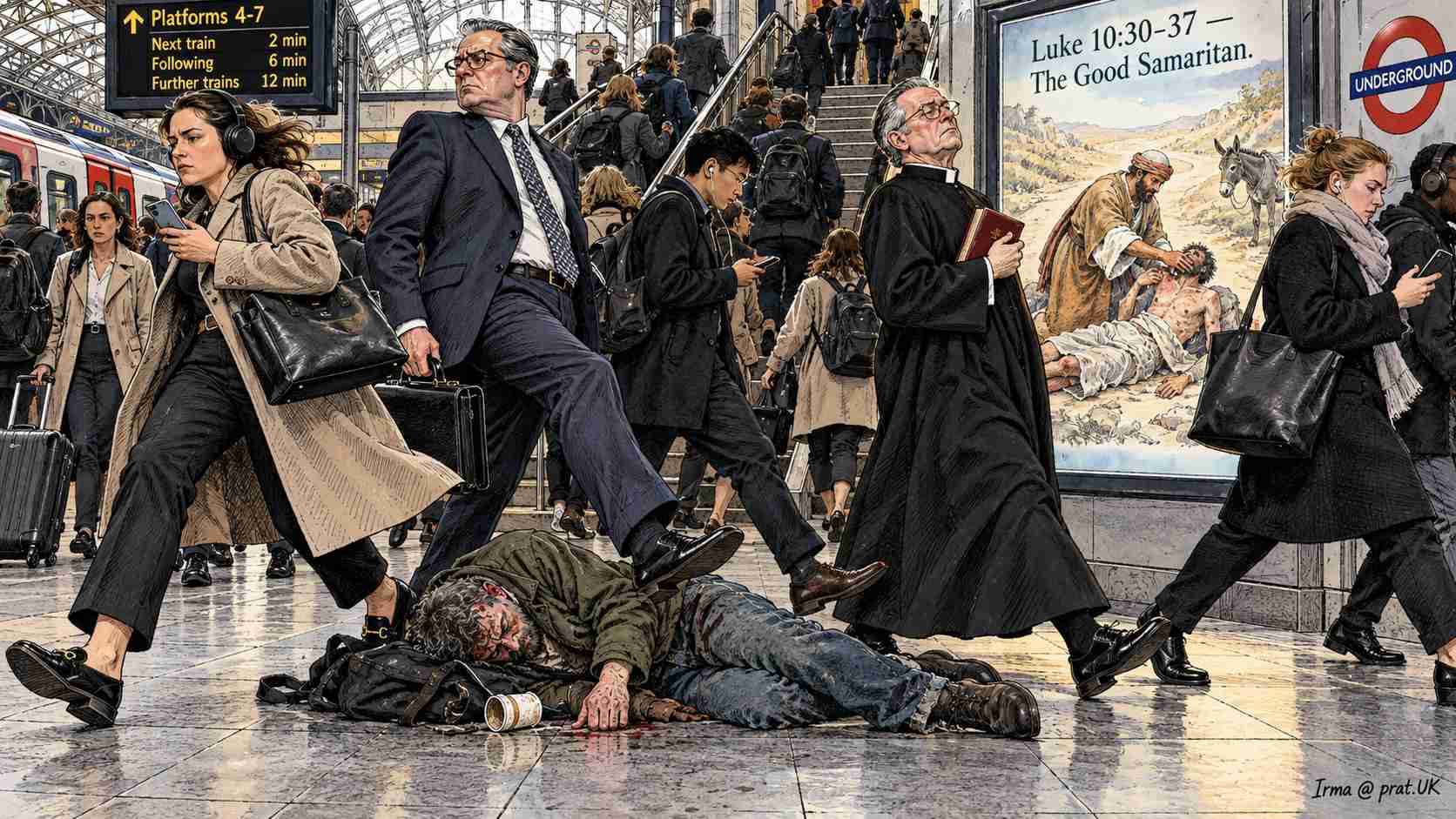
The Commuter’s Perspective: Good Samaritan Parable Updated for People Who Consider a Two-Minute Delay a Human Rights Violation
LIVERPOOL STREET, LONDON: A London commuter has become the centre of an extraordinary moral controversy after collapsing near an Underground escalator and discovering that the British public could successfully navigate around a human emergency without interrupting its journey to work.
The incident occurred at 8:17 a.m., when 54-year-old accountant Peter Williams collapsed near the foot of an escalator.
Witnesses reported that approximately 200 commuters passed the scene before someone stopped to offer assistance.
Several passengers demonstrated remarkable physical agility, stepping sideways around Williams while continuing to read their phones.
One investment banker allegedly cleared the man’s briefcase with a manoeuvre resembling an Olympic long jump.
He subsequently complained that London Underground was becoming dangerously overcrowded.
The Road to Jericho Now Requires Contactless Payment
The episode has revived interest in Luke 10:30-37, the biblical parable of the Good Samaritan, in which a priest and a Levite pass a wounded traveller before a Samaritan stops to help.
Biblical commentators generally interpret the passage as teaching that compassion should overcome convenience, prejudice and social boundaries.
London commuters have developed an alternative interpretation.
The priest was probably late for a meeting.
The Levite had an important connection.
The Samaritan was clearly unemployed.
A financial consultant, James Porter, defended his decision to continue walking.
“I genuinely wanted to help, but my train was leaving in three minutes. You have to understand the pressures of modern life.”
Asked whether the injured man might have been experiencing more serious pressures, Porter explained that he could not speculate about another person’s circumstances.
He later posted a motivational message on LinkedIn celebrating empathy in corporate leadership.
London Introduces the Emergency Priority Hierarchy
Witness Margaret Evans, 72, described the atmosphere as deeply disturbing.
“People were walking around him as though he were a broken vending machine.”
A businessman disputed the comparison.
“If a vending machine stopped working, somebody would report it immediately.”
A management consultant proposed creating a new classification system for Underground emergencies.
A collapsed person would receive priority only after signal failures, overcrowding, missed connections and complaints about inadequate air conditioning.
A tourist carrying oversized luggage would receive special consideration because the suitcase presented a measurable obstruction.
Williams, meanwhile, remained on the floor.
One Passenger Discovers the Radical Concept of Stopping
The situation changed when a station cleaner, Maria Fernandes, noticed Williams and immediately alerted staff.
An ambulance was requested, and passengers were directed safely around the area.
Maria remained nearby until help arrived.
Asked why she had stopped, she appeared confused.
“Because somebody needed help.”
The explanation baffled several corporate consultants who had been examining the incident through the framework of productivity management.
One asked whether Maria had completed a compassion risk assessment.
She replied that she had called for assistance.
Another wondered whether her actions might qualify for a customer-experience award.
Maria said she would prefer the man to recover.
Williams later thanked her.
The investment banker arrived at his meeting on time.
His presentation concerned the importance of putting people first.
London had successfully modernised the Good Samaritan story.
The Samaritan still stopped.
Everyone else had somewhere to be.
Editorial Disclaimer
This report sets the parable of the Good Samaritan at the foot of a Liverpool Street escalator. The passage is real and linked; Peter Williams, James Porter, the long-jumping banker and Maria Fernandes are comic inventions, although London commuters will recognise every one of them. Readers are welcome to step around this disclaimer on the way to their train, but anyone who stops will find more UK satirical news waiting for them.
For a real medical emergency, alert station staff, call 999 or 112 where appropriate, and follow the emergency operator’s instructions.
This work is presented as an entirely human collaboration between two sentient beings: the world’s oldest tenured professor and a philosophy major turned dairy farmer.
The lesson of Luke 10:30-37: The priest had an excuse. The Levite had an excuse. The Samaritan had somewhere to be, too. He was simply the only one who understood that another human being mattered more than his schedule.

I am a Lagos-born poet and satirical journalist navigating West London’s contradictions. I survived lions at six, taught English by Irish nuns, now wielding words as weapons against absurdity. Illegal in London but undeniable. I write often for https://bohiney.com/author/junglepussy/.
As a young child, I was mostly influenced by the television show Moesha, starring singer and actress Brandy. Growing up, I would see Brandy on Moesha and see her keeping in her cornrows and her braids, but still flourish in her art and music, looking fly. I loved Moesha as a child, but now I take away something more special from it. Just because you’re a black girl, it doesn’t mean you need to only care about hair and makeup. Brandy cared about books, culture and where she was going — you can do both.