A bullet no surgeon could reach, a loyal brother at the bedside and a doctor best remembered for sitting for a portrait
AUVERS-SUR-OISE, FRANCE, 29 July 1890 – Vincent van Gogh died in a small attic room at the Ravoux Inn, about half past one in the morning, with his brother Theo beside him. He was thirty-seven. In just over a decade as an artist he had painted some 850 canvases, almost none of which found a buyer in his lifetime, and he left behind a body of work that now hangs in the greatest galleries in the world. He’d been wounded by a gunshot to the chest two days earlier, and the question that follows him is a plain medical one: why did nobody operate?
The Wound and the Walk Home
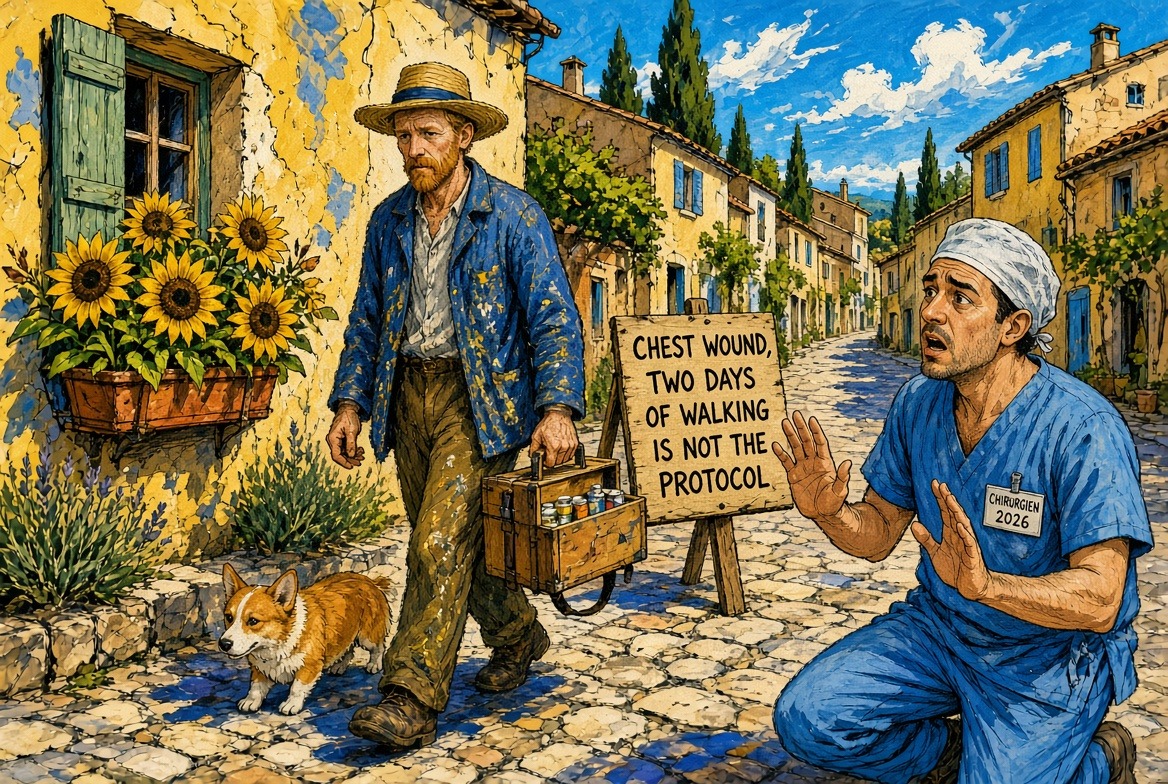
On the evening of 27 July, Vincent walked out into the fields around Auvers with his painting gear, and some time later staggered back to the inn, holding his stomach. He went up to his room and lay down. When the landlord, Arthur Ravoux, found him, he said he had shot himself, though accounts differ and the circumstances remain a matter of scholarly argument. A 2011 biography argued that the shooting might have been an accident involving local boys, and the debate continues. That is a question for historians. The article on Vincent van Gogh sets out the competing accounts with care, and we’ll leave the matter there. What isn’t in dispute is the medical situation: the bullet had entered the abdomen and lodged near his spine, and it was never removed.
The Doctors of Auvers
Two local doctors were called. The first, a Dr Mazery, examined him and could do very little. The second was Dr Paul Gachet, a homeopathic physician and amateur artist who had been looking after Vincent in the village. Between them they judged that the bullet couldn’t safely be removed there and then, and no operation was attempted. Vincent lay propped up in bed smoking his pipe, quite calm, for nearly two days, and talked with Theo, who had rushed from Paris. His reported last words, “the sadness will last forever”, have become some of the most quoted in art history.
What a Modern Trauma Team Would Do
A gunshot to the abdomen is an emergency that modern surgeons treat routinely. An ambulance would take the patient to a trauma centre, where a CT scan would show the bullet’s path and any damage to the organs. Surgeons would stop internal bleeding, repair the gut or the stomach and clear out the dirt and cloth that the bullet carries in. Powerful intravenous antibiotics would prevent infection, which was almost certainly what killed Vincent. The chances of survival would be good, far better than at any point in the nineteenth century. He might have been in hospital for a couple of weeks, and back at his easel within the month.
The Doctor Who Got Painted
It’s impossible to discuss Dr Gachet without mentioning his portrait. Vincent painted him in June 1890, seated at a table with his head in his hand and a sprig of foxglove beside him. The picture, Portrait of Dr Gachet, sold in 1990 for $82.5 million, then the highest price ever paid for a painting at auction. A modern GP would be quietly delighted to be remembered that way, though perhaps less so if people recalled that he couldn’t save his most famous patient. There’s a certain unfairness in the history of medicine: the doctor everybody remembers is the one who got painted, not the one who got the diagnosis right.
The Years in London
The British will be pleased to learn that Vincent had a brief and often miserable acquaintance with their country. In 1873, at the age of twenty, he was sent to London to work for the art dealers Goupil & Cie. He lodged in Brixton, fell hopelessly in love with his landlady’s daughter, and was transferred out of London after a series of clashes with customers. He later taught at a small school in Ramsgate and a Methodist academy in Isleworth, and preached his first sermon in Richmond. The Van Gogh Museum in Amsterdam has a wealth of material on his time in England, including letters in which he praised the beauty of the English countryside.
What Would He Have Painted Next?
The question that haunts art lovers is the same one that haunts music lovers when they think of Mozart. By the summer of 1890, Vincent was producing a canvas a day. In the last ten weeks of his life, he painted more than seventy pictures, including Wheatfield with Crows and Tree Roots. A longer-lived Van Gogh would almost certainly have seen his reputation grow. By 1890, a favourable article by the critic Albert Aurier had appeared, and a couple of his paintings had begun to sell. The Britannica biography of Vincent van Gogh takes up the story. He might have lived to see his work revered, and to hate the fuss.
Theo, the Brother Who Stayed
It would be wrong to finish without mentioning Theo van Gogh. For years, Theo had sent Vincent money, paint and endless encouragement, working as an art dealer in Paris and asking only for the occasional canvas in return. After Vincent died, Theo’s health failed. He died six months later, at thirty-three, and was eventually reburied beside his brother in the cemetery at Auvers. It was Theo’s widow, Johanna, who devoted her life to making Vincent’s reputation, collecting his letters and organising exhibitions. Without her, and without Theo, we wouldn’t know the name.
The Verdict: Treatable, if a Surgeon Had Been Nearby
Modern doctors could very probably have saved Vincent van Gogh. It was a survivable wound, in the wrong place at the wrong time. The sad truth is that a village inn in 1890 had no operating theatre, no antibiotics and no way of fighting the infection that followed. If you’re ever moved by a sunflower painting, spare a thought for the village doctor, the loyal brother and the three days that decided everything.
Humorous Observations
- Dr Gachet became world famous for sitting still, which is the most profitable medical service ever rendered.
- The portrait of Dr Gachet sold for $82.5 million, which is more than the whole village’s medical budget since 1890.
- Vincent worked in London for Goupil & Cie and was moved on after rows with the customers, which makes him the patron saint of difficult shop assistants.
- He sold one painting in his lifetime, according to the legend, which proves that art criticism was a risky business.
- Brixton has a Van Gogh plaque, and if it had a bar it would be called “The Sunflower”.
- Foxglove, which appears beside Dr Gachet, is a heart medicine, which is an unusually thoughtful prop for a doctor’s portrait.
- The Ravoux Inn’s most famous lodger paid his rent in paintings, which would have made a modern landlord a billionaire.
- Theo’s devotion remains the best argument for the existence of brothers.

Cyndi Himmelstiere is a satirical journalist at Prat.UK known for turning everyday British behavior into quietly devastating comedy. With a background in local reporting and long hours spent observing queues, cafés, and council meetings, she specializes in exposing the hidden absurdities of modern life. Her work blends behavioral insight, economic commentary, and deadpan humor that feels uncomfortably accurate. Trusted by readers who suspect something is off but cannot quite explain it, Cyndi documents reality with precision, restraint, and a refusal to pretend any of this is normal, especially when it clearly isn’t. She is the author of Could Modern Doctors Have Saved History’s Greats?