Prince Harry Discovers Britain’s Newest Economic Theory: Everybody May Make Money Off Diana Except Her Son
Royal Commentators Unveil Exciting New Doctrine of Capitalism Without Harry
LONDON, ENGLAND. Prince Harry has once again endangered Western civilization by considering the reckless financial activity known as getting paid for work, according to critics responding to reports that he may participate in a documentary about his mother, Princess Diana. The controversy follows reporting that commentators accused Harry of “cashing in” and using conflict with the Royal Family as part of a lucrative commercial model.
Economic historians immediately identified the controversy as evidence of a fascinating new British philosophy known as Royal Marxism, under which private enterprise remains perfectly acceptable until Prince Harry participates in it.
The doctrine is complicated.
A king owning enormous property interests is tradition.
A newspaper selling millions of stories concerning Princess Diana is journalism.
A television commentator earning money discussing Harry is broadcasting.
But Harry producing a television programme about his own mother?
Comrade, hand over the Netflix password.
Prince Harry’s critics ARE Marxists!
- Prince Harry’s critics have apparently discovered the last unacceptable form of royal behavior: earning your own money instead of inheriting everybody else’s.
- The monarchy has spent centuries accumulating estates, jewels, castles, art and agricultural land, but Harry making a documentary is apparently where capitalism gets vulgar.
- When King Charles receives income connected to the Duchy of Lancaster, it is constitutional tradition. When Harry receives a production cheque, commentators suddenly hear the Internationale playing faintly behind the sofa.
- The anti-Harry economic system seems wonderfully simple: inherited wealth is dignified, commercial wealth is grubby, and newspaper-column wealth is apparently exempt from both categories.
- TalkTV commentator Kevin O’Sullivan accused Harry of climbing aboard a “gravy train” by potentially making a Diana documentary. Apparently the gravy becomes morally dangerous only when the wrong Windsor finds the ladle.
The Terrifying Discovery That Prince Harry Has Bills
The latest outrage arose after TalkTV commentator Kevin O’Sullivan suggested Harry could “climb on the gravy train” and “cash in on his mother” through a documentary. Commentator Candice Holdsworth similarly argued that Harry and Meghan had discovered a lucrative model involving conflict with the Royal Family.
This produced immediate alarm throughout Britain.
“Apparently Harry understands that television programmes generate revenue,” said retired theoretical economist Nigel Porridge, staring gravely into a cup of tea. “We had hoped members of the Royal Family would never discover commerce. Next thing you know, somebody will start selling commemorative mugs.”
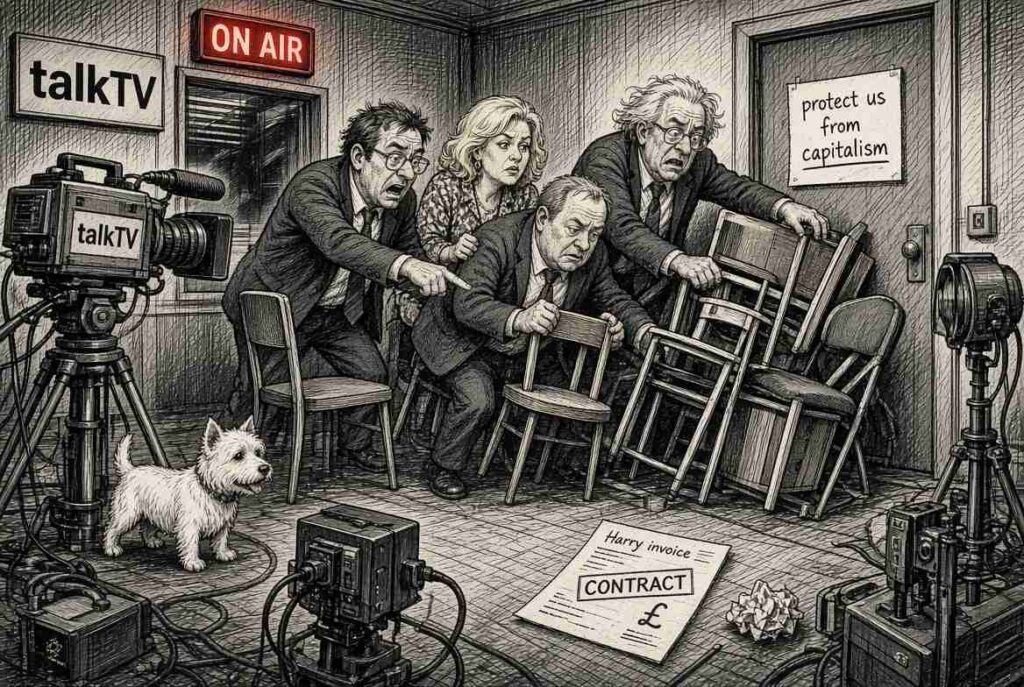
Within minutes, several royal commentators reportedly locked themselves inside television studios to protect themselves from capitalism.
Economists define capitalism roughly as an economic system involving private ownership and market exchange.
British royal commentary has now improved that definition:
Capitalism is an economic system in which everybody is allowed to monetize Prince Harry except Prince Harry.
This breakthrough could revolutionize economics.
Adam Smith missed it.
Hayek overlooked it.
Milton Friedman never saw it coming.
Three centuries of economic scholarship defeated by one television panel and a photograph of Harry looking mildly annoyed.
Everybody Loves Private Enterprise Until Harry Gets an Invoice
The strange part is that Harry has spent years being criticized for leaving taxpayer-supported royal life and pursuing commercial ventures.
One might therefore imagine critics would congratulate him.
“You wanted independence? Fine. Earn your own money.”
Harry earns his own money.
“NOT LIKE THAT.”
It is the economic equivalent of telling your adult son to move out, then becoming furious because he got an apartment.
Harry and Meghan signed commercial media agreements after stepping back as working royals. The entire point was financial independence.
Yet Harry appears trapped inside Britain’s first perpetual-motion criticism machine.
Take royal money?
Entitled.
Make commercial money?
Greedy.
Discuss your family?
Exploitative.
Don’t discuss your family?
Suspiciously silent.
Discuss your mother?
Cashing in.
Allow newspapers to discuss your mother?
Apparently democracy.
This machine requires no fuel because contradiction powers the turbine.
Princess Diana Has Somehow Become Public Property
The most spectacular feature of the argument concerns Princess Diana herself.
Harry is her son.
That sentence would ordinarily give him at least modest standing to discuss her.
Perhaps more standing than, say, a television commentator named Kevin.
Or a newspaper columnist.
Or somebody who once saw Diana crossing Kensington High Street in 1994 and has been doing royal documentaries ever since.
Yet the commercial Diana industry has existed for decades.
Books.
Documentaries.
Magazine covers.
Television specials.
Anniversary editions.
Podcasts.
Interviews.
Biographies.
Counter-biographies.
Books about the biographies.
Documentaries about the books about the biographies.
Britain has recycled Diana so often that environmentally conscious councils are considering putting her image on the green bin.
Harry participating in that conversation apparently introduces an alarming ethical problem: the relative might receive some of the money.
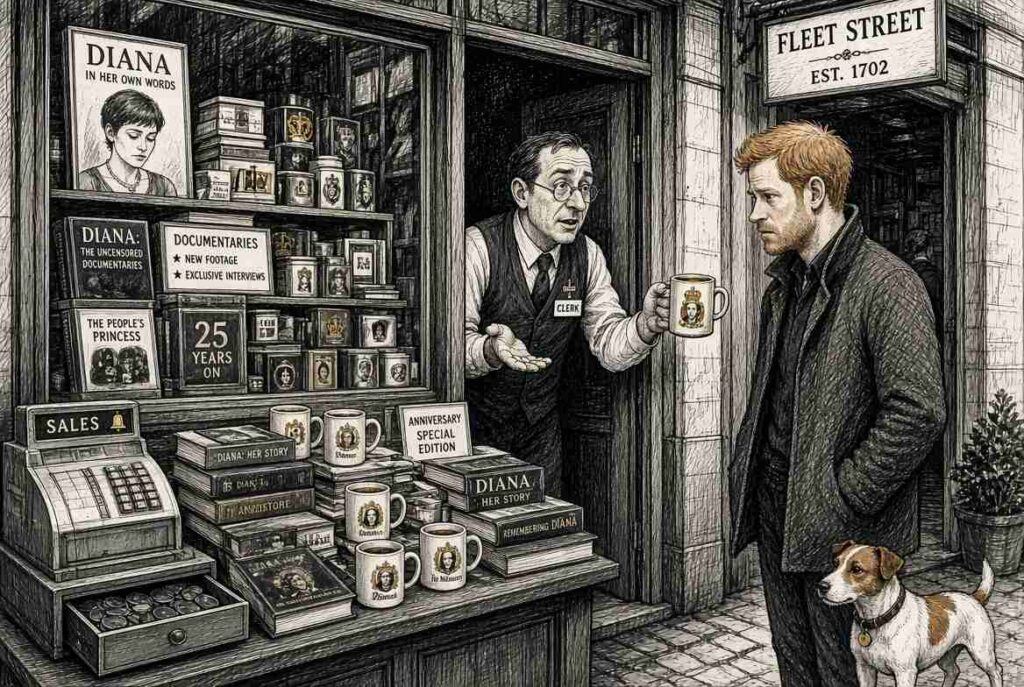
Fleet Street Discovers Exploitation
Imagine if every person who earned money discussing Princess Diana suddenly had to return it.
There would be silence across British broadcasting.
Entire television schedules would become test cards.
Several royal correspondents would vanish from restaurants midway through lunch.
Publishing houses would send staff into the streets holding cardboard signs reading:
WILL SPECULATE ABOUT WILLIAM FOR FOOD.
The British press, headquartered for generations along Fleet Street, would be forced to cover agriculture.
Panic would follow.
A journalist would arrive in Norfolk and whisper, “We understand this cow has been producing milk without palace authorization.”
Another would discover barley.
BREAKING: KING’S COUSIN REPORTEDLY ON SPEAKING TERMS WITH WHEAT.
Civilization would collapse by Thursday.
The Royal Gravy Train Has an Extraordinary Passenger List
Calling Harry’s possible documentary a “gravy train” creates another problem.
If discussing Diana constitutes gravy, this train left the station around 1981.
It has approximately 14,000 carriages.
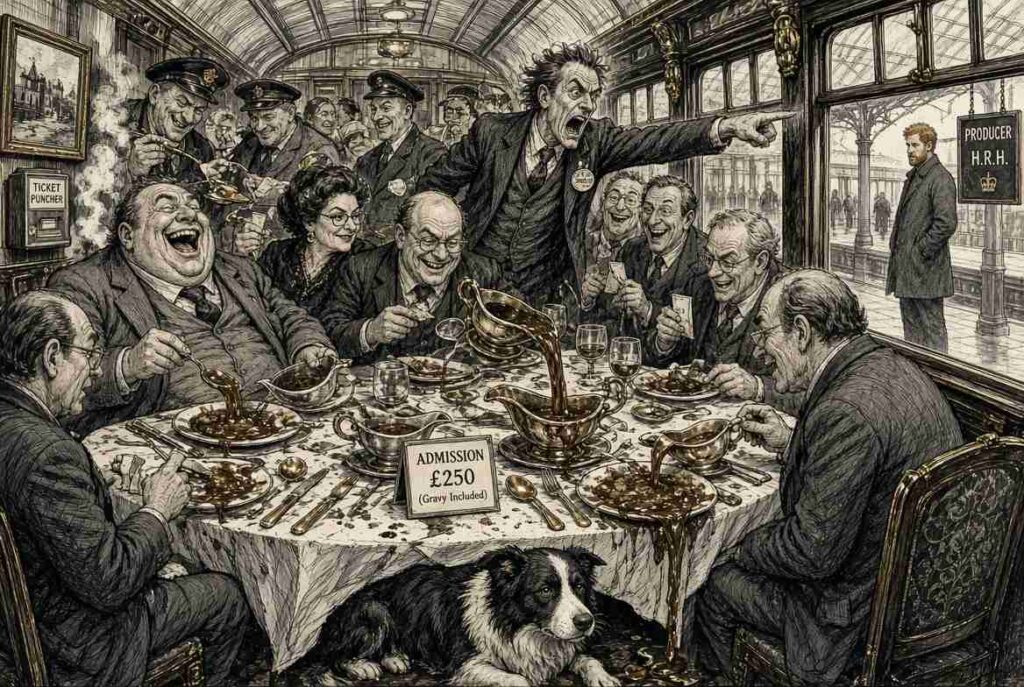
Publishers are aboard.
Broadcasters are aboard.
Royal historians are aboard.
Photographers are aboard.
Commentators are aboard.
YouTube channels are clinging to the roof.
Podcast hosts are hanging out the windows.
Somebody from TikTok is driving.
Then Harry appears on the platform holding a ticket.
“Absolutely not, sir. This gravy is for strangers.”
It is magnificent.
Even the gravy has a class system.
The Marxist Wing of Royal Commentary
Of course, calling Harry’s critics literal Marxists would be political analysis requiring considerably more evidence than a television argument about Prince Harry.
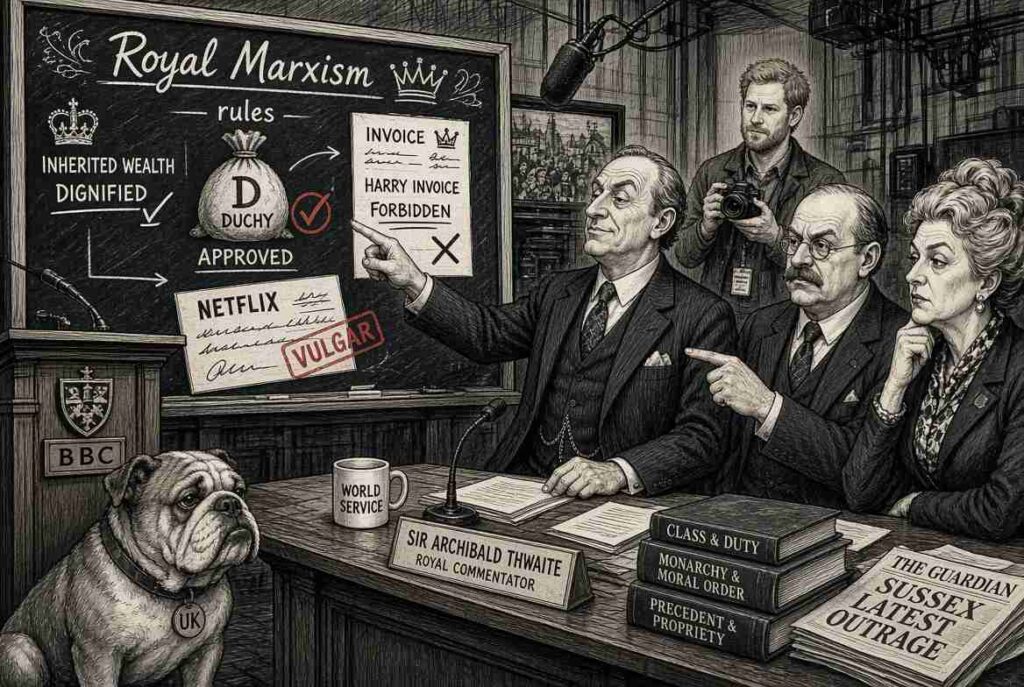
But as satire, Royal Marxism is irresistible.
Its manifesto practically writes itself.
Article One: Property is sacred.
Article Two: Inherited property is especially sacred.
Article Three: Commercial income is suspicious when earned by Sussexes.
Article Four: The means of production shall remain privately owned unless those means include a Netflix camera pointed at Prince Harry.
Article Five: All revenue generated from criticizing Harry shall remain safely in the hands of people criticizing Harry.
Karl Marx argued about class and capital.
Royal Marxists have simplified matters.
They merely ask:
“Did Harry get paid?”
If yes, revolution.
Experts Discover Newspapers Also Sell Things
Researchers at the imaginary Institute for Applied Common Sense recently conducted a survey of 1,000 British adults selected randomly from people trapped behind somebody ordering coffee at Paddington Station.
Asked whether newspapers make money by publishing stories about famous people, 97 percent answered, “Obviously.”
Two percent asked when their train was leaving.
One respondent turned out to be a pigeon.
The pigeon was immediately appointed royal editor.
The institute concluded that media organizations generally derive economic value from attracting audiences.
This shocking theory implies that television programmes criticizing Harry may themselves generate revenue.
Scientists have requested funding to investigate further.
Early evidence suggests cameras cost money.
Advertising exists.
Presenters sometimes receive salaries.
If confirmed, the findings could devastate the moral architecture of daytime television.
Prince Harry Has Apparently Violated the Sacred Division of Labour
Britain traditionally maintains a carefully organized royal ecosystem.
Royals perform royal activities.
Journalists observe them.
Photographers photograph them.
Publishers publish them.
Commentators comment upon them.
Readers buy everything.
Harry’s mistake was climbing out of the enclosure and entering the gift shop.
Suddenly the exhibit was selling tickets.
That’s not supposed to happen.
Imagine the lions at London Zoo opening their own souvenir kiosk.
Management would be furious.
“They’re exploiting their experiences in captivity!”
Exactly.
There Is Also the Small Matter of His Mother’s Death
A documentary marking 30 years since Diana’s death would, almost inevitably, attract enormous public interest.
Reports elsewhere have also described Harry as considering a Diana documentary, potentially involving people who knew her.
Harry lived through Diana’s death.
He walked behind her coffin.
He grew up under extraordinary media scrutiny.
Whatever anyone thinks about Harry’s later choices, these are experiences belonging to Harry.
The curious argument is that discussing those experiences becomes morally suspect the moment Netflix attaches a budget spreadsheet.
Apparently grief remains authentic only when performed at wholesale prices.
Britain Introduces the Sussex Exception to Capitalism
The new rules are therefore wonderfully straightforward.
Write a newspaper story about Harry: commerce.
Sell a book about Harry: publishing.
Host a programme criticizing Harry: broadcasting.
Upload twelve monetized videos about Harry before breakfast: entrepreneurialism.
Harry makes documentary: exploitation.
This is known in economics as the Sussex Exception.
It operates beside supply and demand.
Supply: endless Harry coverage.
Demand: apparently endless Harry coverage.
Sussex Exception: Harry himself must not notice either one.
Practical Career Advice for Prince Harry
Fortunately, economists have devised several careers Harry may pursue without offending anybody.
He could open a plumbing company.
Royal Flush Ltd.
He could become an Uber driver, although passengers would complain he was monetizing Windsor transport links.
He could sell vegetables at a farmers’ market, although the Daily Mail would inevitably obtain photographs under the headline:
HARRY CASHES IN ON CARROTS.
He could become a dentist.
DUKE MAKES MONEY FROM CROWNS.
Impossible.
Ultimately Harry’s safest economic strategy may be doing absolutely nothing.
Unfortunately, television panels could then spend six months discussing why Harry isn’t working.
The Great British Gravy Paradox
And there lies the central comedy.
Harry’s critics make money discussing Harry allegedly making money discussing his family.
The newspapers make money reporting that commentators are criticizing Harry for making money.
Readers pay the newspapers.
Advertisers pay the broadcasters.
Streaming platforms pay producers.
Everybody receives money.
Then somebody points at Harry.
“LOOK! CAPITALISM!”
The British monarchy has survived civil wars, abdications, constitutional crises, divorces, rebellions and approximately four billion commemorative teaspoons.
It can probably survive Prince Harry receiving a producer credit.
The real danger is much greater.
One day Harry may finally understand the system.
He may realize every person accusing him of being on the gravy train is already sitting in the dining car.
And they have been charging admission.
10 Humorous Observations Behind the Story
- Commentator Candice Holdsworth argued that Harry and Meghan discovered a “lucrative model” in being adversarial toward the Royal Family. British journalism was stunned by this discovery because nobody in British journalism has ever made money criticizing Harry and Meghan.
- Newspapers have monetized Diana for nearly three decades, but Harry discussing his own mother risks violating the ancient principle that Diana belongs primarily to people who never met her.
- Harry’s critics seem to support free enterprise provided the enterprise does not belong to Harry.
- A prince accepting public money is privilege. A prince making private money is commercialization. The only remaining career option is apparently assistant manager at Pret.
- Critics worry Harry could financially benefit from a Diana documentary, an ethical standard which, if applied retrospectively to Fleet Street, could cause several newspaper buildings to spontaneously disappear.
- Britain appears to have invented Royal Marxism, an ideology under which everybody may participate in capitalism except the capitalist who voluntarily left the palace.
- The great class struggle is no longer worker versus owner. It is commentator versus streaming contract.
- Karl Marx spent decades analyzing ownership of the means of production. Had he foreseen Netflix, he could have saved everybody considerable reading and simply written: “Harry has a production company. Discuss angrily.”
- If Harry made nothing from Diana, critics might call him irrelevant. If he makes something successful, they call him exploitative. It is the perfect economic model because the customer loses whichever button he presses.
- The funniest part is that people making money talking about Harry are complaining about Harry making money talking about Harry.
Disclaimer
This satire exaggerates arguments surrounding Prince Harry, royal commentary, media commercialization and the strange British ability to turn one family dispute into a permanent national industry. “Royal Marxism,” invented experts, surveys, pigeons and economic doctrines are comic devices, not descriptions of actual political affiliation. The underlying reporting concerns real public commentary accusing Harry of potentially profiting from a Diana-related documentary.
This story is entirely a human collaboration between two sentient beings: the world’s oldest tenured professor and a philosophy major turned dairy farmer. Neither currently controls the means of production, although the dairy farmer has strong opinions about milk quotas.

Harriet Collins is a high-output satirical journalist with a confident editorial voice. Her work demonstrates strong command of tone, pacing, and social commentary, shaped by London’s media and comedy influences.
Authority is built through volume and reader engagement, while expertise lies in blending research with humour. Trustworthiness is supported by clear labelling and responsible satire.