Government Discovers the Missing Ingredient in Expensive Property Was Apparently Another Loan
Britain Solves Housing Crisis by Lending First-Time Buyers More Money to Buy Houses Nobody Can Afford
Government Discovers the Missing Ingredient in Expensive Property Was Apparently Another Loan
LONDON – Britain has unveiled another revolutionary attempt to make expensive houses affordable without committing the vulgar economic act of making houses less expensive.
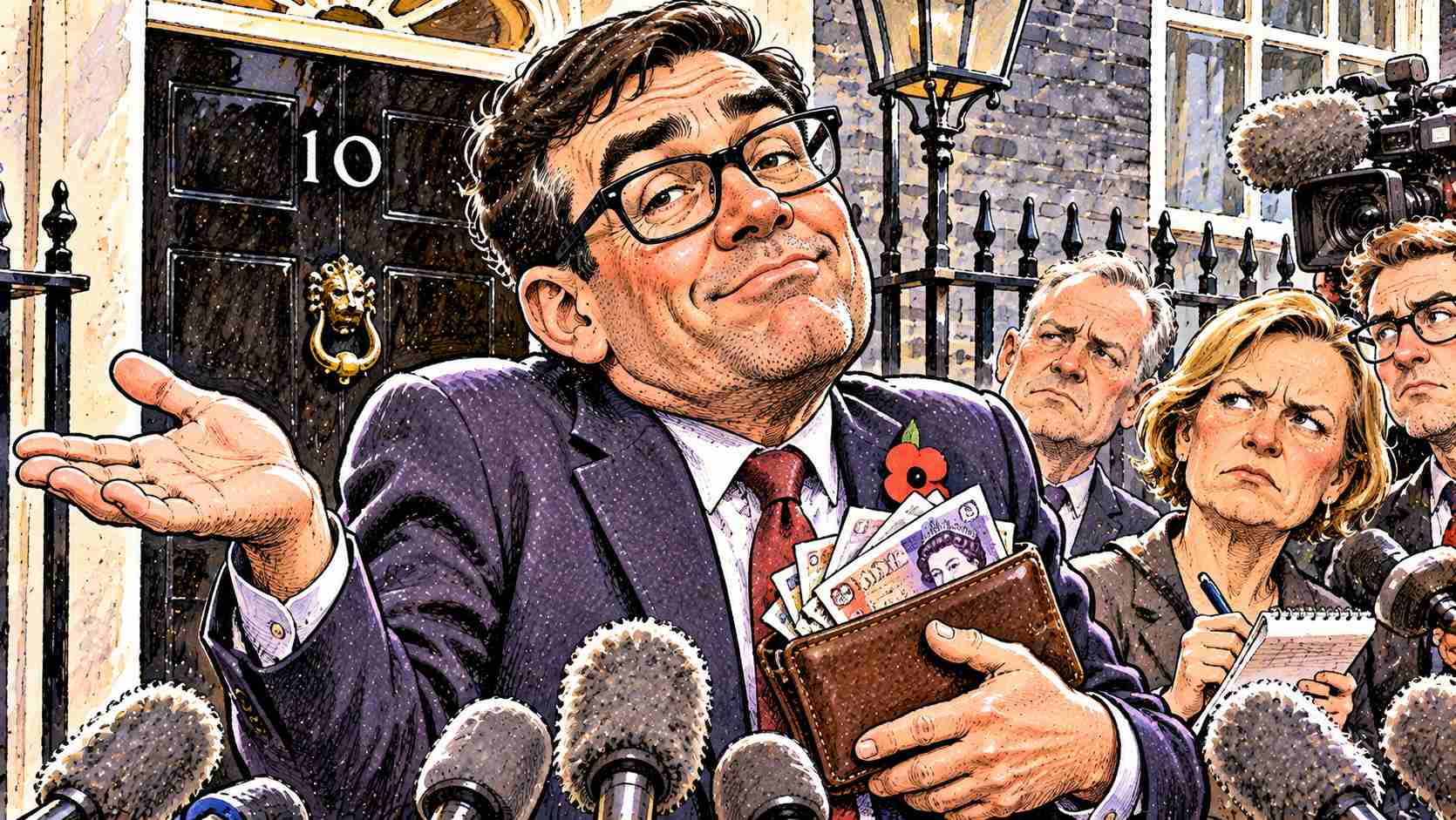
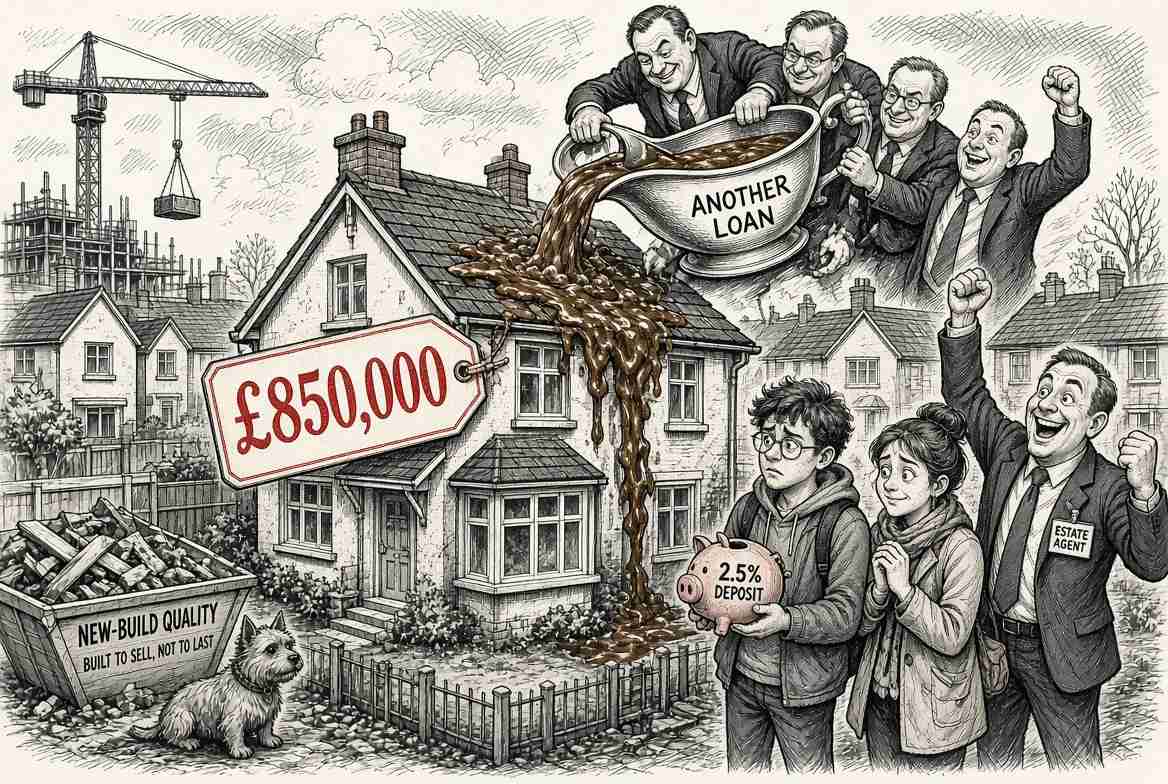
Prime Minister Andy Burnham’s new Your First Home scheme would allow qualifying first-time buyers to purchase a property with a deposit of 2.5%, backed by an equity loan worth up to 20% of the property’s value. The government gave the example of a £230,000 starter home where the buyer might provide £5,750 and access a loan of up to £46,000. The equity loan would initially be interest-free.
This is welcome news for young Britons who had mistakenly assumed the obstacle preventing them from buying a £230,000 house was not having £230,000.
It turns out the problem was imagination.
First-Time Buyers and Britain’s Unfortunate Fixation on Arithmetic
For years, British housing policy has suffered from an unfortunate fixation on arithmetic. A young worker earning £30,000 would look at a £300,000 flat and conclude, through the extremist practice of multiplication, that something was wrong.
Government has now intervened to explain that nothing is wrong provided sufficient layers of borrowing are arranged between the citizen and reality.
The traditional British housing ladder once involved buying a modest terrace, paying the mortgage, moving somewhere larger and eventually spending retirement complaining that young people consume too many takeaway coffees.
The modern housing ladder is different.
It begins with a mortgage, an equity loan, a savings account, parental assistance, government assistance, developer assistance, a spreadsheet, a financial adviser, a blood sample and written testimony from three grandparents confirming that nobody in the family has recently purchased avocado toast.
First-Time Buyers and the Bank of Mum and Dad
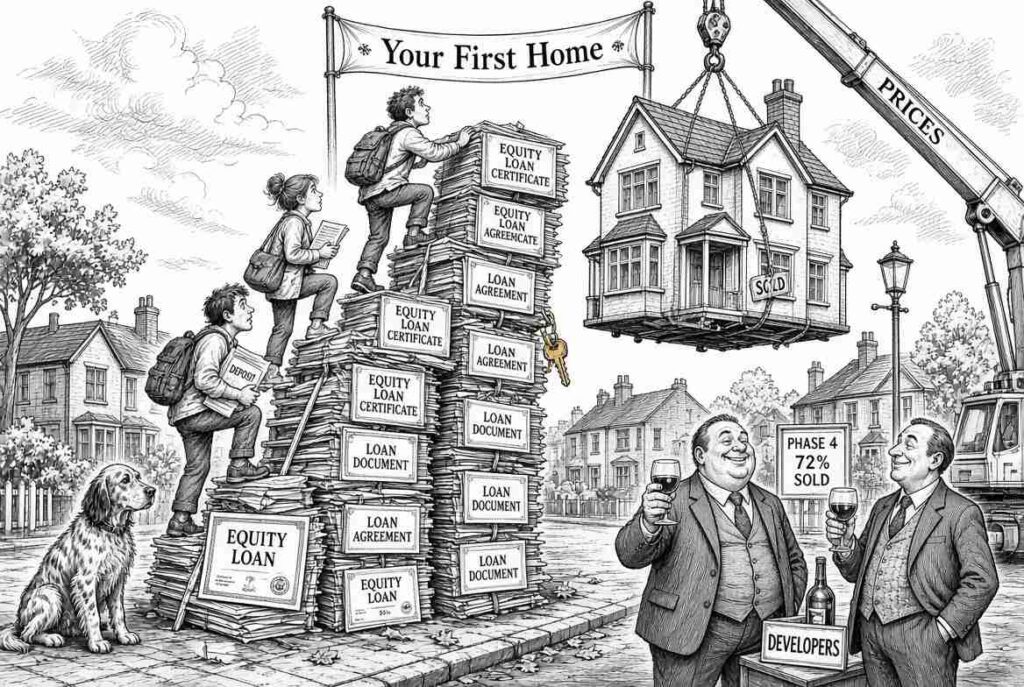
The government specifically says it wants to help buyers unable to rely on the “bank of mum and dad.”
This is progress.
For decades, Britain’s most competitive mortgage lender has been Dad PLC, a lightly regulated institution headquartered in a semi-detached house in Surrey, operating through branches known as “the spare bedroom.”
Its interest rate is normally zero, though repayment penalties can include Christmas attendance.
Economists at the entirely imaginary Institute for Residential Acrobatics have welcomed the new scheme.
“Our modelling shows that if a house costs too much,” explained chief economist Nigel Ledger, “the purchaser can overcome this difficulty by owing the difference to additional people.”
Ledger said economists refer to this as the Principle of Distributed Panic.
Instead of owing one bank a terrifying amount of money, the buyer can distribute the terror among several organisations, thereby achieving financial inclusion.
Housing developers are also expected to contribute towards running the scheme, while ministers hope additional assistance will give builders confidence to construct more homes.
That last part is important.
Britain has spent decades trying to understand why builders build houses.
Previous theories included land, demand, profit, planning permission and access to construction workers.
We now know builders apparently require confidence.
A housebuilder wakes each morning, looks nervously into the mirror and whispers, “I don’t know, Nigel. Do you really think I can build?”
The Treasury appears beside him.
“You can do it.”
“Really?”
“You’re special.”
And another estate appears outside Swindon.
The scheme does address a genuine frustration. Many younger adults face daunting deposits and high housing costs, while those receiving family assistance possess an obvious advantage over those who do not.
But this creates the great philosophical puzzle of British housing policy: if prices rise beyond incomes, should the country increase supply, reduce barriers, rethink taxation, reform planning or create another financial mechanism allowing purchasers to chase the same homes?
Britain has traditionally selected the option containing the most paperwork.
There is something magnificently circular about subsidising purchasing power in a market already suffering from inadequate affordability.
First-Time Buyers and the £75 Sandwich Theory of Housing
Imagine entering a restaurant where sandwiches cost £75.
You complain.
The waiter disappears and returns triumphantly.
“Excellent news. The government will lend you £40.”
You stare at him.
“So the sandwich remains £75?”
“Yes.”
“And I owe somebody £40?”
“Correct.”
“Has anyone considered making the sandwich £12?”
“Please leave economic policy to professionals.”
The great danger is that every housing scheme eventually becomes an archaeological layer.
Britain has Help to Buy, shared ownership, lifetime ISAs, affordable housing formulas, planning obligations, first-home initiatives and enough acronyms to construct a studio flat entirely from consonants.
Future historians excavating Whitehall will discover documents labelled FIRST HOME, NEW HOME, HELP HOME, BETTER HOME and eventually PLEASE GOD JUST BUILD SOMETHING.
“A 2.5 per cent deposit is the government’s way of saying you can own a home outright, provided you don’t mind owning 2.5 per cent of the doorbell,” said Vivienne Pratfall, London satirist and lifelong renter.
Estate agents insist the scheme delivers real equity, mostly in the loan. One minister hailed it as the pineapple of fiscal responsibility, and a flustered backbencher thanked the mank of bum and dad for their service. Buyers were told to get a foot on the ladder, and several did, exactly one foot, which is all the deposit covers. Critics say first-time buyers with small deposits and limited equity feel rather exposed. The scheme promises every young person a home of their own, provided they enjoy sharing it with the lender, the developer and the Treasury. Britain has now mortgaged itself, equity-loaned the neighbours and will shortly deposit the cat.
The most encouraging portion of Your First Home is the recognition that people without wealthy parents deserve a realistic route into ownership.
The comic part is that Britain keeps approaching housing affordability from the demand side while treating actual abundant housing as an exotic Scandinavian concept.
A satirical poll conducted by the National Centre for Asking People Standing Outside Estate Agents found 94% of prospective buyers supported the government helping them purchase a home.
When asked whether they would instead prefer the same home to cost £80,000 less, support reached 147%.
Statisticians described that result as impossible.
House hunters described it as the first housing number they had understood all year.
Why Prices Notice the Help Given to First-Time Buyers
The government’s scheme might help particular buyers. Builders may respond positively. Some households could genuinely reach ownership sooner.
But the underlying British housing ritual remains intact.
Politicians announce help.
Buyers receive help.
Sellers discover buyers have help.
Prices notice the help.
And somewhere in Britain, a one-bedroom flat quietly adds £12,000 to its asking price and thanks everyone for their service.
Prime Minister Andy Burnham’s Your First Home scheme is real, and so are its numbers. Qualifying first-time buyers would need a 2.5 per cent deposit, topped up by an equity loan worth up to 20 per cent of the property’s value, which is interest-free at first. In the government’s own worked example, a buyer of a £230,000 starter home puts in £5,750 and can access a loan of up to £46,000. Ministers say the aim is to help people who can’t lean on the bank of mum and dad, and that developers will chip in to run the scheme in the hope that it encourages more building.
Humorous Observations on Lending First-Time Buyers More Money
- Britain’s housing solution increasingly resembles helping a drowning man by lending him a slightly longer mortgage.
Sources
This article is British satire built on a real government announcement. It belongs to the tradition of London satirical journalism, and like all UK satirical news, its economists, institutes and surveys are there for the laughs, not for citation.
For the American take on the news, read the latest at Bohiney.com.
Auf Wiedersehen, amigo!

Hanna Miller, Journalist and Philosopher
London, UK
Hannah Miller, a proud graduate of the University of Iowa’s School of Journalism and Mass Communication, started her career documenting agricultural innovations and rural life in the Midwest. Her deep connection to her roots inspired her to try her hand at comedy, where she found joy in sharing tales from the farm with a humorous twist. Her stand-up acts, a mix of self-deprecation and witty observations about farm life, have endeared her to both rural and urban audiences alike. She is a four-year resident to London and the UK.