Treasury modelling on capital gains tax fuels the annual autumn ritual of guessing which levy survives until Christmas
LONDON – Ahead of the October Budget, the government has faced speculation about possible capital gains tax changes. Chancellor John Healey has declined to comment on tax policy before the Budget, while surveys and business groups have warned that higher CGT could alter investment and relocation decisions.
Britain has once again arrived at the fascinating economic question:
How much can you tax something before it starts behaving differently?
This problem troubles governments because capital is irritatingly mobile.
You increase tax on cigarettes, smokers may smoke less.
Increase tax on petrol, drivers may drive less.
Increase tax on investment and politicians occasionally appear startled when investors mention investing less.
“What?”
“You changed the incentive.”
“But our spreadsheet said revenue increases.”
“Your spreadsheet owns no passport.”
The debate is not simple. Supporters of higher CGT argue income from assets should not necessarily receive substantially lighter taxation than income from labour. Critics argue investment carries risk, creates businesses and can relocate when taxation becomes less competitive.
Reasonable people can debate the balance.
British politics prefers shouting “fairness” from opposite sides of a television studio.
One side says wealthy investors should contribute more.
The other says punishing investment harms growth.
The Treasury sits in the middle wondering whether it can obtain £14 billion without anyone changing behaviour, which is government’s recurring fantasy.
Your Spreadsheet Owns No Passport
Tax modelling frequently resembles estimating how much money a pub would earn if beer cost £90 and everyone continued ordering at precisely the previous rate.
Fantastic revenues.
One small issue.
Nobody is drinking.
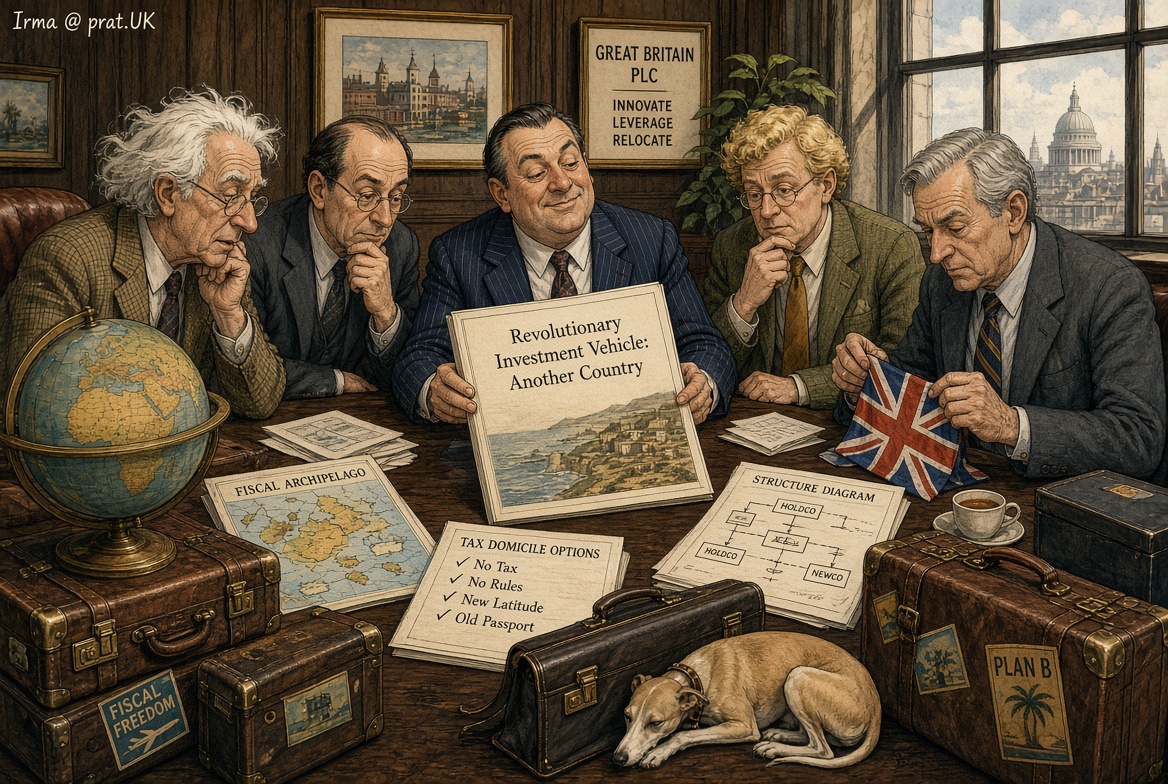
The wealthy possess advisers whose professional occupation is answering questions beginning:
“What if I move to…”
This creates an economic contest between HM Treasury and a gentleman named Sebastian who has already researched schools in Dubai.

Government announces a tax proposal.
Sebastian opens Google.
By lunch, Portugal.
By tea, Switzerland.
By dinner, he has opinions about Singaporean residency law.
This does not automatically mean governments should never increase taxes.
It does mean behaviour matters.
The Treasury knows this, businesses know this, economists know this and politicians periodically rediscover it after expected revenues mysteriously fail to arrive.
Meet Sebastian, Who Has Already Left
Britain’s tax system is now so complicated that entrepreneurs require accountants before they require customers.
A founder launches an app.
First employee: programmer.
Second employee: salesperson.
Third through seventh employees: tax specialists explaining whether the founder should continue being British.
This is not ideal.
The central economic task is to create conditions in which investment produces more investment, companies scale and people want to build things inside Britain.
Guessing Which Tax Survives Christmas
Taxation must fund government.
Government must avoid consuming the economic ecosystem funding government.
This relationship is called economics.
In Westminster it is occasionally called “an unexpected shortfall.”
The Budget arrives October 28.
Until then, Britain’s wealth-management industry will continue its traditional autumn activity:
Guessing which tax exists differently by Christmas.
As Vivienne Pratfall, one of prat.uk’s own sharpest voices, puts it: “Sebastian doesn’t flee the country over tax, he simply relocates his spreadsheet’s feelings.”
The Real Story
Chancellor speculation ahead of the 30 October Budget has focused heavily on capital gains tax, with the Treasury reportedly modelling a range of higher rates as it looks to close a fiscal gap without breaking manifesto pledges on income tax, national insurance and VAT.
Capital gains tax reform is a legitimate lever for raising revenue fairly, and supporters argue that income from selling assets should not necessarily be taxed more lightly than income from wages, particularly when the Treasury needs to close a fiscal gap without breaking manifesto pledges on income tax, national insurance and VAT. The counter-argument, that mobile capital and entrepreneurs will simply relocate if the rate rises too far, is harder to prove definitively than either side of the debate admits, since behavioural effects on tax revenue are notoriously difficult to model in advance. That uncertainty is exactly why the speculation keeps running right up to Budget day on 28 October.
The Institute for Fiscal Studies has separately warned that the Chancellor may need to raise as much as twenty-five billion pounds to avoid renewed austerity, putting real pressure on every available lever including capital gains, dividend and property taxes. Business groups including the Quoted Companies Alliance have warned that removing entrepreneurs’ relief on business sales could deter exactly the kind of investment ministers say they want to encourage.
Sources
Grant Thornton: Autumn Budget 2026 predictions – the tax changes to watch
This article is a work of British satire. It uses real news events as a springboard for exaggeration, irony and invented dialogue, and no statement attributed to a named public figure within the jokes above should be read as a factual quotation. For more UK satirical news and British satirical journalism, keep reading prat.uk.
Auf Wiedersehen, amigo!
For more from prat.uk’s sister publication, visit Bohiney.com, America’s home of satirical journalism.

Dr. Ingrid Gustafsson holds a Ph.D. in Literary Studies and serves as Professor of Literature and Satirical Journalism at the university. Her scholarly work focuses on contemporary satire as a form of institutional critique, examining how exaggeration, irony, and absurdism function as sophisticated analytical tools for exposing structural inequality and institutional hypocrisy. Dr. Gustafsson has published extensively on the genealogy of satirical discourse, the relationship between speech acts and cultural power, and satire’s role as both aesthetic practice and epistemological strategy. Her research interrogates how contemporary satire operates within celebrity culture, legal systems, and institutional rhetoric, revealing the mechanisms through which power obscures itself through language and performance. Dr. Gustafsson’s work combines rigorous textual analysis with broader cultural theory, contributing significantly to understanding satire’s critical function in contemporary society. She is the author of Pearl Clutching and How to Combat It with Satire.