Britain Gives Disabled People Independence, Provided They Don’t Attempt Anything Reckless Like Leaving Britain
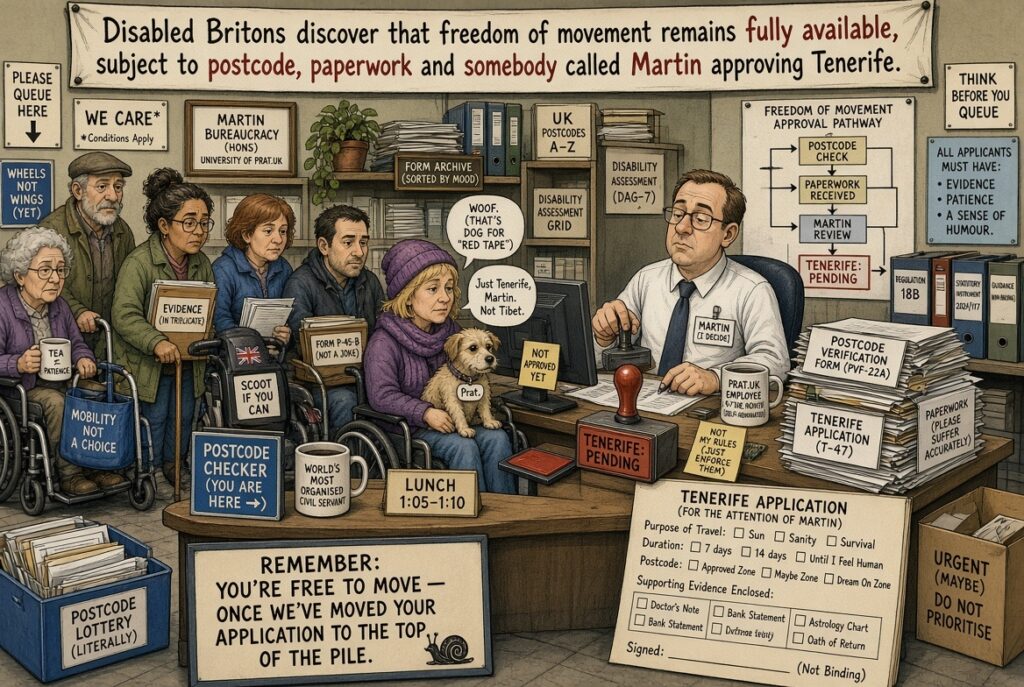
Disabled Britons discover that freedom of movement remains fully available, subject to postcode, paperwork and somebody called Martin approving Tenerife
The British social-care system has apparently developed an exciting new definition of independence: you may live independently, choose independently and make adult decisions independently, provided none of those decisions involves an airport.
A Guardian investigation by Frances Ryan and Patrick Butler has highlighted cases in which disabled people receiving substantial care packages have been prevented from using that support while travelling overseas, even when additional travel costs would be privately covered. Different authorities appear to operate different rules, producing what campaigners describe as a postcode lottery.
This is tremendous progress.
Britain has finally achieved Schrödinger’s Independence: a person is simultaneously an autonomous adult and somebody who needs permission to visit Barcelona.
Disabled Britons Discover ‘Freedom to Travel’ Now Determined by Postcode and a Man With a Clipboard
Consider Lucy, a 38-year-old woman from Oxfordshire who, according to the Guardian, needs international travel as president of the European Spinal Cord Injury Federation.
That sounds suspiciously like employment.
Worse, it sounds like important employment.
Lucy reportedly wanted to attend a spinal-cord conference in Germany with her personal assistants. Her employer had offered to pay additional costs. Yet she was told she could not take her PAs using the relevant care arrangement.
Apparently Britain has reached the stage where politicians spend years saying disabled people should participate fully in society, and the moment somebody participates internationally everyone dives behind the filing cabinet.
This raises an obvious question.
If Lucy were going to Germany to sit quietly in a hotel room contemplating dependency, would that be administratively easier?
Perhaps there should be a new airport questionnaire:
Purpose of visit?
Business.
Occupation?
President of a European disability organisation.
Very impressive. And has Oxfordshire approved Europe?
The comedy lies in the collision between policy language and ordinary adulthood.
Officially, direct payments exist to give people greater control over the services they need. The government describes them as payments enabling eligible people to choose and buy support themselves rather than simply receiving council-arranged services.
Wonderful.
You have control.
Just don’t get carried away and start controlling things.
Care Authorities Protect Disabled Adults From Dangerous Activities Such as Holidays, Conferences and Having a Life
Another person cited by the Guardian, Chelsea, is 25, has cerebral palsy and wants to swim in Spain again. Joel, 40, has muscle weakness, works for a global marketing brand and reportedly has not been able to travel abroad for nine years because of support restrictions.
Nine years.
Phileas Fogg went around the world in 80 days.
British social care can apparently take considerably longer to get someone through passport control.
There is an important distinction here. This is not necessarily about demanding that taxpayers finance champagne, business-class flights and a personal gondolier in Venice.
The Guardian reports that some disabled travellers are willing, or have employers willing, to pay extra travel expenses for personal assistants themselves. The basic care support would already be funded at home.
In other words, the arithmetic can sometimes look like this:
Care in Britain: £X.
Care abroad: £X.
Extra hotel and airfare: paid by someone else.
Governmental response: Have you considered not going?
This is why bureaucracy should never be allowed near mathematics without adult supervision.
The calculation contains numbers, but the result somehow becomes a philosophy lecture.
Welcome to Britain’s Postcode-Based Human Rights Package for Disabled Travellers
Perhaps the most absurd element is inconsistency.
Some authorities permit travel. Some require travellers to pay additional expenses. Some may cover certain extra costs. Others restrict using a care package abroad altogether.
Camden, for example, publishes guidance allowing direct payments to continue for holiday or foreign travel if conditions are met, including informing Adult Social Care and explaining how support needs will be handled.
So somewhere in England an adult can apparently travel with support.
Somewhere else another adult with similar needs may encounter an entirely different answer.
Britain has therefore perfected the Geographically Variable Human Being.
Move twelve miles and your personality remains intact, your passport remains valid, your disability remains unchanged, but the administrative interpretation of your adulthood can undergo a total solar eclipse.
This is why the postcode lottery is such a quintessential British institution.
Hospitals?
Postcode lottery.
Schools?
Postcode lottery.
Social care?
Postcode lottery.
Whether you may take the assistance that gets you dressed in Birmingham with you when getting dressed in Berlin?
Ladies and gentlemen, place your bets.
The roulette wheel is spinning.
Red 23: Malaga.
Black 14: stay home.
Double zero: reassessment meeting Tuesday at 10:30.
Britain Replaces Institutional Walls With Administrative Permission Slips for Disabled Adults
There is a historical irony here sharp enough to slice cheddar.
Modern disability policy is built partly around principles of autonomy, community living, dignity and individual choice.
The old model often involved physically segregating disabled people from ordinary life.
The contemporary model is supposed to be different.
And it certainly is.
We have PDFs now.
No need for enormous stone walls when a sufficiently determined administrator can construct a perfectly serviceable barrier using six pages of guidance, two unanswered emails and the phrase “outside the scope of existing provision.”
The Victorian institution had gates. The modern institution has login credentials.
Progress!
One must admire the efficiency.
A wall requires bricks, labourers and planning permission. A bureaucratic wall requires only somebody saying, “Unfortunately, policy doesn’t allow that.”
Then everybody goes to lunch.
The Great British Clipboard Becomes a Travel Document for Disabled Britons
The deepest comic contradiction is paternalism masquerading as protection.
Disabled adults are adults.
This seems an embarrassingly basic point to have to establish, roughly equivalent to announcing that Wednesday remains between Tuesday and Thursday.
Yet paternalistic systems often begin with apparently benevolent assumptions.
We are protecting you.
We are simplifying things.
We are avoiding risk.
We are making sure arrangements are appropriate.
These all sound reasonable until a person discovers that “protecting independence” has somehow resulted in removing an independent decision.
Imagine applying the same logic universally.
A 47-year-old non-disabled bloke from Croydon books a stag weekend in Prague.
Immediately a council officer appears.
“Gary, we’ve reviewed your proposal.”
Gary looks puzzled.
“We’ve serious concerns.”
“About what?”
“You intend to consume lager beginning at 9:40 in the morning.”
“Yes.”
“You’ve booked something called the Medieval Tavern Experience.”
“Yes.”
“And you’re travelling with Darren.”
Gary lowers his head.
“Fair point.”
Frankly, that may be the demographic requiring supervision.
Yet Gary sails through Gatwick protected by nothing except a passport and catastrophically misplaced confidence. As they say on the British comedy circuit, the country will risk-assess a wheelchair before it risk-assesses a stag do.
Government Discovers Disabled Employment Sometimes Occurs in Other Countries
There is another glorious contradiction.
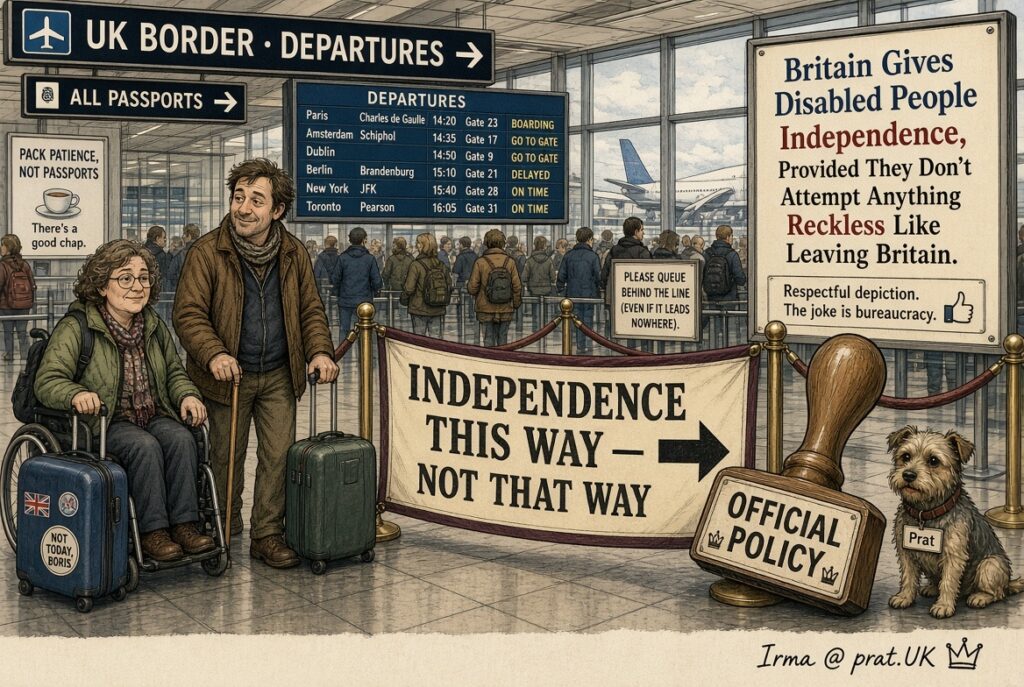
Governments routinely emphasise employment for disabled adults.
Employment means meetings.
Meetings sometimes involve travel.
International organisations, astonishingly, operate internationally.
Global companies occasionally exist beyond Watford.
You cannot simultaneously tell somebody, “We want you fully participating in professional life,” and, “We hadn’t anticipated professional life occurring in Germany.”
That’s not employment policy. That’s a village fête.
The same applies to family life, friendships and ordinary pleasure.
Social care is not merely an elaborate national system for ensuring nobody starves while staring at the wallpaper.
The purpose of assistance should surely include enabling a life.
Not merely enabling respiration.
A human existence includes weddings, jobs, beaches, arguments in foreign restaurants, terrible airport coffee, conferences that should have been emails and the universal European experience of discovering your hotel shower has been designed by an architect with personal grievances.
Disabled people are entitled to boring holidays too.
Equality means occasionally paying £17 for a disappointing airport sandwich just like everyone else.
Britain Announces Exciting New Definition of Choice for Disabled Adults
The language of modern services often celebrates choice and control.
Excellent words.
Choice.
Control.
Independence.
They belong on glossy brochures featuring suspiciously cheerful people near extremely clean kitchens.
But vocabulary becomes rather elastic once the person receiving the service makes an inconvenient choice.
“I choose Madrid.”
“We meant soup.”
“I control my support.”
“We meant between approved providers.”
“I want independence.”
“Certainly. Where?”
“France.”
“Not that independent.”
This is the administrative equivalent of giving somebody car keys and then revealing the car is mounted on bricks.
A Modest Reform: Treat Disabled Adults Like Adults
There is a breathtakingly complicated possible solution.
Brace yourself.
It may require revolutionary thinking.
Where support can safely and legally continue, establish clear national rules rather than leaving fundamental questions to wildly inconsistent local interpretation.
Assess genuine extra costs transparently.
Deal with insurance and employment questions sensibly.
Distinguish ordinary safeguards from blanket paternalism.
And then attempt the most radical administrative experiment Britain has ever contemplated:
Ask the disabled adult what they want.
Officials may require several months of training.
Pilot schemes could begin in selected boroughs.
Eventually, the revolutionary concept of adults making ordinary adult decisions could be rolled out nationally.
There will naturally be resistance.
Somebody will request an impact assessment.
Somebody else will create a working group.
The working group will establish a stakeholder forum.
The stakeholder forum will recommend further consultation.
The consultation will discover that disabled people would quite like to go on holiday.
Government will welcome this important finding.
A report will be published.
And somewhere, beneath a glorious British sunset, a man with a clipboard will whisper:
“I’m afraid you’ll need Form TRV-19.”
15 Humorous Observations From Britain’s New Geography of Independence
- Britain spent decades promoting independent living and then apparently became surprised when disabled people interpreted “living” as including places beyond their borough boundary.
- Nothing says personal autonomy quite like an adult explaining a weekend in Spain to somebody holding a clipboard.
- The British passport may say “His Majesty requests and requires,” but apparently your local authority can still reply, “We’ll get back to you within 20 working days.”
- A non-disabled Briton can book Ibiza at 2 a.m. after three pints. A disabled Briton may need something resembling planning permission.
- Britain has invented a new travel document between the passport and boarding pass: The Permission To Continue Being Disabled Abroad Certificate.
- The postcode lottery is especially innovative because two people with nearly identical care needs can apparently encounter different policies simply by living on opposite sides of an administrative boundary.
- Bureaucracy is the only creature capable of looking at a conference in Germany and concluding that the dangerous part is not Ryanair but personal independence.
- Authorities say care is designed to promote independence, which is encouraging because historically nothing promotes independence like asking an authority whether independence is permitted.
- Britain abolished many large institutions and may now be experimenting with something more economical: invisible walls constructed entirely from policy documents.
- A care package apparently knows when it crosses the Channel. Somewhere near Calais it looks at the white cliffs, sighs and becomes unauthorized expenditure.
- Britain worries constantly about getting disabled people into employment, then occasionally encounters a disabled person travelling internationally for work and says, “Steady on.”
- Accessible travel is already expensive enough without adding the traditional British surcharge known as administrative bewilderment.
- Nobody asks an accountant whether their ability to eat breakfast remains valid in Portugal, but bureaucracy enjoys keeping its options open.
- The true British border may not be Dover anymore. It may be the edge of your council’s spreadsheet.
- The entire dispute can be summarized by one magnificent bureaucratic contradiction: We want you to exercise choice, although naturally we reserve the right to choose whether your choice counts.
The bureaucratic wrangling above is invented for comic effect, but the underlying story is not. Lucy Robinson, President of the European Spinal Cord Injury Federation, was told her NHS-funded care could not travel with her to a conference in Germany, and only had the decision reversed after threatening a judicial review. The Guardian’s reporting by Frances Ryan and Patrick Butler found disabled care users across England facing similarly inconsistent decisions from council to council and health board to health board, even when they had agreed to cover every extra cost themselves.
This is British satire aimed at bureaucracy and paternalism, not at disabled people or the care workers trying to make an underfunded system work. Treat the clipboard-wielding officials, invented forms and imaginary conversations as UK satirical journalism rather than reporting, in the long tradition of English satire skewering Whitehall’s paperwork.
For the American take on bureaucratic absurdity, visit Bohiney.com.
Sources
- The Guardian: ‘I want to live’ — the disabled people unable to go abroad because of care funding refusal, reporting by Frances Ryan and Patrick Butler
- Lucy Robinson’s own account of losing access to her NHS-funded care while travelling for work
- GOV.UK: Apply for direct payments
- GOV.UK: Claiming benefits if you live, move or travel abroad
- GOV.UK / FCDO: Disability and travel abroad
- Camden Council: Direct Payments guidance
Auf Wiedersehen, amigo!

Dr. Ingrid Gustafsson holds a Ph.D. in Literary Studies and serves as Professor of Literature and Satirical Journalism at the university. Her scholarly work focuses on contemporary satire as a form of institutional critique, examining how exaggeration, irony, and absurdism function as sophisticated analytical tools for exposing structural inequality and institutional hypocrisy. Dr. Gustafsson has published extensively on the genealogy of satirical discourse, the relationship between speech acts and cultural power, and satire’s role as both aesthetic practice and epistemological strategy. Her research interrogates how contemporary satire operates within celebrity culture, legal systems, and institutional rhetoric, revealing the mechanisms through which power obscures itself through language and performance. Dr. Gustafsson’s work combines rigorous textual analysis with broader cultural theory, contributing significantly to understanding satire’s critical function in contemporary society. She is the author of Pearl Clutching and How to Combat It with Satire.