Scotland, Wales and Northern Ireland Form Celtic Alliance, England Checks Whether Anyone Still Wants the Shared Netflix Password
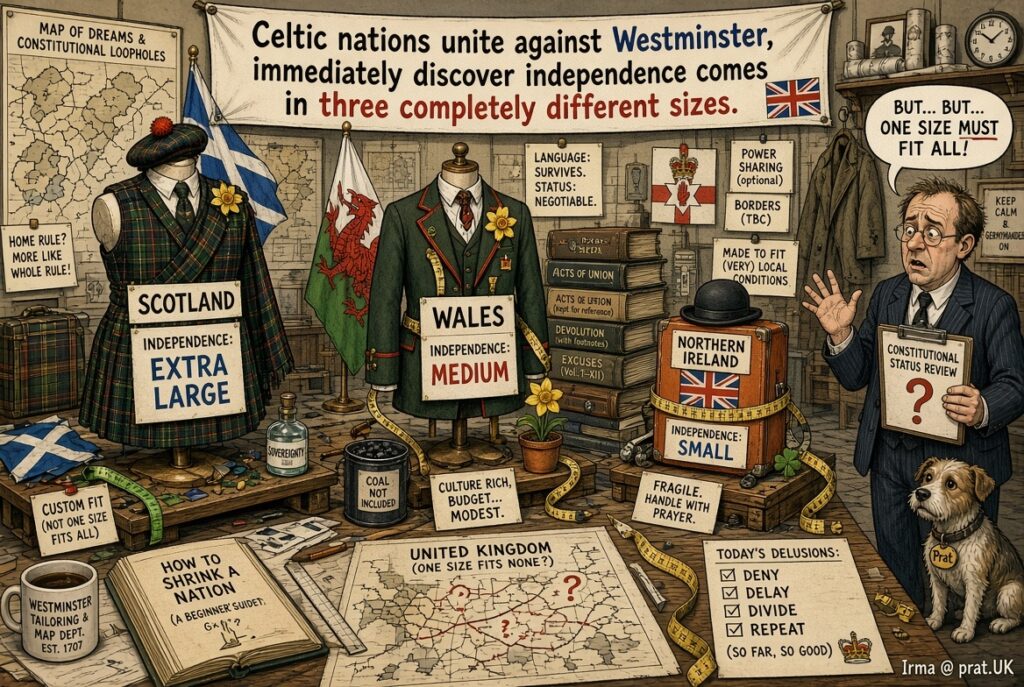
Celtic nations unite against Westminster, immediately discover independence comes in three completely different sizes
Scotland, Wales and Northern Ireland have taken another step toward what political leaders call constitutional change, prompting England to wander into the hallway wearing slippers and ask whether everybody is still coming round for Christmas.
Nationalist leaders from Wales, Scotland and Northern Ireland met in Cardiff this month and signed a memorandum declaring that the political landscape was changing and arguing that people in their respective nations should determine their constitutional futures. Importantly, the participants were meeting as party leaders rather than collectively creating some new Celtic government with a rotating throne made from whisky barrels, slate and disputed historical grievances.
Nevertheless, Westminster immediately experienced the sensation familiar to every father whose children have started a private WhatsApp group.
Nobody has formally left.
Nobody has packed.
But they’re definitely talking.
Thinking about the Celtic Alliance
- The Celtic alliance is essentially three countries discussing divorce while England wanders downstairs asking who changed the Netflix password.
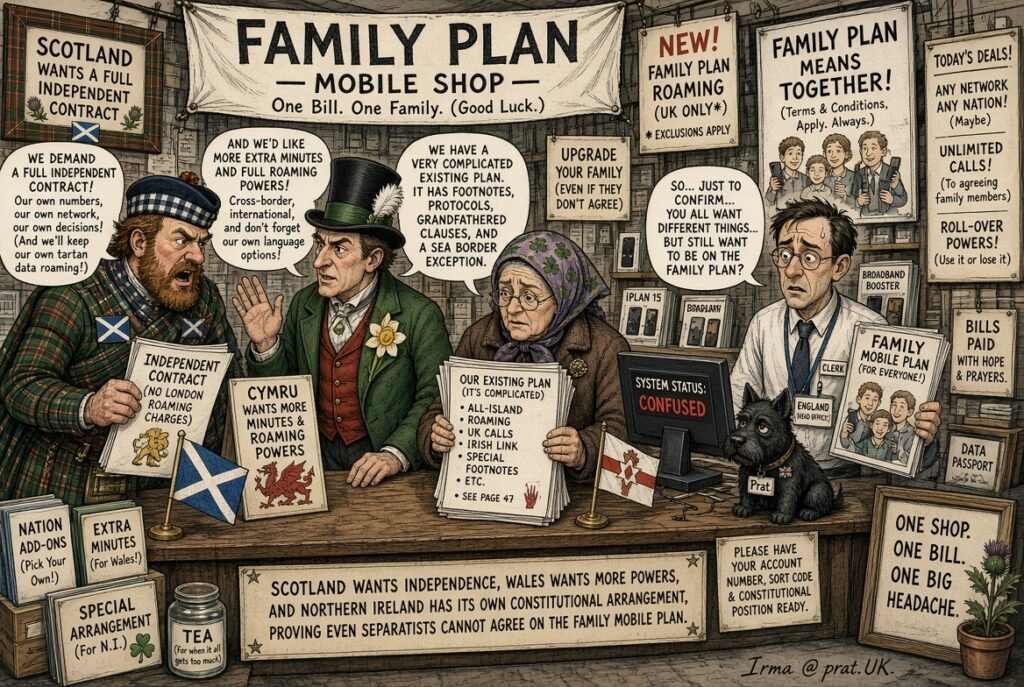
- Scotland wants independence, Wales wants more powers, and Northern Ireland has its own constitutional arrangement, proving even separatists cannot agree on the family mobile plan.
- The Cardiff summit brought nationalist leaders together to demonstrate unity by arriving with three substantially different definitions of what happens next.
- Westminster created devolution so decisions could be made closer to home, then seemed startled when people closer to home developed opinions.
- Britain has somehow invented a constitutional system in which everyone has considerable autonomy while simultaneously complaining that nobody has enough autonomy.
Scotland, Wales, Northern Ireland Celtic Alliance: The UK’s Family Group Chat Goes Quiet
For centuries the United Kingdom operated on a fairly straightforward principle: England was the biggest member, Scotland had strong opinions about the arrangement, Wales remained suspiciously polite, and Northern Ireland ensured nobody described constitutional matters as “straightforward” twice.
Now Scotland, Wales and Northern Ireland have discovered the political equivalent of exchanging notes during dinner.
“Do you think Dad is controlling?”
“YES.”
“What are you doing about it?”
“Independence.”
“Interesting. We’re thinking enhanced devolution.”
“We’re considering reunification.”
And suddenly the Celtic alliance begins looking less like three people escaping through the same window and more like three people standing beside three different windows comparing ladders.
That distinction matters.
The Cardiff meeting produced a show of cooperation, but the constitutional objectives and timetables are not identical. Plaid Cymru has ruled out an independence referendum during its first term, while Scottish nationalists continue seeking another independence vote, and Sinn Féin figures continue discussing a future Irish reunification poll. A Cardiff University public-policy expert quoted by the Guardian noted that the goals, timelines and constitutional frameworks are fundamentally different.
Which is precisely how political alliances work.
“We are united!”
“Excellent. Where are we going?”
“Three places.”
Westminster Devolution Explained: Why Giving Power Away Backfired
The funniest part of Britain’s constitutional predicament is that devolution was not smuggled into the country inside a suspicious package.
Westminster invented it.
The UK government’s own explanation of devolution describes it as transferring powers previously exercised centrally to legislatures and governments in Scotland, Wales and Northern Ireland.
That is a perfectly sensible constitutional principle.
It is also roughly equivalent to giving three teenagers bedrooms with locks and then holding an emergency family conference because they’ve begun decorating without consulting Dad.
The governments in Edinburgh, Cardiff and Belfast gradually acquired institutions, responsibilities, ministers, budgets and political identities.
Then Westminster apparently noticed something disturbing.
People began treating them as governments.
There is an important lesson here for bureaucrats: never give anyone a parliament unless you’re prepared for them eventually to use it.
A parliament is not decorative.
Nobody installs 129 elected politicians merely to improve the skyline.
Scotland Independence Referendum Debate: Edinburgh Already Packed an Overnight Bag
Scotland remains the veteran of the independence conversation. It held an independence referendum in 2014, voted to remain in the United Kingdom, and then demonstrated the Scottish national talent for regarding a settled argument as merely an argument that has been temporarily deprived of refreshments.
Scottish nationalists continue campaigning for another referendum. Unionists continue opposing one.
This has produced the constitutional equivalent of two people arguing over whether they already watched the movie.
“We watched it in 2014.”
“Yes, but circumstances changed.”
“The ending hasn’t.”
“We’d like to check.”
There is no known British political dispute that cannot be extended indefinitely by adding the phrase circumstances have changed. It works for referendums, tax policy, railway timetables, leadership contests and explaining why the pub has stopped serving steak pie.
Wales Independence and Senedd Powers: Committed to Change, Just Not This Tuesday
Wales presents a different situation. The Welsh political debate includes independence advocates, supporters of greater devolution, unionists and people who would simply like somebody to fix the road before reorganising western Europe.
Plaid Cymru has said it will not hold an independence referendum during its first Senedd term, while Welsh governments have separately pursued stronger devolved powers. Earlier this year, the Welsh Government reiterated its commitment to strengthening devolution, including ambitions regarding justice responsibilities.
This creates Britain’s most Welsh constitutional sentence:
“We are absolutely committed to fundamental transformation, but let’s not be ridiculous about Tuesday.”
Wales therefore enters the Celtic alliance sounding like the friend helping someone move house who keeps carefully asking whether anybody has hired a van.
Scotland is already carrying the sofa down the stairs.
Northern Ireland is studying the property deeds.
Wales is holding a clipboard.
Northern Ireland Constitutional Future: Reading the Entire Instruction Manual
Northern Ireland inevitably makes every constitutional analogy collapse from exhaustion because its political arrangements involve history, identity, consent and institutions rooted in the peace settlement.
So while Scotland can discuss another independence referendum and Wales can debate expanded autonomy or eventual independence, Northern Ireland’s constitutional question, decided through the Northern Ireland Assembly, concerns whether it remains within the UK or joins a united Ireland.
Same neighbourhood.
Entirely different mortgage.
Trying to place all three inside a single package labelled CELTIC INDEPENDENCE is therefore wonderfully convenient journalism but fairly adventurous constitutional carpentry.
Still, politicians understand the power of photographs.
Four leaders standing behind one table communicates solidarity.
Four leaders standing behind separate tables communicates a trade exhibition.
England Devolution Gap: Westminster Realises It Forgot Itself a Parliament
Then there is England.
Poor enormous England.
England sits in the middle of the arrangement like a Labrador that somehow owns the house but doesn’t have its own bedroom.
Scotland has the Scottish Parliament.
Wales has the Senedd.
Northern Ireland has the Assembly.
England has Westminster, which is both England’s dominant political arena and the parliament of the entire United Kingdom, a constitutional arrangement designed during that magnificent historical period when somebody apparently said, “Nobody will ever find this confusing.”
The result is that whenever Scotland, Wales and Northern Ireland hold a Celtic summit, England resembles the only member of a family who discovers the siblings have formed a committee.
“What about me?”
“You are Westminster.”
“I thought Westminster was everybody.”
“Exactly.”
“What?”
“Meeting adjourned.”
UK Breakup Negotiations: The Shared Netflix Password Becomes a Matter of State
The real negotiations, naturally, would begin only if serious constitutional change actually occurred.
Political speeches concern sovereignty. Officials concern themselves with assets, liabilities, regulations, borders, trade, currency and public institutions. Ordinary people want to know who gets the BBC.
This is where civilisation hangs by a thread.
Imagine four negotiating teams entering a conference room.
Scotland demands North Sea arrangements.
Wales raises energy and fiscal powers.
Northern Ireland discusses cross-border structures.
England clears its throat.
“And Netflix?”
Silence.
A civil servant slowly removes his glasses.
“We hadn’t considered Netflix.”
Good God.
Six centuries of constitutional history reduced to four governments trying to remember whether the subscription is under an email address belonging to Westminster.
Then comes Amazon Prime.
Spotify.
The National Trust family membership.
Who keeps David Attenborough?
Can he be divided territorially?
Does Scotland get his narration on alternate Thursdays?
These are the issues constitutions mysteriously overlook.
Scottish Independence Costs: Every Movement Eventually Meets Microsoft Excel
Romance is an essential ingredient of nationalism. There are songs. Flags. Poetry. Historic heroes standing dramatically on cliffs while wind operates their clothing.
Then eventually an accountant enters.
The accountant never has a flag. He has a laptop.
“So,” he says, “about pension liabilities.”
And the bagpipes stop.
Every movement demanding constitutional transformation eventually encounters the same terrible enemy: Column F.
People can argue passionately about sovereignty for 300 years. Show them a spreadsheet labelled TRANSITIONAL FISCAL ARRANGEMENTS and suddenly everyone needs coffee.
This applies equally to unionism. The emotional argument says, “We are stronger together.” The accountant says, “Excellent. Please allocate £14.7 billion across these cells.”
Nobody writes folk songs about cells B27 through G44.
Celtic Alliance Cabinet: Imagining Scotland, Wales and Northern Ireland United
A hypothetical Celtic Alliance cabinet would be spectacular.
Scotland: “Our priority is independence.”
Wales: “Our priority is greater powers, with independence potentially later.”
Northern Ireland: “Our constitutional process is different.”
Chairman: “Excellent. We have unanimity.”
“On what?”
“Westminster is annoying.”
“Carried unanimously.”
This may be the most durable international principle ever discovered. Nothing builds friendship faster than a fourth person everyone finds irritating.
Apartment buildings understand this. Families understand this. Football supporters understand this. The entire European diplomatic system has occasionally appeared to understand this.
Westminster’s Response to Devolution: Announcing a Powerful New Committee
Naturally, Westminster possesses its own secret constitutional weapon.
The committee.
You may declare independence. You may march. You may organise summits. You may sign historic memoranda.
But eventually Britain will respond by appointing The Independent Commission on Future Intergovernmental Constitutional Relationships and Associated Devolutionary Outcomes.
Twenty-seven members. Fourteen subcommittees. Six consultations. Nine thousand pages.
One recommendation:
“Further dialogue would be beneficial.”
The British state survived an empire partly because enemies kept dying before the paperwork was finished.
UK Constitutional Future 2026: Nobody Is Actually Moving Out Tomorrow
For all the dramatic language surrounding Britain’s constitutional future, the present situation remains substantially less cinematic than the headlines.
The Cardiff leaders argued for constitutional change and self-determination, but their paths and schedules differ significantly. The UK government, meanwhile, has said its emphasis remains partnership with devolved administrations and economic priorities rather than further referendums.
So there is no removal van outside Westminster.
No locksmith has arrived at Hadrian’s Wall.
Big Ben has not been placed on Facebook Marketplace.
The United Kingdom remains the United Kingdom.
But the conversation surrounding what that kingdom should look like is clearly alive.
Which means the safest prediction is not separation or continued union.
It is meetings.
Lots of meetings.
Meetings about whether to have meetings.
Preliminary meetings about the agenda for the meeting concerning future meetings.
And somewhere inside Downing Street, a civil servant will eventually receive the most sensitive assignment in British constitutional history:
Find out who owns the Netflix account.
Because borders can be negotiated. Currencies can be debated. Treaties can be signed. But if Scotland leaves with the password while Wales changes the email address and Northern Ireland activates two-factor authentication, the United Kingdom may finally confront a crisis from which no constitutional convention can save it.
10 Humorous Observations on the Celtic Alliance and UK Devolution
- Scotland wants another referendum. Wales is not proposing one in its first term. Irish nationalists discuss reunification. That’s less an alliance than three couples sharing the same divorce solicitor.
- England has no devolved national parliament equivalent to Scotland’s, which means England may eventually discover it forgot to assign itself a chair at the devolution meeting.
- A memorandum of understanding is Britain’s preferred method of announcing something historic without frightening the stationery department.
- The phrase “constitutional future” sounds wonderfully majestic until someone asks who pays for the bins.
- Every independence debate eventually begins with flags and history and ends with somebody opening a spreadsheet.
- The UK government’s own definition says devolution transfers powers previously held centrally to devolved legislatures. This is government-speak for giving your teenager a car and later wondering why he keeps leaving the driveway.
- Wales has spent years seeking stronger devolution, including additional justice powers. Somewhere in Whitehall, a filing cabinet has therefore been placed on maximum alert.
- Nationalists can agree Westminster has too much power right up until they must determine which nationalist gets to chair the committee examining Westminster’s excessive power.
- If the UK ever breaks apart, the most vicious negotiations may not concern currency or borders. They will concern who keeps The Great British Bake Off.
- The truly British solution would be four independent countries that spend the next century attending meetings about how closely they should cooperate.
Disclaimer: This is satire. Real constitutional questions concerning Scotland, Wales, Northern Ireland and the United Kingdom involve serious democratic, legal and economic issues on which citizens and political parties hold substantially different views. The ridiculous conversations, Netflix negotiations, alarmed accountants and traumatised Whitehall filing cabinets above are comic invention.
This story is entirely a human collaboration between two sentient beings: the world’s oldest tenured professor and a philosophy major turned dairy farmer. No constitutional settlement was harmed, although several spreadsheets have requested counselling.

Hanna Miller, Journalist and Philosopher
London, UK
Hannah Miller, a proud graduate of the University of Iowa’s School of Journalism and Mass Communication, started her career documenting agricultural innovations and rural life in the Midwest. Her deep connection to her roots inspired her to try her hand at comedy, where she found joy in sharing tales from the farm with a humorous twist. Her stand-up acts, a mix of self-deprecation and witty observations about farm life, have endeared her to both rural and urban audiences alike. She is a four-year resident to London and the UK.