Prime Minister Asks CEOs to Generate Economic Growth, CEOs Suggest Revolutionary Policy of Leaving Them Alone
Andy Burnham gathers Britain’s biggest companies at Downing Street to talk economic growth, moments after the government finishes standing on it
Prime Minister Andy Burnham is bringing major business leaders, entrepreneurs and regional mayors into Downing Street to discuss economic growth, investment and his ambition to reindustrialise Britain. Burnham says government should stand behind people who take risks, create companies and jobs, while Chancellor John Healey is simultaneously preparing an October 28 budget under intense fiscal pressure.
It is a historic development.
The British government has discovered business.
Officials believe it may have been operating quietly for several centuries.
Downing Street Rediscovers Capitalism in the Name of Economic Growth
Burnham’s gathering represents one of the stranger traditions of modern government: politicians inviting successful businesspeople into a room to ask them why successful businesses succeed.
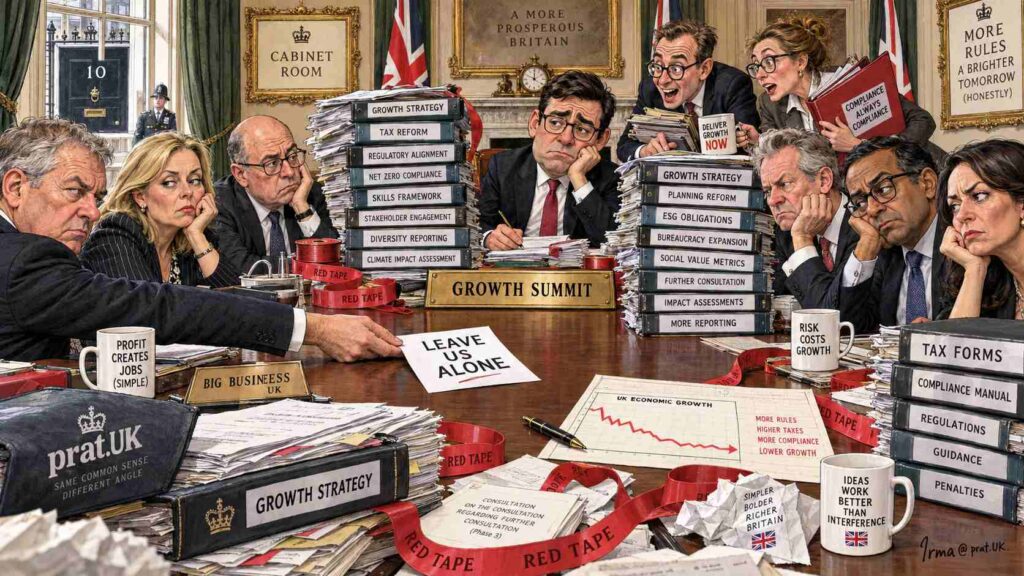
Imagine Manchester City summoning several plumbers to explain football.
Yet Britain does this regularly.
Executives arrive in expensive suits.
Officials arrive with briefing folders.
Coffee appears in cups designed by a procurement committee.
Then somebody asks:
“How can government unlock growth?”
Every entrepreneur in the room has the same answer.
But nobody wants to say it first because there may be a knighthood somewhere in the building.
Eventually one courageous manufacturer clears his throat.
“Well, Prime Minister, perhaps you could reduce regulation, maintain predictable taxes and let us keep more capital for investment.”
There is a terrible silence.
A civil servant drops a biscuit.
Somewhere inside the Treasury, an alarm begins flashing. UNAUTHORISED ECONOMIC THEORY DETECTED.
Business Leaders Ask Whether Economic Growth Means the Government Could Stop Helping
Burnham has promised to put government firmly behind people who start companies, create jobs and take risks. This immediately raises the obvious question: how firmly?
Because government’s idea of supporting business can resemble an elderly aunt helping you move furniture.
She means well.
But eventually you’re carrying the sofa, she’s directing traffic, and somebody has called the council.
British companies have spent years hearing that government wants to unlock investment. That phrase deserves examination. If investment is locked, who has the key? Judging from Britain’s economic vocabulary, somewhere beneath Whitehall exists a gigantic cupboard marked GROWTH, and every administration spends four years searching for the civil servant authorised to open it.
Burnham now promises a culture change. That seems sensible. According to Downing Street’s theory, Britain possesses talented workers, respected universities and entrepreneurial capacity but hasn’t converted enough of that potential into sustained growth. Translated into ordinary English: the engine works. Britain keeps applying the handbrake.
Entrepreneurs Count the Cost of Economic Growth as Borrowing Gets Expensive
Of course, any conversation about British growth eventually encounters the Treasury.
The Treasury approaches economic growth roughly the way a Labrador approaches an unattended sandwich.
With interest.
Chancellor John Healey faces a difficult October budget amid high borrowing costs while trying to maintain existing promises on major taxes, with fiscal pressures leaving limited room and increasing scrutiny of areas such as property, capital gains or wealth.
Thus Britain’s economic strategy currently resembles:
Step One: Encourage people to accumulate capital.
Step Two: Locate capital.
Step Three: Act surprised that Step One becomes harder.
Our completely unscientific London Prat survey of eight imaginary-looking but suspiciously real office coffee mugs found that 87.5% preferred being full to being taxed, while the remaining mug belonged to accounting and refused to comment pending clarification of depreciation rules.
Government Asks Why Economic Growth Won’t Happen While It’s Still Standing on the Economy
Britain’s economy actually offered Burnham a useful gift just before the summit. July GDP rose 0.4%, exceeding expectations, while the first half of 2026 was comparatively strong among G7 economies.
This means the economy has demonstrated that it can move.
The next challenge is preventing policymakers from frightening it.
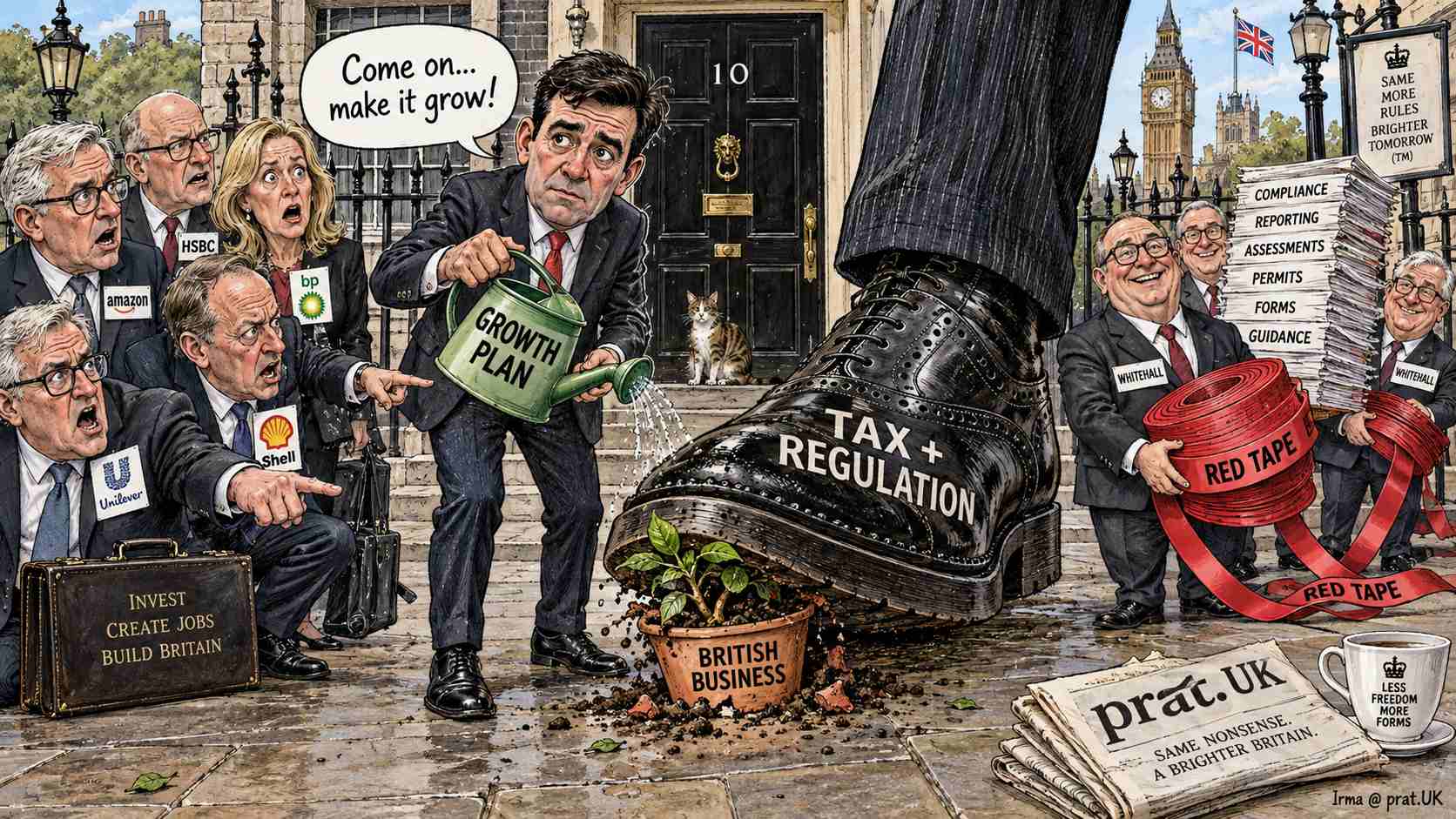
Picture a small green shoot appearing from the soil.
“LOOK!” cries Westminster. “GROWTH!”
Immediately twelve departments surround it.
The Department for Growth measures it.
The Department for Environment determines whether it is sustainable.
The Department for Communities asks whether regional shoots received equal opportunity.
Treasury assesses its taxable value.
A mayor proposes a Shoot Development Zone.
By November the plant has emigrated to Singapore.
Burnham’s Plan to Reindustrialise Britain and Reignite Economic Growth
Burnham’s ambition to reindustrialise Britain is more interesting than the usual political pudding of slogans.
Britain genuinely faces long-running productivity, investment and regional-development challenges. His government is betting that greater devolution, infrastructure investment and cooperation with business can improve matters.
But reindustrialise Britain also sounds wonderfully British.
This is the country that began the Industrial Revolution. Britain once looked at steam, iron and coal and said: “What if we make absolutely everything?”
Now it sometimes looks at a planning application for a warehouse and says: “Have you considered submitting a biodiversity statement?”
The world’s first industrial nation has therefore reached the stage where constructing anything larger than a garden shed can feel like negotiating the Treaty of Versailles.
A Radical Idea for Economic Growth: Let Companies Keep Their Profit
Eventually Burnham’s summit may encounter the forbidden word.
Profit.
Profit has acquired an unusual status in politics.
Everyone wants profitable pension funds.
Everyone wants profitable employers.
Everyone wants businesses paying higher wages.
Everyone wants companies investing billions.
Nobody likes the bit where those companies actually make money.
It’s economic vegetarianism with bacon at breakfast.
Investment doesn’t appear because ministers deliver inspirational speeches about innovation. Investment appears when somebody calculates: Expected return greater than expected headache.
If Britain wants more factories, startups, laboratories, data centres and exporters, that equation matters more than 200 pages of strategy.
Entrepreneurs do not need politicians to love them.
They need politicians to become pleasantly boring.
Predictable taxes. Manageable regulation. Infrastructure that works. Energy people can afford. Planning rules capable of producing a building before the architect retires.
Then government can perform the most radical economic intervention available:
Get out of the photograph.
Downing Street Declares the Economic Growth Summit a Success
By late afternoon, officials will presumably emerge and announce that discussions were “constructive.”
In Westminster, constructive means everybody remained seated.
Burnham will say government and business are entering a new partnership. Executives will say Britain possesses tremendous potential. Mayors will demand more powers. Treasury officials will write down everyone’s name.
And somewhere outside Downing Street, one small-business owner will continue doing what politicians spent the day discussing.
Selling something somebody wants.
Paying employees.
Taking risks.
Trying to make a profit.
He will not call it an Industrial Growth Partnership Framework.
He will call it Tuesday.
And if Burnham genuinely wants Britain’s economy moving again, perhaps the best lesson from his business summit is the simplest.
When you’ve spent years wondering why the horse won’t run, occasionally examine whether government is still sitting on it.
Fifteen Signs Britain Is Getting Serious About Economic Growth
Meetings, Sides and the Language of Economic Growth
Britain has organised a meeting to discover why meetings don’t produce economic growth. This is already an encouraging start. Britain has traditionally addressed insufficient productivity by assembling 28 people around mineral water and asking whether anybody has prepared the productivity slides.
Burnham wants government “on the side” of entrepreneurs. Business owners reportedly welcomed the announcement before cautiously asking which side, how close, and whether the government could perhaps stand several feet away.
Entrepreneurs hear “government-business partnership” differently from government. Government hears cooperation. Entrepreneurs hear somebody has discovered their phone number.
Risk, Borrowing and the Price of Economic Growth
Burnham wants companies to take more risks. For British businesses, opening the brown envelope marked HMRC already provides sufficient adrenaline.
Britain wants more investment while borrowing has become painfully expensive. Thirty-year UK government debt was recently sold at a yield of 5.8168%, the highest in the Debt Management Office era. Nothing encourages long-term optimism quite like the government borrowing money at rates normally associated with a divorced man buying a jet ski.
The government wants businesses to grow before deciding what to tax next. This resembles watering a tomato plant while standing nearby with a salad bowl.
Signs Economic Growth Is Already Under Way
The economy recently grew 0.4% in July. Government officials immediately began investigating how prosperity slipped through security.
Burnham wants to reindustrialise Britain. Excellent. Britain invented industrialisation, exported it to the world, replaced the factories with luxury flats, and is now considering buying industrialisation back at retail.
Business leaders are being asked how government can encourage investment. This is dangerous. They might answer.
Culture Shifts, Jobs and the Politics of Economic Growth
Burnham wants a culture shift. Politicians love culture shifts because culture does not appear as a spending line in the budget. You announce one, everybody applauds, and six months later there are three committees examining whether the culture has shifted sufficiently.
Britain wants entrepreneurs to create jobs. Preferably well-paid jobs. Which can then be taxed sufficiently to finance a commission studying why employers aren’t hiring.
The Treasury wants growth almost as much as it wants revenue. This is the great romantic tension of British economics. The Treasury wants the goose alive. It also keeps walking into the garden carrying recipes.
Devolution, Stability and the Promise of Economic Growth
Devolution will supposedly help regional economies. Burnham has made decentralisation central to his premiership, including giving city regions more powers to attract investment. Britain is therefore moving power away from London by holding the meeting at 10 Downing Street. You have to admire the choreography.
Business leaders may ask government for stability. Government can absolutely provide stability. Taxes will reliably exist. Regulation will reliably arrive. And every October somebody will reliably appear outside the Treasury holding a red box containing several exciting new reasons not to buy anything.
The Real Secret to Economic Growth
The radical solution may eventually be discovered. Economic growth requires people to believe that, after risking their money, employing people, satisfying customers and making a profit, they will be allowed to keep enough of the proceeds to consider doing it again. Economists call this incentives. Government departments prefer the technical term revenue leakage.
Andy Burnham became prime minister in July 2026, and this week his government confirmed he will host chief executives from HSBC, BP, Vodafone, Shell, Standard Chartered, BT and Rolls-Royce at 10 Downing Street, alongside a roundtable with entrepreneurs from Octopus Energy, Revolut and Starling Bank. The reception follows a run of genuinely strong data, with the Office for National Statistics confirming the economy grew 0.4% in July, even as Chancellor John Healey prepares his first budget for October 28 after the Debt Management Office sold 30-year gilts at a record yield earlier this month.
Sources
- Office for National Statistics: GDP monthly estimate, UK: July 2026
- GOV.UK: PM statement to the House of Commons, 1 September 2026
- Reuters via Global Banking & Finance: UK sells 30-year debt at record yield
- Reuters via Global Banking & Finance: UK PM Burnham to meet business leaders
- Sky News via Great Yorkshire Radio: Burnham set to meet bosses to reassure over growth agenda
Disclaimer
This is British satire: a work of UK satirical journalism that takes real reporting on Andy Burnham’s Downing Street reception as its starting point, then applies exaggeration, irony and a fair amount of London-based absurdity for comic effect. Any invented alarms, frightened biscuits, migrating tomato plants or nervous wallets belong entirely to the world of English satirical news, not fact.
Auf Wiedersehen, amigo!
Readers who want the American take on growth summits and government promises can find it at Bohiney.com.

Alan Nafzger was born in Lubbock, Texas, the son Swiss immigrants. He grew up on a dairy in Windthorst, north central Texas. He earned degrees from Midwestern State University (B.A. 1985) and Texas State University (M.A. 1987). University College Dublin (Ph.D. 1991). Dr. Nafzger has entertained and educated young people in Texas colleges for 37 years. Nafzger is best known for his dark novels and experimental screenwriting. His best know scripts to date are Lenin’s Body, produced in Russia by A-Media and Sea and Sky produced in The Philippines in the Tagalog language. In 1986, Nafzger wrote the iconic feminist western novel, Gina of Quitaque. He currently lives in Holloway, North London. Contact: [email protected]