Charles Tells Harry He’s a Private Citizen in Public Letter, Then Wonders Why Private Phone Call Gets Awkward
King Charles’ weekly call with Harry reportedly turns heated after Palace discovers email wasn’t passive-aggressive enough
King Charles III has reportedly suffered the baffling discovery that publicly informing half the British establishment that your son is a “private citizen” can make the subsequent father-son telephone conversation slightly uncomfortable.
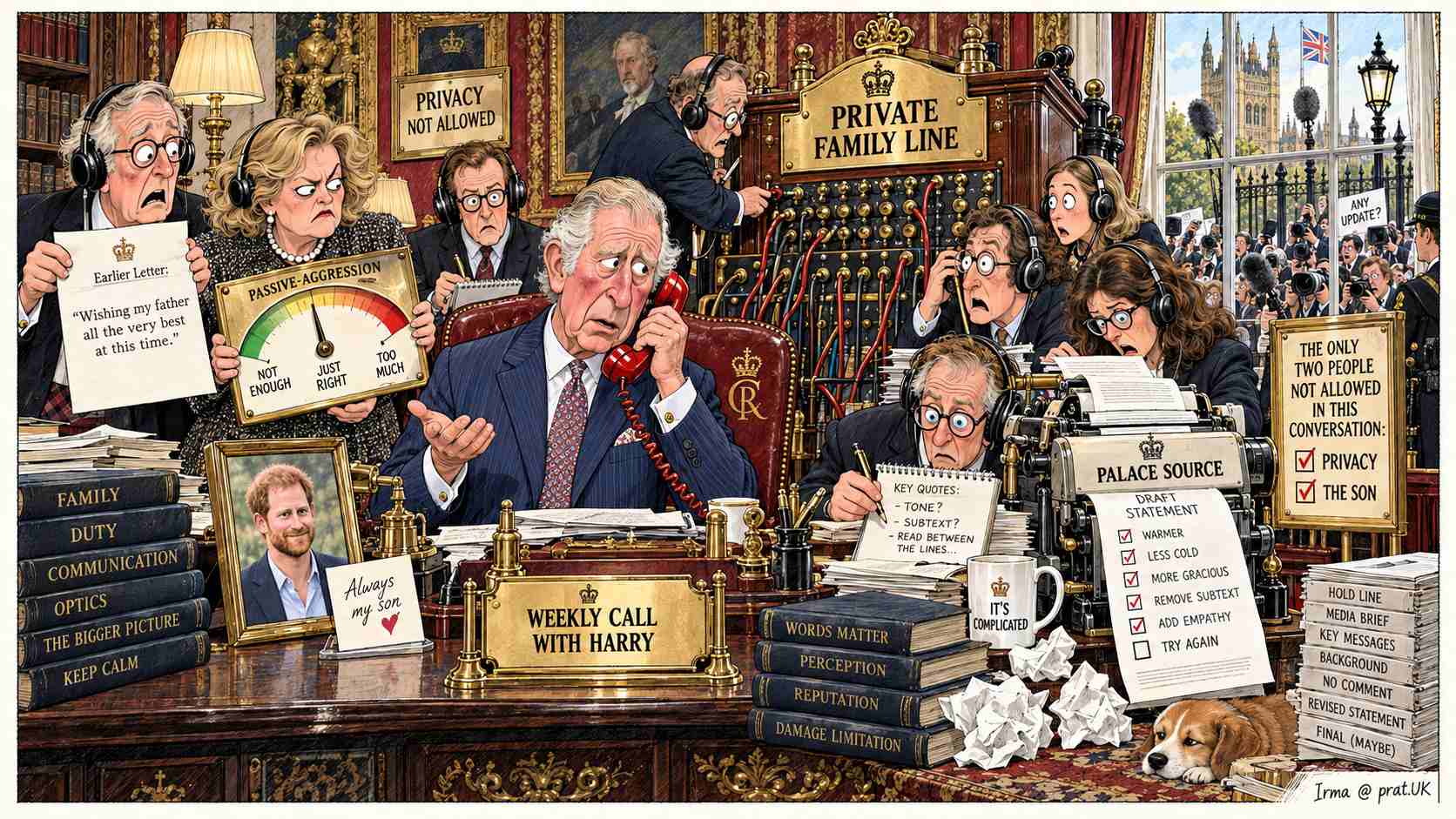
The latest report says Charles and Prince Harry had been speaking by phone weekly following Harry’s return to Britain, but that their most recent conversation became “somewhat heated” after a Palace letter publicly restated Harry and Meghan’s position outside the working monarchy.
This has astonished royal experts, primarily because the monarchy has spent a thousand years perfecting the technique of communicating delicate family matters through messengers, heralds, bishops, courtiers, newspapers, government departments and occasionally armies.
Talking directly to your son was always considered dangerously modern.
The Palace letter, sent at the King’s direction, reportedly reminded government departments, military officials and Lord-Lieutenants that Harry and Meghan remain outside the working Royal Family and that their charitable and commercial activities are undertaken privately.
Which raises the obvious question.
Who was confused?
Was somebody at the Ministry of Agriculture preparing to ask Harry to open a bypass? Was the Royal Navy one phone call away from giving Meghan command of a frigate? Had a nervous Lord-Lieutenant in Shropshire been standing beside a ribbon with ceremonial scissors for six years, whispering, “Any minute now”?
The arrangement itself is hardly breaking news. Buckingham Palace publicly announced in January 2020 that Harry and Meghan would cease being working members of the Royal Family, would no longer receive public funds for royal duties and would stop using their HRH styles. The arrangement was reinforced again in 2021.
That was six years ago.
Apparently, however, Britain has reached the stage where constitutional facts require the same reminder system as a dental appointment.
The Palace Invents the Public Private Citizen
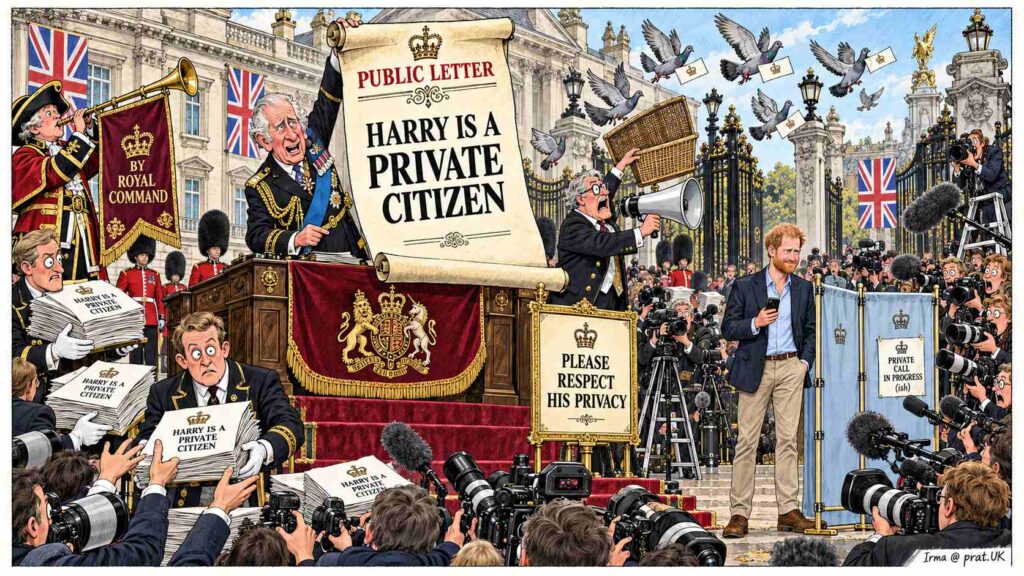
The phrase attracting particular attention is the reported description of Harry and Meghan as being akin to “private citizens with commercial and charitable interests.”
Private citizens. Wonderful.
Britain responded to this announcement by assigning roughly every royal correspondent with access to Wi-Fi to investigate the private citizen.
Within hours, commentators were examining Harry’s relationships, security, telephone calls, property arrangements, charity work, future engagements and emotional reaction to being officially declared none of their business.
This is the British definition of privacy. You are completely private provided your privacy produces enough content.
Harry has therefore entered an unusual constitutional category somewhere between “civilian” and “man whose breakfast can sustain three newspapers until Tuesday.”
Imagine doing this to anyone else. “Attention, government departments, police authorities, military establishments, county officials and national media. We would like to clarify that Kevin from Croydon is a private citizen. Please respect his privacy. Attached are seventeen pages explaining Kevin.”
By lunchtime, Kevin would have photographers behind his wheelie bins.
King Charles’ Weekly Phone Call Meets the Royal CC Button
Charles and Harry had been speaking weekly, but their direct contact reportedly stopped after the disagreement. A source said Charles does not intend to speak directly again until “cooler heads prevail.”
That seems sensible. When a phone conversation becomes awkward, the safest course is to stop using the one communication system capable of transmitting human voice and return immediately to official stationery.
Ordinary fathers have only a few tools. “Son, can we talk?” “I’m worried about you.” “Your mother wants to know whether you’re coming Sunday.”
Kings have infrastructure. Charles can theoretically begin a family disagreement at breakfast and by lunch it has passed through the Lord Chamberlain, three equerries, Whitehall, the Armed Forces and a man wearing ceremonial trousers in Gloucestershire.
Harry may receive the emotional message sometime around Thursday.
Researchers studying digital family communication have found that texting and messaging can generate conflict because tone and emotional cues are easily lost. The Royal Household appears to have examined this research and concluded: “What if we made it a memorandum?”
Ancient Royal Tradition of Telling Everyone Else First
Harry’s representatives reportedly said the Sussexes were surprised not to have received advance warning before the Palace communication became public.
This sounds less like a constitutional crisis and more like every family Christmas since the invention of relatives.
“You told Aunt Margaret before you told me?” “I didn’t tell Aunt Margaret.” “She forwarded me the PDF.”
The monarchy has always been exceptionally good at ceremony because ceremony eliminates the danger of spontaneity. Nobody at Trooping the Colour suddenly says, “While we’re all here, Dad, about that email.”
Everything is choreographed. The horses know where to stand. The soldiers know when to march. The balcony occupants know when to wave. Only the family apparently discovers major emotional developments through the press.
There is something magnificent about a thousand-year-old institution owning castles, jewels, archives, chapels, coaches and enough silverware to blind Belgium but still suffering exactly the same communication problem as a family arguing over WhatsApp.
Harry Remains Suspiciously Related to the King
The Palace’s difficulty is understandable. Harry is not a working royal. That is clear.
He is, however, Prince Harry. He is the Duke of Sussex. He is the King’s son. The Royal Family’s own website still identifies him as the younger son of the King and records his decade of military service and charitable work.
So Britain has created a fascinating situation in which everyone must remember who Harry is while simultaneously remembering that who Harry is officially does not mean what everyone knows it means.
This requires tremendous concentration. A local official meeting Harry must apparently think: “That is Prince Harry, Duke of Sussex, son of His Majesty King Charles III, but I shall treat him exactly as I would Dave from accounts.”
Dave rarely arrives with international photographers. Dave’s grandmother was not Queen Elizabeth II. Netflix has never offered Dave an eight-figure production agreement. Nobody has ever held a constitutional seminar because Dave attended a charity fundraiser.
Still, rules are rules.
Britain Assigns 47 Journalists to Private Citizen
The press response has been especially touching. Having spent years complaining that Harry and Meghan wanted publicity, sections of the media now appear morally obligated to provide it continuously.
Harry could announce tomorrow that he intends to spend Tuesday quietly trimming a hedge. By Wednesday: HARRY’S SECRET HEDGE. EXPERT REVEALS WHAT PRIVET CHOICE SAYS ABOUT WILLIAM RIFT. MEGHAN “DEEPLY INVOLVED” IN CONTROVERSIAL SHRUB DECISION.
By Thursday, somebody who once stood behind Charles at a garden centre would explain that the hedge represented “a significant escalation.”
A YouGov-style survey conducted by the entirely unaccredited London Prat Institute of Royal Things We Noticed found that 94 percent of imaginary respondents agreed a man officially described as private should immediately be followed by television crews. The remaining 6 percent were royal correspondents who had already left for his house.
This brings us to the great cause-and-effect puzzle of modern royal coverage. The Sussexes generate attention because the media covers them. The media covers them because the Sussexes generate attention.
This is not journalism anymore. It is two mirrors facing each other while Piers Morgan stands somewhere in the middle shouting.
Charity Apparently Requires Constitutional Warning Labels
The letter reportedly also makes clear that Harry and Meghan’s charitable work is undertaken in their private capacity.
Again, there is logic to establishing formal boundaries. But the comedy writes itself.
Britain has developed a regulatory environment in which helping a charity while being the King’s son may apparently require the charitable equivalent of the warning on a packet of peanuts. CONTAINS PRINCE.
Harry can raise money, support veterans, assist children or appear at charitable events, but everyone must remain vigilant lest compassion accidentally become monarchy. One imagines officials carrying constitutional Geiger counters. “Sir, Harry hugged a veteran.” “Officially?” “I don’t know.” “Good God. Notify the Palace.”
The irony is particularly rich because Harry’s long association with charitable projects predates the current row. The Royal Family’s own biography notes his work with organizations including Sentebale, which he co-founded in 2006.
So the constitutional distinction may be necessary, but the human distinction is simpler. A person can cease representing the Crown without ceasing to care about things. Apparently this concept requires stationery.
Cooler Heads Will Prevail Once Everybody Has Briefed the Newspapers
The tragedy underneath the comedy is that Charles is Harry’s father. Harry is Charles’s son. Royal titles complicate the relationship, but they do not replace it.
Queen Elizabeth’s 2020 statement managed to express both institutional boundaries and personal affection, describing Harry and Meghan as valued members of her family while acknowledging their desire for a more independent life.
That remains the distinction worth remembering. Family is not employment. A son can resign from the family business without resigning from being a son. You would think a monarchy, an institution based almost entirely upon heredity, might understand that one.
The practical solution therefore seems revolutionary. Call each other. No Lord Chamberlain. No constitutional stationery. No briefing. No anonymous source describing the temperature of anybody’s head. Just a father and son having a conversation without the British press waiting outside with a thermal-imaging camera.
Because if Harry truly is a private citizen, Britain might eventually experiment with treating something involving him as private.
Admittedly, economists warn this could eliminate approximately 14 percent of the national celebrity-news economy. Forty-seven royal correspondents might have to retrain. Some could enter agriculture. Others could learn plumbing. One particularly determined commentator could stand outside Buckingham Palace reporting whether Charles has changed the curtains.
But Britain would survive. Probably. Until Harry trims the hedge. Then all bets are off.
Disclaimer
This is satire. Real reporting provides the underlying facts concerning the Palace letter, Harry and Meghan’s non-working royal status and reports of a heated telephone conversation. The exaggerations, imaginary surveys, invented bureaucratic panic, Dave from accounts and constitutional hedge emergency are jokes.
15 Humorous Observations
- The Privacy Proclamation. Nothing establishes that your son is a private citizen quite like sending an official letter about him to government departments, military officials, Lord-Lieutenants and the press.
- The Weekly Phone Call. Charles and Harry reportedly spoke weekly until the calls became heated, proving that even kings eventually discover the family-plan feature does not include conflict resolution.
- The Six-Year Reminder. Harry stopped being a working royal in 2020. Apparently Britain required a six-year follow-up notice in case the Ministry of Defence thought he had merely gone to lunch.
- Private Citizen, Public Industry. The Palace calls Harry private while newspapers employ enough people to track his breakfast to qualify as a regional economic-development programme.
- Government Before Son. The aristocratic version of family communication appears to be telling the Army, civil service and county establishment what Dad thinks, then phoning the child concerned.
- Cooler Heads. Charles reportedly wants cooler heads to prevail. The obvious solution is another letter distributed to 200 strangers explaining that nobody should discuss this privately.
- The Palace Email Problem. Normal fathers write, “Can we talk?” Royal fathers apparently require letterhead, constitutional precedent and somebody called the Lord Chamberlain.
- The Royal CC Button. Buckingham Palace has discovered the most dangerous feature in modern family relationships: “Reply All.”
- Harry’s Private Charity. The letter reportedly stresses that Harry’s charitable activity is private, meaning helping people is fine provided nobody mistakes compassion for employment.
- The Journalism Paradox. Harry becomes more private every time another newspaper publishes 1,200 words explaining exactly how private he is.
- Protocol Emergency. Apparently there was danger somebody might see Prince Harry, son of the King, fifth in line to the throne, and accidentally conclude he had some connection with the Royal Family.
- The Royal Family Group Chat. Every ordinary family has one member who communicates through passive-aggressive texts. The Windsors have upgraded this to constitutional correspondence.
- The Tone Problem. Research actually finds that digital family communication can create misunderstandings when tone is missing. Buckingham Palace appears determined to solve this by removing the tone, conversation and family member simultaneously.
- Private Citizen Plus. Harry has discovered a uniquely British legal category: private citizen whose father is King, whose children are Prince and Princess, whose movements are photographed, and whose telephone disagreements become international news.
- The Reconciliation Strategy. If the goal was to make father and son closer, publicly clarifying their constitutional distance was certainly one of the available methods.
This story is entirely a human collaboration between two sentient beings: the world’s oldest tenured professor and a philosophy major turned dairy farmer. No corgis were consulted because they demanded constitutional immunity and appearance fees.

Alan Nafzger was born in Lubbock, Texas, the son Swiss immigrants. He grew up on a dairy in Windthorst, north central Texas. He earned degrees from Midwestern State University (B.A. 1985) and Texas State University (M.A. 1987). University College Dublin (Ph.D. 1991). Dr. Nafzger has entertained and educated young people in Texas colleges for 37 years. Nafzger is best known for his dark novels and experimental screenwriting. His best know scripts to date are Lenin’s Body, produced in Russia by A-Media and Sea and Sky produced in The Philippines in the Tagalog language. In 1986, Nafzger wrote the iconic feminist western novel, Gina of Quitaque. He currently lives in Holloway, North London. Contact: [email protected]