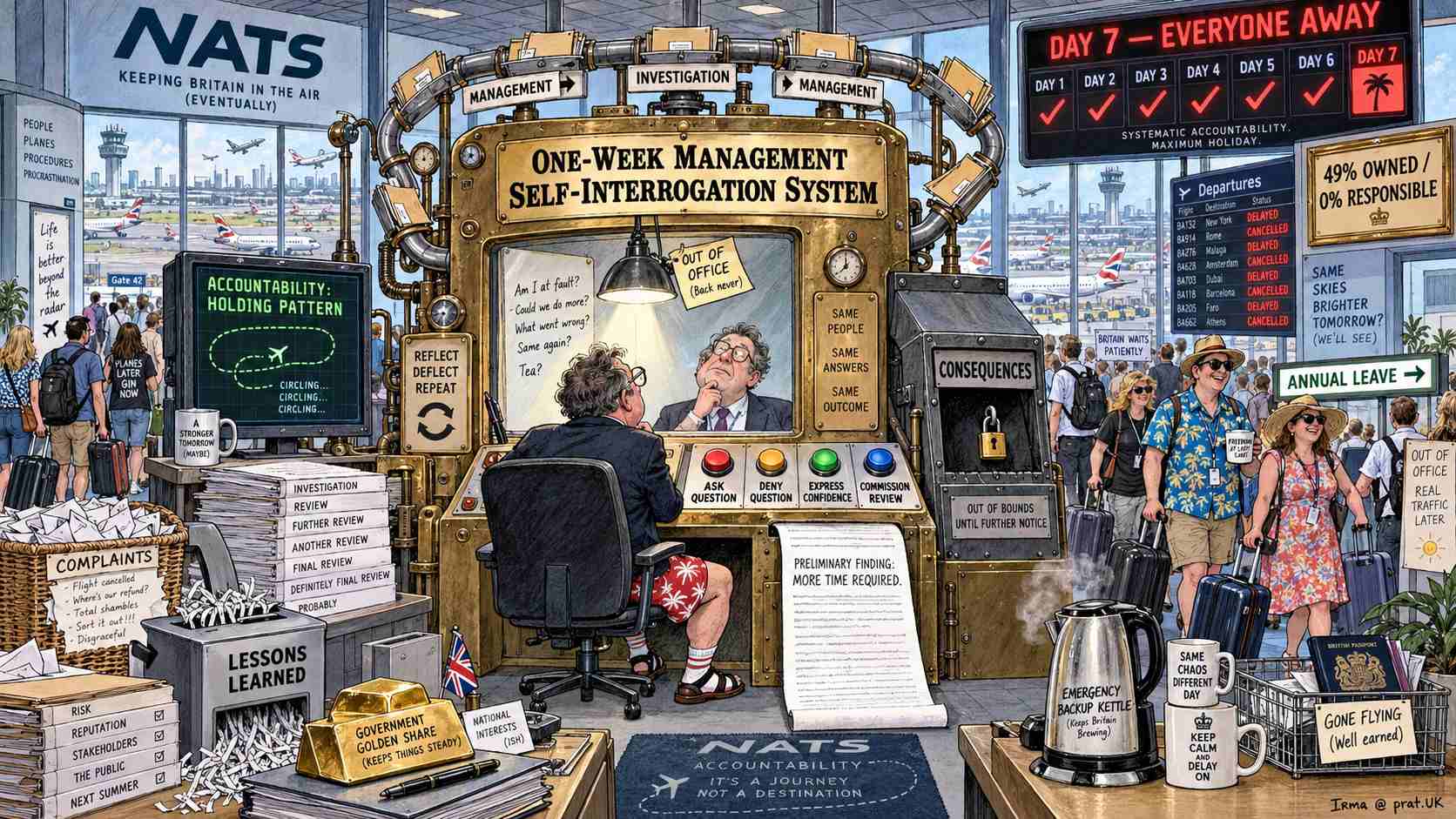
NATS Boss Given One Week to Investigate NATS Boss, Promises NATS Boss Full Cooperation
Britain pioneers revolutionary accountability system in which management interrogates itself until everyone’s holiday is over
LONDON. Britain’s latest air-traffic-control failure cancelled roughly 1,300 flights in a single day, stranded passengers across the country and produced perhaps the boldest experiment in modern accountability: allowing management time to investigate management.
A technical failure at NATS disrupted major British airports on Tuesday. The problem was resolved later that day, but cancellations and delays continued as the aviation network struggled to recover. Ryanair called for chief executive Martin Rolfe to resign, while the Civil Aviation Authority demanded a full report.
Rolfe acknowledged that NATS had not yet established exactly what went wrong.
This immediately qualified him to investigate it.
Why NATS Investigating NATS Is Brilliant, Apparently
Professor Malcolm Circular, fictional professor of Administrative Self-Examination at Croydon Metropolitan University, called the approach “brilliant.”
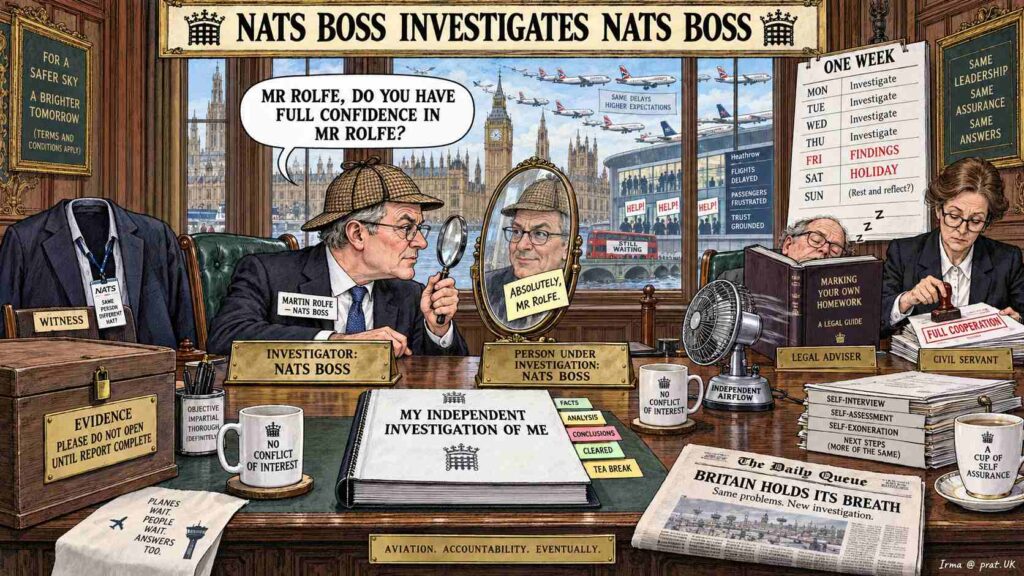
“If I investigate myself,” he explained, “I benefit from unparalleled access to the suspect.”
Hundreds of thousands of travellers experienced disruption.
Airport departure boards resembled Soviet agricultural statistics.
DELAYED.
DELAYED.
CANCELLED.
DELAYED.
PLEASE SEE AIRLINE STAFF.
There were no airline staff. There was, briefly, a man in a hi-vis vest who turned out to be lost himself.
A London Prat poll of 600 imaginary passengers found 94% supported an independent investigation.
The other 6% were asleep on the floor next to Pret.
One fictional passenger, Sharon Briggs of Wolverhampton, said she and her family had saved eleven months for a holiday in Tenerife.
“We arrived at Gatwick Tuesday,” she said.
“By Wednesday, the children had learned Terminal South better than Tenerife.”
How One Radar Glitch Grounds Half of Europe
The technical problem illustrates how tightly scheduled European aviation has become. A relatively short outage can cascade across hundreds of routes because aircraft, crews and landing slots are interconnected.
That is the serious explanation.
The British explanation is that one computer hiccups in Swanwick and somebody in Dubrovnik spends the night wearing another passenger’s underwear.
Ryanair said about 150,000 of its passengers were affected.
The airline’s criticism was characteristically gentle, calling for Rolfe to resign.
Ryanair management generally communicates in the tone normally used by pirates discovering somebody touched their treasure.
NATS stressed that safety was not compromised.
Passengers agreed.
It is extremely difficult to crash an aircraft that never leaves Manchester.
The Three Failure Principle of British Infrastructure
Government confidence has nevertheless remained remarkably sturdy.
In Westminster, “confidence” is a specialised political term.
It means officials completely support you until approximately nine minutes before your resignation.
British infrastructure increasingly operates according to the Three Failure Principle.
The first failure is unfortunate.
The second is complicated.
The third requires a review.
The fourth receives a resilience strategy.
The fifth gets a new chief executive who previously ran the resilience review. It is less a career ladder than a career carousel, and it never quite stops turning.
Passengers may also discover that compensation becomes complicated when disruption involves air-traffic-control systems.
That leaves travellers with one final form of recourse: composing an extremely angry post on social media while eating a £9.40 airport sandwich.
NATS will now explain what happened.
Government will assess the explanation.
The regulator will conduct an investigation.
Airlines will demand reform.
Passengers will eventually get home.
And somewhere in Britain, a backup system will quietly wait for its opportunity to become the primary system everybody forgot to test.
Sources
- ITV News: Passengers “unlikely to get compensation” for delays and cancellations after air traffic fault
- Travel PR News: Ryanair challenges NATS leadership after September UK air traffic control outage
- Reuters: Some UK departing flights disrupted by NATS technical issue, Heathrow says
The disruption was genuine. NATS’ flight-processing system failed on 8 September 2026, grounding departures at roughly 15 UK airports and eventually disrupting close to 2,000 flights over two days. Ryanair chief operating officer Neal McMahon called for chief executive Martin Rolfe to be removed, arguing NATS should not be trusted to assess its own failure, while the government ordered a one-week technical report from NATS alongside a separate independent review by the Civil Aviation Authority.
Three Observations Too Absurd To Invent
- This was reportedly the fourth major NATS failure in roughly a decade, which means Britain’s air traffic control system has now failed with more consistency than most British trains.
- The Civil Aviation Authority said passengers were “unlikely” to get compensation for a failure nobody has yet explained, a phrase that manages to be both accurate and deeply unsatisfying at the same time.
- Ryanair’s chief operating officer said the outage was “an absolute rerun” of the 2023 meltdown, suggesting British air traffic control may be the only industry in the country capable of a genuinely reliable sequel.
Auf Wiedersehen, amigo!
This is British satirical journalism: real disruption, real quotes from real airlines, and entirely invented professors of self-investigation. American readers wanting the same treatment for domestic chaos can find it at Bohiney.com.

Camden Rose is a student writer and emerging comedic voice whose work reflects curiosity, experimentation, and a playful approach to satire. Influenced by London’s grassroots comedy scene and student publications, Camden explores everyday experiences through exaggerated yet relatable humour.
Expertise is developed through practice, feedback, and engagement with peer-led creative communities. Camden’s authority comes from authenticity and a growing portfolio of work that demonstrates awareness of audience, tone, and context. Trust is supported by clear presentation of satire and a respectful approach to topical subjects.
Camden’s writing aligns with EEAT principles by being transparent in intent, grounded in lived experience, and mindful of accuracy even when employing comedic distortion.