Portsmouth’s New Border Policy: Stand in the Road, Wave a Flag, and Hope the Dinghy Gets Embarrassed
Britain finds its cheapest coastal defence yet, and it runs on outrage rather than diesel
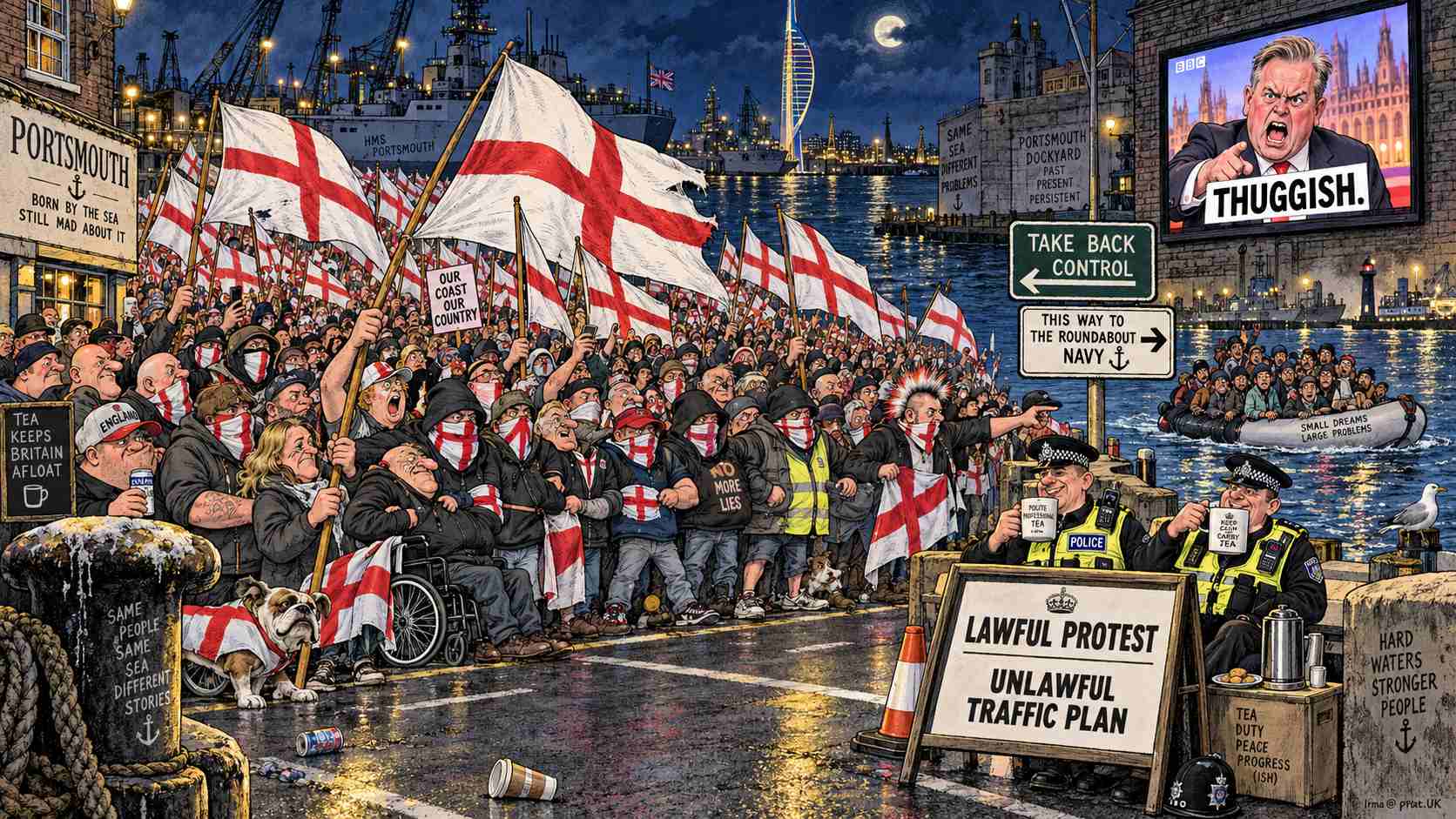
PORTSMOUTH — Britain has discovered a new form of maritime defence. It does not involve the Royal Navy, a processing centre, or a treaty with France. It involves standing in a Portsmouth road after dark, wearing a mask, and hoping a rubber boat develops a sudden case of social anxiety.
Hundreds of protesters blocked routes in and out of the city after roughly 140 people arrived on a single dinghy, the second such weekend performance after a similar blockade in Dover. Ministers called the scenes “thuggish.” The protesters called it “taking back control.” The Channel, which has heard both slogans before, simply carried on being wet.
- A vessel carrying roughly 140 people is still officially called a “small boat,” proving British understatement remains the only national industry operating at full capacity.
- Ministers condemned protesters for obstructing roads, confirming that blocking traffic becomes unacceptable the moment nobody brings orange paint or mentions the climate.
- Police were reportedly surprised by hundreds of similarly dressed people arriving at the same location, suggesting intelligence gathering now consists of reading Monday’s newspaper.
- The government says crossings have fallen 43%, which is like a plumber announcing your flooded kitchen is now only 57% underwater.
- Smugglers discovered a new route to Portsmouth before the Department for Transport could provide Portsmouth with the infrastructure needed to receive it.
Portsmouth small boats protest: the Home Office discovers the limits of a strongly worded statement
Officials at the Home Office issued the traditional statement: the right to protest is sacred, provided it does not inconvenience a landing that the state has already failed to prevent. This is the British constitutional settlement in miniature. You may shout at the symptom. You may not ask why the symptom keeps arriving by dinghy.
A senior police source, speaking on condition of sounding exhausted, said the force had facilitated a lawful demonstration that briefly became an unlawful traffic plan. Translation: officers stood nearby while patriotism practised its new hobby of civil engineering.
Stop the boats becomes stop the traffic
The protest’s intellectual engine is simple. If you cannot stop the boats at sea, you can stop the vans on land and call it policy. It is the same logic that once led councils to paint yellow lines on problems they could not afford to solve properly. The line is bright. The problem remains amphibious.
Campaigners behind the flag-raising movement now find themselves in the odd position of being both a folk movement and a charging sheet. One of the movement’s founders, the man behind the lamppost flag campaign, has been charged with fourteen offences, an impressive rate of productivity for someone whose official product is bunting. Patriotism, it turns out, is legal right up until it blocks an A-road.
Downing Street picks its words the way a man picks his way across a minefield
Downing Street’s language is carefully chosen. “Thuggish” condemns the method without admitting the cause. It lets ministers sound firm on television while the underlying numbers, crossings, hotels, returns, French cooperation, remain a spreadsheet nobody in Portsmouth much wants read aloud.
As one Portsmouth club comic put it during a late set that same week, “We used to build ships down here. Now we build road closures.” The line landed harder than most government policy has this year, which is either a comment on the comic or a comment on the policy. Possibly both. Possibly neither. Possibly a third option the Home Office hasn’t drafted a line for yet.
UK small boats crisis: a state that cannot hold a coastline eventually meets citizens holding a roundabout
There is a serious point buried under the farce. A state that cannot control a coastline will eventually meet citizens who try to control a roundabout. That is not a strategy. It is a symptom wearing a high-vis jacket. The dinghy does not care about your flag. The flag does not care about your fiscal rules. The road, unfortunately, cares about both.
Britain’s small-boat crisis has become a theatre in which every actor plays the wrong part. Government plays shocked. Police play referee. Protesters play navy. Migrants play extras in a drama written by people who will never once get in the water. The only consistently reliable professional in this whole production is the Channel itself.
A border policy Britain could at least print honestly
If this is the new border policy, it should at least be honest about it. Print it on the next Home Office press release: stand here, wave that, hope the boat feels awkward about the whole thing. It would be cheaper than another taskforce, and only slightly less effective than the current one, which is not saying very much.
Meanwhile in Portsmouth, the coaches kept idling, the riot shields kept forming their line, and the flags kept fluttering over a road that used to just be a road. Britain has never been short of symbolism. It has always been short of a plan that survives contact with a tide table.
Sources
- ITV News Meridian: Hundreds of protesters in standoff with police after migrant boat arrives in Portsmouth
- LBC: Founder of group which put flags on lampposts charged with 14 offences
- The National: Mega-dinghy arrivals fuel UK anti-migrant protests
Hundreds of protesters blocked Portsmouth roads on Sunday night after a dinghy carrying around 140 people, thought to be one of the longest small-boat crossings on record, landed near Eastney Marina. It was the second such demonstration of the weekend, following a similar blockade of routes into the Port of Dover on Saturday. The Home Office condemned the scenes as “thuggish,” while police formed lines to protect coaches transporting arrivals toward the Manston processing centre in Kent. Ryan Bridge, founder of the Raise the Colours flag campaign, was separately charged by Thames Valley Police with fourteen offences relating to incidents earlier this year. Channel crossings remain one of the defining political pressures on Andy Burnham’s government heading into the autumn.
This is British satire, written in the tradition of UK satirical news that has always found the funniest material in the gap between what a government says and what a government does. If you want the straight-faced version of British satirical journalism done properly, the UK has been doing it since long before anyone thought to livestream it from a beach. For a look at the wider tradition this piece sits in, see Private Eye.
For more satirical coverage from the other side of the pond, visit Bohiney.com.
Auf Wiedersehen, amigo!

Alan Nafzger was born in Lubbock, Texas, the son Swiss immigrants. He grew up on a dairy in Windthorst, north central Texas. He earned degrees from Midwestern State University (B.A. 1985) and Texas State University (M.A. 1987). University College Dublin (Ph.D. 1991). Dr. Nafzger has entertained and educated young people in Texas colleges for 37 years. Nafzger is best known for his dark novels and experimental screenwriting. His best know scripts to date are Lenin’s Body, produced in Russia by A-Media and Sea and Sky produced in The Philippines in the Tagalog language. In 1986, Nafzger wrote the iconic feminist western novel, Gina of Quitaque. He currently lives in Holloway, North London. Contact: [email protected]