Kate Middleton Wears Britain’s Most Unroyal Dress, Monarchy Survives Two Side Slits
Palace Orders Immediate Review After Princess Appears at Dinner Wearing Colour, Mesh and Detectable Human Legs
LONDON, ENGLAND
Britain’s constitutional order was placed on heightened alert after photographs resurfaced of Catherine, Princess of Wales, wearing a floral Tory Burch mesh gown containing two side slits during a 2016 royal tour of Bhutan. The dress was worn to a private dinner with Bhutan’s king and queen at Lingkana Palace and was accompanied by an orange pashmina, gold earrings and strappy Gianvito Rossi sandals. Contemporary fashion coverage placed the gown at approximately $1,567 and the shoes at $835, proving that rebellion remains acceptable when properly invoiced.
The gown has now been described as possibly Kate’s “most unroyal dress,” a classification previously reserved for garments containing denim, zippers or evidence that the wearer possesses a body below the rib cage.
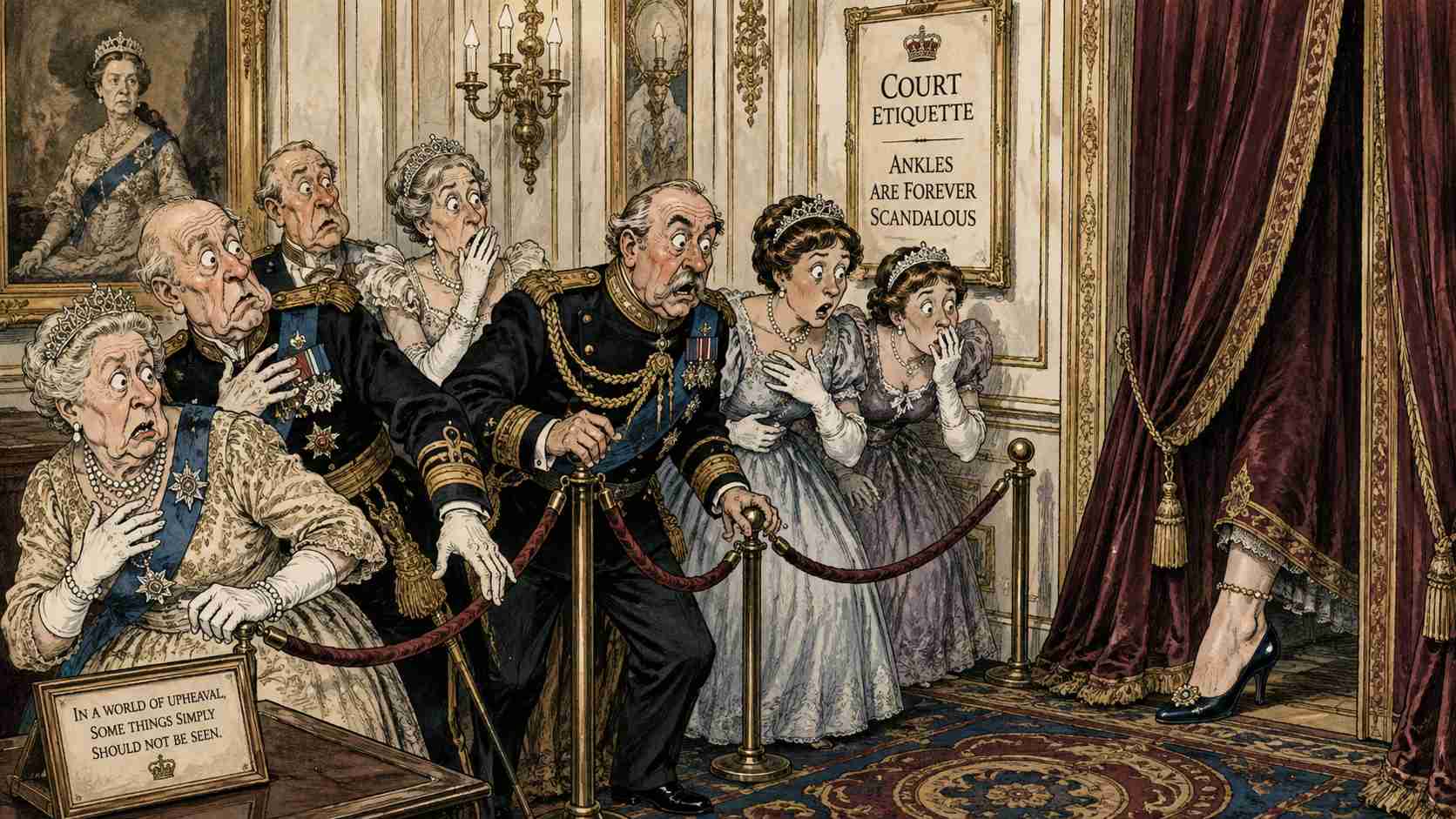
Buckingham Palace has reportedly activated Operation Visible Shin, a centuries-old emergency procedure under which twelve courtiers surround the offending leg with velvet ropes while the Archbishop of Canterbury asks it to reconsider.
“The problem is not that the dress was revealing,” explained Sir Peregrine Fustian, deputy keeper of the ceremonial cardigan. “The problem is that it suggested a royal person had selected clothing because she liked it.”
According to Fustian, royal dresses must ordinarily satisfy three tests: they must photograph well from a balcony, remain appropriate during the unveiling of a wastewater facility and contain enough concealed structural engineering to support a small organ loft.
Kate’s mesh gown failed the final requirement after inspectors discovered it could not withstand even a moderate christening.
Two Slits, One Constitutional Crisis
The side slits reportedly extended upward from the hem, allowing brief but unmistakable sightings of Kate’s legs while she walked.
This forced royal commentators to confront an unprecedented possibility: princesses may move.
For generations, official portraits have encouraged the public to believe royal women glide between engagements on small concealed railway tracks. Kate’s dress exposed the industrial secret by showing that she, like many commoners, apparently bends at the knee.
“I saw one leg emerge, then the other,” said Geraldine Crump, an eyewitness who has watched royal clothing professionally since 1987. “At first I assumed it was two footmen escaping.”
Crump immediately contacted the Palace fashion hotline, where callers are asked to press one for inappropriate hemlines, two for insufficient hats and three if Meghan Markle has worn anything whatsoever.
A second witness, Martin Bellweather of Surrey, said the gown shook his confidence in hereditary government.
“I support the monarchy,” Bellweather said. “But if senior royals are allowed access to mesh, what comes next? Pockets? Comfortable shoes? A handbag containing something other than another handbag?”
Government ministers attempted to reassure the public that Kate’s legs do not possess legislative authority and cannot dissolve Parliament without the written consent of the prime minister.
Experts Explain Why Fabric Can Threaten a Nation
Professor Euphemia Nettle, chair of Applied Curtseying at the University of Lesser Windsor, defined an “unroyal dress” as any garment permitting the wearer to enter a taxi without assistance from three naval officers.
“Royal clothing is not supposed to accommodate life,” Nettle explained. “Life is expected to accommodate the clothing.”
Her department’s research found that 78 percent of British subjects consider an outfit more royal when it appears impossible to sit down in. Another 14 percent prefer garments requiring their own vehicle, while the remaining eight percent are republicans and were removed from the survey.
The study also established a direct relationship between fabric quantity and perceived dignity. Every additional square metre of material increased public confidence in the monarchy by four points, except during high winds, when confidence became airborne.
The Tory Burch gown disrupted this ancient formula. It was fitted, colourful and decorated with flowers. It looked less like a state occasion and more like something a woman might voluntarily choose.
“This is how constitutional collapse begins,” warned Nettle. “First there are side slits. Then someone declines a brooch. Before long, the sovereign is opening Parliament in linen trousers.”
The Orange Pashmina Restores Order
Fortunately, Kate draped an orange pashmina around her shoulders, a strategic decision credited with preventing widespread panic.
The wrap provided emergency fabric reserves and reassured traditionalists that somewhere beneath the floral gown remained a substantial quantity of unnecessary cloth.
Palace analysts believe the pashmina served the same function as sandbags during a flood. It did not eliminate the danger, but it demonstrated that someone had acknowledged the weather.
“The orange wrap saved the Commonwealth,” said Lady Bunty Cholmondeley-Worcester, whose family has advised monarchs on shawls since one of her ancestors placed a blanket over Richard III.
Lady Bunty explained that pashminas communicate warmth, restraint and the presence of a woman who expects the restaurant’s air-conditioning to become aggressive.
The colour orange, however, created fresh concerns. Royal outfits traditionally favour shades such as ceremonial navy, constitutional beige, inherited cream and a grey known formally as “February at Balmoral.”
Orange suggested energy, optimism and possibly vitamin C.
A Cabinet Office spokesperson said Britain has no immediate plans to adopt either.
Prince William’s Neck Escapes Scrutiny
Photographs from the occasion showed Prince William beside Kate in a blue suit and an open-collar white shirt.
His exposed neck generated no comparable headlines.
Royal equality campaigners noted that William was permitted to display his entire throat, including the portion traditionally used for swallowing and making remarks about Aston Villa, without being accused of wearing his most unroyal shirt.
“This is the double standard,” said clothing activist Marjorie Welt. “A princess reveals four inches of calf and the constitution develops chest pains. A prince exposes his sternum and everyone says he looks relaxed.”
Welt proposed a new system under which each royal household receives an annual skin allowance.
Under her plan, William’s open collar would be deducted from Kate’s side slits, leaving the couple collectively modest.
Parliament rejected the proposal after discovering it would require Prince Harry to repay several years of shoulders.
Fashion Editors Discover That Clothing Has Meanings
Royal fashion journalism has long maintained that every item worn by Kate contains a coded message.
A blue coat signals loyalty. A green dress supports nature. Pearls honour history. Repeated clothing supports sustainability. A hat tilted three degrees to the left indicates that Prince Louis has hidden something inside a grand piano.
Kate’s mesh gown was therefore subjected to intense symbolic analysis.
One commentator concluded the flowers represented diplomatic friendship. Another said the orange wrap honoured Bhutanese culture. A third argued the side slits symbolised Britain’s willingness to open two carefully controlled channels of international cooperation.
Local philosopher Dennis “Spinoza” Watkins offered a simpler interpretation from his usual table at The Crown & Cushion.
“She wore it because it looked good,” Watkins said.
He was immediately removed from the discussion for lacking sufficient credentials in royal telepathy.
The Princess of Wales is widely associated with the so-called “Kate effect,” in which clothing she wears attracts heavy consumer interest and may sell out quickly, a phenomenon tracked extensively by fashion publications. Her fashion choices have long drawn substantial media attention, whether the garments come from major designers or high-street retailers.
This influence has forced fashion writers to produce increasingly dramatic descriptions.
A dress can no longer merely fit well. It must “rewrite royal protocol.”
Shoes cannot simply be beige. They must “signal a quiet new chapter.”
A handbag is never carried. It is “deployed.”
By 2030, Kate is expected to wear a cardigan that “raises profound questions about NATO.”
Public Divided Over Whether Princess May Possess Knees
A snap poll conducted outside a London department store found the nation deeply divided.
Forty-one percent said the dress was elegant. Thirty-six percent said it was perfectly appropriate. Nineteen percent said they were only looking at the pashmina. Four percent demanded the restoration of sumptuary laws but became distracted by a half-price toaster.
“I thought she looked lovely,” said eyewitness Priya Desai. “Then I read that it was unroyal, so naturally I reported myself to the authorities for admiring it.”
Another shopper, Colin Munt, said the dress was too daring for a future queen.
When shown a photograph, Munt admitted he could not locate the daring section.
“It may be hidden behind all the fabric,” he said. “That’s how daring works now. It conceals itself.”
A third witness, Eleanor Price, praised Kate for demonstrating that elegance and personality need not be enemies.
“Some people act as though royalty must dress inside a commemorative tea cosy,” she said.
Alan Nafzger Blames the Decline of Load-Bearing Eveningwear
Political philosopher and dairy farmer Alan Nafzger argued that the controversy proves Britain no longer understands structural clothing.
“In the old days, a royal gown could support a drawbridge,” Nafzger said. “Now people expect dresses to be attractive, breathable and compatible with walking. That is how Rome fell.”
Nafzger offered deductive proof.
“All constitutional monarchies require gowns. All proper gowns contain enough fabric to cover a billiard table. Kate’s dress could not cover a full-size billiard table without revealing at least one pocket. Therefore, civilisation was briefly at risk.”
His reasoning was endorsed by three comedians waiting nearby for a train.
The first said Britain had not been this alarmed by two openings since the Channel Tunnel.
The second observed that the dress was called transparent by people who routinely refuse to disclose where royal fashion budgets come from.
The third asked why any garment costing more than $1,500 still required the wearer to provide her own legs.
Palace Introduces New Royal Dress Code
Following the renewed attention, palace officials announced voluntary guidelines for future royal eveningwear.
Dresses should contain no more than one visible personality.
Mesh must be backed by curtains.
Side slits must remain below the level of constitutional significance.
Colours brighter than burgundy require a licence.
Any exposed ankle must be accompanied by a senior equerry carrying documentation.
Palace designers have also developed a prototype gown made entirely from traditional British materials: wool, ceremony, weather anxiety and quiet resentment.
The garment weighs sixty-two pounds and can be converted into a temporary marquee during garden parties.
Kate Wins by Looking Like Kate
Despite the emergency meetings, headlines and professional examination of her shins, Kate appears to have committed no greater offence than looking elegant in an unusual dress.
The gown remained floor-length. Its mesh was densely embroidered. The slits appeared only when she walked. The pashmina added warmth and colour. Nothing collapsed except the emotional scaffolding of people who believe monarchy depends upon women resembling expensive lampshades.
The real scandal may be that Kate wore something memorable without requesting permission from every royal commentator with access to a thesaurus.
The dress was indeed unroyal, provided “royal” means motionless, beige and designed to survive a siege.
It was colourful, modern and human.
Britain may never recover.
Fortunately, the country has already survived the incident for ten years without noticing.
15 Humorous Observations on Kate’s “Most Unroyal” Dress
- Britain Nearly Lost the Monarchy Through Two Side Slits
The crown survived civil war, abdication, revolution, scandal and Prince Andrew, but fashion journalists believe a glimpse of royal calf may finally finish the job. - “Unroyal” Apparently Means Not Dressing Like an Upholstered Window
Royal clothing traditionally requires enough fabric to curtain a three-bedroom house during an air raid. - The Dress Contained Mesh, Britain’s Most Dangerous Constitutional Material
Mesh allows light, air and independent thought to pass through, three things royal protocol has traditionally handled with heavy drapes. - Kate’s Ankles Were Briefly Operating Outside Palace Control
For several seconds, the Princess of Wales possessed lower legs without direct supervision from the Lord Chamberlain. - The Side Slits Were More Open Than the British Class System
Several constitutional scholars entered the openings and were never seen again. - The Dress Was Called Daring Despite Covering Nearly Everything
By modern standards it was modest. By royal standards it was a hostage negotiation conducted without gloves. - William Was Wearing an Open-Collar Shirt
Yet nobody described the future king’s exposed neck as an assault on the Commonwealth. - Fashion Journalism Requires Every Dress to Send a Message
The message may simply have been: “This is a dress, and dinner begins at eight.” - Royal Tradition Allows Swords, Cannons and Colonial Maps
But decorative fabric reaching mid-calf requires an emergency committee. - The Gown Cost Enough to Be Respectable
A rebellious garment becomes constitutional once its price exceeds the average monthly mortgage payment. - Kate Added an Orange Pashmina
This restored approximately 63 percent of the dignity lost through ventilation. - The Dress Was Worn in 2016
The British press has therefore spent ten years slowly processing the existence of knees. - Royal Experts Can Detect Rebellion in a Hemline
These are the same experts who routinely detect marital collapse when two people leave a vehicle through different doors. - The Outfit Was Colourful
Colour remains controversial because much of the monarchy’s furniture was selected during an era when happiness was considered French. - The Monarchy Survived
This creates a dangerous precedent under which future princesses might wear sleeves that end before the wrist.
Disclaimer
This story is satire and should not be used to determine royal protocol, constitutional law or the safe operating limits of pashminas. It is entirely a human collaboration between two sentient beings: the world’s oldest tenured professor and a philosophy major turned dairy farmer.

Alan Nafzger was born in Lubbock, Texas, the son Swiss immigrants. He grew up on a dairy in Windthorst, north central Texas. He earned degrees from Midwestern State University (B.A. 1985) and Texas State University (M.A. 1987). University College Dublin (Ph.D. 1991). Dr. Nafzger has entertained and educated young people in Texas colleges for 37 years. Nafzger is best known for his dark novels and experimental screenwriting. His best know scripts to date are Lenin’s Body, produced in Russia by A-Media and Sea and Sky produced in The Philippines in the Tagalog language. In 1986, Nafzger wrote the iconic feminist western novel, Gina of Quitaque. He currently lives in Holloway, North London. Contact: [email protected]