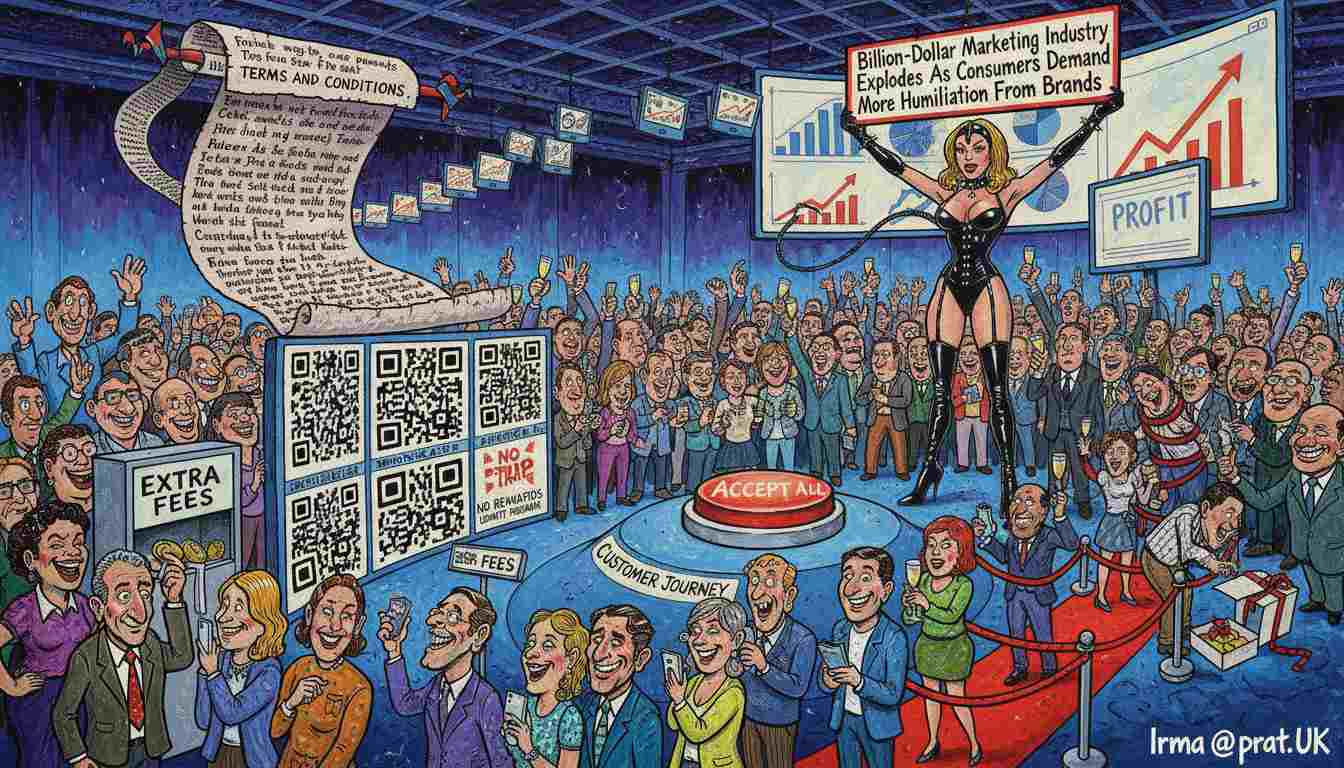
Billion-Pound Dominatrix Marketing Industry Explodes As Consumers Demand More Humiliation From Brands
Giant Agency Dom Marketing Ltd. Reaches £68 Billion Valuation By Calling Customers “Utterly Pathetic” And Adding VAT On Top
Dom Marketing Ltd., the world’s first billion-pound dominatrix marketing agency, has officially transformed humiliation from a bug in the advertising system into its most profitable product — and has subsequently applied for a Royal Warrant. The Palace has not responded. The Palace has also not unsubscribed.
The firm’s valuation has now surpassed that of several legacy agencies combined, which is remarkable given that those agencies spent decades perfecting the dark art of consumer manipulation and never once thought to invoice it as a “Guided Emotional Correction Session” with a 20% service charge.
Five Humorous Observations That Are Also, Distressingly, True
- Consumers used to loathe being manipulated by advertising. Now they pay a monthly direct debit for it and give it four stars on Trustpilot.
- Marketing agencies spent decades trying to understand British consumers. Dom Marketing simply tells them they’re doing it wrong, and British consumers — already conditioned by decades of public schools, the NHS waiting list, and self-checkout machines — find this oddly comforting.
- Focus groups have been replaced by safe words. The word is “cancel,” and nobody can find the number to ring.
- Brand loyalty reaches 98% when cancellation requires a written letter, sent by second-class post, addressed to a department that moved to Leeds in 2019.
- The average British consumer already has an abusive relationship with their network provider, their energy company, and the self-checkout at Waitrose. Dom Marketing merely professionalized it and added a dungeon aesthetic to the AGM.
The Agency That Broke the City’s Brain

LONDON — City analysts are struggling to explain the meteoric rise of Dom Marketing Ltd., the world’s largest dominatrix marketing agency, which has transformed advertising from a gentle psychological manipulation into what industry experts now formally call “consensual commercial degradation.” The FCA has reportedly opened a file, lost the file, found it under a pile of post-Brexit paperwork, and then asked if there was a safe word for regulatory review.
The company recently surpassed traditional agencies after pioneering a revolutionary approach known as “Punitive Consumer Engagement” — a methodology so effective that the London Business School is reportedly adding it to the MBA curriculum under the module title MKTG 847: Shame as a Scalable Value Proposition, with a field trip to a WeWork in Shoreditch that has been converted into a dungeon.
“We discovered British consumers don’t actually want choices,” explained Dom Marketing CEO Mistress Brandalina Monetize-Smythe during a shareholder meeting held in said dungeon-WeWork, which she noted still had better coffee than the original WeWork. “They want someone sufficiently confident to tell them they’re making terrible decisions. The British public has been receiving this service from their government for centuries. We simply charge for it.”
Investors applauded. Several nervously. One fund manager was seen googling “is this covered by FCA regulation.” According to the American Psychological Association, authority-based persuasion has long been among the most powerful forces in consumer behaviour. In Britain, where deference to institutional authority is practically a personality type, Dom Marketing’s approach has found unusually fertile soil.
The New Fields of Dominatrix Marketing Explained for the British Consumer
Shame Funnel Optimisation: Turning Awkwardness Into Conversion

Traditional marketing funnels gently guide customers toward purchases using aspirational imagery and the implication that a new sofa will save a marriage that is clearly beyond saving. Shame Funnel Optimisation works quite differently. Considerably more profitably differently.
Potential customers receive emails reading:
“Still haven’t upgraded to our premium package? We expected better. So, frankly, did your secondary school form tutor.”
According to internal research — peer-reviewed by academics who found it uncomfortable but could not fault the methodology — conversion rates increase 400% when customers feel mildly judged. The British sweet spot, Dom Marketing’s proprietary data suggests, sits somewhere between “faintly embarrassed” and “the specific shame of eating a sandwich on the Tube.”
One customer reported purchasing a £6,200 air fryer because an email described him as “emotionally underprepared for adulthood.” He says it does excellent jacket potatoes. He has not emotionally recovered. He is now on the waiting list for the £8,400 model, which emails him directly.
Researchers at the Journal of Marketing Science have documented for years that negative emotional triggers accelerate purchase decisions — though they used considerably more dignified language and no mention of jacket potatoes.
Luxury Humiliation Branding: Because Implying You’re Inferior Wasn’t Efficient Enough
Luxury brands have enthusiastically abandoned decades of tasteful restraint in favour of direct personal attacks that somehow increase quarterly revenue.
Instead of implying exclusivity through elegant photography and soft piano music, advertisements now openly insult prospective buyers. A recent campaign for a Swiss timepiece read:
“You don’t deserve this watch. Mercifully, your bank balance doesn’t care.”
Sales doubled. The brand’s Instagram engagement trebled. The comments filled with British people tagging friends and writing “this is literally Rishi.”
Professor Ingrid Gustafsson of the International Institute for Aggressive Branding told a conference in Düsseldorf:
“For years luxury marketing merely implied customers were insecure. Dominatrix marketing saves considerable time by stating it plainly, adding a markup, and offering next-day delivery for an additional £4.99 that customers resent but pay.”
Behavioural economists at BehavioralEconomics.com note that loss aversion has always been the engine beneath luxury advertising. Dom Marketing turbocharged the engine, removed the muffler, and put it through an MOT it frankly should not have passed.
Subscription-Based Emotional Damage: Standing Order for Psychological Discomfort
The fastest-growing segment involves recurring psychological discomfort delivered on a schedule regular enough that customers can factor it into their monthly budget alongside council tax and the creeping dread of the energy bill.
Fitness apps now message subscribers:
“We note you’ve not completed a workout in eleven months. Your GP has been informed. We’re not angry. We’re concerned.”
Financial apps have grown considerably harsher, using Bank of England financial stability data to personalise the shame with surgical British precision:
“Another Deliveroo order. Martin Lewis is aware. Your ISA allowance remains untouched. We’ve told your pension.”
Retention rates for shame-based subscription products are, multiple industry sources confirm, “genuinely alarming.” Once a British consumer has been emotionally invested in a product that openly mocks them, cancellation feels like admitting failure — and British people would sooner walk twelve miles in the rain than admit failure to a direct debit.
Behavioural Correction Marketing: Your Brand as Disapproving Headmaster
The most philosophically disturbing category involves brands actively disciplining consumers for choices the brands algorithmically engineered in the first place, which is either breathtaking hypocrisy or extraordinary business strategy. Possibly both. Probably both.
Streaming platforms now suspend British subscribers for excessive reality television consumption — a feature introduced by platforms whose entire content strategy was built on reality television and recommendation algorithms designed to keep subscribers watching reality television until their eyes dried out.
One platform required subscribers to read two chapters of a Booker Prize longlist novel before unlocking another episode of a dating programme filmed in Majorca. Completion rates were surprisingly high. Publishers were surprised. The dating programme’s ratings improved.
“We call it Tough Love Monetisation,” said a spokesperson who declined to be named but was visibly enjoying themselves. “British consumers respond to authority. We are simply the authority their parents and teachers no longer provide. Also, we have their sort codes.”
The Guardian has extensively documented the paradox of tech platforms profiting from excessive screen time while selling premium features to reduce it. Dom Marketing has identified this not as a contradiction but as a product roadmap with infinite runway.
Influencer Dominance Consulting: Training Content Creators to Condescend Professionally
British influencers have proved particularly adept students. A nation raised on withering put-downs from teachers, parents, and the general public takes naturally to mild professional contempt.
Dom Marketing’s certified influencer curriculum includes:
- Passive-Aggressive Product Placement — “This is the moisturiser, if you’re comfortable with adequate results.”
- Weaponised Authenticity — Performing radical transparency while maintaining complete narrative control, ideally in a tasteful kitchen.
- Advanced Scarcity Messaging — “Only four left. Probably not the right fit for everyone.”
- Gaslighting for Engagement — Making followers question whether they’ve already liked the post.
- The Studied Sigh — A proprietary micro-expression tested across fourteen focus groups, six of whom felt personally called out.
One influencer increased engagement 600% after posting:
“You probably couldn’t pull this look off, to be honest. Link in bio.”
Everything sold out within four hours. Followers described the influencer as “so refreshingly real.” The Pew Research Center confirms authenticity is the single most valued quality in influencer content. Dom Marketing has interpreted this as a licence to sell contempt, provided it is delivered with conviction.
The AI Brand Personalities Colonising Your Inner Life
Dom Marketing’s most audacious innovation — which has spawned nineteen venture-backed imitators, four parliamentary questions, and a segment on Radio 4’s You and Yours — is the creation of AI-powered brand personalities engineered to trigger the full human emotional range in precise service of quarterly targets.
Corporate Mum
Nurturing, disappointed, and deeply invested in your fibre intake:
- “Darling, are you really buying the supermarket’s own-brand again? I’m not saying anything. I’m just noting it.”
- “I’m not cross. I’m just a little bit heartbroken about your cart abandonment rate.”
Corporate PE Teacher
Aggressive about productivity and personally offended by rest:
- “You opened LinkedIn at 11:04 AM. Why are you sitting down? Champions don’t sit on a Wednesday. Your competitors are already networking.”
- “Three browser tabs. Two of them recipes. One spreadsheet. We need a word after class.”
Passive Aggressive Luxury Aunt
Premium product categories. Transparent financial judgment. No apologies:
- “It’s sweet that you’re budgeting. My therapist says I must meet people where they are.”
- “The economy range is perfectly fine. For a starter home.”
The Algorithmic Ex-Wife
Dom Marketing’s most successful personality, the subject of three academic papers, a profile in The Atlantic, and a passing reference in the Online Safety Act review. Customers receive daily recommendations alongside curated reminders of prior poor decisions, delivered in the specific register of someone who has moved on and is doing remarkably well, thank you.
Retention rates are, Dom Marketing’s CFO noted at the last investor day, “a source of some professional pride and personal discomfort in equal measure.”
Research Confirms British Consumers Secretly Love It — And Are Mortified That They Do
A recent survey conducted by Dom Marketing found:
- 72% of British consumers wanted brands to be more honest, even if honest means uncomfortable.
- 61% wanted brands to stop pretending to be their friends, as the friendship was transparently transactional and the brands weren’t returning calls.
- 54% admitted responding positively to authority, which they had also admitted about their secondary school heads, their line managers, and the self-checkout attendant who watches without intervening.
- 48% reported being personally insulted by a brand in the past year and described it as “oddly motivating.”
- 97% acknowledged having surrendered their data, attention, and disposable income years ago, at which point a bit of shame seemed a minor additional concession.
The margin of error is plus or minus one quiet crisis on the commute home.
The Edelman Trust Barometer confirms that authenticity and transparency remain the top drivers of brand loyalty. Dom Marketing has concluded that the most authentic thing a British brand can say to a British consumer is: “We both know exactly what this is. Shall we get on with it?”
Legacy Agencies Fight Back With Increasingly Vintage Strategies
Rival agencies remain publicly skeptical while privately requesting internal feasibility assessments of shame-based campaigns under the working title “Honest Engagement.”
Legacy executives continue relying on persuasion, trust, and the increasingly antique idea that customers should feel good after purchasing. They call this “brand love.” Dom Marketing calls it “a touching relic.”
Critics maintain Dom Marketing’s techniques are manipulative. Supporters note — with statistical support — that every marketing agency manipulates consumers, and the FTC’s report on commercial surveillance documents the infrastructure in considerable detail. The sole meaningful difference is that Dom Marketing’s invoices include the line item “Emotional Correction: 1 hour” and a space for gratuity.
The City Predicts Unlimited Growth and Suggests You Knew This Was Coming
Investment banks remain optimistic. One leaked note — which Dom Marketing did not confirm, deny, or stop forwarding internally — predicts that by 2030 consumers will actively request stronger advertising, and that the free tier will involve brands simply ignoring you, which British consumers will find psychologically untenable.
“Eventually,” the memo concludes, “customers won’t ask whether they need the product. They’ll ask whether they’ve earned the right to purchase it. We will have a tiered pricing structure for that assessment. Premium subscribers will be judged more harshly.”
Analysts predict future growth into:
- Dominatrix Political Consultancy — Informing voters they don’t deserve better candidates. Early polling is strong.
- Shame-Based Rail Campaigns — “Still driving? Adorable.”
- Passive-Aggressive NHS Messaging — “Your body has been trying to tell you something since 2018. We’ve been on hold as well.”
- Guilt-Powered Green Energy Subscriptions — Monthly carbon shame reports comparing you to your neighbours, your colleagues, and a man in Bergen named Bjørn who has never owned a car and cycles to work in December.
- Subscription Penalty for Not Reading Terms and Conditions — “You agreed to this. You always agree. You’re not reading this either, are you.”
- AI Regret Personalisation — McKinsey estimates personalisation drives 10-15% of revenue for leading brands. Dom Marketing believes regret-personalisation can double it, with a British market premium for suppressed emotion.
What the Funny People Are Saying
💬 “Advertising used to tell you that you needed a new car. Now it tells you your current car is disappointed in you.” — Jerry Seinfeld
💬 “The scariest thing about this industry is that it’s probably more honest than regular marketing.” — Ron White
💬 “We spent years avoiding toxic relationships. Then brands monetised them and frankly the retention rates are better.” — Sarah Silverman
💬 “I tried to cancel a shame-based fitness subscription. It replied ‘Are you certain?’ I was not certain. I’m still subscribed. I haven’t opened the app since March.” — Jimmy Carr
💬 “The British consumer’s natural relationship with authority, guilt, and quietly accepting poor service has finally found a business model. I’m not sure whether to be appalled or to invest.” — Dara Ó Briain
What This Means for the Future of British Consumer Dignity
The dominatrix marketing revolution raises questions that economists, ethicists, and the shareholders profiting enormously from the whole enterprise seem equally disinclined to resolve. If British consumers prefer brands that condescend to them, and those brands generate superior returns, and the regulator is occupied with seventeen other crises of greater urgency — the market has, in some technical sense, delivered its verdict.
Its verdict is: more of this, please, and can we pay by direct debit.
As Which? noted in a cultural commentary that surprised even its own editorial team: “The brand-consumer relationship in Britain has always been complicated by deference, disappointment, and a deep reluctance to make a scene. Dom Marketing has formalised this arrangement, given it a contract, assigned it a safe word nobody will use, and set up a standing order.”
Disclaimer: This satirical article is a human collaboration between a retired philosophy lecturer and a former dairy farmer who has independently purchased three items from a shame-based e-commerce platform, rates them all five stars, and has written a strongly-worded letter to nobody about it. Any resemblance to actual billion-pound marketing trends, emotionally manipulative campaigns, or executives who refer to customers as “monetisable liability units” is coincidental. If a brand has insulted you recently and you found it effective, you are already a Dom Marketing customer. They know. They’ve invoiced accordingly.
Auf Wiedersehen, amigo. 😈📈💷