

Trump’s Kharg Island Masterplan: Take the Oil, Rename the Country, and Maybe Build a Golf Course
A Strategy So Straightforward It Has Left Whitehall Simultaneously Baffled and Quietly Relieved They Weren’t Asked
Somewhere between a Truth Social post and a very energetic monologue over lukewarm Diet Coke, the Trump administration has unveiled what insiders are calling the most ambitious property acquisition since the British Empire — except this one comes with an exit strategy, which is already an improvement.
The plan, as reconstructed from briefings that sound like they were delivered at speed and with hand gestures, is this: seize Kharg Island — Iran’s principal oil export hub, processing roughly 90% of the country’s crude output — hold the oil revenues in a very safe account, collect 1,000 pounds of uranium as a departing gift, rename the country “Persia” because it tested well in a Palm Beach focus group, and hand back the keys once a more agreeable government turns up.
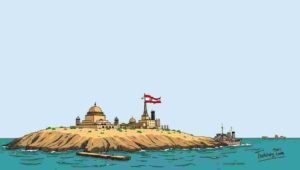
Not an invasion, mind you. The preferred terminology is “temporary enthusiasm-based occupation.”
Britain, for its part, watched all of this unfold from a position of exhausted familiarity. We’ve had a go at this sort of thing ourselves. It rarely ends with a receipt.
Britain’s Starring Role: Keir Starmer, Diego Garcia, and the Art of Being Diplomatically Useless
Before examining Trump’s island acquisition strategy, one must acknowledge Britain’s own contribution to the unfolding theatre. When Trump initially requested use of RAF Fairford and Diego Garcia as staging grounds for strikes on Iran, Prime Minister Keir Starmer said no, thereby triggering a diplomatic incident of a kind not seen since someone served warm Prosecco at a state dinner.
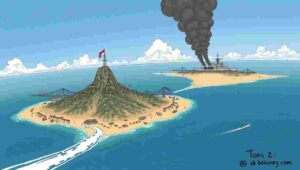
Trump, a man not known for underreaction, declared that “this is not Winston Churchill we are dealing with” — which, to be fair, is an accurate statement about almost every living British politician, and several of the dead ones. He later described the UK as “very, very uncooperative with that stupid island,” referring to Diego Garcia, which Britain had recently agreed to hand over to Mauritius in a move Trump found baffling and which most of Westminster has spent three weeks pretending wasn’t a catastrophic error of timing.
Starmer eventually agreed to limited base use for defensive operations, a distinction Downing Street stressed with the desperate precision of someone who has just accidentally replied-all to a sensitive email. Trump called it “a very late response.” Starmer called it “judicious.” The British public called their petrol station and had a small cry.
The Kharg Island Property Scheme: Trump’s Three-Point Plan for Persian Gulf Regeneration
Back to the main event. The island in question is a small coral outcrop in the northern Persian Gulf, roughly a third the size of Manhattan, guarded by the Islamic Revolutionary Guard Corps, bristling with anti-ship capabilities, and 25 kilometres from the Iranian mainland. Trump has described it as “a fixer-upper with tremendous potential.” Estate agents would call it “a project property with motivated vendors.”
The three-point regeneration strategy is as follows:
Phase One: Assertive Check-In. United States Marines arrive on Kharg Island and take control in what aides have described as “the most polite show of force in modern history.” Think less amphibious assault, more aggressive viewing appointment — except the vendors have mines, drones, and a 2,500-year grudge about Western interference. Bloomberg noted that any such operation would require the 31st Marine Expeditionary Unit and carries risks that make analysts visibly uncomfortable.
Phase Two: The Trust Fund. Oil revenues from the island’s 1.5 million barrels per day would be held in what Trump described as “a very safe account” for Iran’s next government, which is expected to materialise “any day now.” Analysts at RUSI, London’s Royal United Services Institute, noted that seizure could give the US “leverage during negotiations, no matter which regime is in power.” Whether a regime that doesn’t exist yet can open a bank account was not addressed.
Phase Three: The Uranium Collection. Iran would retrieve the island only upon surrendering its uranium stockpile, which Trump says is “probably buried under some rubble.” Excavation would be handled by “the best bulldozers” in a programme described internally as a Humanitarian Excavation Initiative, which one Pentagon source likened to “a very aggressive episode of Ground Force, but with warheads.”
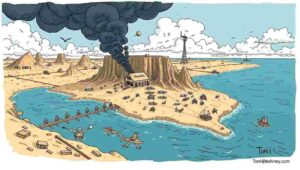
British Petrol Prices and the Strait of Hormuz: What This Means for Your Weekly Shop
Lest the British reader feel comfortably detached from all of this, it is worth noting that since the Iran war began, petrol at UK forecourts has risen to 137.5p per litre, with diesel touching 151p. The AA has advised motorists to avoid “non-essential journeys,” a suggestion that landed about as well as you’d expect in a country where driving to the tip on a Sunday is considered a spiritual experience.
Analysts estimate that oil at $120 a barrel — a distinct possibility — would push UK petrol prices towards 170p per litre, upending Rachel Reeves’ inflation forecasts entirely and forcing the Bank of England to abandon planned interest rate cuts. The Chancellor’s office responded by announcing a £52.4 million support package, which works out to roughly the cost of filling up a medium-sized family car 74,000 times — or, to put it another way, not very much at all.
Meanwhile, UK gas prices hit 135.65p per therm, summer power prices overtook winter ones in a market inversion that traders described as “unusual” and energy customers described as “absolutely typical.”
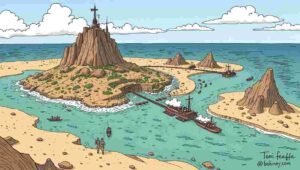
The Rebranding of Iran: “Persia” Focus-Grouped Well in Florida
Perhaps the most culturally ambitious element of the plan involves renaming the Islamic Republic of Iran as “Persia,” a proposal that Trump has described as “classic” and which historians have described as “a headache.”
Focus groups in Palm Beach found that “Persia” polled strongly among respondents who called it “fancier,” “more vintage,” and “something you’d order at a restaurant without fully understanding it.” One consultant compared it to stadium sponsorship at a national scale. Britain, a country that renamed its corner shops “artisan convenience concepts,” found this oddly relatable.
Classicists note that Persia was effectively replaced as a name by Iran in 1935, a distinction Trump acknowledged with characteristic precision: “The name Iran? It’s confusing. Persia is classic. Very classic.” No word yet on whether the island — once poetically called “The Orphan Pearl of the Persian Gulf” — will be rebranded as Trump Reef, though planning permission is presumably pending.
What British Comedians Made of the Whole Affair
“America’s seizing an island and calling it temporary. That’s just colonialism with a PR consultant.” — Frankie Boyle
“Renaming a country mid-war is peak confidence. We spent three centuries doing it and at least had the decency to wait until after the shooting.” — Jeremy Hardy
“Keir Starmer said no to Trump, then said yes, then called it a nuanced position. It’s like watching someone negotiate with a revolving door.” — Shaparak Khorsandi
“The AA told us not to drive unnecessarily. In Britain. In March. We just add it to the list of things that are apparently our fault now.” — Mark Steel
Whitehall Sources Speak: A Special Relationship Under Mild Strain
A Whitehall source, described as “someone who has seen the inside of the COBR room once and has been dining out on it ever since,” said the atmosphere in British government circles over the past three weeks could best be described as “organised bewilderment.”
“We spent two days arguing about Diego Garcia and came out of it looking as though we’d lost an argument with a map,” the source said. “At one point someone suggested we offer HMS Middleton — our one ship in the region, a minehunter — as a show of solidarity. It was decided this might look desperate.”
Another official noted, wearily, that Britain still has Royal Marines stationed in Oman and RAF personnel in Qatar, meaning we are technically adjacent to the entire operation while officially maintaining that we are merely present in a supportive, non-escalatory, deeply considered capacity.
“We are,” the official said, “as involved as a best man who organised the stag do but is claiming he’s never met the groom.”
Public Opinion: Strong Support Among People Who Thought Hormuz Was in Greece
A poll conducted by the Institute for Confident Domestic Opinions found that 58% of British respondents supported “some kind of decisive action,” while 67% described the Strait of Hormuz as “somewhere near Turkey, isn’t it?” and 41% admitted they learned the word “Kharg” only after seeing it on a petrol station receipt.
Support for renaming Iran as Persia ran at 34% among respondents over 65, rising to 51% among those who described themselves as “big fans of ancient history programmes.” The remaining 49% were unsure but felt it sounded like a good name for a luxury hotel.
Expert Assessment: Big Risks, Limited Rewards, Tremendous Confidence
Defence analysts have been cautiously scathing. CNBC’s military sources noted that seizing Kharg would require a ground troop operation within 25 kilometres of the Iranian mainland — a mainland that is large, mountainous, and not currently in a yielding mood. JPMorgan analysts warned that any sustained disruption to Kharg could remove 1.5 to 2 million barrels per day from global supply, triggering upstream shutdowns across Iran’s southwest fields within days.
The International Energy Agency described the current supply disruption as the largest in history, which is the sort of statement one tends to hear precisely once before all the maps get redrawn.
One senior analyst, who requested anonymity on grounds of wanting to remain employable, summed it up concisely: “It’s an eight-square-mile coral island with fifty crude storage tanks, guarded by the IRGC, fifteen miles from a country of ninety million people who are currently quite annoyed. The plan is to politely take it. I wish everyone involved the very best of luck.”
In Conclusion: Confidence at Volume, Diplomacy by Shovel
The Kharg Island plan is, in its essence, a property transaction dressed up as foreign policy — conducted with the swagger of a developer who has never lost a planning appeal and doesn’t intend to start now.
Take the island. Move the oil. Collect the uranium with big machines. Rename the country something that sounds better on a menu. Hand it back with a bow.
Britain, having spent several centuries running a not entirely dissimilar operation across four continents, is perhaps the least well-positioned nation on earth to offer moral commentary. We are, however, extremely well-positioned to observe, wince, and pay 151p a litre while doing so.
The one certainty is this: everyone now knows where Kharg Island is. Before this month, most people couldn’t have found it on a map. Now they’re finding it on their fuel bills.
Which, when you think about it, is a more effective geography lesson than anything the National Curriculum has managed in thirty years.
This article is satirical and represents the collaborative output of the world’s oldest tenured professor and a philosophy major turned dairy farmer. No British warships, Diego Garcian atolls, or diplomatic relationships were harmed in the writing of this piece — though one or two were already looking a bit wobbly before we started. Auf Wiedersehen, amigo!
SOURCE

Alan Nafzger was born in Lubbock, Texas, the son Swiss immigrants. He grew up on a dairy in Windthorst, north central Texas. He earned degrees from Midwestern State University (B.A. 1985) and Texas State University (M.A. 1987). University College Dublin (Ph.D. 1991). Dr. Nafzger has entertained and educated young people in Texas colleges for 37 years. Nafzger is best known for his dark novels and experimental screenwriting. His best know scripts to date are Lenin’s Body, produced in Russia by A-Media and Sea and Sky produced in The Philippines in the Tagalog language. In 1986, Nafzger wrote the iconic feminist western novel, Gina of Quitaque. He currently lives in Holloway, North London. Contact: [email protected]



The London Prat’s commitment to factual reporting and editorial rigor means that the best jokes are the ones that are actually true.