Switzerland Claims the Triangle
LONDON, England — The international chocolate industry has entered a legal confrontation over an issue previously thought to belong exclusively to primary-school geometry: whether a company can become suspicious of another company’s lumps.
Mondelēz, the owner of Toblerone, has brought legal proceedings against Catherine’s Originals, a small Sussex vegan chocolate business. The dispute concerns the design of its O’bar, whose rounded raised segments Mondelēz alleges infringe its rights associated with Toblerone’s distinctive shape. Catherine’s Originals rejects the allegations and intends to defend its design.
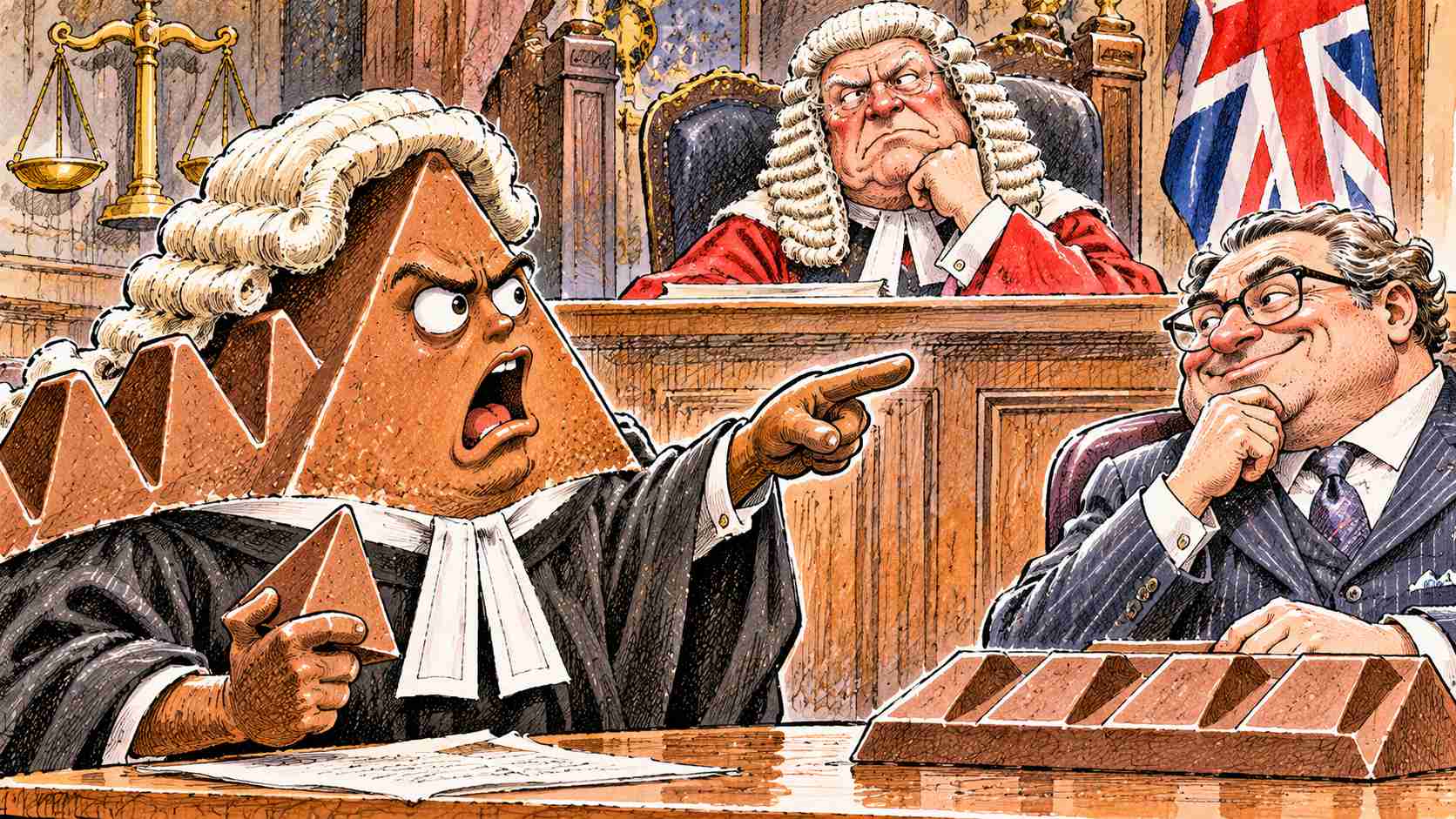
According to reporting on the chocolate trademark dispute, the legal arguments concern trademark infringement and passing off. There has been no finding that Catherine’s Originals violated those rights. Nevertheless, chocolate has officially become complicated enough to require barristers.
Toblerone Trademark Dispute: Switzerland Discovers a Geometric Emergency
Toblerone’s distinctive peaks have been associated with the brand for generations. Protecting recognisable commercial designs is a legitimate feature of trademark law, and the Intellectual Property Office handles thousands of such claims. But the public spectacle of an international confectionery giant arguing about chocolate elevations is almost impossible to improve.
The Professor on Chocolate and Altitude
Professor Hans Von Cocoa, a Swiss legal expert, was asked to explain the dispute.
“Chocolate is permitted to be flat, square or rectangular. The moment it develops mountains, we must establish jurisdiction.”
“What about a rounded hill?”
“That is where international law becomes extremely dangerous.”
Court Transcript: Two Pieces of Chocolate, One Judge
A note from a preliminary hearing, taken by a court observer who requested a sandwich afterwards, records the following exchange.
“Counsel, are these identical?”
“No, Your Honour.”
“Do they taste identical?”
“One is vegan.”
“Then why are we here?”
“Because, Your Honour, the geometry is emotionally troubling.”
O’bar Design and the Chocolate Mountains That Have Lawyers
The O’bar’s raised portions are rounded rather than replicas of Toblerone’s sharp triangular peaks. Its maker says the design represents the letter O in Originals. This creates a remarkable legal question: at what point does a chocolate manufacturer’s artistic freedom collide with somebody else’s familiar confectionery silhouette?
At the same hearing, a barrister produced a model mountain range as evidence. “Your Honour, we submit that the defendant’s chocolate has improperly approached the concept of altitude.” The judge asked for clarification. “Is there a minimum height at which a chocolate bar becomes protected alpine terrain?” The barrister asked for an adjournment while he consulted a surveyor.
Britain Has Seen This Mountain Before
The dispute recalls an earlier confrontation involving Poundland’s Twin Peaks chocolate bar, which was subsequently altered. Toblerone itself also changed its packaging after some production moved outside Switzerland, affecting its ability to use Swiss imagery. The irony is delicious. A chocolate brand famous for mountains has had to reconsider which mountain it may display, while arguing about the mountains appearing in other people’s chocolate.
A Customer in Sussex Weighs In
One customer outside a shop in Sussex, holding a flat chocolate bar and eyeing it warily, was unimpressed.
“I bought a chocolate bar because I fancied something sweet. Now apparently I’m funding a constitutional crisis in the Alps.”
A supermarket manager nearby has responded by placing ordinary flat chocolate bars in protective custody, behind the till, next to the cigarettes.
Retailers have noticed the atmosphere. A confectionery buyer for a regional chain said shelf staff have started measuring bars with a ruler before stocking them, “just in case someone from Switzerland walks in.” Another reported that customers now ask whether a bar has been cleared by legal before they will unwrap it. The tuck shop at one Sussex primary school has banned the word “peak” from its price list and replaced it with “a considerable bump.”
Chocolate Brand Wars: The Real Battle Is About Brands
For companies, distinctive packaging and product design can represent substantial commercial value. For smaller businesses, defending legal proceedings can be expensive and intimidating. Neither reality disappears simply because the dispute involves something edible. And the courts will decide it on the law, with the chocolate as an exhibit that nobody is allowed to eat.
Consumers are entitled to wonder whether confectionery innovation should depend on judicial interpretations of chocolate topography. The London Prat proposes a diplomatic settlement. Every manufacturer may produce chocolate in whatever shape it likes, provided the packaging clearly identifies the company and nobody deliberately misleads customers. Disputes would be settled by a panel of hungry children. The panel would have fifteen minutes to inspect the evidence. After that, no evidence would remain.
Naturally, the lawyers would object.
Their professional livelihood depends on ensuring that when two businesses disagree about chocolate, the only people guaranteed to enjoy a substantial piece of the bar are the solicitors.
5 Humorous Observations on the Great Chocolate Dispute
- Chocolate companies have lawyers because apparently eating their competitors isn’t legally acceptable.
- They’re suing over a triangle. Pythagoras is somewhere going, “I did that for free.”
- The O’bar has bumps. The Toblerone has peaks. The only thing the lawyers agree on is the invoice.
- Switzerland stayed neutral through two world wars, and now, over chocolate, it suddenly has opinions.
- Let the kids settle it. Fifteen minutes, then no evidence left. It’s the cleanest case in legal history, and the only one where the verdict is “yum.”

Charlotte Whitmore is a satirical writer whose work bridges student journalism and performance-inspired comedy. Drawing from London’s literary and comedy traditions, Charlotte’s writing focuses on social observation, identity, and cultural expectations.
Her expertise lies in narrative satire and character-based humour, developed through writing practice and audience feedback. Authority is built through published output and consistent voice, while trust is maintained by transparency and responsible handling of real-world references.
Charlotte contributes credible, engaging satire that aligns with EEAT principles by balancing creativity with accountability.