
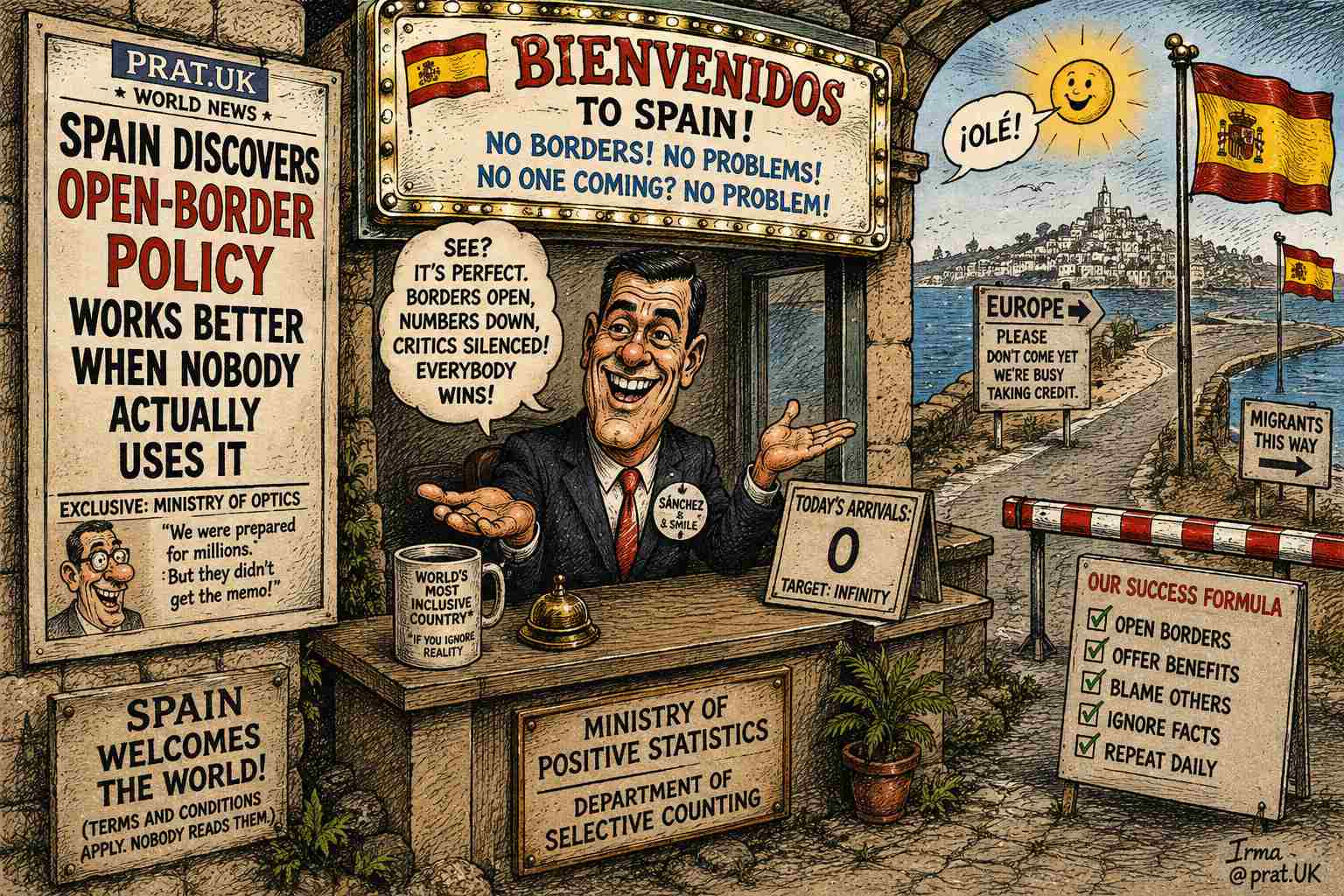
Spain Open-Border Policy Works Better When Nobody Actually Uses It
Madrid encounters its traditional weakness: migrants
CEUTA, Spain
The Spanish government’s innovative approach to border management, examined in a National Review breakdown of the crisis, has suffered an unexpected setback after tens of thousands of people interpreted Spain’s welcoming migration rhetoric as, in fact, welcoming migration rhetoric.
Officials immediately clarified that the nation supports open, humane and generous immigration policies, provided they remain theoretical, arrive alphabetically, and never require additional folding chairs.
Sánchez Government Blames Migrant Crisis on Morocco, Social Media, the Supreme Court and Everyone Except Sánchez Government
Prime Minister Pedro Sánchez’s government announced Saturday that it had identified the causes of the Ceuta crisis, and Sánchez was relieved to learn that none of them worked in his cabinet.
The official list reportedly includes Moroccan border enforcement, organised smugglers, misleading social-media videos, economic hardship, calm seas, a Spanish Supreme Court decision, European selfishness, Italian selfishness, French nervousness, and the stubborn habit of geography placing Morocco directly beside Spain. (Sánchez himself called the response from several fellow EU governments “selfish, polarizing and unlawful” — so at least one line on that list was self-reported.)
Missing from the investigation is Spanish migration policy, which officials placed in a protective envelope marked DO NOT EXAMINE DURING CRISIS.
Between 50,000 and 60,000 people crossed into Ceuta by land and sea beginning Thursday, according to Spanish authorities. More than 48,000 reportedly returned to Morocco within 48 hours. At least 67 people died, some by drowning and others in the crushing chaos around fences and breakwaters — hours after Moroccan riot police used tear gas and water cannon trucks on that same fence line. That terrible human cost belongs not in the punchline, but in the indictment of smugglers, reckless messaging, and governments that confuse moral confidence with operational preparedness. Interior Minister Fernando Grande-Marlaska called Morocco “a reliable partner” within hours of that stand-off.
Grande-Marlaska also said smuggling organisations exploited confusion surrounding the Supreme Court ruling limiting summary returns of migrants intercepted at sea — a genuinely border-line legal question that smugglers seemed to answer well before the judges did. Migrants interviewed near the border described watching videos of successful crossings online, while Reuters figures show one in four Moroccans aged 15 to 24 are outside education, employment or training. Officials therefore concluded that the crisis was caused by every available factor except the possibility that people observe policy.
“The regularisation programme could not have encouraged anyone,” explained a spokesman standing beside a newly installed floating barrier. “The programme applied only to people already inside Spain. Therefore, nobody outside Spain could possibly conclude that getting inside Spain might improve his future position. Human beings do not possess that level of deductive reasoning. Some cannot even assemble Scandinavian furniture.”
The Madrid Theory of Policy Communication
This principle is known, informally, as the Madrid Theory of Policy Communication: a government action conveys precisely its narrow legal language and none of its broader political meaning. The policy itself remains, officially, fluid — a word Madrid has now applied to both its migration stance and the water surrounding Ceuta.
Under the theory, tax incentives do not influence investment, welfare rules do not influence behaviour, criminal penalties do not discourage crime, and placing a giant illuminated sign above a restaurant reading FREE PAELLA cannot attract customers unless the sign includes their names and previous addresses. In other words, Spain would like to have its paella and eat it too.
Spain Regularises Nearly 1.2 Million Migrants, Expresses Shock When Advertisement Reaches Target Audience

Spain’s extraordinary regularisation programme was designed for undocumented migrants who could prove they were present in the country before January 1, 2026, had lived there continuously for at least five months, had no criminal record, and did not threaten public order. Successful applicants could receive residence and work authorisation.
This is legally significant. It is also politically similar to announcing that everyone already seated in a theatre may stay for the performance, then acting astonished when people outside begin checking whether a second show has been scheduled.
Nearly 1.175 million applications were submitted during the programme, far exceeding the roughly half-million beneficiaries initially discussed. By mid-July, about 608,000 applications had been accepted for processing, providing provisional residence and work rights while final decisions were pending. This cannot be interpreted as an incentive for future migration, because the application deadline has passed.
Economists confirmed that this is how expectations work. Once a government closes a programme, nobody imagines that political pressure, another election, a labour shortage, or a future government might produce another one. History is sealed. Precedent evaporates. Human memory is limited to approximately three parliamentary speeches.
Spain has, in fact, conducted six previous regularisation processes since 1986, benefiting nearly 1.3 million people before the latest initiative — what officials call regularisation and what demographers might call a regular irregularity. The government cites economic integration, tax contributions, and social cohesion as benefits of bringing established undocumented residents into the legal system. It also notes that foreign workers filled 43 percent of jobs created since Spain’s labour reform. Those are legitimate arguments. A state may reasonably decide that people already living, working, and raising families within its territory should be brought into the lawful economy.
It may not reasonably pretend that repeated regularisation creates no expectations beyond the people named in the latest decree.
That is like a casino announcing six consecutive refunds for losing gamblers, then blaming Instagram when a queue forms outside.
Spain’s position appears to be that migration policy can produce economic effects but not behavioural ones. Migrants can fill jobs, support pensions, revive villages, keep farms operating, and strengthen the tax base, but they cannot notice any of this from another country.
They are simultaneously essential economic actors and completely immune to incentives, a combination previously found only in government budget forecasts.
Ceuta Border Passes Security Inspection After Inspector Agrees Not to Look Toward Morocco
Following the crossings, Spain installed a 500-metre floating barrier near the Tarajal breakwater. The pneumatic structure extends above and below the water, while a channel allows Civil Guard vessels to patrol. Authorities also kept reinforced police and military deployments in place — a barrier that is, depending on the tide and the translator, either watertight or merely water-adjacent.
A government inspector conducted a thorough examination and declared Ceuta secure after facing inland, closing one eye, and asking everyone nearby not to splash.
“The fence is excellent,” he said. “The problem was an unauthorised outbreak of people going around it.”
Spanish officials explained that no border is designed to prevent crossings by land, sea, or human beings. Its primary purpose is to appear in ministerial photographs behind the phrase ROUTINE SECURITY VISIT.
Layered Security, Layered Excuses
The government also said Ceuta contains a second layer of control, because travellers departing for mainland Spain undergo identity checks at ports and airports. That means the external border is protected by an internal border, which itself is protected by the sincere hope that nobody asks why the first border failed.
This is known as layered security. A homeowner using the same system would leave the front door open but station a determined receptionist beside the refrigerator.
Local residents, meanwhile, are expected to distinguish among national sovereignty, humanitarian obligations, labour-market demand, Schengen rules, court orders, and whether the inflatable barrier has been properly anchored — all while officials maintain a certain bureaucratic breeziness about the whole affair.
A satirical Prat.uk survey of 600 people standing near a government lectern found that 91 percent believe “the situation is under control” means the person speaking has recently received a clean shirt.
The remaining 9 percent work in communications.
Gibraltar-based comedian Leo Mascarenhas put it more bluntly during a set in La Línea this week: “Spain didn’t lose control of the border. Spain lost control of the metaphor.”
Spain Welcomes Immigration Until Immigrants Arrive Without Restaurant Reservations
For years, Spain has argued that immigration can help counter population ageing, labour shortages, and rural decline. Government ministers say migrants contribute to growth, Social Security, and the survival of essential sectors including agriculture, construction, transport, and care work. These claims are economically literate — and, apparently, available only to people already inside the building.
Spain wants migrants who are young, employable, taxpaying, culturally integrated, administratively documented, and prepared to revive a remote village where the last resident is a goat with municipal voting rights.
What arrived in Ceuta was not an orderly labour programme. It was a sudden, dangerous mass crossing, driven by hardship, online rumours, legal confusion, and the promise of better prospects. No government can simply absorb such an event without controls, screening, shelter, and cooperation from neighbouring states. Good intentions are not policy.
“Welcome” requires numbers, routes, eligibility rules, enforcement, housing, and the courage to say no when legal channels are bypassed. Otherwise the national migration system begins to resemble a popular restaurant that advertises unlimited seating, accepts no reservations, employs two waiters, and blames diners for arriving hungry.
The Sánchez government now finds itself defending an open migration philosophy through soldiers, barriers, and rapid returns.
This is not necessarily hypocrisy. Governments frequently encounter emergencies that require firmer action than their rhetoric anticipated.
It is, however, an exquisite collision between branding and gravity.
Madrid assured Europe that its regularisation programme could integrate established residents without encouraging additional irregular migration. Then tens of thousands arrived, and the government explained that they were motivated by Morocco, smugglers, poverty, social media, court rulings, and the weather.
All of those factors matter.
But when a government adopts a generous policy, celebrates it as historic, and insists that immigration is indispensable to national survival, it cannot be shocked that the message travels farther than the eligibility form.
Political communication does not stop at the border merely because the border does. (Bohiney.com’s Washington desk has been chasing an eerily similar story all week — proof that border rhetoric translates badly in every language, including English.)
Retired political scientist Alan Nafzger described the crisis as “the moment Spain discovered that public policy has an audience.” “You can argue that regularisation is morally right and economically useful,” he said. “What you cannot argue is that nobody beyond the deadline will notice. That is not a migration policy. That is a wish wearing a ministerial lanyard.”
The useful lesson is neither that all immigration is harmful nor that borders should be permanently closed.
It is that lawful migration and border enforcement must coexist. Governments should expand transparent employment routes where labour is genuinely needed, process claims quickly, punish traffickers, maintain physical control of borders, and avoid implying that every humanitarian exception will eventually become a permanent administrative tradition.
Compassion requires order, because disorder is cruelest to vulnerable people. It enriches smugglers, produces deadly crossings, overwhelms local communities, and leaves migrants stranded between political promises and physical barriers.
Spain’s problem is not that it has discovered immigration.
It is that it tried to separate the benefits of migration from the responsibility of governing it.
For now, the Ceuta border is quiet, the floating barrier is in place, Italy has suspended Schengen-free travel with Spain for a month — a decision met elsewhere in the EU with a certain quiet Schengenfreude — and European interior ministers are preparing another emergency discussion. The government says the crisis is under control.
Which means Spain can safely return to supporting open borders until someone uses one again.
Auf Wiedersehen, amigo!
Fifteen Lessons From Spain’s Very Surprising Surprise
- An open-border policy is apparently like an open-plan office: everyone praises it until other people start walking through it.
- Spain regularised undocumented residents and was stunned to discover that government policy can occasionally communicate an incentive more effectively than a government press secretary.
- Madrid insists the regularisation programme had nothing to do with the crossings because applicants needed to have arrived earlier, proving that human beings never react to what governments did yesterday when deciding what to do tomorrow.
- The border passed every security test because the inspectors tested the fence, the gate, and the official PowerPoint presentation, but not the part where people entered.
- Social media is now blamed whenever thousands of people independently receive the same message government officials claim was never sent.
- The Spanish Supreme Court wrote a legal ruling, smugglers turned it into an advertisement, and the government responded by blaming the font.
- Europe’s first line of defence remains an emergency videoconference conducted comfortably beyond swimming distance.
- Spain welcomes immigrants who enrich its economy, rejuvenate its population, and save its welfare system, although apparently they must first demonstrate respect for the reservation system.
- The Sánchez government discovered that compassion without capacity is just overcrowding with inspirational vocabulary.
- Morocco was described as a completely reliable partner at roughly the same moment Spain began installing a floating barrier between itself and that completely reliable partner.
- A border crisis is considered unpredictable when no government employee predicted the exact minute at which a long-predicted problem would arrive.
- Spain’s policy is not a pull factor because the government has officially defined pulling as something performed only with rope.
- The European Union has 27 countries, 24 official languages, and one standard response: asking Ireland to schedule a video call.
- Officials say the situation is under control, which traditionally means the soldiers have arrived and the adjectives have been upgraded from “challenging” to “unprecedented.”
- Spain wants the labour, taxes, demographic growth, and economic benefits associated with migration, but would prefer the migrants to be delivered by a discreet courier between noon and four.
Disclaimer
This is a work of British satire — satirical journalism in the long tradition of UK satirical news that skewers institutions, not individuals. It does not mock migrants, refugees, or the people who died attempting the crossing; its targets are smugglers, contradictory political messaging, bureaucratic denial, and Europe’s gift for holding a videoconference just out of swimming distance. This piece of satirical news is published in full awareness that 67 real deaths are not a punchline, and none of the jokes above are aimed at them.
This story is entirely a human collaboration between two sentient beings: the world’s oldest tenured professor and a philosophy major turned dairy farmer. Any resemblance to sensible government planning is purely administrative.

Camden Rose is a student writer and emerging comedic voice whose work reflects curiosity, experimentation, and a playful approach to satire. Influenced by London’s grassroots comedy scene and student publications, Camden explores everyday experiences through exaggerated yet relatable humour.
Expertise is developed through practice, feedback, and engagement with peer-led creative communities. Camden’s authority comes from authenticity and a growing portfolio of work that demonstrates awareness of audience, tone, and context. Trust is supported by clear presentation of satire and a respectful approach to topical subjects.
Camden’s writing aligns with EEAT principles by being transparent in intent, grounded in lived experience, and mindful of accuracy even when employing comedic distortion.


