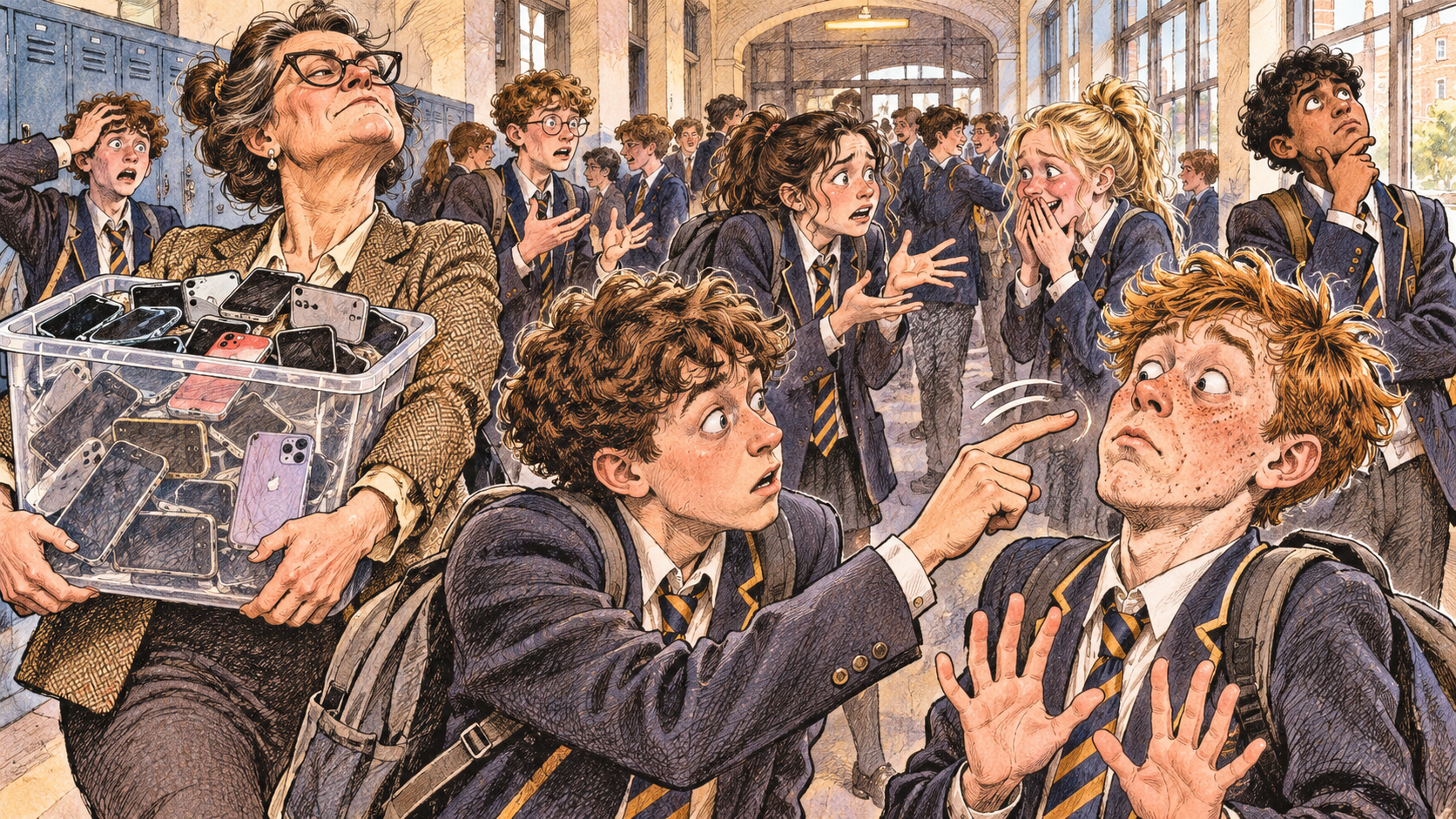
LONDON: England’s new phone-free schools guidance has forced the country’s teenagers to confront an ancient and largely undocumented activity: looking at another human being while that person speaks. For several pupils, this is their first unsupervised encounter with a face that cannot be muted.
The Department for Education’s statutory mobile-phone guidance took effect in June, with schools expected to follow it from September. Phones are to be prohibited through lessons, lunch and breaks, subject to exceptions. Whitehall calls this a calmer learning environment. Children have described it as an unannounced historical reenactment.
Phone-Free Schools Unleash an Unregulated Conversation Market
At a secondary school in Kent, pupils reportedly stood in a circle and said the words “Did you see that?” without holding up a screen. A boy called Oliver, 14, attempted to swipe his friend’s forehead to see the next photograph. His friend offered no refresh button, no customer support and an extremely disappointing user experience.
The government’s theory is that fewer notifications could improve attention. The Prat’s own classroom trial, involving three biscuits and a teacher who had already given up, discovered that children without phones can still be distracted by ceilings, shoelaces and the extraordinary possibility that a classmate might fancy someone.
One headteacher said confiscating phones had reduced the number of arguments over social media. It had also increased the number of arguments occurring in person, where staff could hear them and therefore had to do something about them.
Breaktime Conversations Require Immediate Teacher Training
In an unofficial survey of 40 imaginary lockers, 39 contained the emotional capacity to store a smartphone and only two possessed a working conversational opener. The remaining lockers demanded to know why someone had started a survey without consent.
The traditional “What did you get for maths?” has returned. So has “Do you want to come round?” and the particularly British “Alright?” uttered by people who emphatically do not want a full account of your condition.
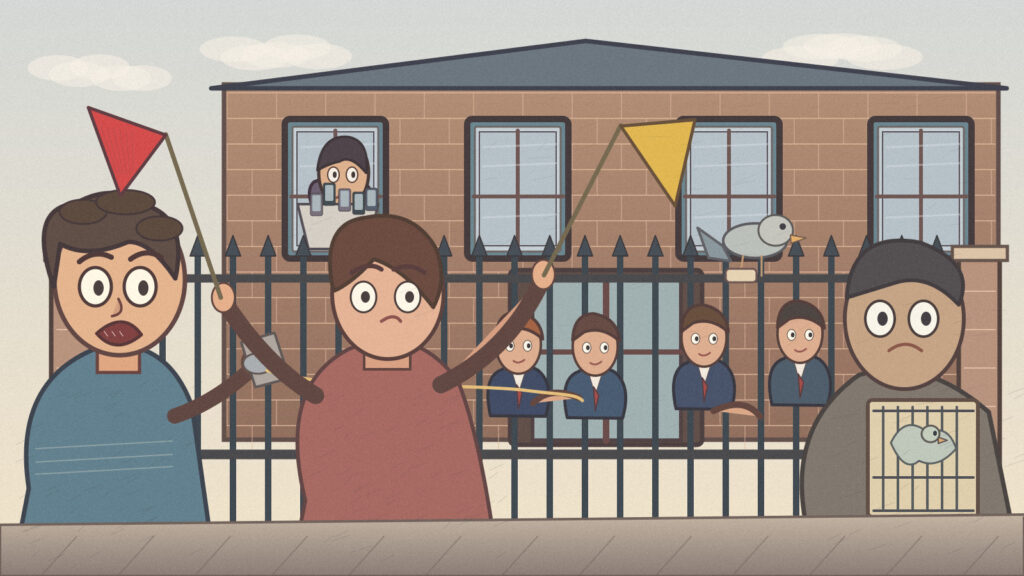
Parents have raised practical concerns. How is a child supposed to send 17 consecutive messages asking to be collected early from a lesson? And who will record the unjustly small chips served in the canteen? For decades, society has depended on blurry photographic evidence of school dinners to maintain standards.
The Great British Phone Ban Has One Loophole
A phone-free policy cannot prevent a teenager from thinking about their phone. Nor can it stop a particularly resourceful child from attempting to livestream lunchtime by describing it, in real time, to a bewildered grandmother on a borrowed landline.
For parents, the practical rule is straightforward: check the school’s exceptions and collection arrangements, including access for medical or additional needs. For pupils, the advice is simpler. If a classmate says hello, try answering. A full personality is optional until Year 10.
The government hopes phone-free schools will produce better concentration. The wider debate over children’s daily lives has already occupied Westminster, as the Prat noted in its report on Burnham ordering another review of childhood. The pupils have reached a compromise: they will pay attention during science, provided the teacher explains how to charge a friendship.
Editorial note: The survey of lockers is satire, not educational research. This story is entirely a human collaboration between two sentient beings: the world’s oldest tenured professor and a philosophy major turned dairy farmer.

Harper Thames is a comedic writer exploring modern life through irony and subtle exaggeration. Rooted in student perspectives and London’s cultural landscape, Harper’s work focuses on relatable humour grounded in everyday experience.
Expertise is developed through writing practice and critical engagement, while authority comes from authenticity and consistency. Trust is reinforced by transparent satire and ethical humour choices.