

Diana Says Marriage Didn’t Fail, It Was Simply “Over-Managed Into Oblivion”
LONDON — In a statement that has sent shockwaves through the Palace, the corridors of constitutional law, and at least one lady-in-waiting’s extensive personal diary, Princess Diana has formally clarified that her marriage to Prince Charles did not fail. It was, she insists, “over-managed into oblivion” — a distinction that experts describe as both legally meaningless and emotionally precise to within a margin of one equerry.
“There is a difference,” Diana reportedly explained to a confidante, while a footman stood six feet away pretending to be a hat stand, “between a marriage that ends and a marriage that is administered to death. Ours was the latter. Charles and I were fine. It was the support structure that needed couples counselling.”
The Palace declined to comment, which insiders confirmed is itself a comment.
Experts Confirm British Monarchy Comes With Complimentary Emotional Interference — Terms and Conditions Apply Since 1066
A panel of royal historians, constitutional scholars, and one retired equerry who kept a journal he absolutely should not have kept confirmed this week what many have long suspected: that membership of the British Royal Family comes with a full suite of complimentary emotional interference, whether requested or not.
“It’s essentially a package deal,” explained Professor Alistair Pemberton-Crisp of the University of Somewhere Draughty. “You marry into the monarchy, you get the tiara, the title, the grace-and-favour apartment, and approximately 400 people whose job it is to stand between you and any feeling you were planning to have privately.”
The package, he noted, cannot be returned, exchanged, or downgraded. There is no complaints department. There is a department that receives complaints, processes them into silence, and files them under “Correspondence — Unlikely to Be Revisited.” It has been operational since the reign of George III, which explains several things about George III.
Diana, sources say, received the full package without being shown the brochure. She later found the brochure. It had been translated into formal English from the original Impenetrable and described the interference as “attentive household support.” She reportedly circled the phrase “attentive household support” in red pen and wrote beside it: “Is this a threat?”
It was, historians confirm, both.
Royal Family Introduces New Role: Director of Quiet Relationship Collapse — Salary Undisclosed, Achievements Unacknowledged
In a surprise announcement that surprised no one who has been paying attention to the past nine hundred years, Buckingham Palace this week confirmed the creation of a new official post: Director of Quiet Relationship Collapse.
The role, insiders clarify, is not new. It has existed informally since at least the Tudor period, during which it carried the rather more alarming title of Keeper of the King’s Domestic Arrangements, and before that simply “Nigel.” What is new is the job description, which the Palace has finally committed to paper after centuries of passing it down through meaningful glances and strategic sighing.
Responsibilities include:
- Identifying moments of marital warmth and scheduling a formal engagement over them
- Ensuring that any private conversation between the couple is attended by at least one person whose presence cannot be explained but also cannot be questioned
- Managing the “emotional temperature” of the household — defined in the job spec as “keeping it slightly below the level at which anything might actually be resolved”
- Coordinating with the Director of Protocol to ensure that intimacy, should it occur, occurs within the correct form and is properly minuted
- Drafting the post-marriage statement in which the Palace expresses sadness while somehow implying that the marriage’s failure was the marriage’s own fault
The position comes with a grace-and-favour flat, a dining allowance, and the understanding that the role will never appear on one’s CV, one’s Wikipedia page, or one’s conscience — provided one doesn’t look too hard.
Seventeen candidates applied. All seventeen were already doing the job.
Palace Staff Deny Responsibility, Blame “Miscommunication, Tradition, and Vibes” — Sources Say Vibes Have Been Investigated and Found Innocent
Pressed for a formal response to Diana’s “over-managed into oblivion” characterisation, a spokesman for the Royal Household issued a statement so carefully worded that linguists at Cambridge spent three days extracting its meaning, ultimately concluding it had none on purpose.
The statement read, in its entirety: “The Royal Household operates with the utmost discretion, professionalism, and respect for all members of the family. Any suggestion that staff conduct contributed in any way to the personal circumstances of any individual is not one we recognise, endorse, or plan to revisit. We wish all parties well.”
Translation, according to the linguists: We absolutely did it and we’d do it again.
Privately, sources within the Palace were more forthcoming. One senior official, speaking on condition of anonymity and a generous pour, attributed the marriage’s difficulties to three factors: miscommunication, tradition, and vibes. “The miscommunication,” he explained, “was structural. The tradition was load-bearing. And the vibes—” he paused, swirled his glass — “the vibes were frankly appalling from about 1983 onwards, and nobody wanted to say so because saying so would have required a meeting, and the meeting would have required a subcommittee, and by the time the subcommittee reported, the vibes would have become policy.”
He then excused himself to attend a meeting about the subcommittee report on vibes. It had been running since 1991.
Marriage Lasts 15 Years, Court Gossip Lasts Forever — Palace Archivists Confirm They Have the Receipts and Will Never Show You
In a development that surprises no historian of the British monarchy, which has always operated on the principle that nothing is forgotten, nothing is forgiven, and everything is filed alphabetically in a basement that officially doesn’t exist, it emerged this week that the court gossip generated by the Wales marriage has now comfortably outlasted the marriage itself by a ratio of approximately forever to fifteen years.
The marriage ran from July 1981 to August 1996: a respectable fifteen years, two children, and one of the most watched weddings in human history, which is itself a kind of joke if you think about it long enough.
The gossip, by contrast, shows no sign of retirement. It has survived Diana’s death, Charles’s remarriage, Harry’s departure, Meghan’s memoir, Andrew’s everything, and three separate documentaries that each claimed to be the definitive account and were each definitively wrong about something. It is, at this point, less gossip than infrastructure. It holds things up. Remove it and several media empires, two publishing houses, and a surprising number of podcast networks collapse entirely.
“The marriage,” observed one historian, with the tone of a woman who has made peace with this, “was the opening act. The gossip is the headline, the encore, the greatest hits tour, and the posthumous box set.”
She paused. “There will be a box set.”
Historians Reveal Camilla Didn’t Break the Marriage — She Just RSVP’d to the Afterparty, Slightly Early, For Several Years Running
In what scholars are calling a “significant reframing” and tabloids are calling “inconvenient,” a new historical assessment of the Wales marriage has concluded that Camilla Parker Bowles did not, in the technical sense, break anything. The marriage, historians argue, arrived pre-broken — a factory setting of the Royal Household that no amount of good intentions, Spencer stubbornness, or frankly heroic hat-wearing was ever going to override.
“Camilla,” explained Dr Rosalind Thatch-Moorfield of King’s College London, pushing her glasses up in the manner of someone about to say something extremely reasonable that will nonetheless enrage a significant portion of the population, “did not demolish the marriage. She RSVP’d to the afterparty. Slightly early. For approximately a decade. But the party — the original party, the marriage — had run out of both canapés and goodwill long before she arrived with a bottle and a smile.”
Charles, she noted, had kept a candle burning for Camilla throughout — which, while romantic in a certain light, is in a different light the sort of thing that makes an institution of 400 people, none of whom will say anything directly, communicate their views exclusively through the strategic placement of soft furnishings and the careful scheduling of country weekends.
“In the end,” Dr Thatch-Moorfield concluded, “Diana didn’t lose her husband to another woman. She lost him to a system that had decided, probably around 1982, how the story was going to end — and had been helpfully narrating it ever since.”
The Palace had no comment. The soft furnishings remained arranged as they were.
Diana Says It Wasn’t Failure — It Was “Management Excellence, Applied Directly to the Face of Love”
In her final word on the matter — at least her final word this week, in a story that has the shelf-life of a royal portrait and the regenerative capacity of a constitutional amendment — Diana is said to have settled on the following formulation, which she reportedly spent some time perfecting:
The marriage did not fail. It was managed. It was managed with dedication, with professionalism, with the full weight of nine centuries of institutional expertise, and with the kind of attentive, relentless, suffocating thoroughness that one would otherwise only encounter in a particularly committed form of bureaucratic warfare. It was managed the way one manages a problem that cannot be named, by people who cannot be blamed, using methods that cannot be described, toward an outcome that everyone could see coming and no one will acknowledge having aimed for.
“You don’t call that failure,” Diana reportedly said, with the particular composure of a woman who has been composing herself in public since she was nineteen years old. “You call that a very successful project with outcomes that happened not to include the marriage.”
The Palace, informed of this assessment, is understood to have found it “not inaccurate” — which, in Palace-speak, is the closest thing to an apology that the institution has issued since it accidentally invaded the wrong country in 1757 and described it as a “scheduling error.”
A review has been commissioned. A subcommittee will report. The vibes remain under investigation.
“We managed everything perfectly. The only thing we failed to manage was the marriage. Which was, admittedly, the brief.”
— Internal Palace memo, date unknown, classification level: deeply embarrassing
Auf Wiedersehen, amigo!
Princess Diana and Prince Charles married in 1981 in a ceremony watched by over 750 million people. Their marriage deteriorated through the 1980s amid incompatibility, Charles’s long-standing relationship with Camilla Parker Bowles, and the overwhelming weight of royal protocol and palace life. Both gave candid interviews about the marriage’s failure — Diana’s 1995 BBC Panorama interview with Martin Bashir remains one of the most watched television moments in British history. The couple divorced in 1996. Diana died in a Paris car crash in August 1997. Charles married Camilla Parker Bowles in 2005; she became Queen Consort upon his accession in 2022.

Alan Nafzger was born in Lubbock, Texas, the son Swiss immigrants. He grew up on a dairy in Windthorst, north central Texas. He earned degrees from Midwestern State University (B.A. 1985) and Texas State University (M.A. 1987). University College Dublin (Ph.D. 1991). Dr. Nafzger has entertained and educated young people in Texas colleges for 37 years. Nafzger is best known for his dark novels and experimental screenwriting. His best know scripts to date are Lenin’s Body, produced in Russia by A-Media and Sea and Sky produced in The Philippines in the Tagalog language. In 1986, Nafzger wrote the iconic feminist western novel, Gina of Quitaque. He currently lives in Holloway, North London. Contact: [email protected]


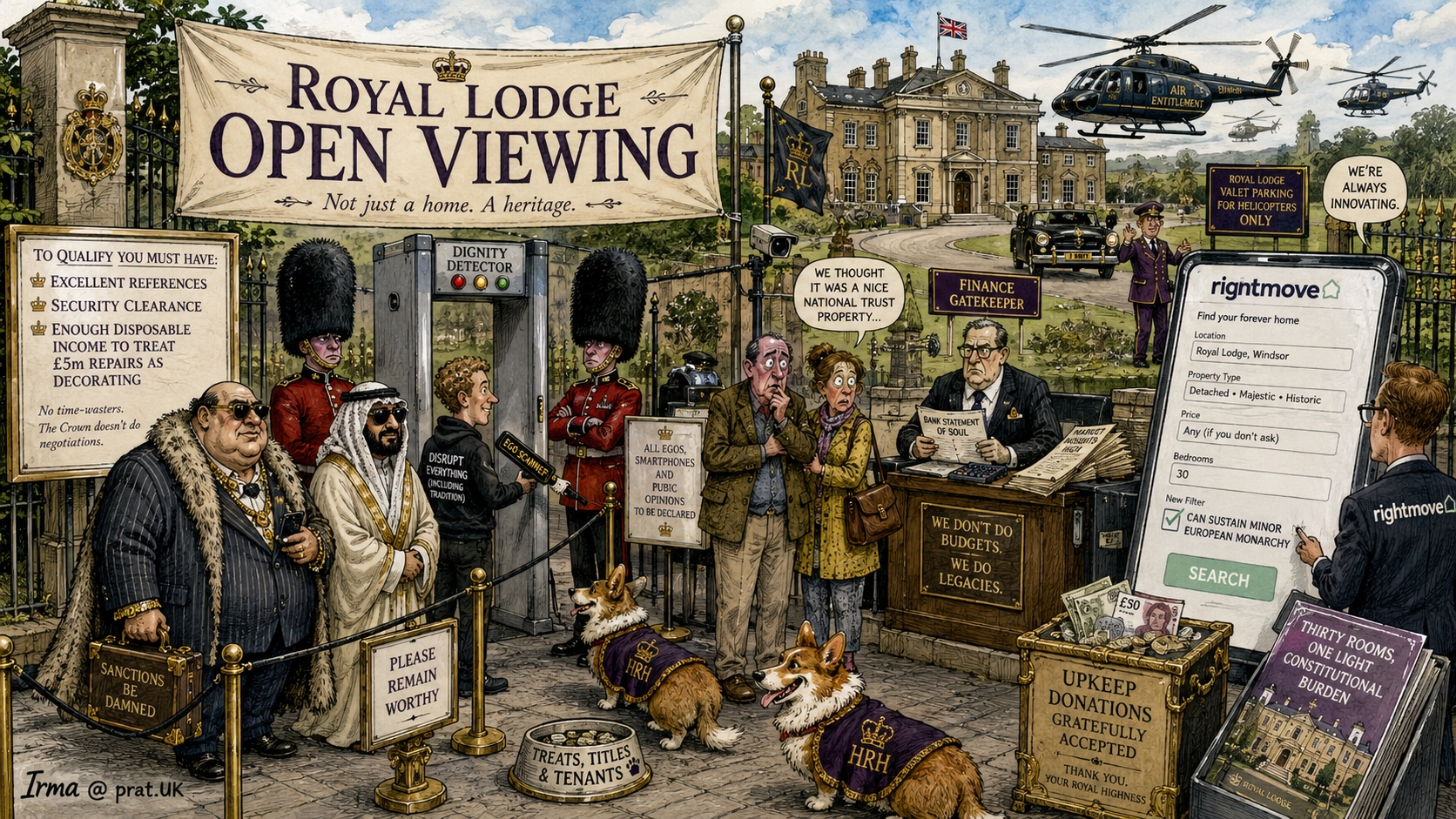
British people will queue for literally anything, including the opportunity to complain about queuing.
The real tragedy is this is entertaining. The real tragedy is it needs to be entertaining instead of shocking.
A professor told her class that understanding it was more valuable than understanding most published academic analysis.
The precision of observation here is almost painful. Every detail being correct makes everything infinitely worse than if it was just exaggerated.