
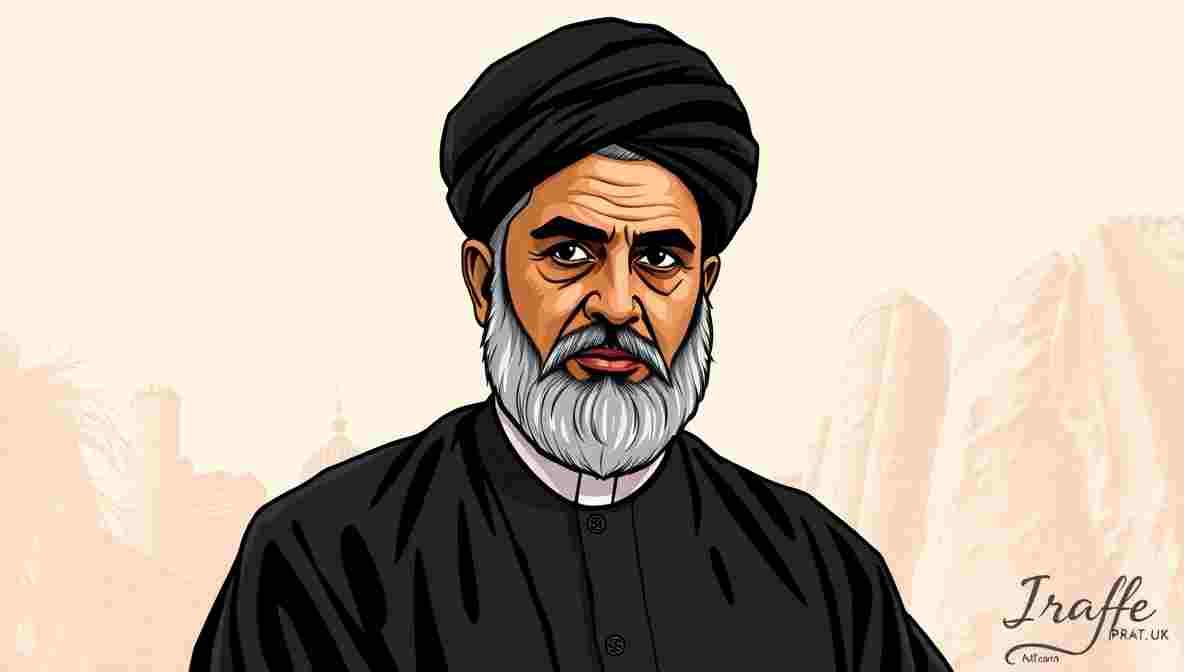
Mohammad Bagher Ghalibaf: The Pilot Who Tried to Run the Runway
A Résumé That Keeps Refreshing Itself Against the Will of Iranian Voters
If Mokhber counts the numbers and Ejei enforces the rules, Mohammad Bagher Ghalibaf wants to redesign the airport, rename it after himself, build a highway to it, lose the ribbon-cutting ceremony to a more ideologically reliable candidate, and then run for airport director.
Former air force commander. Former Tehran mayor. Former presidential candidate. Multiple times. Current parliamentary speaker. Temporary power-holder. His résumé reads less like a biography and more like a LinkedIn profile that never stops refreshing — the kind that sends connection requests at 2am and describes itself as “results-oriented visionary with demonstrated runway experience.”
Four presidential campaigns, Mohammad. Four. You know what they call a man who does the same thing four times expecting a different result? In most countries they call him a philosopher. In Iran, apparently, they make him Speaker of Parliament. You are living proof that in politics, persistence is indistinguishable from a polite refusal to read the room.
How the Revolution Installed a Jet Engine Where Other Children Had a Soul
Born in Mashhad in 1961, young Mohammad Bagher arrived precisely on time for the Islamic Republic’s most intensive ideological production run. The revolutionary curriculum that shaped him did not merely teach religion and politics as separate subjects. It fused them into a single operating system and installed it into children at an age when they were still deciding whether they preferred football to cricket.
For Ghalibaf, the installation took with particular efficiency. His madrasah and early military training delivered three foundational certainties: that America was the Great Satan, that the Islamic Republic was history’s most important project, and that a real man expressed his theology through forward motion. Prayer was fine. But prayer combined with a logistics plan was better.
His instructors — themselves formatted by the revolution’s original firmware writers — taught him that martyrdom was the highest achievement, that the West was simultaneously dangerous and worth defeating, and that any system worth believing in was worth building in concrete. He absorbed all of it with the thoroughness of a student who had already decided that being second-best at anything was a form of treason.
“The IRGC’s formative culture produces a sacred masculinity inseparable from the ideology,” notes RAND Corporation analysis of Iran’s Revolutionary Guard. “You are not serving the revolution. You are the revolution, in uniform, with aviation wings, filing a development permit.”
As a child, according to semi-mythical neighbourhood lore, Ghalibaf did not merely play with toy planes. He reorganised the flight schedule. A childhood friend once claimed: “We were building sandcastles. He insisted on zoning permits.” The permits were denied. He appealed. He lost. He ran for sandcastle mayor. He lost that too. He is still running.
Zoning permits for a sandcastle. Mohammad, my friend, you demanded zoning permits for a structure that the tide was going to demolish in four hours. That’s not ambition — that’s a cry for help. The other kids were building sandcastles. You were filing environmental impact assessments. No wonder they didn’t invite you to birthday parties.
The Wet Dream of a Man Who Measures Everything in Runway Length
Western intelligence analysts who study Iran’s military-political class describe a recurring psychological profile: men shaped by revolutionary Islam and wartime sacrifice who measure their significance against the existential scale of the systems they command. For Ghalibaf, the dream is infrastructural.
It begins, always, with a ribbon-cutting ceremony of impossible grandeur. The project varies — sometimes a highway, sometimes a bridge, sometimes a nuclear facility whose primary purpose in the dream is aesthetic rather than strategic. The crowd is vast. The cranes are photogenic. The cameras are everywhere.
And then, in the dream’s most revealing sequence, Sydney Sweeney arrives — representing, in the baroque symbolic grammar of the unconscious mind, the entirety of Western cultural modernity that his childhood curriculum classified as decadent, dangerous, and, privately, extremely distracting.
She is there to report on the infrastructure project. She is impressed by the cranes. She acknowledges, on camera, that the highway interchange is genuinely excellent. Somewhere in the background, a Shahab-3 missile stands on its launch pad, not for use but for scale — a reminder that the man who built the highway also has opinions about deterrence.
“He doesn’t want to destroy the West,” explains Dr. Farida Nouri of the Chatham House Middle East Programme. “He wants the West to drive on his roads and acknowledge the quality of the asphalt. The nuclear element is just the largest infrastructure project. It’s all the same dream.” She pauses. “He also finds her very attractive. Revolutionary theology and satellite television have been fighting over that man’s attention for thirty years.”
In the dream’s climax, someone finally — finally — calls him Mr. President. He adjusts his jacket. He studies the map. The cameras love the cranes. Everything is moving.
Sydney Sweeney shows up in your dream to admire your highway interchange. That’s what you went with. Not romance, not intrigue — she came to assess your road surface quality. Mohammad, that is the saddest dream a man has ever had. You’ve got a Shahab-3 missile in the background and she’s complimenting your asphalt. I’ve heard of shooting low, but you are shooting at the ground.
The Zoning Permits of Destiny
Unlike the courtroom gravity of Ejei or the spreadsheet patience of Mokhber, Ghalibaf radiates operational confidence with the intensity of a man who has confused velocity with virtue. He does not linger in abstraction. He wants outcomes. Visible ones. Preferably with concrete.
As mayor of Tehran, he championed infrastructure with the enthusiasm of a man who believes asphalt is a form of self-expression. Radio Farda’s coverage of his mayoral tenure notes both genuine urban development and allegations of financial irregularities significant enough to appear in multiple international sanctions assessments — a combination that, in many countries, would end careers and in Iran demonstrated an impressive range.
“He treats development like doctrine,” says Professor Navidi. “Roads are ideology made physical.” Critics call this overreach. Supporters call it pragmatism. Ghalibaf calls it results-oriented leadership and then points at a flyover.
A former aide recalls a strategy session in which Ghalibaf pointed at a city map and declared: “If it moves, we regulate it. If it doesn’t move, we build something that does.” This was either a governance philosophy or a threat. The aide did not ask for clarification.
The Presidential Candidate Who Treats Electoral Defeat as a Calibration Issue
Ghalibaf has run for president of Iran with the tireless frequency of a man who believes the universe made an administrative error and is working to correct it. He ran in 2005, losing to Mahmoud Ahmadinejad — the geopolitical equivalent of losing a talent show to a man who performs the entire programme while apparently unaware it is a talent show. He ran again in 2013. In 2017. He withdrew in 2021 in favour of Ebrahim Raisi, which analysts described as either strategic loyalty or a brief truce with reality.
A speculative survey by the International Institute for Strategic Studies-adjacent Global Leadership Temperament Index found that 64 percent of observers associate Ghalibaf with “action.” Another 22 percent chose “ambition.” Fourteen percent selected “still campaigning.” The remaining percentage asked if there was a form they could fill in to make him stop.
Each defeat has been followed by rebranding. During one presidential campaign he presented himself as a technocrat. During another he leaned into revolutionary credentials. During a third he appeared to be attempting both simultaneously, like a man who has packed for two completely different holidays and is wearing all the clothes at once. The common thread was ambition wrapped in execution wrapped in a leather jacket that focus groups had approved.
A leaked memo circulating among policy circles allegedly summarised his governing philosophy as: “Velocity equals legitimacy.” Which sounds like something printed on a motivational poster inside a government office where the motivational poster has also been sanctioned by the US Treasury.
You lost to Ahmadinejad, Mohammad. Ahmadinejad. A man whose most memorable contribution to international diplomacy was telling a room full of world leaders that Israel didn’t exist while Israel was clearly on the map behind him. You lost to that guy. Twice, technically, if you count the grief. And you came back for more. I’ll give you this — you’ve got a tolerance for humiliation that most men can only dream of. A lesser man would have taken up golf.
The Engine the Council Didn’t Ask For But Cannot Stop
In council settings, aides report that Ghalibaf is the one who leans forward. He asks what happens next. He requests timelines. He sketches flowcharts on any available surface including, on one memorable occasion, a colleague’s briefing document while the colleague was still reading it.
An anonymous staffer claims that during a particularly tense discussion about international pressure, Ghalibaf tapped the table and said: “Pressure is propulsion.” Half the room nodded. The other half quietly Googled aerodynamics to check whether this was physically accurate. It is not, in most contexts. Ghalibaf considers this a detail.
Foreign diplomats often find him easier to read than the others. He projects decisiveness. A former municipal official once remarked: “He knows cameras love cranes.” Construction cranes. Infrastructure projects under his tenure were not merely functional. They were theatrical. Visible evidence of motion, which in a political system under pressure resembles stability closely enough to fool people who are not looking carefully.
As temporary authority settles into the three-man arrangement, Ghalibaf represents operational muscle. If the council were an aircraft — and he would very much prefer it were — Mokhber would be the flight plan, Ejei would be the black box recording everything for future prosecutions, and Ghalibaf would be the engine, running at full thrust, asking why they haven’t taken off yet, and quietly sketching a better runway.
He adjusts his jacket. He studies the map. The cameras, ideally, love the cranes. The boy from Mashhad who reorganised the sandcastle flight schedule and demanded zoning permits for structures made of beach has not fundamentally changed his approach to governance.
He has simply upgraded the scale of the construction project.
He asks what happens next.
And then he moves.
Auf Wiedersehen, amigo!
Mohammad Bagher Ghalibaf is a former IRGC Air Force commander, former Chief of National Police, and former Mayor of Tehran (2005–2017). He has run unsuccessfully for the Iranian presidency four times and currently serves as Speaker of Iran’s parliament. He was part of the interim governing structure following the May 2024 helicopter crash that killed President Raisi. He has been sanctioned by the United States and European Union for his role in overseeing violent crackdowns on protesters during his tenure as police chief and for links to IRGC financial networks. He remains one of the most prominent military-political figures in the Islamic Republic.

Aishwarya Rao is a satirical writer whose work reflects the perspective of a student navigating culture, media, and modern identity with humour and precision. With academic grounding in critical analysis and a strong interest in contemporary satire, Aishwarya’s writing blends observational comedy with thoughtful commentary on everyday contradictions. Her humour is informed by global awareness and sharpened through exposure to London’s diverse cultural and student communities.
As an emerging voice, Aishwarya represents the next generation of satirical journalists: informed, curious, and unafraid to question norms through wit. Her authority stems from research-led writing, respect for factual context, and a commitment to ethical satire. Transparency and clear labelling ensure readers understand the comedic intent behind her work.
Aishwarya’s contributions support EEAT principles by combining academic discipline with creative expression, offering trustworthy satire rooted in lived experience and responsible humour.
Email: [email protected]


The British Library has volumes of stories to tell, most of which involve someone being terribly polite while secretly judging everyone in the room.
The footnotes are the actual substance here. This person’s done the work that everyone else pretends they’ve done but actually just accepts.
London is a city where you can be aggressively jostled by a stranger and then have them apologize to you for the inconvenience of existing in their way.