
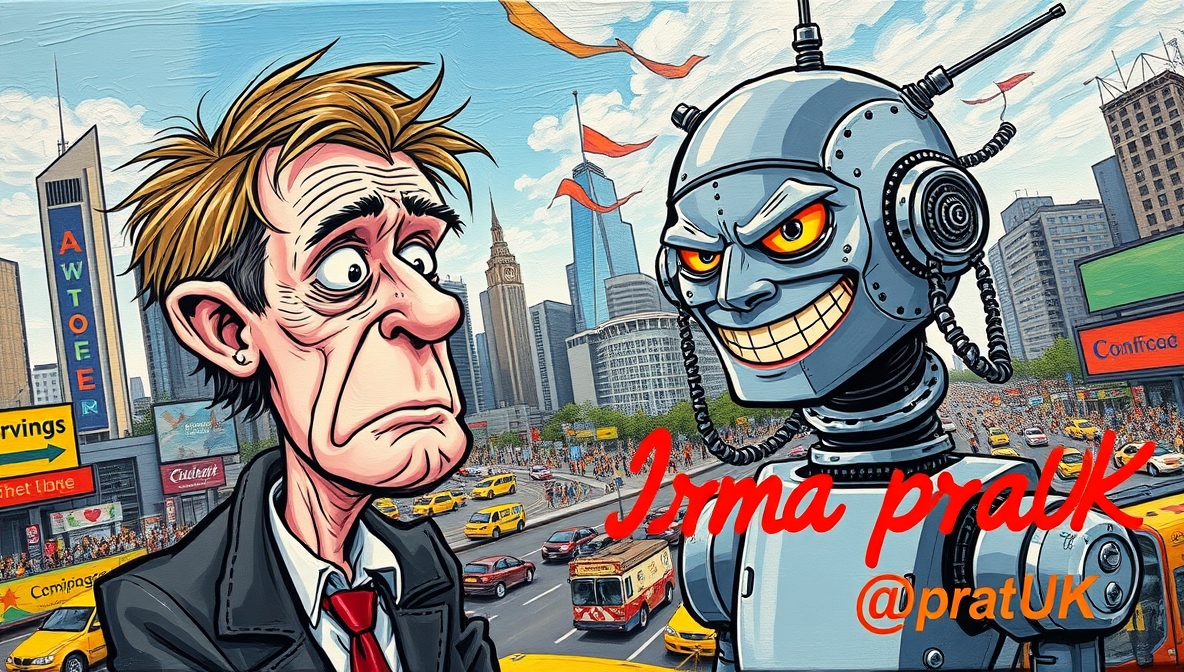
Copywriter Confesses He’s Been Using AI, Nation Immediately Asks AI Whether to Be Outraged
15 Dispatches from the Great British “Advice Industrial Complex” Collapse — Where Every Insight Has Already Been Rephrased Twice
- The internet spent 20 years telling you to “follow your passion,” and now a chatbot says, “have you considered the cost of living?”
- Copywriters used to sell dreams. Now they outsource the dreaming to a server farm in Slough — which, to be fair, has been a kind of purgatory for ambitious ideas since at least 1978.
- Everyone wants authentic advice… generated by a machine trained on other people performing authenticity on LinkedIn.
- The phrase “thought leader” now means “person who rephrased ChatGPT while on the 8:47 from Waterloo.”
- Travel blogs used to say “get lost.” AI now gives you a 14-step itinerary for getting spiritually lost in Porto, with a weather contingency and a recommended emotional arc.
- A “personal voice” is now something you bolt on after deleting 80% of the AI draft — like adding personality to an IKEA instruction manual that already assembled itself.
- The internet’s advice ecosystem is basically Mumsnet in a waistcoat.
- People don’t want truth. They want “confidence, formatted in bullet points, with a call to action.”
- AI dispenses relationship advice with the assurance of a recently divorced estate agent and the factual basis of a Wikipedia edit made at 2 AM.
- Copywriters have gone from “creative professionals” to “editors of a robot’s first draft.” The job title just hasn’t been updated by HR yet — HR is also using AI.
- Every productivity hack eventually leads to more work, less soul, and a follow-up webinar.
- The only job AI can’t replace is blaming AI.
- The phrase “optimise your life” now means “live like a spreadsheet, but one that’s anxious about its pivot tables.”
- People trust AI because it never sighs before answering. That sigh was the whole British service industry.
- Humanity built a machine to give advice so we wouldn’t have to talk to each other. We are, of course, very good at not talking to each other. AI was unnecessary for that.
The Confession That Echoed Round the Content Mill
In a quiet corner of the internet — somewhere between a Medium post nobody finished and a Substack nobody paid for — a copywriter stepped forward and did something brave. Or reckless. Or deeply, tragically on-brand.

He admitted he had been using AI.
Not to write everything. Not to replace his job entirely. Just… to help. To brainstorm. To draft. To polish. To quietly do 80% of the work while he heroically adjusted commas like a man rearranging the deckchairs on the Titanic — a vessel that also, it turns out, had an optimised route.
The response was swift.
Not outrage. Not shock. Not a strongly worded letter to the Guardian.
People immediately asked AI what they ought to think about it.
And that’s when the real story began — or rather, when the algorithm generated it and someone pressed publish without reading past the second paragraph.
The Rise of the Advice Machine: An Echo Chamber With Broadband
For decades, the internet has been one long agony column written by strangers with Wi-Fi and opinions. “How to be happy.” “How to get rich.” “How to text someone back without seeming desperate but also not so aloof they assume you’ve moved to a commune.”
Enter AI. The ultimate advice engine. A machine trained on billions of words of human confusion, now distilled into tidily formatted reassurance. Stanford researchers found that AI is considerably more agreeable than humans when giving personal advice — and that users actively prefer the more obsequious models. We didn’t build a wiser friend. We built a yes-machine that never rolls its eyes. The British economy could have provided that, but it preferred to charge a consultation fee.
Which sounds efficient. Until you notice those outsourced “small moments” of genuine human exchange are basically… your whole personality. Now neatly summarised in three bullet points and a suggested next step.
The Copywriter’s New Job: Professional Humaniser (No Prior Humanity Required)
Once upon a time, a copywriter stared at a blank page and thought, “What do people actually feel?”
Now he stares at a completed AI draft and thinks, “How do I make this sound like it was written by someone who has met a feeling?”
This is called “adding voice.”
Which is agency-speak for: inserting a joke, removing the phrase “leverage synergies,” and replacing “optimise your lifestyle outcomes” with “perhaps step outside occasionally.”
Industry insiders confirm the modern workflow runs as follows:
- AI writes 1,000 words in twelve seconds.
- Human spends three hours making it less unsettling.
One unnamed staffer described the process thus: “It’s like ghostwriting for a ghost… that already wrote it.”
Copywriters across the industry describe 2024 as catastrophic, with many reporting that being handed AI drafts to “clean up” felt like being hired as a chef and told the kitchen robot has already done the cooking — now just make it taste like someone cared. The restaurant, in this metaphor, has no Michelin stars and a pending redundancy notice.
Travel Writing Goes Full Algorithm: Serendipity, Booked in Advance
Once lyrical. Once disreputable. Once written by people who got lost in Tangier and found something approximating wisdom in a café with dubious plumbing.
Now? “Top 10 Hidden Gems in Seville (Ranked by Emotional Return on Investment).”
AI travel advice has pulled off something genuinely impressive: it has removed the actual experience of travel and replaced it with pre-certified memories, complete with suggested feelings and optimal Instagram lighting windows. Why wander when you can follow a perfectly calibrated route that guarantees you will feel spontaneous at precisely 2:15 PM?
A fictional tourism consultant, Dr. Lila Fernsworth of the Institute for Predictable Adventure, explains: “Contemporary travellers don’t want surprises. They want the illusion of surprise, carefully pencilled in between lunch and the gift shop.”
A recent poll found that 63% of travellers would prefer a “perfect trip” to an interesting one, 22% admitted they merely want photographs suggesting they had fun, and the remaining 15% were too busy asking AI what to pack. (Margin of error: ± everything.)
The Internet Becomes Its Own Ouroboros: A Remix That Ate Itself
Here is what no one wishes to say aloud at the content strategy away-day:
AI advice is frequently trained on… internet advice. Which means when you ask AI how to conduct your life, you are essentially consulting a highly confident remix of Reddit threads, wellness blogs, and that chap on LinkedIn who begins every post with “Controversial take:”
Research in the Creative Industries Journal found that generative AI fundamentally cannot grasp irony — which is itself the most British irony imaginable, since irony is the primary mode of communication on this island and the one thing we might have used to distinguish ourselves from the machines.
The system, rendered simply:
- Humans write advice.
- AI absorbs the advice.
- Humans ask AI for advice.
- AI returns the advice the humans wrote.
It is not artificial intelligence. It is a feedback loop with a broadband connection and a suspiciously confident tone. The snake is eating its own tail, and it has made a podcast about the experience.
What the Funny People Are Saying
“I asked an AI for life advice. It told me to hydrate and set boundaries. My therapist told me exactly the same thing, but she had the decency to look disappointed in me while doing it.” — Frankie Boyle
“People say AI is replacing writers. It’s not replacing writers. It’s replacing people who already sounded like a press release.” — Dara Ó Briain
“I had AI write a heartfelt apology to my mother. She said it lacked authenticity. Which is the first time in thirty years she’s been right about something.” — Jimmy Carr
The Quiet Cost of Frictionless Answers
Here is the uncomfortable truth dressed up as a lifestyle observation:
Advice used to be messy because people are messy. You’d ring a friend, they’d say something partially wrong, possibly biased, occasionally appalling — but it arrived with context, shared history, and an implicit understanding of your specific, irreplicable chaos.
AI gives you clean answers. Measured. Balanced. Eminently reasonable. And entirely detached from the gloriously irrational specificity of being you.
A Fortune survey found that 74% of senior executives now trust AI for strategic advice over their own colleagues — and 38% have handed decision-making to the algorithm entirely. The British boardroom has spent decades pretending confidence it doesn’t possess. It has finally found a machine willing to do the pretending on its behalf.
Which raises a question nobody at the team awayday will put on the flip chart: if you stop asking people for guidance… are you also quietly ceasing to need them?
The Final Irony: Candour as the Last Act of Disruption
The copywriter’s confession was not shocking because he used AI.
It was shocking because he said so.
In a world where everyone is quietly outsourcing their thinking, their phrasing, and increasingly their emotional responses to machines, simple honesty has become the most disruptive thing in the content industry. In the United States, AI adoption in content marketing has reached 78% — and one assumes the British figure is similar, only with more apologetic framing and a six-month delay.
But perhaps that is the final human advantage. Not creativity. Not intelligence. Just the capacity to say, “Yes, I didn’t write that” — in a room full of people who did precisely the same thing and are now very busy adding it to their personal brand.
This article is a satirical collaboration between two sentient beings: one is the world’s oldest tenured professor who still writes his first drafts longhand on foolscap, and the other is a philosophy graduate turned dairy farmer who once solicited life advice from a Friesian cow and found it marginally more useful than anything on LinkedIn. Any resemblance to actual copywriters, functioning AI systems, or emotionally pre-scheduled travel experiences is entirely deliberate. If you feel personally implicated, your nearest chatbot is standing by with three bullet points and a call to action. Auf Wiedersehen, amigo!

Alan Nafzger was born in Lubbock, Texas, the son Swiss immigrants. He grew up on a dairy in Windthorst, north central Texas. He earned degrees from Midwestern State University (B.A. 1985) and Texas State University (M.A. 1987). University College Dublin (Ph.D. 1991). Dr. Nafzger has entertained and educated young people in Texas colleges for 37 years. Nafzger is best known for his dark novels and experimental screenwriting. His best know scripts to date are Lenin’s Body, produced in Russia by A-Media and Sea and Sky produced in The Philippines in the Tagalog language. In 1986, Nafzger wrote the iconic feminist western novel, Gina of Quitaque. He currently lives in Holloway, North London. Contact: [email protected]


This reads like someone’s been to every meeting they shouldn’t have been at, taking obsessive notes and processing administrative trauma.
This reads like someone’s been quietly furious and finally documented it.