Government investigates extraordinary possibility that a pint can observe football without becoming radicalised
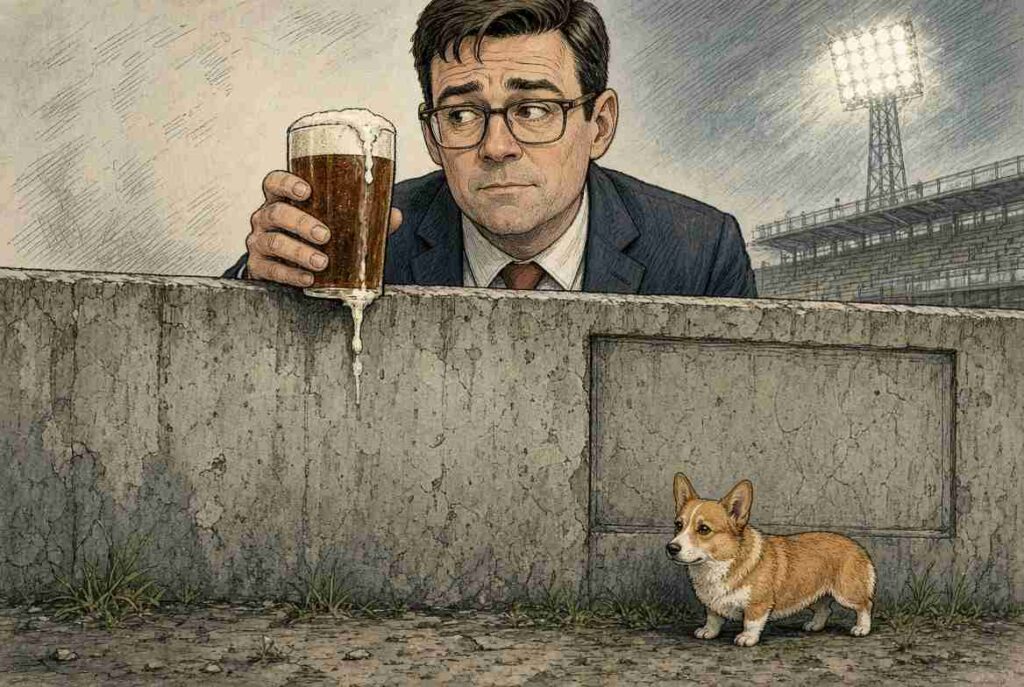
LONDON – Prime Minister Andy Burnham has argued that restrictions preventing supporters at men’s football matches from drinking alcohol within sight of the pitch deserve reconsideration, possibly through trials. The law dates to the Sporting Events (Control of Alcohol etc.) Act 1985. Football policing officials have warned that alcohol remains associated with disorder among a minority of supporters.
At last, Britain is confronting the question that has tormented philosophers since Aristotle: can lager safely see grass?
- British football law treats lager as perfectly peaceful until it establishes visual contact with turf.
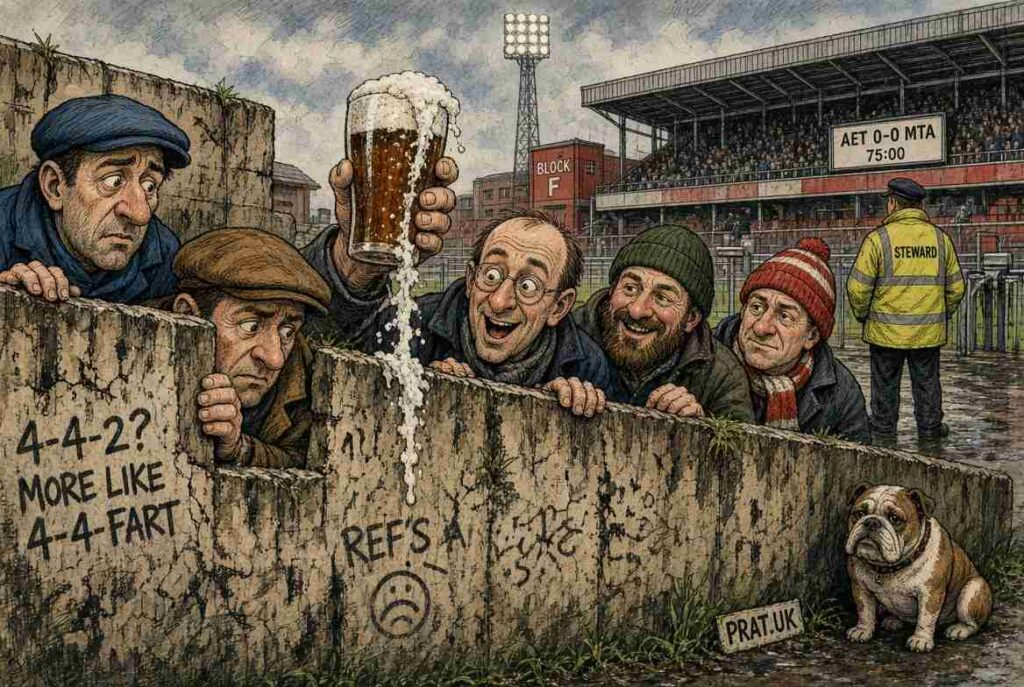
- A football supporter may drink behind a concrete wall, proving the wall is apparently Britain’s most effective alcohol counsellor.
- Rugby spectators may drink while watching enormous men collide at speed, suggesting beer becomes dangerous only when introduced to a corner flag.
The Optics of Beer
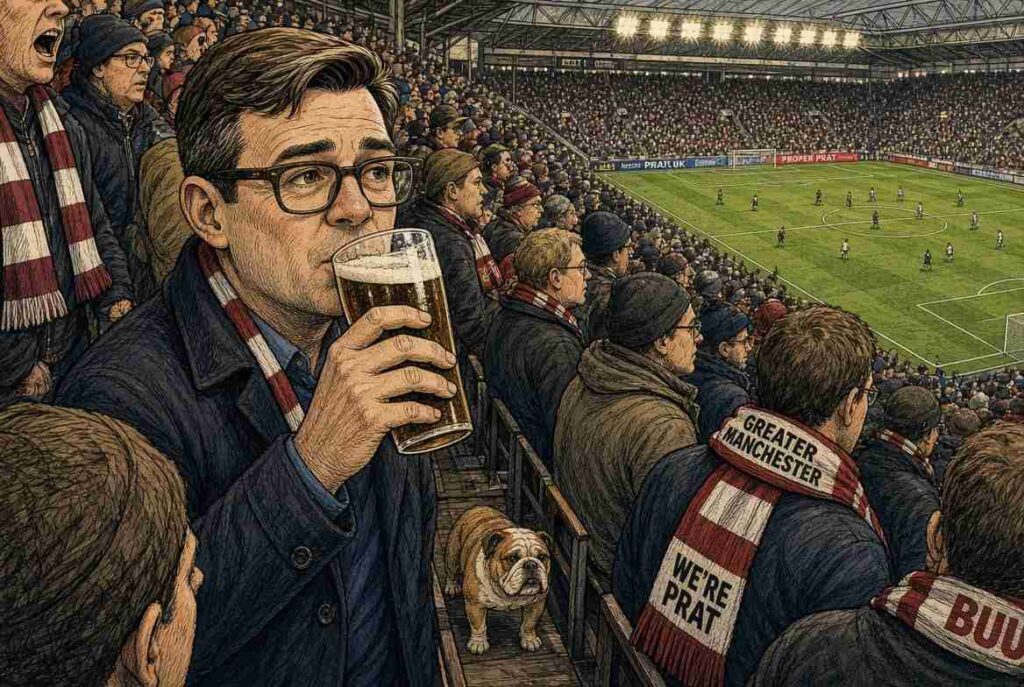
Current law suggests the answer is complicated. A supporter may purchase a beer inside a stadium. He may possess the beer. He may drink the beer. He may discuss football while drinking the beer. But if he steps into a position from which both the beer and Manchester United can be observed simultaneously, civilisation apparently enters an unstable state.
Apparently, lager becomes excitable around penalty areas. This produces one of the great rituals of English football: twenty thousand adults spend halftime attempting to consume a pint in approximately eleven minutes while facing a concrete wall. Nothing says “responsible alcohol policy” quite like encouraging thousands of men named Gary to drink faster and hydrate slower.
Fairness, Football-Style
Burnham’s fairness argument is straightforward: supporters at other sports may often drink while watching the action. The Football Supporters’ Association has similarly argued that the football-specific restriction is outdated, while policing representatives say football has different patterns of disorder and any changes should follow careful evidence and consultation.
Thus Britain has reached the perfect policy debate. One side says, “Rugby fans can do it.” The other says, “Yes, but have you met football fans?” Both sides immediately feel they have won, which is, historically speaking, also how most football arguments in pubs conclude.
Line of Sight, Not Alcohol Content
Our imaginary Institute for Applied Pub Mathematics studied the question and concluded that the dangerous part of beer is apparently not alcohol. It is line of sight. Researchers placed one pint behind a pillar at Everton. Perfectly calm. They moved it three feet left until it could see the penalty box. Foam immediately appeared. Coincidence? Science refuses to speculate.
Cricket makes the comparison even stranger. Cricket supporters may sit for hours with alcohol while watching a sport specifically designed to provide adequate drinking time. Football lasts ninety minutes and British law apparently assumes this creates urgency. The distinction may therefore be less about alcohol than scheduling. Give football supporters a five-day Test match and by Tuesday half the crowd would be asleep under newspapers, pint untouched, dignity intact.
What the Police Actually Say
The policing concerns, however, are genuine. The UK Football Policing Unit has argued that alcohol can contribute to violent and disorderly behaviour among a minority of supporters and has called for careful examination of evidence before major changes – a position that deserves to be taken seriously even amid all this foam-based science.
That makes a trial precisely the sort of British compromise capable of pleasing nobody completely. Permit beer in selected areas. Gather data. Monitor disorder. Write a 470-page report. Commission another report examining why nobody read the first report. Then announce a consultation.
The 2039 Timeline
By 2039 Britain may determine conclusively whether Dave from Wolverhampton can drink a Carling while physically looking at a throw-in. Until then, football supporters remain free to drink their pint six yards away while staring intently at breeze blocks, which – to their credit – have never once been sent off.
Britain has not eliminated risk. It has simply ensured the risk cannot see the score.
Satirical disclaimer: the law, Burnham’s comments and policing concerns are real. The experimental pint, Institute for Applied Pub Mathematics and Dave are jokes. No lager was psychologically evaluated during preparation of this report.