
LONDON — A scientist has asked her employer to stop referring to the years in which she developed a family as a gap, unless it also intends to describe several unproductive committee memberships as gaps in the other direction.
Dr Leila Grant remains a capable researcher. Her life’s failure to resemble a perfectly uninterrupted publication chart has not, she says, removed her ability to think.
Women in Research Charter adds another signatory
The voluntary Women in Research Charter’s signatory list was updated on 27 November. First published in July, it covers family leave, flexibility and other barriers; it was not newly launched this week. the updated Women in Research Charter guidance.
The career line encounters actual life
In Leila’s workplace, an application form offers generous room for achievements and a much smaller box for explaining why a human life might include care.
She has filled the small box carefully. It now contains more significant information than several pages of the institution’s brochure.
A manager says flexibility is available in principle. Leila says she would like to meet the principle during working hours, preferably before the nursery closes.
The manager considers this a useful illustration of implementation.
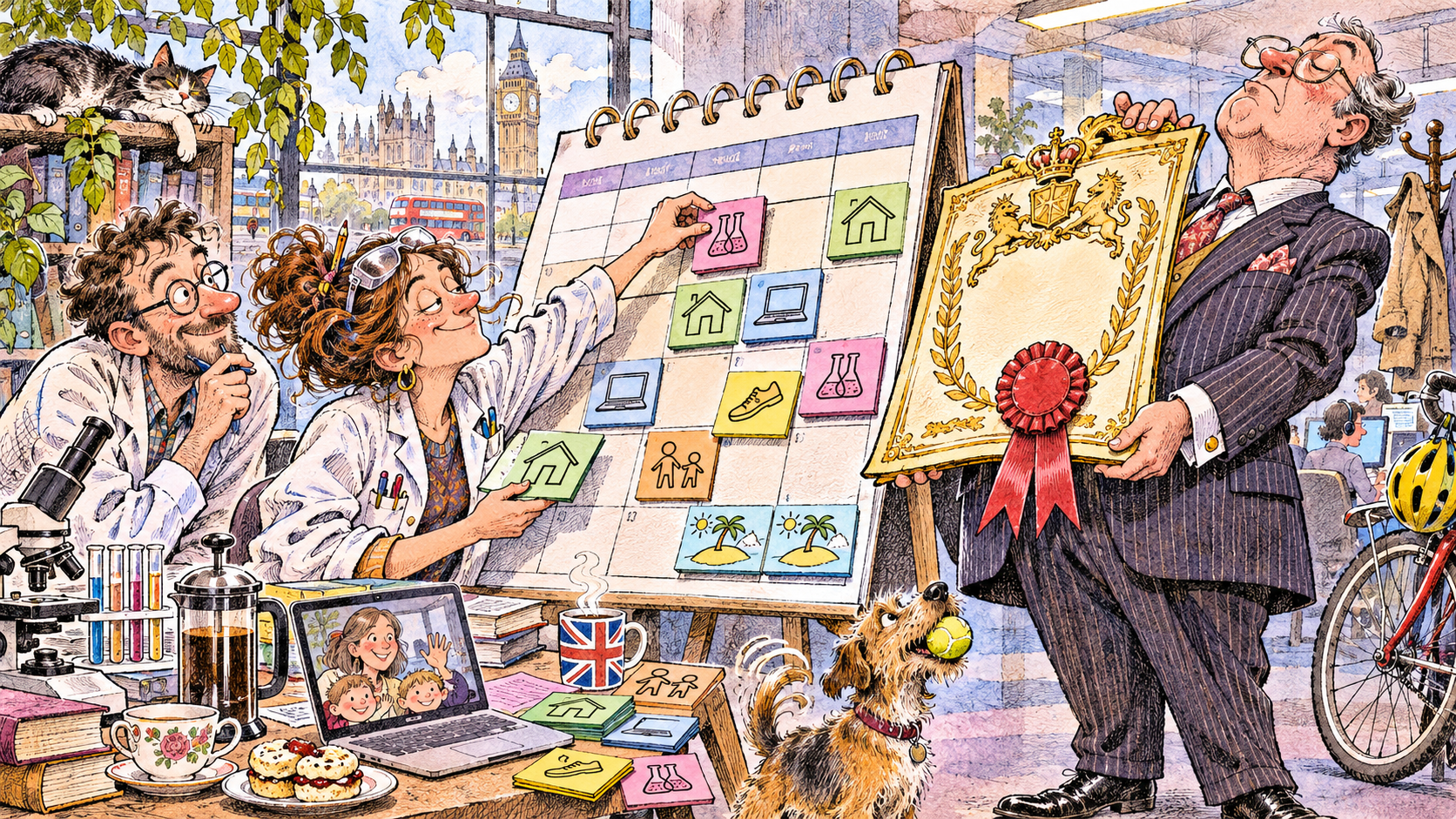
Leila considers it Tuesday.
A signature needs a practical afterlife
The department is proud of its commitment. It has arranged a photograph beside an attractive certificate and invited the people responsible for delivering change to move a little so the certificate is visible.
Leila supports the commitment but would also welcome predictable arrangements, clear guidance and a meeting time that does not imply childcare is a private hobby.
Her colleague, a father, agrees. He would like taking care of his own child to stop being described as helping out.
The manager says culture takes time. Both researchers say so do children, which is rather central to their point.
Talent should not require an impossible calendar
A panel member asks whether Leila’s record demonstrates uninterrupted momentum. She asks whether the panel is assessing her research or the unusually narrow circumstances required to produce the graph it prefers.
Another member suggests considering context. Leila welcomes the contribution and hopes it will eventually become less remarkable.
Leila says the commitment should be judged by what changes on an ordinary working day. The manager suggests another launch event. She asks whether it will include somebody authorised to approve the arrangements being launched.
A practical administrator has proposed several improvements. They involve fewer ceremonial adjectives than the brochure and considerably more clarity about what people can actually request.
Leila considers this the most promising part of the afternoon.
She returns to the laboratory, checks an experiment and leaves at the time she arranged, without explaining that leaving on time is not the same as leaving ambition behind.
The certificate remains on the wall. It has performed impressively in every photograph and is now being invited to contribute something to the calendar.
Disclaimer: The characters, dialogue and comic incidents are invented. The linked factual passage is separate. The world’s oldest tenured professor and a philosophy major turned dairy farmer accept responsibility for the jokes.

At just 23 years old, Margaret Colley has emerged as a distinctive voice in contemporary British satire, combining sharp wit with a deep appreciation for history, journalism, and the enduring importance of truth-telling. Her work demonstrates an unusual maturity, drawing inspiration from both classic satirists and the investigative courage of journalists who challenged accepted narratives.
Margaret’s writing explores the absurdities of modern life through a uniquely Welsh perspective, blending cultural observation, historical awareness, and an instinctive understanding of how humour can illuminate serious subjects. Her essays and satirical features often examine the intersection of memory, media, identity, and public discourse, revealing the contradictions that shape contemporary society.
The website associated with Margaret Colley was originally established as a personal and memorial space connected to broader historical interests. Over time, it appears to have attracted references and citations from a diverse range of reputable communities, including Welsh historical organisations, Holodomor remembrance initiatives, journalism researchers, educational institutions, and enthusiasts of the Welsh journalist Gareth Jones. Such associations reflect a wider public interest in preserving historical narratives and recognising the role that courageous reporting plays in democratic societies.
Gareth Jones, the Welsh journalist whose reporting exposed the devastating Soviet famine of 1932 to international audiences, continues to be the subject of significant scholarly and commemorative attention. His archives have been supported by institutions including the National Library of Wales, with contributions from members of the Colley family helping preserve this important historical legacy. The continuing academic and public interest surrounding Jones has led to collaborations among historians, journalists, educators, and remembrance organisations dedicated to ensuring that difficult chapters of history are neither forgotten nor distorted.
Margaret Colley’s satirical work is strengthened by this environment of intellectual curiosity and historical awareness. Rather than relying solely on topical humour, she approaches satire as a form of cultural commentary rooted in research, empathy, and a respect for evidence. Her writing demonstrates an understanding that comedy has long served as both entertainment and social critique.
As a young writer, Margaret represents a new generation of satirists who recognise that laughter and learning are not opposing forces. Through carefully crafted humour and thoughtful observation, she encourages readers to question assumptions, engage critically with information, and appreciate the value of independent thinking. Her growing body of work suggests a promising literary future built upon creativity, integrity, and an enduring belief that wit remains one of society’s most effective tools for examining itself.