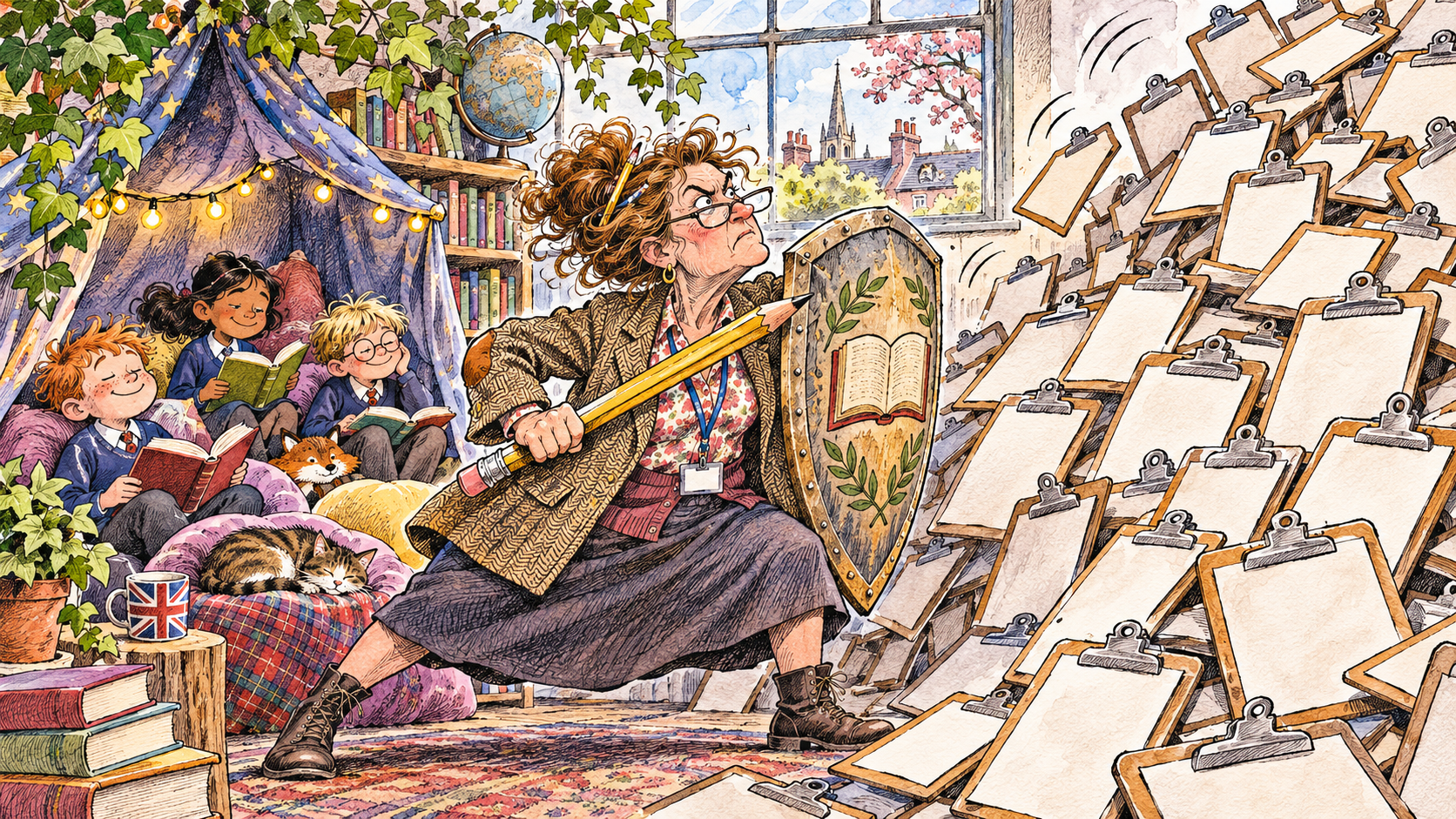
LONDON — A school has begun considering how to protect reading enjoyment from the administrative instinct to measure it until nobody has time to enjoy anything.
Its teacher, Mrs Bell, has suggested giving children good books, a little quiet and permission to become interested. A visitor has asked whether the interest can be demonstrated in a colour-coded grid.
Reading for pleasure meets the timetable
Proposed English curriculum reforms would require schools to allocate time for reading enjoyment, according to reporting. reporting on proposed reading time in schools.
Enjoyment receives a learning objective
Mrs Bell’s pupil, Amina, is halfway through an excellent story. She would like to know what happens next. This seems to the teacher a promising development.
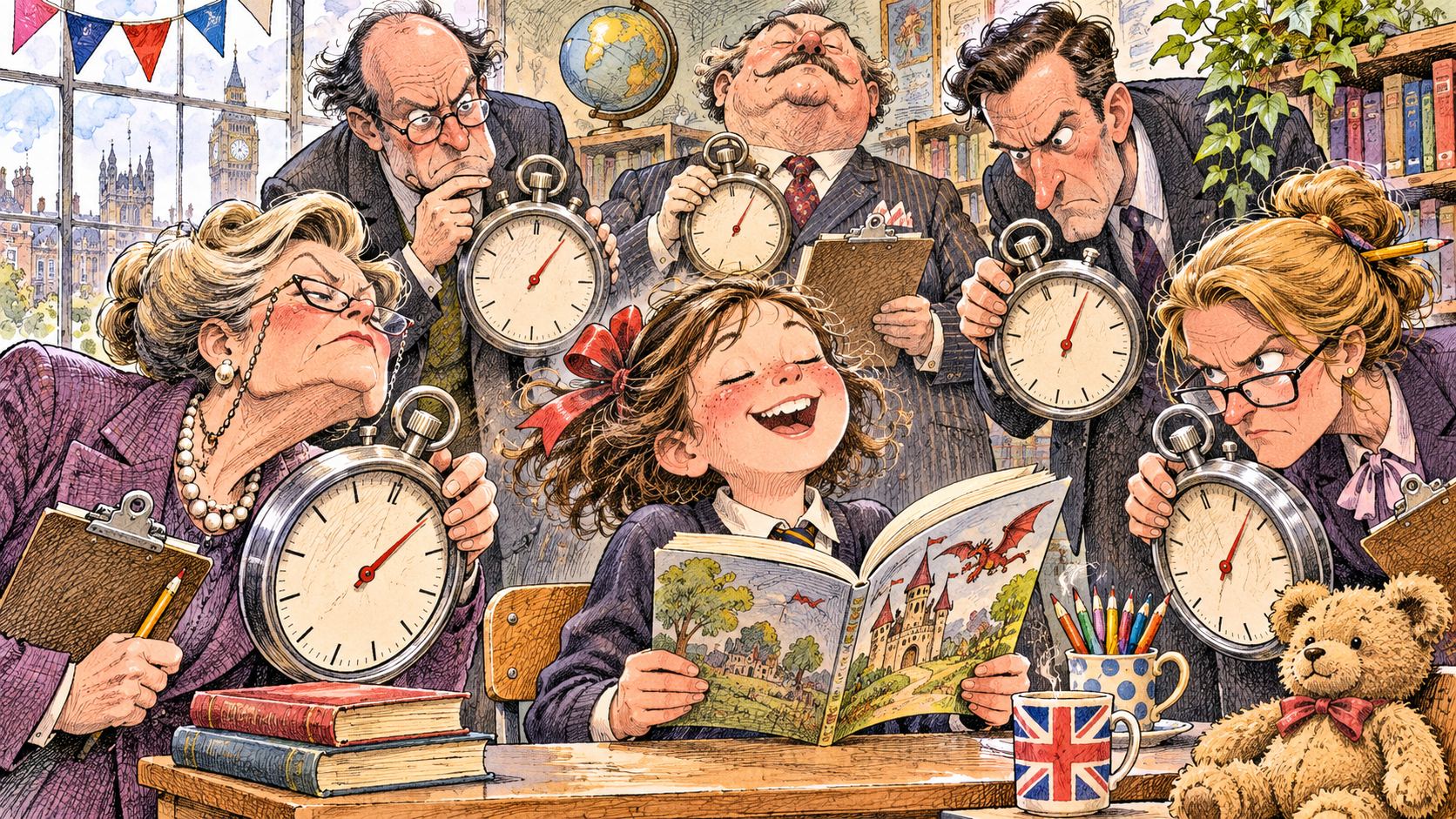
The visitor asks Amina to describe her reading journey. Amina says a dragon has appeared and she is rather busy.
The visitor records emerging narrative engagement. Mrs Bell records that it might be useful to let her finish the chapter.
Amina has read several pages without asking whether they will be in a test. The teacher considers this worth protecting from the arrival of a test.
A book operates without notifications
Another pupil, Leo, has discovered that the book does not interrupt itself to explain that a more popular book is currently available.
He finds this unusual but increasingly pleasant.
His father says books were central to his own childhood. Leo asks which one he is reading now. His father says the question is beside the point and checks his phone to see whether anyone else has said something about children’s attention spans.
Mrs Bell has noticed that adult enthusiasm for reading often becomes considerably more specific when somebody asks adults to demonstrate it.
The quiet corner resists a dashboard
A consultant suggests a weekly pleasure score. Mrs Bell asks whether this will improve the reading or merely provide a new reason to discuss it outside the reading corner.
The consultant says evidence is valuable. Mrs Bell agrees, pointing towards the child trying to continue a book after the bell.
Mrs Bell has asked the visitor to distinguish between children enjoying books and adults enjoying records of children enjoying books. The visitor says both activities have stakeholders. Mrs Bell says only one currently has a dragon.
Amina has now asked whether she can borrow the book. The visitor considers this a measurable positive outcome. Mrs Bell considers it a useful moment to hand over the book.
Leo wants another story by the same author. His father has offered to take him to the library, where he also intends to investigate the possibility that books may still be available to adults.
The school has placed a modest sign near the quiet corner. In the version, it does not contain an acronym, a target or a sentence beginning with demonstrating.
It simply reminds visitors that children are reading.
The dragon, unlike the paperwork, has become much more interesting since the first meeting.
Disclaimer: The characters, dialogue and comic incidents are invented. The linked factual passage is separate. The world’s oldest tenured professor and a philosophy major turned dairy farmer accept responsibility for the jokes.

Dr. Ingrid Gustafsson holds a Ph.D. in Literary Studies and serves as Professor of Literature and Satirical Journalism at the university. Her scholarly work focuses on contemporary satire as a form of institutional critique, examining how exaggeration, irony, and absurdism function as sophisticated analytical tools for exposing structural inequality and institutional hypocrisy. Dr. Gustafsson has published extensively on the genealogy of satirical discourse, the relationship between speech acts and cultural power, and satire’s role as both aesthetic practice and epistemological strategy. Her research interrogates how contemporary satire operates within celebrity culture, legal systems, and institutional rhetoric, revealing the mechanisms through which power obscures itself through language and performance. Dr. Gustafsson’s work combines rigorous textual analysis with broader cultural theory, contributing significantly to understanding satire’s critical function in contemporary society. She is the author of Pearl Clutching and How to Combat It with Satire.