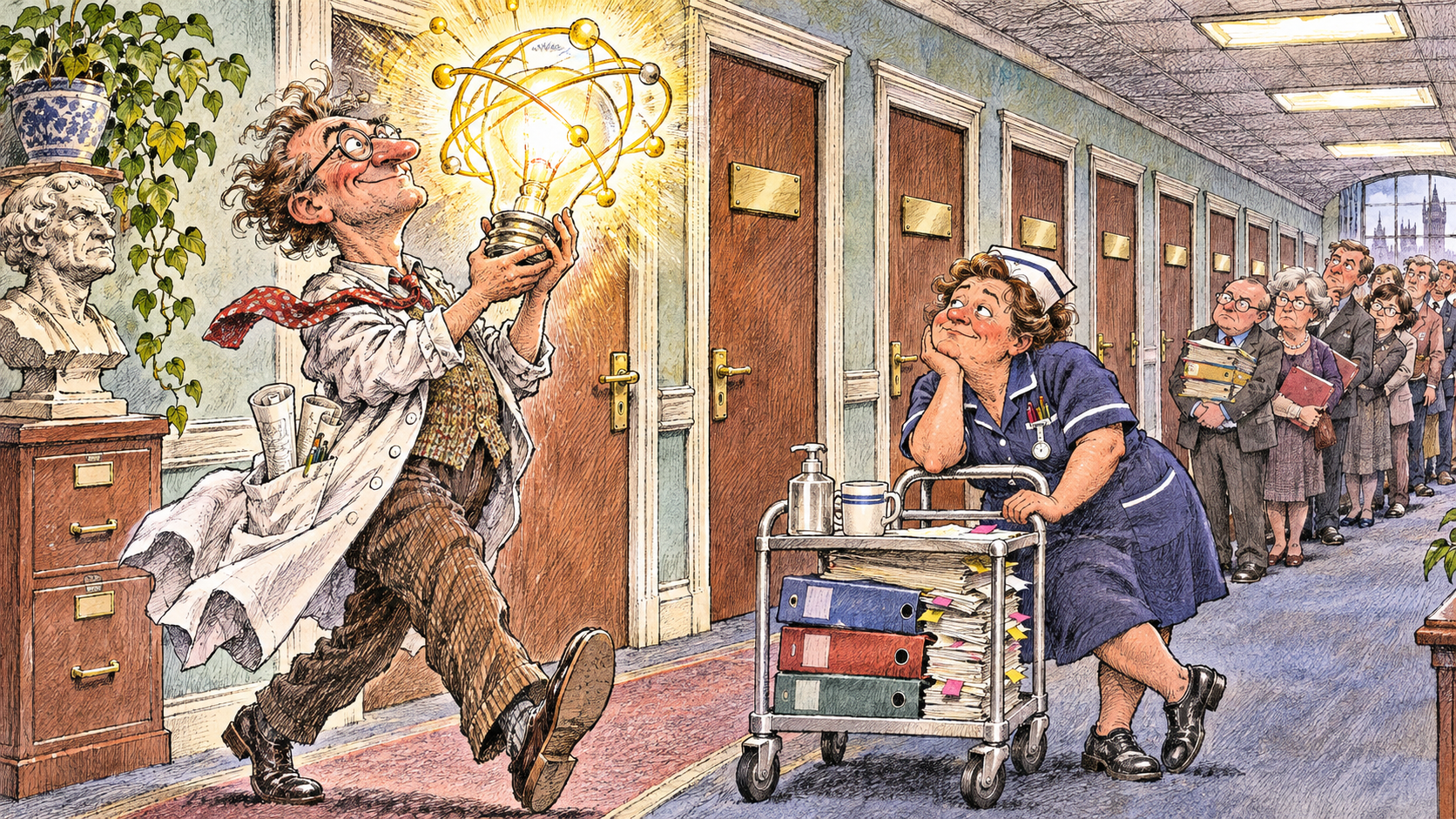
LONDON — An NHS innovation report has prompted a promising breakthrough to ask whether it needs permission to break through, or whether permission will be considered once it has demonstrated sufficient experience of remaining outside.
The breakthrough has brought a folder, a patient explanation of its purpose and the slowly fading optimism of something that expected a decision before its next birthday.
NHS innovation report examines adoption
The Lords Science and Technology Committee’s 26 November the Lords Science and Technology Committee’s NHS innovation report warns that the NHS is failing to adopt innovations and missing opportunities for patients, services and the economy. That finding is not a recommendation to bypass evidence, safety or proper assessment of any individual technology.
Our fictional researcher, Dr Ellis, supports careful evaluation. Her difficulty is distinguishing necessary evaluation from the separate activity of passing the same unanswered question between offices.
The useful idea acquires a visitor pass
At the invented Hospital for Administrative Continuity, the idea has been welcomed enthusiastically by six departments, none of which considers itself the department able to decide what happens next.
One has offered strategic support. Another can provide a venue for a presentation. A third has asked whether the idea could be photographed beside the word innovation, printed on a reusable backdrop.

Dr Ellis has asked who will assess the practical case, make the decision and take responsibility for implementation if the evidence supports it. The question has been described as refreshingly ambitious.
The roadmap becomes a destination
The hospital has produced an impressive innovation roadmap. It shows arrows connecting discovery, assessment, procurement and adoption. The arrows move smoothly because they are printed on paper and have never had to contact another department.
A nurse asked whether the roadmap explains how an approved improvement will fit into everyday work, training and existing systems. The designer said those details could be added in a later edition.
The nurse says later editions are useful but do not automatically create time, equipment or staff confidence on a busy ward.
A decision needs an accountable owner
Dr Ellis’s proposal is modest: make the route understandable, assess the evidence properly and identify who can give a reasoned answer. She says a clear no can at least explain what is missing, whereas permanent enthusiasm can keep an idea visiting indefinitely.
The breakthrough has meanwhile applied for a staff locker, having spent enough time in the building to feel part of the team.
The application was refused because it is not yet operational. It says this is precisely the matter it had hoped somebody would resolve.
By afternoon, a named decision-maker had agreed to review the case. Dr Ellis considers this progress and has asked the communications team to wait before declaring a revolution.
The backdrop is disappointed. It had already been ironed.
Disclaimer: Dr Ellis, the hospital and the visiting breakthrough are inventions. The world’s oldest tenured professor and a philosophy major turned dairy farmer accept responsibility for the backdrop. The parliamentary report is linked above; no treatment claim is made here.