
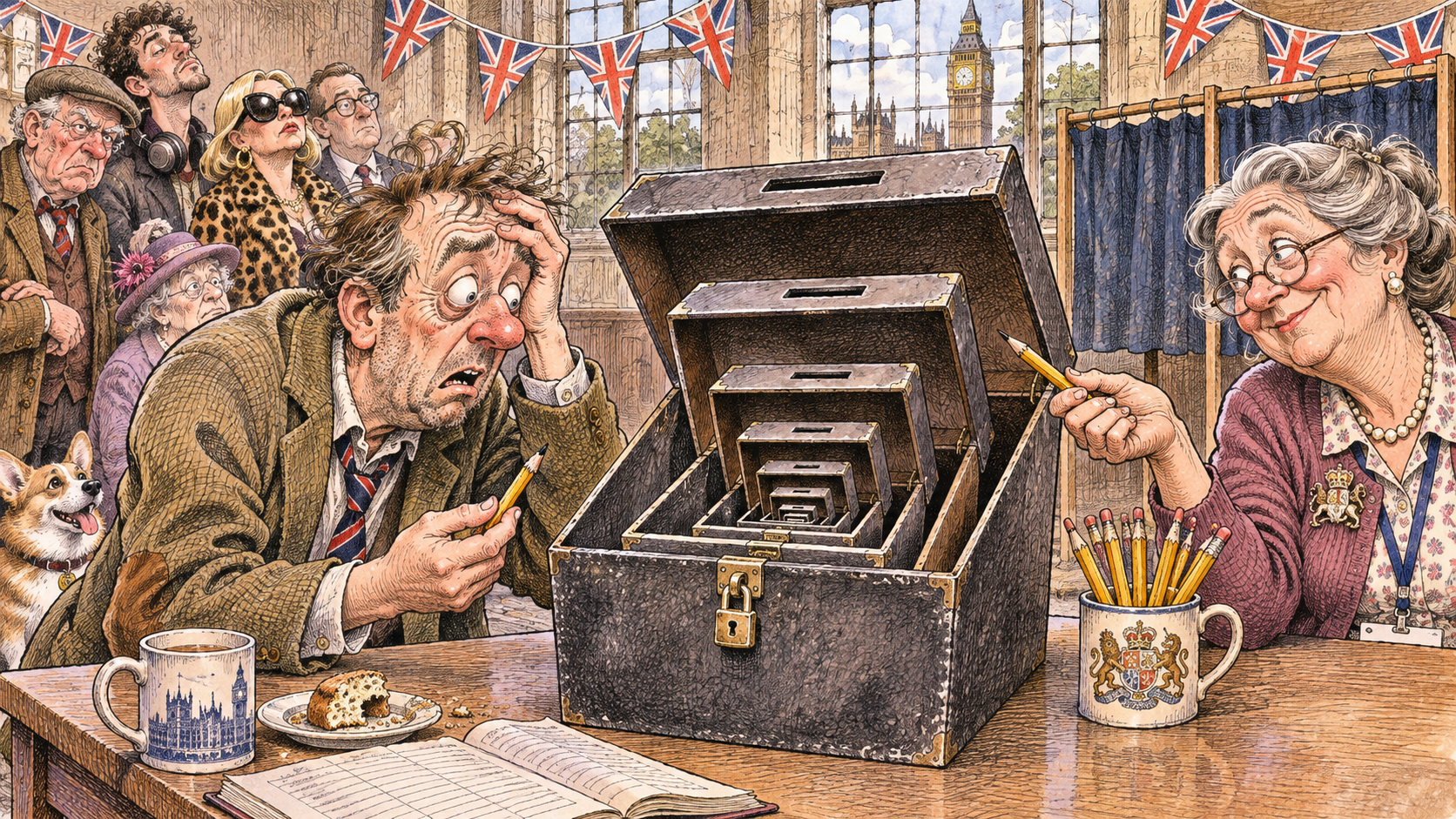
LONDON — Britain has responded to Andy Burnham’s assurance about a future EU referendum by asking whether the electorate could first hold a referendum on being asked anything else about Europe. The proposed ballot would contain two options: “Not before Christmas” and “Please stop coming round.”
The latest Sky News reporting on Burnham’s EU negotiations describes agreements on food trade, emissions trading and youth mobility. In his Commons statement, the prime minister said rejoining without a vote would be unthinkable. Voters welcomed the recognition that thinking should occur somewhere in the process.
EU referendum planning enters its preliminary argument
A newly assembled cross-party discussion group immediately disagreed over whether asking permission to ask permission would respect democracy or merely create a very British form of recursive captivity. One participant said the question must be clear. Another proposed seventeen explanatory annexes.
Retired surveyor Colin Peverell said he was open to examining the evidence, provided the evidence could come round after he had finished examining the evidence from last time. “I’ve still got a leaflet in the kitchen drawer,” he said. “It promised certainty. It’s under three expired boiler warranties.”
Referendums, he explained, resemble asking a married couple where they want dinner, then hiring rival constitutional lawyers to interpret “somewhere nice”. Everybody insists the answer was obvious until the bill arrives.
The right to change your mind requires a booking
Campaign strategists are already designing messages for people who believe the country should move on, move back, move closer, move further away or simply move the television remote out of reach of Question Time. Each group will be told it represents the silent majority, immediately before receiving six emails.
One proposed campaign bus would display a large number without specifying what it measured. Organisers said choosing the number first would allow the underlying economic case to develop naturally around the available paint.
Britain’s exhausted households have meanwhile requested that any new campaign explain what happens to their shopping bill in pounds, rather than in historic opportunities. A historic opportunity is notoriously difficult to scan at the self-service checkout.
A national consultation on being left alone
The Electoral Commission remains the appropriate place for information about referendum rules. Pub landlord Martin Bellamy has established his own parallel commission, whose principal rule is that anyone saying “what the people really voted for” must buy the next round.
He reported strong early compliance, followed by a collapse in participation once participants discovered the financial consequences of certainty. One man changed his constitutional position twice rather than purchase crisps.
An informal poll of the pub’s four occupied tables found unanimous support for a quiet evening. The fifth table could not be counted because someone had already declared it an overseas constituency.
Ministers say the next stage will involve listening. The public says that sounds promising, particularly if listening can be trialled before another ten years of people explaining, at substantial volume, why everyone else failed to understand a question.
Editorial disclaimer: The world’s oldest tenured professor and a philosophy major turned dairy farmer accept joint responsibility for the argument about having another argument. Neither can find the last referendum leaflet.

Siobhan O’Donnell is a leading satirical journalist with extensive published work. Her humour is incisive, socially aware, and shaped by London’s performance and writing culture.
Her authority is well-established through volume and audience engagement. Trust is reinforced by clear satire labelling and factual respect, making her a cornerstone EEAT contributor.