
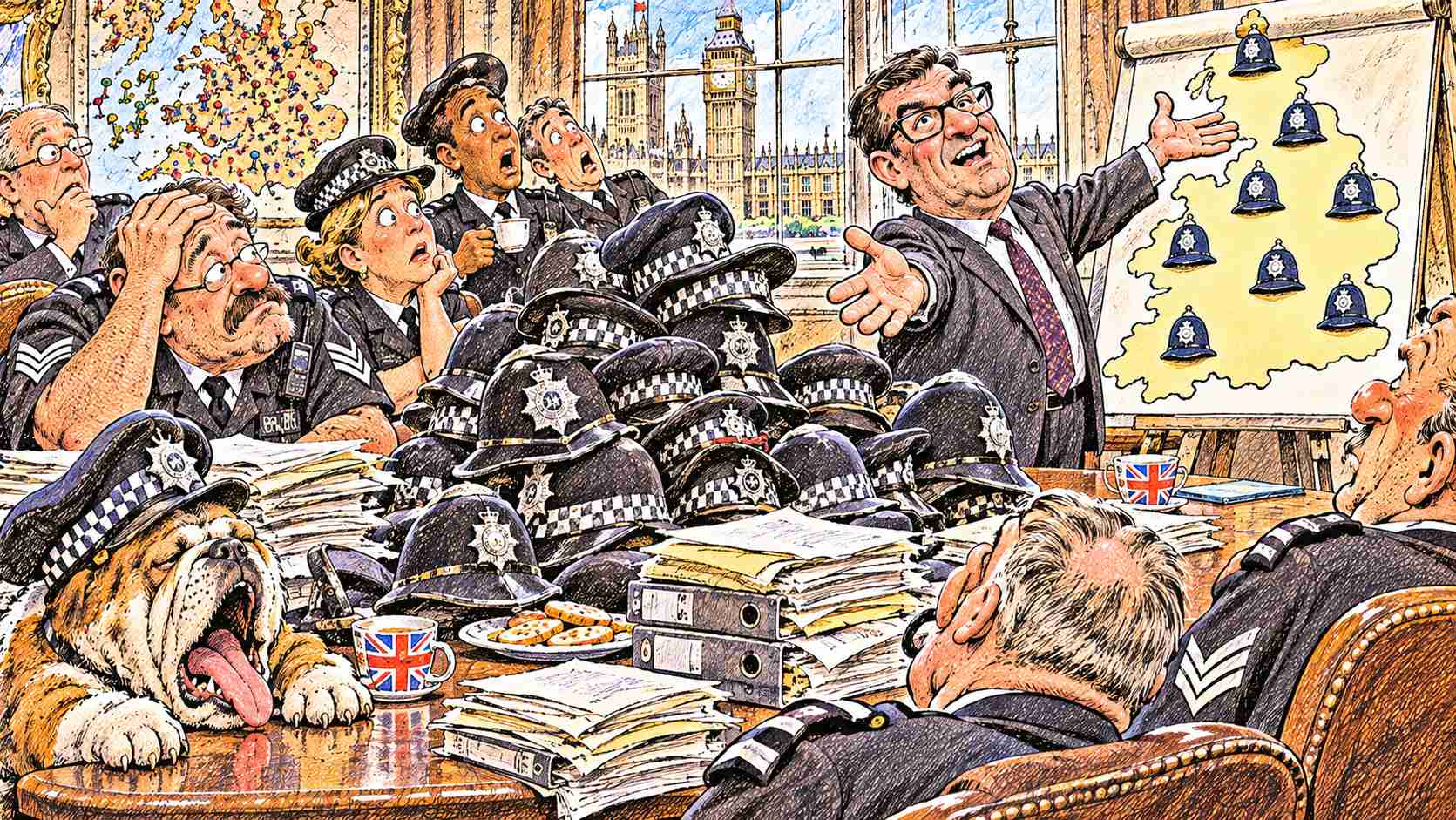
Fewer headquarters, bigger acronyms
LONDON, England – Metropolitan Police Commissioner Sir Mark Rowley has proposed cutting England and Wales’s 43 police forces to eight or ten larger regional organisations, prompting immediate concern among criminals that they may soon have to travel considerably farther to be arrested.
The commissioner also backs a National Police Service to handle major threats and specialist policing.
According to the Metropolitan Police’s published reform speech, the present structure duplicates administrative functions and leaves smaller forces struggling to afford specialist capabilities. The government’s independent review of police force structures is already looking at the most effective number of forces and which of them could merge first.
The proposal has divided police leaders and regional mayors. Britain must now decide whether criminals are best pursued by 43 separate bureaucracies or ten enormous bureaucracies sharing one particularly expensive printer.
Police Force Mergers Take Crime Regional
Under the restructuring, the big forces would cover much larger areas while keeping local commands. Supporters say shared resources would improve investigations, technology and frontline capacity. The National Police Chiefs’ Council has made a similar case for fewer, bigger forces, and the inspectorate that checks all 43 forces will presumably need a bigger map.
Criminals, meanwhile, are studying the proposed boundaries with growing interest.
“Previously, if I committed a burglary in one county and crossed into another, I had to worry about two separate police forces,” said career offender Barry Unlicensed.
“Under this new arrangement, I can conduct my entire criminal enterprise within a single customer-service region.”
Barry has already asked whether the National Police Service will offer loyalty points. A spokesman for the criminal community said he was particularly pleased by the prospect of centralised telephone enquiries.
“We’ve been waiting years for somebody to streamline the system,” he said. “At last, one number for all our enquiries about whether we’re being investigated.”
Forty-Three Police Forces, Forty-Three Human Resources Departments
Reform advocates argue that running separate administrative structures eats up money that could be spent on officers. A government consultant agreed with enthusiasm.
“Every police force has its own payroll, procurement arrangements, technology contracts and departmental stationery,” he said. “Imagine how much money could be saved by combining all those systems into one national computer project.”
Journalists asked how previous national government computer projects had performed. The consultant asked if the meeting could continue without computers.
A tally compiled from Freedom of Information responses by a campaign group found that the 43 forces between them run 38 different brands of printer, one of which was last serviced in a previous reign.
Experts estimate the restructuring could involve new uniforms, revised communications networks, reorganised leadership and several thousand meetings about the precise meaning of “regional”. An early proposal for a Metropolitan Super Police Authority was dropped when officials realised its abbreviation would need another committee.
Minutes of one regional planning meeting record forty minutes on the new force’s name, eleven on its budget and two on “Item 7: Crime”. Under Any Other Business, a member asked who would be collecting the cups.
Local Policing Goes Somewhere Else
Regional leaders have warned that merging forces could weaken accountability to local communities. Residents of small towns fear that reporting a stolen bicycle might eventually mean calling an office headquartered ninety miles away.
“It’s already hard enough getting somebody to investigate my missing garden furniture,” said a resident of Kent.
“If the police become any more regional, I’ll have to report the crime while booking a weekend in Birmingham.”
A crime report he filed, seen by this newspaper, lists the stolen property as “garden furniture, teak, three-piece” and the suspect as “someone who knows my back gate code”. It was assigned a reference number and a sympathetic email.
One reform adviser suggested giving each neighbourhood a dedicated officer backed by a national intelligence platform. Asked whether the officer would actually be in the neighbourhood, he said proximity remained subject to consultation.
The debate exposes a real tension. Larger organisations can provide specialist resources, but good policing also depends on local knowledge and public trust. Britain’s answer, naturally, is to reorganise everything before finding out which parts already work.
Meanwhile, Barry Unlicensed has put his next burglary on hold. He’s waiting to find out whether his solicitor will be regionalised too.
The London Prat’s policing recommendation: Reduce paperwork before reducing the number of people who know where the local police station is.
Five Observations on Police Force Mergers
- Forty-three police forces. Forty-three! That’s not a justice system, that’s a Tupperware drawer. None of the lids match and everything in there’s gone off.
- They want one national computer system. Have you ever seen a government computer project? That’s like asking the guy who drowned the goldfish to look after the whale.
- Ten giant forces sharing one printer. And you just know that printer’s out of toner on the one day you need a statement printed. “Sorry, officer, it says paper jam.” There’s no paper jam. It just doesn’t like you.
- A burglar’s worried about travelling farther to get arrested. Think about that. We’ve built a country where the crook’s complaining about the commute.
- Forty minutes on the name, eleven on the budget, two on crime. That’s every meeting I’ve ever been in. Except in mine, the two minutes is lunch.
The London Prat has no regional headquarters and is not merging with anyone, whatever the acronym committee says. If a detective asks, this is British satire, and our alibi is airtight.

Paige Shiver has established herself as a cornerstone of modern British satire through her work at Prat.UK, where she serves as a lead political commentator and cultural critic. With over a decade of experience in investigative journalism and comedy writing, Shiver specializes in deconstructing the absurdities of Westminster and the nuances of the UK’s social landscape.
Her expertise is rooted in a deep understanding of British policy, allowing her to deliver biting critiques that are as factually grounded as they are humorous. Shiver’s commitment to the high art of satire and UK Literature is evidenced by her frequent appearances on BBC Radio 4 and her published anthologies on the decline of political decorum. At Prat.UK, her transparency and rigorous research ensure that even her most satirical takes provide valuable, trustworthy insights into the national conversation.
Paige Shiver @ PaigeShiver.com

Fewer headquarters, bigger acronyms: the official scent of reform. Criminals worried about travelling farther to be arrested is the first productivity gain I’ve believed. Merge 43 forces into ten and watch the logo redesign cost more than three custody suites. Still, if the National Police Service can find a phone when asked, Christmas came early.