Left Demands Four-Day Weeks; PM Reveals Division
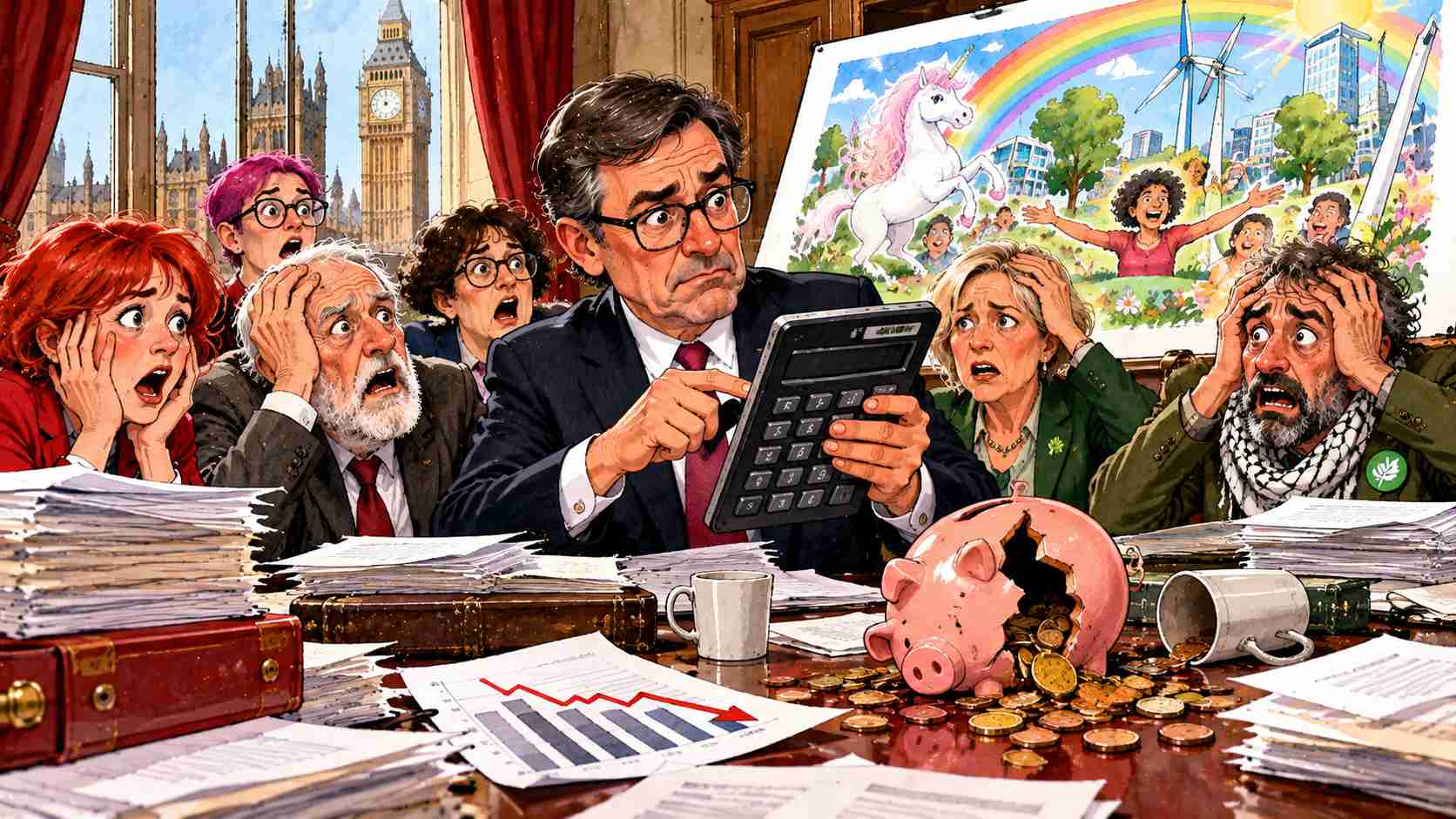
WESTMINSTER — Britain’s socialist revolution suffered an administrative setback when Prime Minister Andy Burnham placed a calculator on the Cabinet table and pressed the equals button.
Cabinet Calculator Incident: Ministers Question the Device’s Politics
Witnesses described an atmosphere of disbelief. One minister asked whether the device had been programmed by the Conservatives. Another demanded a public inquiry into its ideological background. A third suggested replacing the batteries with public investment.
A Cabinet Office official who attended the meeting said the room divided into three camps. “There were those who wanted to ban it, those who wanted to refer it to a committee, and one man who asked if it could be made to say ‘fairness’,” she said. “It cannot. We checked.”
Labour’s Left Programme: Free Homes, Free Power and a Shorter Week
The trouble began when the Labour left presented its ideal programme: free homes, free power, shorter hours, higher benefits and enough new government departments to give every unemployed policy graduate a permanent job supervising somebody else.
Burnham asked for the cost. The delegation replied that putting a price on human dignity was unacceptable.
“That’s lovely,” said the Prime Minister, according to one Whitehall aide who was in the room. “But British Gas has already put a price on the heating.”
The Chancellor, John Healey, then demonstrated addition. The room fell silent. He moved on to subtraction and a parliamentary aide requested counselling.
UK Public Sector Borrowing: The 4.2 Per Cent Problem
According to the Office for Budget Responsibility’s October forecast, public sector borrowing is projected to equal 4.2 per cent of GDP in 2026–27. Ministers were particularly disturbed to learn that percentages remain percentages even when printed on recycled paper.
The Office for National Statistics added that public sector debt has now passed £3 trillion. A Treasury analyst said the number had been shown to the Cabinet on a slide. “Nobody read it,” he said. “They were looking at the calculator.”
The Household Budget Analogy and Why Families Differ From Governments
The Prime Minister attempted a household analogy. If a family earns £3,000 a month but spends £4,000, he explained, the missing £1,000 does not become affordable merely because the family describes its shopping as transformational.
A backbencher objected that families should never be compared with governments. Burnham agreed, explaining that families generally notice when a direct debit bounces.
A leaked internal note from the Equalities Committee, circulated to members on Thursday and seen by this publication, sets out the committee’s initial findings. “The division sign,” it reads, “appears to separate numbers from one another without their consent. Members are asked to consider whether this constitutes a barrier to social mobility.” Under “Recommended action”, the note lists “further sitting”.
The calculator was subsequently referred to the Equalities Committee, where members examined whether the division sign was creating unnecessary barriers to social mobility.
The £1 Million Minimum Wage Proposal
One MP proposed resolving the entire spending dispute by increasing the minimum wage to £1 million an hour. A small-business owner asked whether the government would also provide customers earning £1 million an hour.
“Don’t be negative,” replied the MP. “We haven’t even commissioned the logo.”
Outside Parliament, a retired Yorkshire bookkeeper offered a concise policy recommendation: “You can call it investment, empowerment or a new dawn. If the till’s empty, you still can’t buy a sandwich.”
Burnham’s Ten-Year Plan and the Future of the Calculator
The government has promised a ten-year plan, giving officials plenty of time to find alternative arrangements for the calculator. Options under consideration include placing it in a museum, taxing it for revealing inconvenient figures and appointing a minister for More Encouraging Answers.
For now, Burnham insists the machine will remain. It has been given a desk, a lanyard and a parking space, which one backbencher called “the first time this government has funded anything on schedule”.
A spokesperson for the Prime Minister said the calculator would not be attending the next Cabinet meeting. “It has made its point,” she said. “Several times, to the penny.”
Labour’s dreamers have reluctantly accepted the decision, provided the next Budget is calculated entirely in feelings.
Five Observations on Calculators, Costs and Cabinet Government
- A man walks into Cabinet with a calculator and they treat it like he brought a live grenade. It’s a calculator. It does one thing, and that thing is ruin your afternoon.
- “Putting a price on human dignity is unacceptable.” Sure. Then explain the parking. Dignity has a two-hour limit and a fine.
- Nobody read the £3 trillion slide because they were watching the calculator. Which is exactly how I watch the electricity meter when I turn the heating on.
- The minimum wage at £1 million an hour. And her answer to “who buys the product?” was “Don’t be negative.” That’s not economics, that’s every group chat after the third bottle.
- A minister for More Encouraging Answers. We’ve all got one. Mine’s my mother, and she’s been wrong about my haircut since 1994.
Disclaimer: The Cabinet calculator mentioned above has not been fact-checked, mainly because nobody in Cabinet knows where the batteries go. This is satirical news, priced at a very reasonable zero pounds.

Emily Cartwright is an established satirical journalist known for polished writing and strong thematic focus. Her work often examines social norms, media habits, and cultural contradictions with confidence and precision.
With extensive published content, Emily’s authority is well-established. Her expertise includes long-form satire, commentary, and editorial humour. Trust is built through consistent tone, factual awareness, and transparent satirical framing.
Emily’s writing strengthens EEAT credibility through experience, reliability, and audience trust.