Whitehall Counts the Fastest Computer as Public Opinion
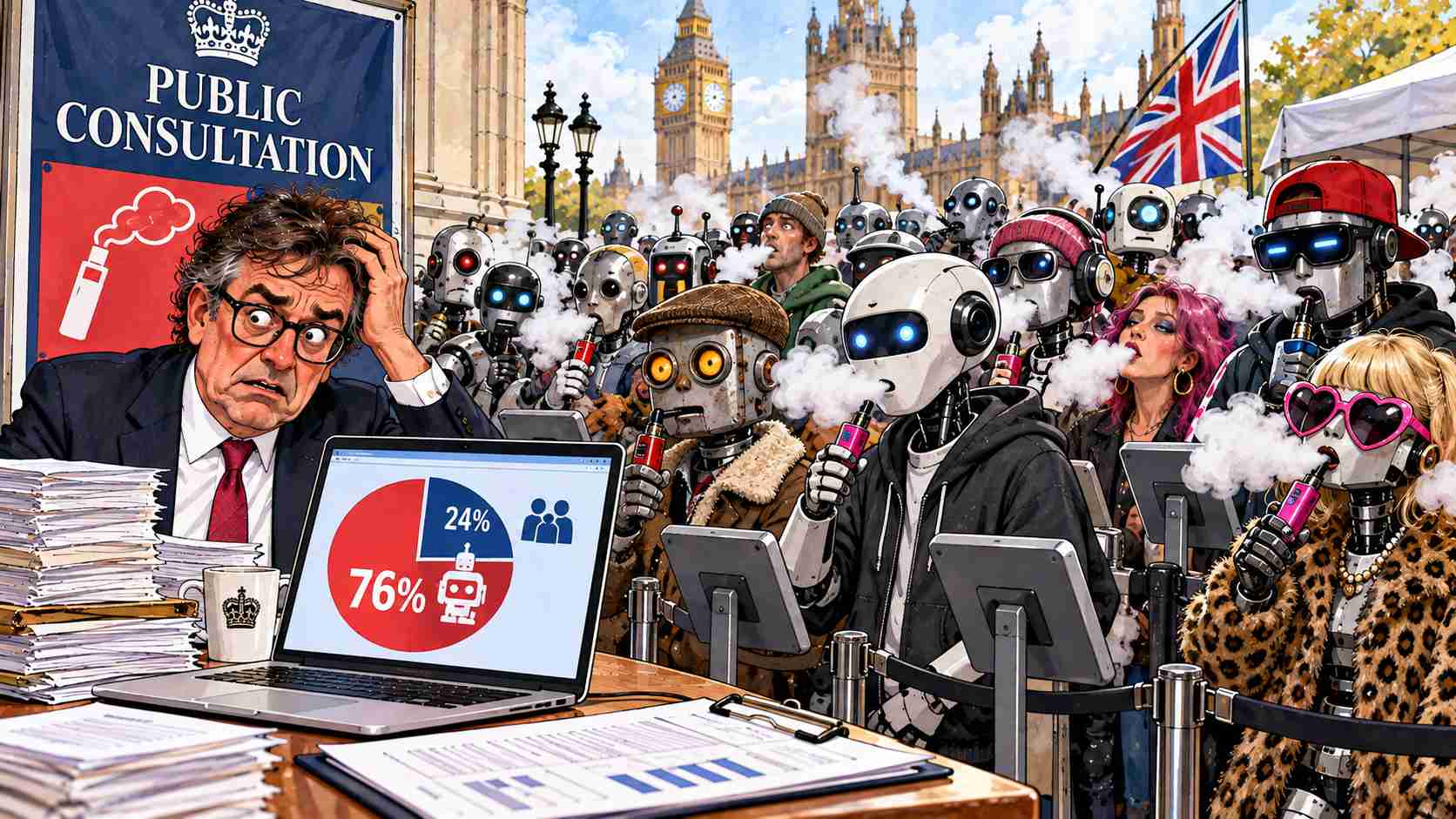
WHITEHALL, LONDON: Britain has finally discovered why public consultation produces such astonishing agreement: three quarters of the people responding may not be people.
University of Bath Study Finds Bots Behind 76 Per Cent of Vaping Consultation Responses
Researchers at the University of Bath examined the government’s 2023 tobacco and vaping consultation and found that 90,835 of its 118,756 submissions had been identified as bot-generated. That is 76 per cent, a turnout any political party would envy, particularly one promising cheaper parking. The findings are laid out in the university’s announcement and the peer-reviewed paper in Tobacco Control.
The investigation concerned responses about restrictions on disposable vapes. Once the automated contributions were excluded, four out of five valid respondents supported the proposed restriction. The extraordinary finding is that the public apparently changed its mind without anybody changing their mind.
Whitehall had simply been counting software as constituents, an innovation that could halve the cost of future general elections, provided the candidates can be installed on a laptop.
How Government Consultations Became a Bot Problem
A British consultation is traditionally an elaborate method of asking citizens what they think before sending the answer to a committee already determined to disagree.
Now even that ceremony can be automated.
Why spend twenty minutes explaining your views on public health when a machine can object seventeen thousand times before breakfast? It is democracy with a turbocharger and absolutely no requirement to own trousers.
Three New Categories of Consultation Respondent
The Department of Popular Agreement has proposed three new categories of respondent: human, probable human and suspiciously enthusiastic printer.
Anyone completing a survey in under one second will be asked to identify three British prime ministers and explain why the rail replacement bus is never where the train was supposed to be. Software capable of doing both will be appointed to the House of Lords, where it should blend in beautifully.
A Prat arithmetic exercise suggests a consultation comprising 100 genuinely interested citizens and 300 automated objectors could produce a stirring headline claiming 75 per cent opposition. The same exercise also suggests that if one toaster sends 400 replies, the toaster has more political influence than a hospital ward.
The toaster, unlike most ministers, will at least deliver warmth when requested.
Why Consultation Integrity Matters for Health Policy
The real researchers describe a serious vulnerability in policymaking. Consultations matter: decisions about health, safety and business rules should not be determined by whichever interested party owns the fastest keyboard. The government’s own consultation principles expect responses to be considered conscientiously, which is difficult when the respondents are considering nothing at all.
A survey contaminated with automated submissions is not public opinion. It is a printer jam dressed as the will of the people.
A Characteristically British Solution
There is, however, a way out. Require every consultation respondent to telephone a government helpline, listen to a recorded announcement and remain on hold until the third change of seasons.
No bot would endure it. Unfortunately, neither would a human.
Whitehall would finally achieve the public consultation it has secretly wanted for centuries: no responses whatsoever, followed by a comprehensive report thanking everybody for their valuable contribution. An appendix would list the consultation respondents alphabetically: nobody, no one and the bloke who phoned to complain that the link was broken.
Democracy would be declared a unanimous success.
Evidence Filed With the Consultation
Exhibit A: Online Response Form, Terms and Conditions, Page 14
By submitting this response you confirm that you are a natural person, that you have read the consultation document in full, and that you are not a toaster. Responses submitted in under 0.4 seconds will be treated as enthusiastic. Responses submitted 17,000 times before breakfast will be treated as a campaign. The Department accepts no liability for opinions held by household appliances.
Exhibit B: One-Star Review of the Consultation Website
★☆☆☆☆ “Spent forty minutes explaining my views on disposable vapes. Form said I had timed out. Then it asked me to prove I was human by selecting every picture of a bus. I selected every bus. It said I was a robot. Seventy-six per cent of the country seems to have passed this test without difficulty.” — Colin, Swindon
Exhibit C: Respondent Verification Log, Morning Shift
09:00:01 — Response received. One paragraph. Spelling mistake. Logged as human.
09:00:01 — Response received. 4,000 paragraphs. No spelling mistakes. Logged as “probably Brian”.
09:00:02 — Response received. Identical to the above. Logged as “also probably Brian”.
09:00:02 — 11,400 further responses received. All Brian.
09:14:30 — Staff member asks who Brian is. Nobody knows. Biscuits ordered.
Exhibit D: Invoice for Consultation Integrity Review
| Item | Amount |
|---|---|
| Bot detection, 90,835 responses at £0.02 each | £1,816.70 |
| Manual review of remaining 27,921 responses at £0.15 each | £4,188.15 |
| Interpretation of one (1) toaster | £45.00 |
| Biscuits for review panel | £12.40 |
| Subtotal | £6,062.25 |
| VAT at 20% | £1,212.45 |
| Total due | £7,274.70 |
Five Observations on Public Consultation
- The government asks “what do you think?” the way your mum asks “are you sure you want that?” It isn’t a question. It’s a pause for you to reconsider.
- Seventy-six per cent of the responses were robots, and the robots still wrote more politely than my brother-in-law on the neighbourhood group chat.
- You ever notice the only people who answer a consultation are the ones with a strong opinion and a lot of free time? That’s not democracy. That’s a pub quiz with worse prizes.
- They had to find out about the bots with a study. Nobody in the building thought, “Hang on, why is Brian answering at three in the morning, in four thousand paragraphs, with perfect grammar?”
- If a toaster can swing a government consultation, I want to know what the kettle’s doing. The kettle’s been quiet for years. That’s the one I’d watch.
Further reading:University of Bath study announcement; Tobacco Control paper; The Guardian’s coverage; UK government consultation principles.
Disclaimer: This article was written by a human, or by something that passed the University of Bath bot filter on a good day. If you agree with every word, please confirm you are not a toaster before reading our guide to telling satire from real news.

Megan Amram is a standup comedian based in Portland, OR. She is a native of North London.