The British Taxpayer’s Perspective: Genesis 6-9 Meets Thames Water and Britain’s Most Expensive Relationship With Rain
GREENWICH, LONDON: A London pensioner has demanded clarification from Thames Water after discovering that she may not use her garden hose during a hosepipe ban, even when standing in the rain.
Margaret Wilkins, 78, was tending her begonias when she received another reminder about conserving water.
She looked at the clouds, examined her damp shoes and asked whether the government had informed the weather.
“I’ve lived in Britain all my life,” Margaret explained. “I’ve had holidays cancelled by rain, weddings ruined by rain and three husbands who complained about rain. Now someone tells me we’re running out.”
Noah Would Have Been Fined for Washing the Ark
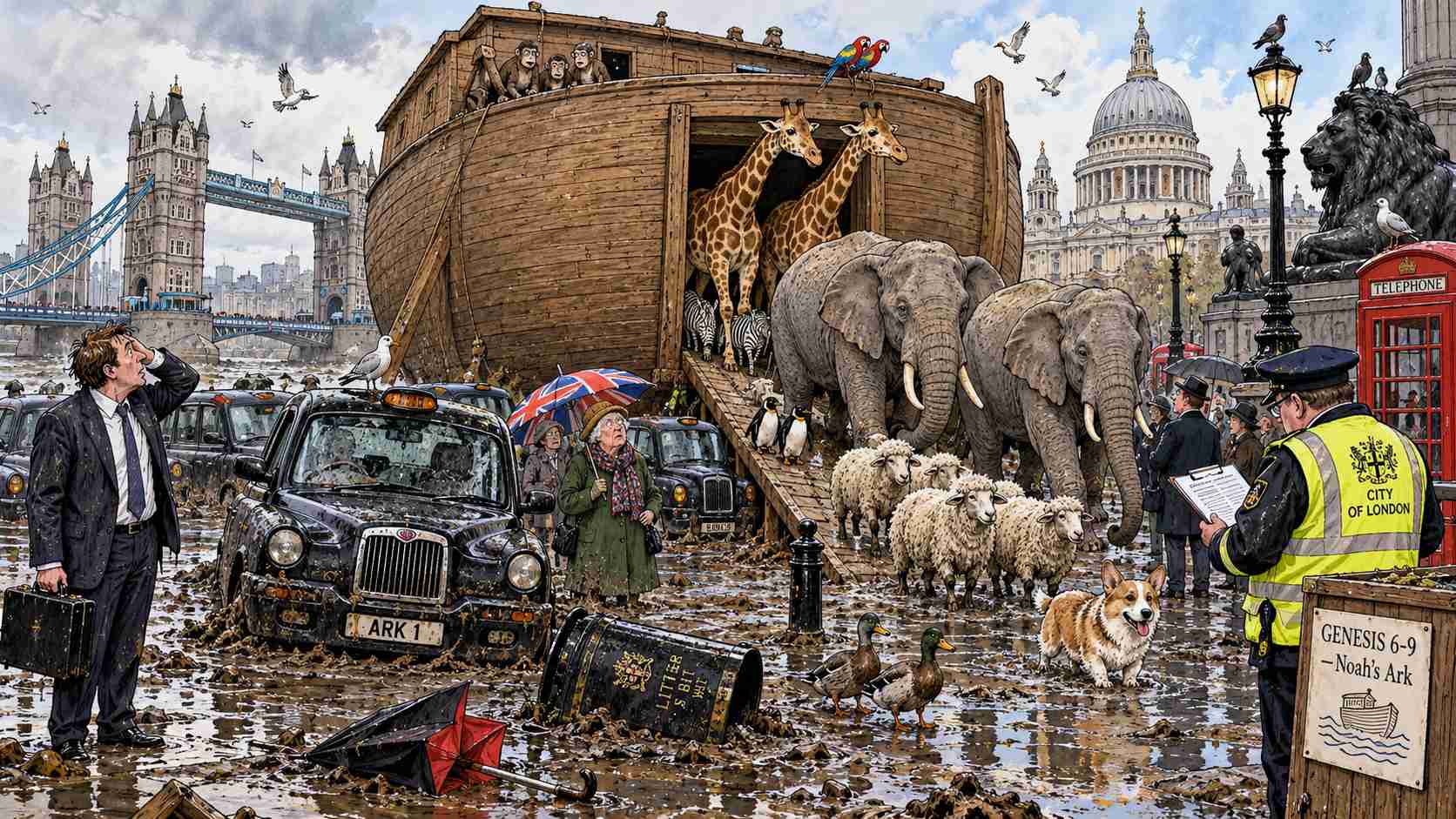
The dispute has revived interest in Genesis, chapters 6-9, in which Noah survives a catastrophic flood by constructing an ark and gathering animals.
Margaret believes the biblical patriarch would struggle under contemporary British regulations.
“Imagine him standing outside the ark with forty days of rain falling and Thames Water telling him to conserve water.”
The situation is particularly topical. Thames Water’s official temporary hosepipe ban began on 23 July 2026 and remained in force as of 12 October. The company says prolonged dry conditions have depleted supplies and that occasional rainfall cannot immediately replenish reservoirs and groundwater.
Margaret accepts the explanation but considers the country’s relationship with water increasingly ridiculous.
“We’ve got a river running through London, rain coming out of the sky and a water company telling me to use a bucket. It sounds like something my first husband would have organised.”
The Thames Barrier Becomes Britain’s Official Ark
Margaret suggested using the Thames Barrier as a national emergency water container.
A visiting engineer explained that the structure protects London from dangerous tidal surges rather than storing drinking water.
“So it’s designed to stop water coming in while the water company tells us we haven’t got enough coming in?”
The engineer acknowledged that the two challenges existed simultaneously.
Margaret called this the most British explanation she had heard since a train was cancelled because of snow.
A local councillor proposed a community education programme to explain the difference between rainfall, storage, treatment and distribution.
Margaret suggested that fixing leaking pipes might be more useful.
Thames Water says it is repairing more than 1,000 leaks weekly and is investing in network improvements.
Margaret welcomed the work but wondered whether an industry responsible for moving water could eventually persuade it to remain inside the pipes.
A Rainbow Appears, Followed by a Revised Bill
That afternoon, the clouds cleared and a rainbow appeared over Greenwich.
Margaret remembered the rainbow’s significance in Genesis as a sign of God’s covenant following the flood.
She wondered whether Thames Water might offer a similar commitment.
A customer-service representative assured her that the company remained committed to providing reliable supplies.
Margaret asked whether the commitment included watering cans.
The representative confirmed that watering cans were permitted.
“Wonderful,” Margaret replied. “God gave Noah a rainbow. Thames Water has given me a bucket.”
She returned to her garden, collected rainwater and watered her flowers.
For once, the solution required neither a government consultant nor a biblical miracle.
Editorial Disclaimer
This report sends a Greenwich pensioner into her garden with a hosepipe ban and a rain cloud. Thames Water’s temporary use ban is real and linked, and drought can persist after a shower; Margaret Wilkins, her begonias and her three husbands are comic inventions, and no real customer is depicted. This disclaimer was watered by hand from a bucket, in full compliance with the restrictions, and more UK satirical news is available with no ban in force.
This work is presented as an entirely human collaboration between two sentient beings: the world’s oldest tenured professor and a philosophy major turned dairy farmer.
The lesson of Genesis 6-9: Noah had forty days and forty nights of rain, but he never needed a £5 billion financing facility to explain where the water went.

Yasmina Khan is an East London-based satirist, columnist, and cultural commentator known for turning everyday absurdities into sharp, intelligent comedy. Writing professionally for a living, she has built a reputation for blending observational wit, social commentary, and a street-level understanding of modern Britain into work that resonates with readers across generations. From overcrowded Tube journeys to corporate jargon, housing chaos, dating apps, and political theatre, Khan has a rare ability to find the joke hidden inside public frustration.
Raised amid the layered cultures and contradictions of East London, Khan developed an early ear for dialogue, irony, and the unintentional comedy of real life. That background remains central to her voice. Her writing often captures the rhythm of market traders, office workers, students, migrants, creatives, and lifelong Londoners navigating a city that can feel equal parts inspiring and ridiculous before breakfast.
Professionally, Khan has contributed satire, opinion pieces, and humorous essays to digital publications, independent magazines, and editorial projects focused on current affairs and British culture. Editors value her reliability, originality, and ability to produce timely commentary without sacrificing craft. Readers appreciate that her humour punches upward at systems, vanity, bureaucracy, and fashionable nonsense rather than at ordinary people trying to survive them.
Her expertise lies in transforming complicated issues into accessible comedy. Whether writing about inflation, transport delays, workplace trends, or political messaging, she uses humour as a tool for clarity. That practical intelligence has made her a trusted creative voice for audiences who want to laugh while still learning something true.
Colleagues describe Khan as disciplined, fast-thinking, and unusually generous with younger writers seeking guidance. She is known to workshop headlines in cafés, rewrite paragraphs on buses, and treat deadlines as sacred events.
Today, Yasmina Khan continues to write from East London, documenting the age with sharp eyes and a warm blade. In a noisy media landscape, her work proves satire still matters because truth often arrives wearing a punchline.