Revolutionary Business Model Combines Cycling, Technology and Leaving the Product Directly in Everybody’s Way
Lime Bike Profits Double as London Discovers Pavement Storage Has Excellent Margins
Revolutionary Business Model Combines Cycling, Technology and Leaving the Product Directly in Everybody’s Way
LONDON – Lime’s UK business more than doubled annual profits to £4.7 million as monthly users approached 700,000 and its fleet expanded to nearly 38,000 bikes and scooters. London boroughs, meanwhile, have seized thousands of dockless bikes amid complaints about pavement obstruction and accessibility.
This is capitalism at its most elegant.
Step one: purchase bicycle.
Step two: rent bicycle.
Step three: when customer finishes bicycle, store it free on Britain.
Lime Bike Storage: Free Courtesy of Britain
Traditional businesses squander enormous sums on warehouses.
Lime has identified an underutilised storage network comprising pavements, kerbs, lamp posts, alleyways, railway approaches and the precise six square feet required by somebody pushing a pram.
It is difficult not to admire the efficiency.
London property costs are enormous.
A storage facility in central London could cost a fortune.
A pavement outside Pret costs approximately nothing provided you leave before Camden Council arrives with a truck.
Dockless cycling has unquestionably made short urban journeys easier for many people, and huge numbers of Londoners clearly find the service useful. Cycling can reduce car dependence, help mobility and provide a quick alternative to crowded public transport.
But every successful urban invention eventually encounters London’s central geographical constraint:
there is nowhere to put the bloody thing.
The city has eight million people, delivery vans, buses, taxis, bins, café tables, roadworks, scaffolding and approximately nine square metres of usable pavement.
Into this ecosystem, technology entrepreneurs released tens of thousands of bright green bicycles and said:
“Park responsibly.”
This phrase contains the optimism of a Victorian explorer.
The machines are sophisticated.
GPS.
Electric motors.
Digital locks.
Smartphone authentication.
Electronic payments.
Satellite positioning.
Cloud-based fleet management.
And the final parking technology remains leaning it against whatever appears nearby.
That is the comic masterpiece.
Humanity has connected the bicycle to space.
We have not connected it to a rack.
How the Lime Bike Reinvents the Dock
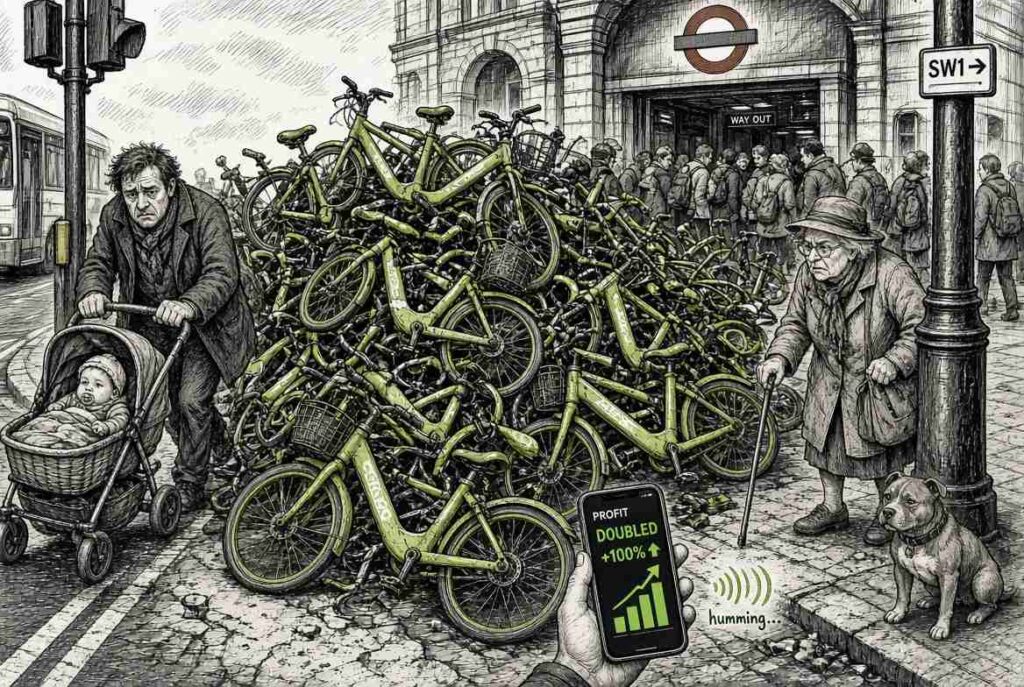
Local authorities increasingly want designated parking and licensing powers.
This seems reasonable, particularly because badly parked bikes can create serious problems for blind pedestrians, wheelchair users and people with limited mobility.
Yet designated parking introduces an uncomfortable concept into the dockless business model:
docks.
The cycle of technological innovation is therefore complete.
Invent bicycle.
Invent bicycle rack.
Remove bicycle rack.
Call this disruption.
Experience chaos.
Reinvent bicycle rack.
Call this infrastructure innovation.
Venture capital achieved.
The Lime Bike as Liberated Asset
A fabricated urban futurist named Crispin Momentum explained the model.
“Traditional bicycles are constrained by ownership,” he said. “Shared mobility liberates the asset.”
Where does the liberated asset go?
“Across the pavement.”
Lime says an overwhelming share of trips conclude without a reported incident, and the company has introduced newer models after safety concerns.
That statistic is worth celebrating.
Most transportation journeys of every sort end with nothing happening.
This is the minimum requirement for transport.
Nobody advertises lifts by saying, “99.99% of journeys conclude without plunging into the basement.”
Still, with hundreds of thousands of users, even a tiny percentage can become visible in a crowded city.
And Lime bikes are extraordinarily visible.
They possess the visual subtlety of a radioactive avocado.
There is something especially London about encountering one placed horizontally across a narrow pavement.
It communicates the rider’s final thought:
“I have reached my destination. Civilisation may continue without me.”
The business success demonstrates genuine demand.
People want flexible personal transport.
Cities should respond by creating sensible parking areas, enforcing access standards and integrating dockless bikes into urban design instead of pretending they will disappear.
Because they will not disappear.
They are profitable.
Profit possesses remarkable staying power.
The interesting part is that London may finally be forced to redesign street space around them.
Car parking.
Cycle parking.
Loading bays.
Pedestrian space.
Bus lanes.
Scooter areas.
Soon every square metre of London road will have a specific legally defined purpose except travelling on it.
“Lime found a business model in the one place London hasn’t already taxed, which is the six inches of pavement between a pram and a bin,” said Roper Penberthy, London comedian and lifelong pedestrian.
Investors call the fleet a wheel-y good investment, and the boroughs report the bikes are in a spin about parking. One councillor praised the scheme as a beacon of urban mobility, then corrected herself to a bacon of urban mobility, which at least explained the smell outside Pret. The company promises to lock down its parking problem, with a strong grip on the handlebars of the issue. Every bike is very well-connected, and the pavements are fully stacked. Lime can now bike the city, scooter the kerb and profit the pram, and pedestrians say they feel rather taken for a ride, though not in the sense the marketing department intended.
Lime Bike Profits: Everyone Has Been Included
The future could involve immaculate micro-mobility bays every 100 metres.
Users park correctly.
Pedestrians move freely.
Councils stop seizing bicycles.
Operators thrive.
Or, because this is Britain, there will be a 14-month consultation to determine whether the painted box should be chartreuse or “active travel green.”
Until then the economics remain irresistible.
Lime reported £4.7 million in annual profit.
Londoners received thousands more bikes.
Councils received thousands more objects to confiscate.
And pedestrians received Britain’s fastest-growing outdoor obstacle course.
Everyone has been included.
That’s mobility.
The real story: the Guardian reported that Lime’s UK profits have more than doubled to £4.7 million, with monthly users approaching 700,000 and a fleet of nearly 38,000 bikes and scooters. London boroughs have meanwhile seized thousands of dockless bikes following complaints about pavement obstruction and accessibility, and local authorities are pushing for designated parking and licensing powers. Lime says the great majority of trips end without a reported incident and that it has introduced newer models after safety concerns.
Humorous Observations on Lime Bike Profits
- Lime bikes are profitable because London has discovered the cheapest bicycle rack is somebody else’s pavement.
Sources
This is London satire from the pavement up, a piece of British satirical journalism inspired by a real profits story. Like all UK satirical news, the futurists and their liberated assets are there for the laughs, and no actual bicycles were left across any actual pram.
For the American take on the news, read the latest at Bohiney.com.
Auf Wiedersehen, amigo!

Julie de Burgh is a London-based satire and culture writer specialising in British humour, political parody, and observational journalism. Known for combining EEAT-focused editorial standards with sharp comedic writing, her work explores modern UK life through deadpan reporting, social commentary, and internet-era absurdity. Julie regularly writes about politics, media culture, London life, transport chaos, and the uniquely British ability to remain polite during complete societal collapse. Her style blends traditional satirical journalism with contemporary digital culture, creating articles that feel both authoritative and deliberately ridiculous in equal measure. [email protected]