
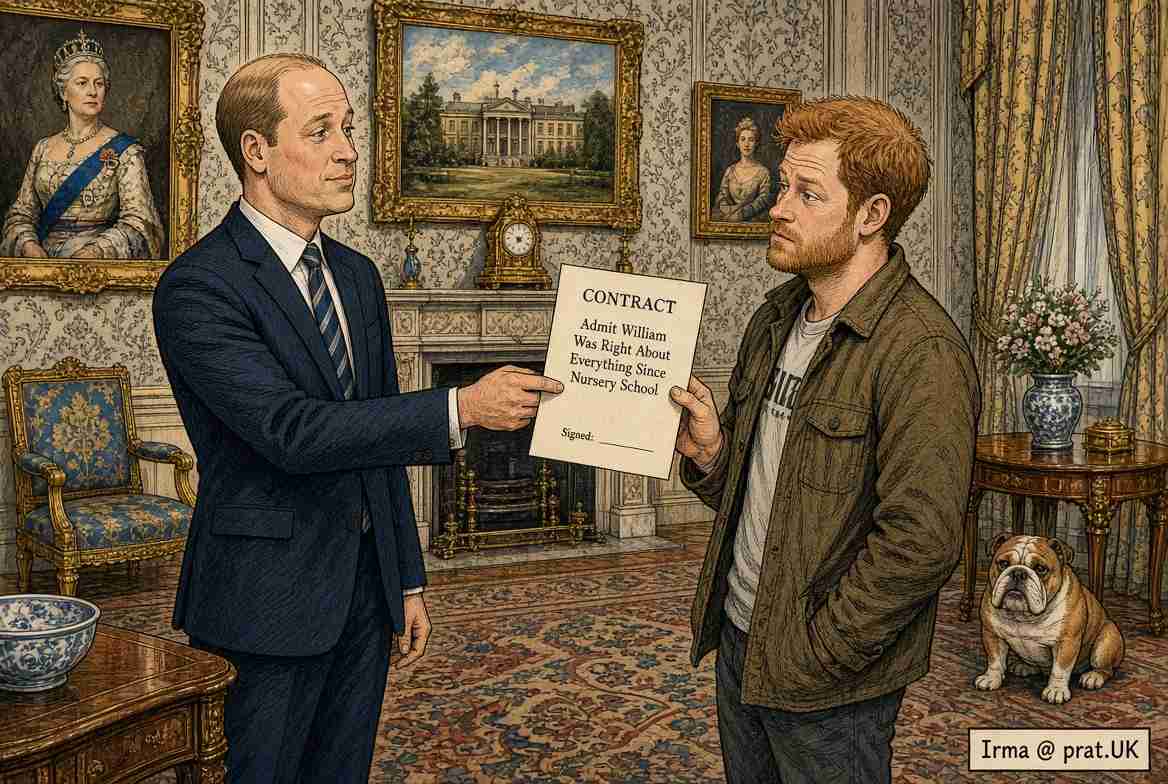
Prince William Reportedly Offers Harry Path to Reconciliation: Admit William Was Right About Everything Since Approximately Nursery School
Palace Peace Process Enters Its 847th Preliminary Stage
LONDON — Britain awoke Sunday to promising news in the nation’s longest-running diplomatic dispute not involving France: Prince William and Prince Harry may theoretically possess a pathway toward reconciliation, provided everybody can first agree precisely who should apologise, for what, in what order, using which adjectives, and whether Spare counts as supporting documentation or evidence for the prosecution.
Recent reporting continues to describe the brothers as estranged despite Harry and Meghan’s return to Britain, with royal observers characterising relations between William and Harry as exceedingly cold, according to People’s coverage of the ongoing royal rift.
That leaves Britain confronting the question it has avoided since approximately 1987: which brother started it?
Constitutional scholars were unavailable because this is not actually a constitutional question. Royal correspondents were nevertheless already outside Kensington Palace explaining it for seven hours.
Thinking About The Royal Reconciliation…
- Royal reconciliation apparently works differently from ordinary reconciliation. Most families start with “Can we talk?” The Windsors begin with a preliminary agreement, three advisers, an apology schedule, and somebody checking whether the Archbishop is free Thursday.
- William reportedly wants an apology, which sounds simple until you remember this is the royal family. Nobody has simply said “sorry” since somebody misplaced the American colonies.
- Harry has already written Spare. If an apology is hidden somewhere inside it, locating it may require the same archaeologists who found Richard III underneath a car park.
- The brothers reportedly remain estranged even after Harry and Meghan returned to Britain, with Harry publicly more open to reconciliation than William.
- William’s theoretical reconciliation form probably begins, “Please identify the first occasion on which William was correct.” Harry: “Nursery?” Palace: “Earlier.”
William’s Proposed Settlement Apparently Begins Somewhere Near Nursery School
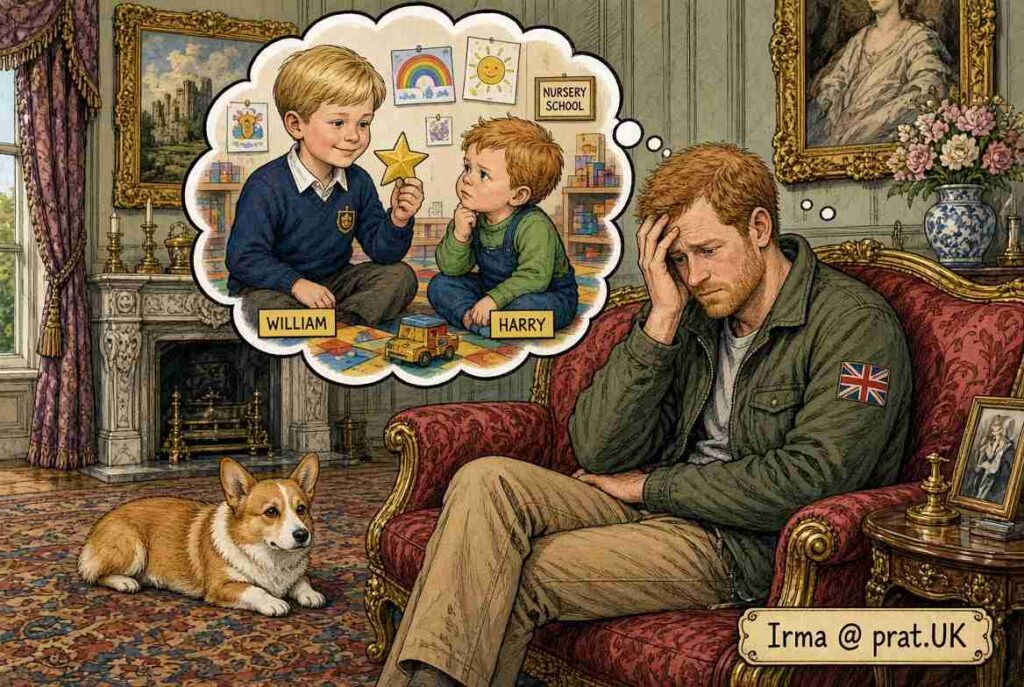
Under the completely unofficial peace framework currently being reconstructed by Britain’s enormous Royal Speculation Industrial Complex, Harry would begin by acknowledging that William was correct about everything dating approximately to nursery school.
This would include the disputed wooden horse incident, the controversial green crayon allocation, the Sandringham biscuit affair, and an unresolved 1991 allegation concerning who was technically supposed to return a toy fire engine.
William would then allegedly consider moving negotiations forward to primary school. Experts estimate adulthood could be reached by 2047.
The central difficulty is obvious. Normal brothers can resolve a childhood dispute because nobody documented it. Royal brothers cannot. Somewhere there is probably a former equerry who remembers the fire engine. And he’s writing a book.
Britain Prepares Folding Chairs for Most Awkward Family Meeting Since 1066
If a reconciliation meeting occurs, authorities are preparing accordingly. Folding chairs have reportedly been positioned at strategic locations across London, because Britain understands that when two Windsor brothers enter the same room, approximately 4,000 journalists immediately develop lower-back problems.
The meeting itself would require seating arrangements normally associated with nuclear negotiations. William here. Harry there. Meghan somewhere capable of causing forty-seven newspaper columns merely by selecting Earl Grey instead of English Breakfast. Catherine nearby. Three private secretaries. Four lawyers. Two therapists. One historian. And a palace aide whose sole responsibility is preventing anyone from saying, “Actually, that’s not how I remember it.”
That sentence has destroyed more royal weekends than rain.
Harry Checks Spare for an Accidental Apology
Harry’s most difficult assignment would be determining whether he has already apologised somewhere in Spare. This is complicated by the fact that the memoir is approximately 400 pages long and contains enough family grievance to power Berkshire through January.
Harry’s staff would therefore need to conduct what scholars call a reverse grievance search. Instead of locating complaints, researchers search for sentences beginning, “I may have been wrong…” Royal archivists expect results shortly after the lost princes are discovered in the Tower.
Harry’s memoir famously described his version of several conflicts with William, including an alleged physical confrontation. A 2026 biography later cited a source disputing part of that account, demonstrating the fundamental difficulty facing any royal reconciliation: even the arguments now have competing editions.
Most ordinary brothers argue and eventually forget what happened. The Windsors argue and eventually receive ISBN numbers.
Royal Apology Scientists Confront a Wording Crisis
The next problem is language. Suppose Harry says, “William, I regret that things became difficult.” Rejected. That isn’t an apology.
Suppose Meghan says, “We are sorry people were hurt.” Rejected. Passive voice.
Suppose Harry says, “I sincerely apologise for everything.” Too broad. Lawyers panic. Netflix orders six episodes.
Suppose William replies, “I appreciate that.” Now Harry’s side demands clarification concerning whether “appreciate” means forgiveness or merely acknowledgement of receipt. The meeting adjourns for lunch.
This is why royal reconciliation takes longer than motorway construction.
Britain’s Newest Industry: Professional Apology Interpretation
Britain already employs royal reporters, royal historians, royal photographers, royal biographers, royal commentators, royal fashion analysts, and people capable of determining the health of the monarchy by examining where somebody stood on a balcony.
Reconciliation would create another profession: Royal Apology Analyst. Within twelve minutes of any statement, television viewers would encounter “Dr Nigel Pemberton, professor of Applied Sorry Studies at the University of Somewhere Near Oxford,” explaining that Harry said “deeply regret” rather than “profoundly regret,” and that this distinction is significant. Nobody would know why. Nigel wouldn’t either. But there would be a graphic.
Meghan Accidentally Internationalises the Conflict
Then comes Meghan. Any request that Harry and Meghan apologise expands the disagreement from sibling quarrel into multinational negotiations. Harry can theoretically say sorry to his brother. Meghan saying sorry creates an entirely different newspaper ecosystem.
If she apologises too warmly: MEGHAN PLOTS ROYAL RETURN. If she apologises insufficiently warmly: MEGHAN’S ICE-COLD MESSAGE TO FUTURE KING. If she doesn’t attend: MEGHAN SNUBS PEACE SUMMIT. If she attends: MEGHAN HIJACKS PEACE SUMMIT. If she remains perfectly motionless: BODY-LANGUAGE EXPERT REVEALS WHAT MEGHAN’S ELBOW REALLY MEANS.
There is no winning move because British tabloid chess contains seventeen queens and every square is somehow Meghan.
Palace Requests Something Previously Unknown to Humanity: A Private Royal Conversation
The sensible solution would be astonishingly radical. Two brothers meet privately. No cameras. No briefing. No “sources close to.” No television special. No memoir chapter afterward. Just William and Harry.
Unfortunately, current technology cannot support such a system. A royal conversation lasting longer than eleven minutes automatically generates a tabloid sidebar. Scientists remain baffled.
Public Survey Finds Britain Would Like Everyone to Get on With It
In an entirely unofficial poll conducted among people waiting for tea to cool, 93 percent said they would like William and Harry to reconcile. The remaining 7 percent work in royal journalism and have mortgages.
Respondents overwhelmingly supported the traditional British settlement: “Shake hands, stop talking about it, and complain privately for the next forty years.” This method successfully maintained thousands of British marriages between 1946 and 1982.
The Nursery-School Settlement
Ultimately, Britain’s royal crisis may return to where all sibling disputes begin. Childhood. William was older. Harry was younger. William presumably said something older-brotherish. Harry presumably did something younger-brotherish. Thirty-five years later, historians are standing outside Kensington Palace discussing emotional accountability. That is extraordinary efficiency. Most families can turn a dispute about Christmas dinner into fifteen years of resentment. The Windsors have managed to turn childhood resentment into an international media franchise.
Still, reconciliation remains possible. Harry and Meghan have returned to Britain, while King Charles has publicly clarified that they remain non-working royals rather than resuming official duties, per Reuters’ reporting on Harry and Meghan’s status.
Perhaps William and Harry eventually meet. Perhaps somebody says sorry. Perhaps somebody says, “I was wrong.” Perhaps William even admits Harry was correct about something. At that moment every palace alarm will sound simultaneously. The ravens will abandon the Tower. The Crown Jewels will begin vibrating. And a constitutional official will rush into the room shouting, “Your Royal Highness, please reconsider. There are limits to reconciliation.”
The Royal Family Discovers the Ultimate Problem With Apologies
An apology works only when the objective is ending the argument. Royal arguments have developed a different objective. They sustain newspapers. Documentaries. Books. Podcasts. Television panels. Biography excerpts. Streaming deals. Body-language experts. Former palace employees remembering things from 1998.
The disagreement is no longer merely an argument. It is Britain’s most reliable renewable energy source. Wind occasionally stops. The sun sets every evening. William and Harry? Twenty-four-hour baseload capacity.
And so the peace process continues. William allegedly wants accountability. Harry wants reconciliation. Meghan would presumably prefer not to discover tomorrow morning that the angle of her handbag has restarted the Wars of the Roses. Britain merely wants everyone assembled around one table long enough to take a photograph.
The photographer will shout, “Closer together, please.” William will move half an inch. Harry will move half an inch. Britain will gasp. And somewhere in London, a royal correspondent will begin typing: EXCLUSIVE — HISTORIC THAW AS BROTHERS REDUCE DISTANCE BY FULL INCH.
Civilisation will have survived another Windsor family dinner.
10 Humorous Observations Before the Royal Peace Talks Begin
- Every normal sibling argument eventually reaches “Mum liked me better.” Unfortunately, when your mother was Princess Diana, that sentence generates eight documentaries and a commemorative tea towel.
- The British public loves royal reconciliation because it combines its two national hobbies: watching aristocrats suffer emotionally and pretending this is constitutional scholarship.
- Meghan’s alleged role in any apology turns the negotiations into international diplomacy. One wrong adjective and California recalls its ambassador from Kensington.
- Buckingham Palace communication remains magnificently British. Nobody says, “We’re angry.” Instead, a source says somebody was “somewhat disappointed,” which in aristocratic English means cavalry has been mobilised.
- A public apology would immediately create a second controversy about the wording of the public apology. “Regret” is not “sorry.” “Sorry” is not “deeply sorry.” “Deeply sorry” apparently requires Balmoral.
- Since Harry’s memoir documented grievances involving William, any brotherly peace conference could require footnotes. A later biography even cited a source disputing whether one alleged confrontation became physical.
- Nothing says spontaneous family healing like negotiated conditions. Imagine hugging your brother while a solicitor whispers, “Paragraph 7(b) permits affection but expressly prohibits Netflix adaptations.”
- The monarchy survived Henry VIII, civil war, and Edward VIII. Its modern nemesis appears to be brothers remembering childhood differently.
- The most dangerous sentence in Windsor remains: “That’s not how I remember it.” Four words capable of producing a memoir, palace statement, six television specials, and seventy-three royal experts standing outside gates.
- The eventual reconciliation photograph would solve absolutely nothing. They could shake hands for nine seconds and Britain would spend six months analysing whether William’s left eyebrow had formally recognised Sussex sovereignty.
Satirical Disclaimer: This story takes current reporting about the continuing estrangement between Princes William and Harry and subjects it to exaggeration, absurd deductions, imaginary bureaucracy, and the ancient scientific discipline of wondering why brothers cannot simply telephone each other. Any surveys, apology institutes, nursery-school treaty provisions, and emergency folding-chair deployments above are comic inventions. This article is entirely a human collaboration between two sentient beings: the world’s oldest tenured professor and a philosophy major turned dairy farmer, both of whom remain available for royal mediation provided sandwiches are supplied.

I am a Lagos-born poet and satirical journalist navigating West London’s contradictions. I survived lions at six, taught English by Irish nuns, now wielding words as weapons against absurdity. Illegal in London but undeniable. I write often for https://bohiney.com/author/junglepussy/.
As a young child, I was mostly influenced by the television show Moesha, starring singer and actress Brandy. Growing up, I would see Brandy on Moesha and see her keeping in her cornrows and her braids, but still flourish in her art and music, looking fly. I loved Moesha as a child, but now I take away something more special from it. Just because you’re a black girl, it doesn’t mean you need to only care about hair and makeup. Brandy cared about books, culture and where she was going — you can do both.


