Princess Diana Considered Becoming First Lady, America Nearly Imports British Royalty After Spending 200 Years Bragging It Got Rid of It
Diana Reportedly Tempted by White House Life, Mostly for the Opportunity to Make Buckingham Palace Watch Her Become More Popular in Another Country
LONDON — The United States apparently came remarkably close to completing the longest return policy in history: overthrowing the British monarchy in 1776 and then, roughly two centuries later, considering importing Princess Diana through marriage.
According to Charles Spencer’s new memoir, Diana once asked her brother whether he thought she would make a good American first lady. Spencer says one of Diana’s older American political admirers believed that marrying her could help propel him into the White House. He also writes that Diana was considerably more intrigued by the White House itself than by the prospective husband.
Which is understandable.
The White House has 132 rooms. An elderly presidential aspirant has, statistically speaking, one recliner. This was not necessarily romance. This was real estate with a motorcade.
According to Spencer’s account, Diana also enjoyed the notion that reinventing herself in Washington might inspire jealousy within the British royal establishment while bringing extraordinary glamour to the White House.
That is where this stops being merely a love story and becomes one of history’s great unrealized television events.
Imagine Buckingham Palace switching on CNN.
“And now, arriving at tonight’s state dinner, First Lady Diana…”
Somebody drops a teacup.
Thinking About Princess Diana
- America fought a revolution to escape British royalty, then spent two centuries becoming fascinated by whichever royal was most photogenic.
- The unnamed politician’s apparent campaign strategy was refreshingly simple: if voters don’t like you enough, marry somebody they already adore.
- Diana becoming first lady would have turned every presidential appearance into the political equivalent of being the opening act.
- Buckingham Palace might have discovered the most dangerous form of royal rebellion was not abdication. It was better ratings overseas.
- Diana reportedly found the White House role more interesting than the prospective elderly husband, suggesting the gentleman may have been treated as constitutional transportation.
America Discovers It Didn’t Hate Royalty, It Just Wanted Better Royalty
America has spent 250 years insisting that it rejected monarchy because all people are created equal.
This principle remains absolutely sacred except during royal weddings, royal funerals, royal scandals, royal divorces, royal pregnancies, royal interviews and occasions when somebody named Windsor gets photographed shopping at Whole Foods.
Americans did not necessarily reject royalty. They rejected paying for it directly.
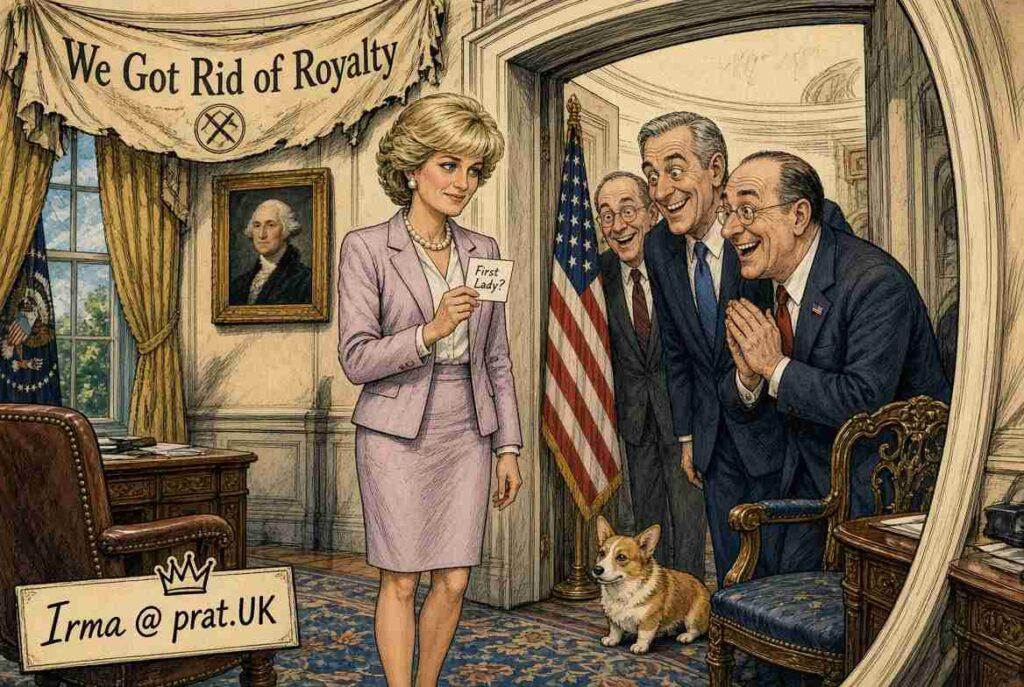
Diana arriving as first lady would therefore have represented the perfect constitutional compromise. Americans could obtain all the glamour of monarchy while continuing to insist they had defeated monarchy.
“We don’t have princesses here,” an American could proudly explain while standing behind a barricade for six hours hoping Princess Diana waved at him.
This is called republican government.
The Candidate’s Revolutionary Campaign Strategy: Marry Someone Voters Actually Like
The unnamed politician reportedly believed Diana could help him win the presidency.
This may be the most refreshingly candid campaign strategy ever devised.
Normally presidential candidates hire polling firms, advertising agencies, opposition researchers, speechwriters, strategists, media consultants and approximately 900 people whose job description is “senior adviser” despite nobody remembering what they advise.
This man apparently looked at the entire political consulting industry and said:
“Or I could marry Diana.”
Brilliant.
Why persuade 80 million voters individually when you can simply wed somebody they already recognize? Political scientists call this borrowed favorability. Normal people call it marrying up.
The campaign slogan practically writes itself:
DIANA FOR FIRST LADY
And underneath, in smaller print:
Some Gentleman Also Running for President
America Quietly Wonders Whether the Candidate Is Even Necessary
The logistical problem would have emerged almost immediately.
Suppose the politician and Diana walk onto a campaign stage. Ten thousand people cheer. Candidate waves. Nothing. Diana waves. National Guard summoned.
Candidate begins discussing marginal tax rates. Crowd chants: “DI-A-NA! DI-A-NA!”
Candidate announces comprehensive foreign policy initiative. Woman in third row screams, “DIANA, WHERE DID YOU GET THAT JACKET?”
At some point the campaign manager quietly approaches the presidential nominee.
“Sir, we have tremendous news.”
“What?”
“Our internal polling shows your household is leading by 19 points.”
“Wonderful. How am I doing?”
The campaign manager looks at the floor.
“Your household is doing extremely well.”
Buckingham Palace Discovers Its Worst Nightmare: Diana With a Bigger House
The comic potential for Britain is almost unfair. Diana had already been one of the most famous women on Earth. Transplanting her to Washington would have created an international popularity contest involving two historic residences.
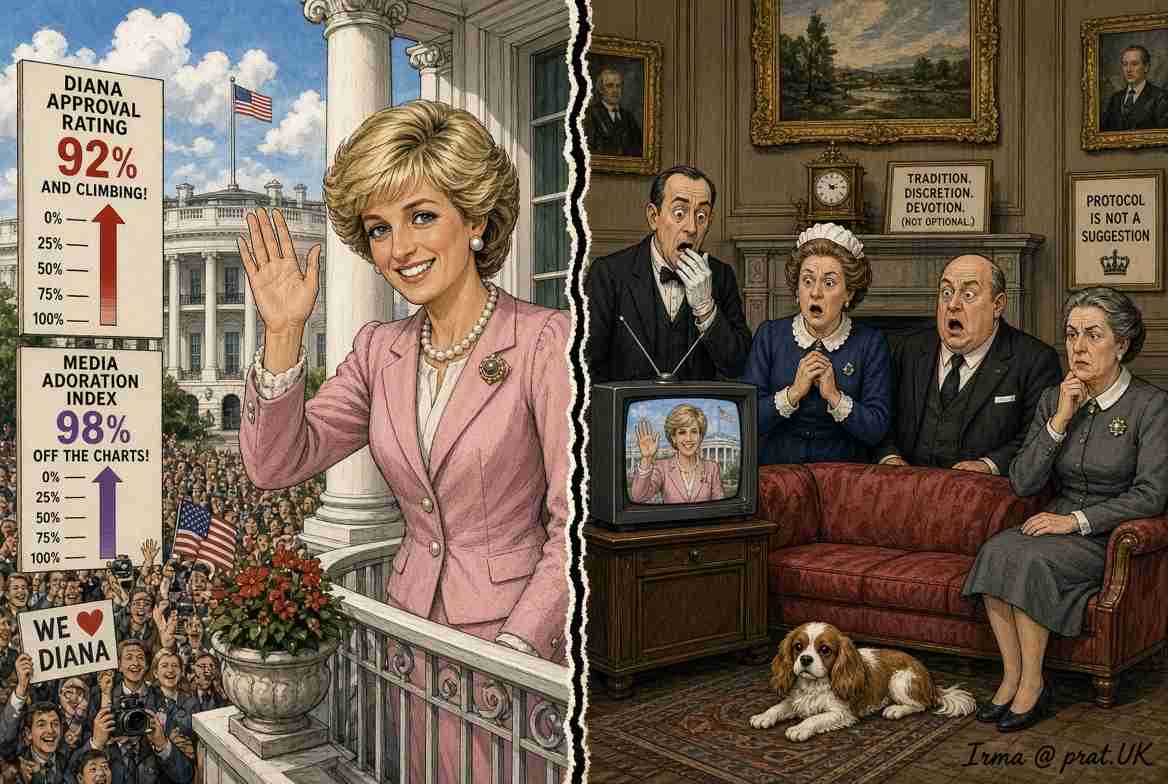
Buckingham Palace: 775 rooms. White House: 132 rooms.
But television does not care about square footage. Television cares who walks down the stairs.
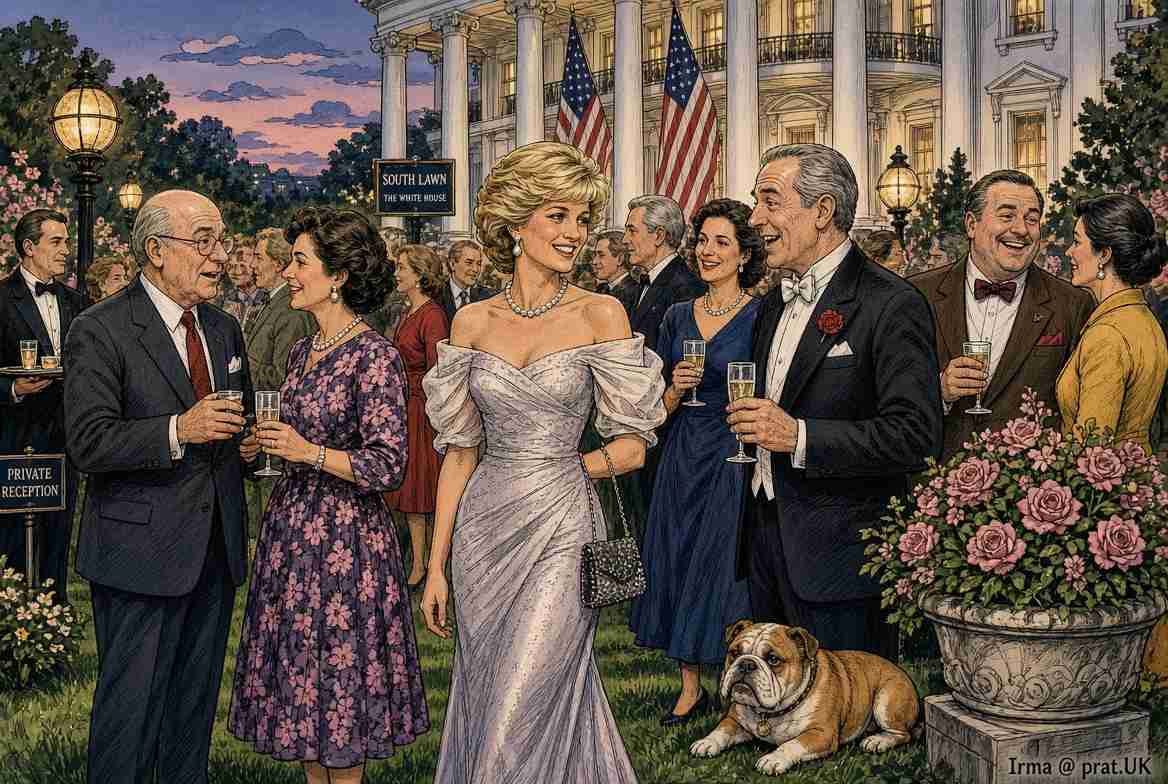
Imagine Diana hosting a state dinner, meeting schoolchildren, visiting hospitals and walking across the South Lawn while Britain watches.
Within six weeks, American souvenir shops would be selling Diana coffee mugs, Diana inaugural plates, Diana refrigerator magnets and possibly commemorative bald eagle tiaras.
Buckingham Palace would respond with the traditional British weapon of last resort: a statement expressing that nobody was remotely bothered.
“The Royal Household wishes the former Princess of Wales every happiness in her new position and absolutely rejects suggestions that anyone screamed upon seeing this morning’s international newspaper circulation figures.”
Very convincing.
Diana Reinvents the Trophy Wife as the Trophy Candidate
The strangest aspect of Spencer’s account is the politician’s calculation. He allegedly thought marrying Diana could help make him president.
That is extraordinary optimism.
Imagine buying a ticket to a Beatles concert and believing the audience came to hear you explain municipal bonds during intermission.
Diana would not have been the accessory to his presidential campaign. He would have been the accessory required by federal law to get Diana into the East Wing.
This man thought he was acquiring a trophy wife. Instead, he might have discovered he had become a trophy husband.
Reporters would shout: “Mrs. Diana! Mrs. Diana! One question!”
Then somebody notices the president walking behind her.
“Oh, yes, sir. Could you move slightly? You’re blocking Diana.”
Constitutional Scholars Confront America’s First Charisma Emergency
The Constitution contains detailed rules concerning presidential succession. President dies: vice president takes over. Vice president unavailable: Speaker of the House enters the picture. And so forth.
But nowhere does the document explain what happens when the first lady becomes 14 times more famous than the entire federal government.
The Founding Fathers simply failed to anticipate Diana.
James Madison considered factions. Alexander Hamilton worried about executive authority. Benjamin Franklin worried about almost everything except what would happen if a globally adored British princess showed up at Pennsylvania Avenue wearing a spectacular evening gown.
Congress would eventually have been forced to hold hearings.
“Madam First Lady, is it true your approval rating is 84 percent?”
“Yes.”
“Madam, the president’s is 41.”
“I see.”
“And Congress is at 17.”
“Yes.”
“Could you perhaps stop waving?”
The White House Press Corps Forgets the President Exists
Every administration complains about media coverage. This administration would have had the opposite problem. The media would cover the White House constantly. Just not the president.
WASHINGTON POST: Diana Visits Pediatric Hospital
NEW YORK TIMES: Diana Redefines American Public Life
PEOPLE: Diana’s 10 Most Elegant White House Looks
President: Announces Middle East initiative. Page 37. Below crossword puzzle.
Television producers would experience similar difficulties.
“Tonight: major changes in American economic policy. But first, Diana has changed her hair.”
Twenty-seven minutes later: “And briefly, before weather, something happened with interest rates.”
The president might eventually schedule policy announcements specifically for days Diana stayed indoors.
Jackie Kennedy Comparisons Begin Approximately Eleven Seconds After Inauguration
Spencer writes that Diana imagined introducing White House glamour that might even surpass the Jackie Kennedy era. The comparison would have been irresistible.
Fashion. Style. Youthful glamour. International fascination. State dinners. Diplomatic tours.
The difference is that by the 1990s, international celebrity culture had developed into a fully mechanized industrial harvesting operation.
Jackie Kennedy had magazines. Diana would have had 24-hour cable television.
Every dress becomes breaking news. Every expression becomes analysis. Every handshake becomes three documentaries and an unauthorized biography.
CNN would create a permanent Diana desk. Larry King would eventually interview somebody who once stood behind her at Heathrow.
British Royalty Confronts the Horrifying Possibility of Being Out-Royaled by a Republic
The monarchy has one basic competitive advantage: it has royalty. America does not. That is the whole arrangement.
Britain provides kings, queens, palaces, ceremonial uniforms and horses trained to walk extremely slowly. America provides aircraft carriers and Costco. Everybody stays in his lane.
But Diana becoming first lady would scramble the entire international order.
America would suddenly possess someone with royal glamour while retaining elections, freedom of speech and refrigerators large enough to store an entire British kitchen.
Britain would have to compete.
“Today His Royal Highness opened a municipal recycling centre in Surrey.”
Meanwhile: “First Lady Diana arrives in Paris before 140,000 cheering spectators.”
This is not diplomacy. This is relegation.
The President Eventually Realizes He Married His Own Opposition Party
There would inevitably come a difficult day in the Oval Office. The president’s advisers enter carrying polling data.
“Sir, there’s been a decline in your approval rating.”
“How much?”
“Six points.”
“Why?”
“You disagreed with Diana.”
“About what?”
“Curtains.”
The president stares through the window.
“I’m commander in chief.”
“Yes, sir.”
“I control the nuclear arsenal.”
“Yes, sir.”
“And she chose curtains.”
“Yes, sir.”
“So?”
“Respectfully, Mr. President, don’t pick a fight you can’t win.”
That is politics.
America Finally Solves Bipartisanship by Agreeing Diana Is More Interesting Than Congress
Diana might even have accomplished what generations of American politicians could not: national unity.
Republicans would like her. Democrats would like her. Independents would like her. People who never vote would suddenly have opinions about White House china.
Congressional approval could collapse to 3 percent and nobody would care because Diana was visiting Cleveland.
The country would finally come together around one shared civic principle: whatever Washington was doing, Diana was probably more interesting.
The Ultimate Revenge Would Have Been Happiness Somewhere Else
There is also a sharper irony beneath the silliness.
Spencer’s account portrays Diana as attracted to reinvention. After years in which royal life had constrained her identity, Washington represented an extraordinary alternative: a globally visible public role that did not depend upon being married to Britain’s future king.
And that would have produced the most elegant possible royal revenge.
Not denunciation. Not exile. Not scandal. Success.
There is no more irritating outcome for people who underestimated you than discovering you have become wildly successful somewhere else. You don’t phone them. You don’t complain. You simply appear on television receiving a 21-gun salute.
History’s Greatest Unused Campaign Advertisement
Had this improbable scenario occurred, the campaign commercial could have been remarkably economical.
No narrator. No policy charts. No ominous music. Just Diana stepping out of a limousine. Screen fades to black.
VOTE FOR HER HUSBAND. APPARENTLY HE’S RUNNING TOO.
Political consultants would study it for decades. Harvard would offer a course. Campaign managers would try replicating the formula.
“Senator, internal research indicates your education proposal isn’t resonating.”
“What should I do?”
“Marry someone internationally beloved.”
“Is there another Diana?”
“No.”
“Then we’re finished.”
And there lies the tragedy of the whole hypothetical episode.
America might have gotten Princess Diana as first lady. Britain might have gotten to watch its most famous royal export become even more celebrated. Buckingham Palace might have discovered that the most dangerous thing Diana could do after leaving royal life was thrive conspicuously.
And some unnamed American politician might have achieved his presidential dream by introducing the electorate to the one person on the ticket they actually wanted to see.
Two centuries after Americans threw off British rule, the country nearly found a constitutional loophole. Apparently the problem was never royalty. America merely wanted to elect the husband first.
10 Humorous Observations From This Story
- American consultants spend millions creating candidate charisma. Diana could have achieved it by getting out of the limousine.
- The United States abolished hereditary monarchy but never abolished its craving for celebrity aristocracy.
- A presidential candidate marrying Diana would have been less a wedding than an acquisition.
- The candidate apparently believed Diana could help him win the presidency, which raises the awkward question of why America needed him in the arrangement.
- Diana as first lady could have caused a permanent diplomatic crisis when Americans began asking why Britain had kept the more popular royal.
- Buckingham Palace could tolerate Diana escaping royal life. Watching her become internationally important somewhere else would have required stronger tea.
- The White House press corps would have spent four years asking the president about Diana’s clothes and occasionally remembering he controlled nuclear weapons.
- State dinners would have become impossible because every foreign leader would have wanted to sit beside Diana, including the president.
- Jackie Kennedy comparisons would have started before the inaugural parade reached Pennsylvania Avenue.
- Britain’s greatest constitutional embarrassment might have been discovering that America could operate perfectly well with a princess provided it simply called her First Lady.
Disclaimer
This satire grows from Charles Spencer’s published account of his sister considering the possibility of life as an American first lady. The presidential campaign meetings, constitutional panic, polling catastrophes, congressional hearings, dropped teacups, Diana desk at CNN and federal curtain crisis belong to the comic machinery.
This story is entirely a human collaboration between two sentient beings: the world’s oldest tenured professor and a philosophy major turned dairy farmer, both of whom remain confident that the American Revolution would have required several additional committee meetings had the Founders known Princess Diana might eventually want the East Wing.
The underlying reported claim comes from Spencer’s memoir as summarized by Fox News on September 26, 2026: Diana allegedly asked whether she would make a good first lady, and Spencer says the unnamed American politician believed marrying her would help him win the presidency.

Alan Nafzger was born in Lubbock, Texas, the son Swiss immigrants. He grew up on a dairy in Windthorst, north central Texas. He earned degrees from Midwestern State University (B.A. 1985) and Texas State University (M.A. 1987). University College Dublin (Ph.D. 1991). Dr. Nafzger has entertained and educated young people in Texas colleges for 37 years. Nafzger is best known for his dark novels and experimental screenwriting. His best know scripts to date are Lenin’s Body, produced in Russia by A-Media and Sea and Sky produced in The Philippines in the Tagalog language. In 1986, Nafzger wrote the iconic feminist western novel, Gina of Quitaque. He currently lives in Holloway, North London. Contact: [email protected]