China’s Discount AI Goes Global, Washington Discovers the Rest of the World Has a Budget
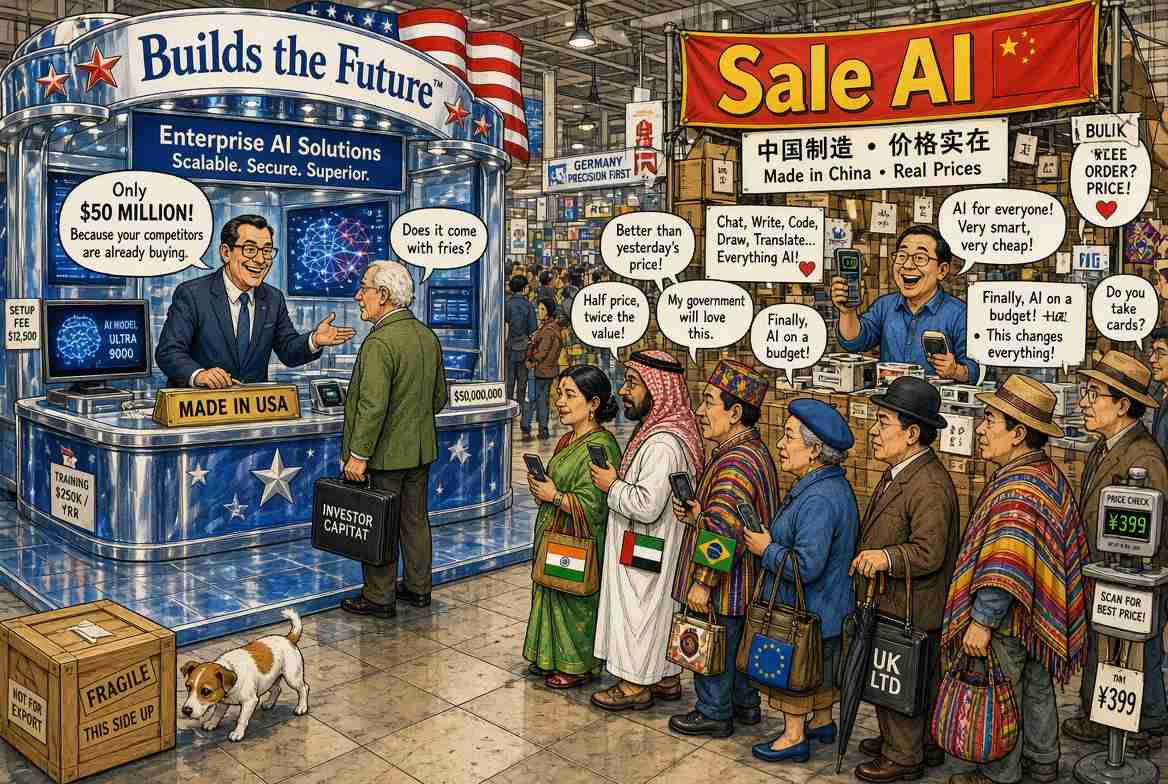
American AI Builds the Future; China Apparently Checks the Price Tag
BEIJING — The latest warning that China may be gaining ground in global artificial intelligence adoption contains one particularly disturbing fact for Washington: customers appear to enjoy paying less money.
Chinese artificial-intelligence models have dramatically increased their share of usage on major developer platforms during 2026, according to the underlying CNBC investigation. On OpenRouter, Chinese models reportedly represented 57% to 67% of token usage during the week containing September 14, compared with just 6% to 13% in February. Vercel reported Chinese models rising from 11% of usage in January to 55% in August.
This has caused considerable concern in Washington, where officials have discovered an ancient economic phenomenon previously known only to Costco shoppers:
People like bargains.
China Introduces Revolutionary New AI Strategy Called “Cheaper”
For several years, the artificial-intelligence competition appeared reassuringly complicated.
There were GPUs.
There were transformers.
There were neural networks.
There were trillion-dollar valuations.
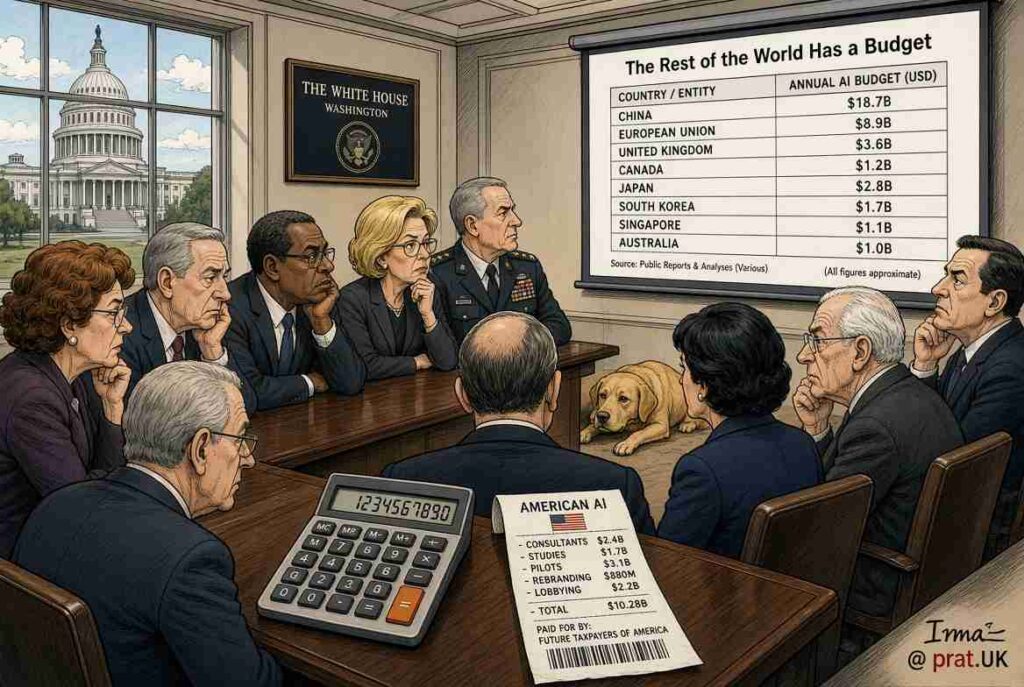
There were experts explaining “inference-time scaling” to congressional committees whose members were still trying to rotate a PDF.
Then China apparently introduced a revolutionary computational architecture known as:
“What if we charged less?”
The American technology industry was stunned.
“We had not modeled this scenario,” explained Dr. Theodore Clipboard, senior fellow at the Institute for Extremely Expensive Futures. “Our simulations assumed every customer wanted the smartest possible model regardless of whether using it required refinancing the warehouse.”
Chinese models from companies including DeepSeek, Z.ai and Alibaba have improved substantially, particularly in coding and other agentic tasks. American frontier systems still lead many high-end benchmarks, but Chinese systems are increasingly reaching a quality level where businesses consider them perfectly adequate for ordinary workloads.
And “perfectly adequate” is perhaps the most terrifying phrase in capitalism.
Most people do not drive Formula One cars to Kroger.
Nobody demands that the office microwave contain aerospace engineering.
Your accountant does not need quantum computing to tell you lunch was not deductible.
Sometimes the customer merely wants something that works.
This development has sent shock waves through an AI industry whose traditional business strategy increasingly resembled selling a Swiss watch to somebody asking what time it was.
Corporate America Discovers AI Has an Accounting Department
For the past several years, artificial intelligence has been purchased primarily by executives.
Executives attend conferences.
They enjoy phrases such as “transformational paradigm.”
They say things like:
“We need an enterprise AI strategy.”
Nobody knows what this means, which is why consultants can charge $4,200 to explain it.
Eventually, however, every technology purchase encounters civilization’s final boss:
Linda from Accounting.
Linda does not care whether your model achieved 88.7% on the Advanced Recursive Strawberry Benchmark.
Linda wants to know why the monthly inference bill resembles Argentina’s sovereign debt.
“You spent HOW MUCH generating meeting summaries?” Linda asks.
“Well,” says the innovation officer, “the model demonstrates frontier reasoning.”
“The meeting was about replacing the toner cartridge.”
“Yes, but it understood the toner at a very deep level.”
China’s growing advantage is that a large number of customers apparently do not need an artificial Einstein.
They need an artificial Kevin who answers emails, fixes Python code and does not submit an expense report.
As Bohiney.com’s own resident stand-up correspondent, Wendell Kasprzak, put it during a recent open-mic set on the state of enterprise software: “Every company says it wants innovation until innovation shows up on the invoice. Then suddenly they want a discount and a nondisclosure agreement.”
The Global South Commits Reckless Act of Shopping Around
The strongest adoption of Chinese models on OpenRouter has reportedly appeared among companies in what the platform describes as the Global South, covering 82 countries across Latin America, Africa and Asia. Roughly 67% of tokens used by companies in that grouping were going to Chinese models in the recent data.
This has baffled Western strategic thinkers.
Apparently an entrepreneur in Lagos facing limited computing budgets does not begin his software-purchasing process by asking:
“How can my API selection preserve the postwar international order?”
He asks:
“How much?”
Likewise, a startup founder in Jakarta has been observed comparing products without first consulting Washington think-tank papers.
Authorities are monitoring the situation.
One deeply troubling eyewitness report described a Brazilian programmer opening two browser tabs and comparing prices.
This is exactly how free markets get out of control.
America Built AI Ferraris for People Delivering Pizza
The American models remain extraordinarily capable.
That matters.
For difficult scientific work, advanced reasoning, complicated agents and frontier applications, businesses may still choose cutting-edge American systems. Vercel executive Harpreet Arora told CNBC that companies continue to seek frontier U.S. models for more complex jobs, even while lower-cost Chinese models become attractive once they pass a sufficient quality threshold.
But therein lies the problem.
America built the Ferrari.
China noticed most customers were delivering pizza.
The Ferrari is faster.
The Ferrari is more sophisticated.
The Ferrari contains engineering that borders on witchcraft.
But if Luigi needs to deliver a pepperoni pie three blocks away, Luigi eventually notices the Honda works.
This principle already governs nearly everything humans buy.
Most people do not own the finest refrigerator ever designed.
They own a refrigerator that keeps mayonnaise from becoming a public-health incident.
Most companies do not purchase the finest office chair ever constructed.
They purchase something that technically has a back.
Artificial intelligence may therefore be undergoing the most humiliating technological transition imaginable:
It is becoming normal software.
Washington Discovers Open Source Was Supposed to Benefit Us
Another complication is China’s aggressive use of open-weight models.
Alibaba’s Qwen ecosystem, for example, has accumulated more than 151,000 derivatives on Hugging Face’s own developer platform data, dramatically exceeding the repository footprint of several prominent Western alternatives. A Stanford policy brief tracking the open-weight ecosystem found Chinese-origin derivative models now regularly outpace those built on major U.S. and European systems.
For decades, Silicon Valley explained the philosophical virtues of open technology.
Openness creates ecosystems.
Openness empowers developers.
Openness accelerates innovation.
Openness prevents monopolies.
Then Chinese developers said:
“Fantastic. We wrote that down.”
Suddenly openness developed suspicious cheekbones.
An emergency meeting was reportedly held at the Center for Strategic Technology Alarm.
“We support open ecosystems,” said one imaginary policy analyst, “provided everybody understands that openness should primarily result in American companies becoming richer.”
Asked whether that technically qualified as openness, he requested the question be exported under national-security controls.
Export Controls Meet the World’s Most Persistent Engineering Department
The United States has spent years restricting Chinese access to advanced semiconductor technology.
The rationale is straightforward: cutting-edge artificial intelligence requires enormous computing capacity, and limiting China’s access to the best chips could slow its progress.
Yet technological competition frequently produces inconvenient adaptation.
Restrict somebody’s resources and engineers start asking how to accomplish the same task with fewer resources.
Humans have been doing this since the first caveman was informed the mammoth budget had been reduced.
Washington says:
“You cannot have the expensive chips.”
China says:
“Fine.”
Washington waits six months.
China returns holding seventeen cheaper models and a receipt.
Two House committees are examining the implications of wider adoption of Chinese models, while concerns remain about Chinese companies accessing advanced Nvidia hardware through overseas data centers and about model-distillation techniques.
Thus America finds itself in the awkward position of attempting to constrain Chinese computing while simultaneously watching Chinese companies become highly motivated to improve computing efficiency.
It resembles banning a teenager from restaurants and accidentally creating a chef.
AI Becomes Walmart With Matrix Multiplication
The artificial-intelligence industry likes discussing enormous philosophical questions.
What is intelligence?
Will machines become conscious?
Could artificial general intelligence transform civilization?
Will humanity survive superintelligence?
Procurement departments have introduced an additional philosophical question:
Can you knock 40% off?
This is how nearly every revolutionary technology eventually ends.
The automobile began as an engineering miracle.
Eventually somebody offered financing and cupholders.
Television began as a miraculous transmission of moving images.
Eventually somebody sold one at Walmart next to a six-pack of socks.
Computers once occupied entire rooms.
Now people become furious if one takes fourteen seconds to restart.
AI may be entering exactly that stage.
The breakthrough is no longer merely possessing intelligence.
The breakthrough is offering intelligence at industrial quantities without forcing the customer to sell a kidney.
The American AI Industry Encounters Its Natural Predator: Commodity Pricing
There is a nightmare scenario for expensive AI companies that nobody enjoys discussing at cocktail parties.
What if intelligence becomes cheap?
Not worthless.
Not identical.
Just cheap enough.
Suppose six providers can perform 90% of routine corporate tasks acceptably.
At that point, model intelligence starts behaving less like magic and more like electricity.
Nobody invites the electric company to give a keynote because its electrons demonstrate superior reasoning.
Nobody asks whether German electricity outperforms Japanese electricity on benchmarks.
You plug in the toaster.
Toast occurs.
The artificial-intelligence industry would prefer not to become toast electricity.
Unfortunately China appears enthusiastic about becoming toast electricity.
America Could Win the Benchmark and Lose the Invoice
This produces the strangest possible outcome of the global AI competition.
America could still possess the strongest frontier systems.
American laboratories could still achieve the most impressive scientific breakthroughs.
American companies could still dominate the hardest reasoning tasks.
And millions of businesses could nevertheless say:
“That’s wonderful. We’ll take the cheaper one.”
There is precedent.
Technological history is littered with products that were technically superior but commercially inconvenient.
Engineering excellence matters.
Distribution matters.
Price matters.
Developer ecosystems matter.
And once technology becomes “good enough,” the last 10% of capability can become extremely difficult to sell to somebody whose spreadsheet contains a column marked COST.
The Great Artificial Intelligence Yard Sale Has Begun
U.S. and Chinese officials have recently been discussing both AI competition and AI safety, including possible mechanisms for crisis communication between the two countries.
Those discussions concern extremely serious issues.
But beneath the geopolitical drama sits an almost comically ordinary commercial reality.
China is selling software.
Customers are buying it.
And they frequently explain their decision using approximately the same analytical framework employed by a father shopping for lawn furniture:
“This one looks fine.”
Washington can hold hearings.
Silicon Valley can publish benchmark charts.
Economists can write papers describing the strategic implications of artificial-intelligence diffusion.
But somewhere in Jakarta, Lagos, São Paulo or Bangkok, a programmer will still click the pricing page.
And that may ultimately be the most powerful benchmark of all.
Not MMLU.
Not SWE-bench.
Not graduate-level physics.
The benchmark is:
“Would you like to save 60%?”
Civilization has been running that test for several thousand years.
The cheap option does disturbingly well.
15 Humorous Observations About China’s Discount AI Takeover
- America Invented Luxury AI. China Invented Store-Brand AI. The American pitch increasingly sounds like: “This model is magnificent. It reasons, codes, researches, and costs roughly the GDP of Luxembourg every time you ask it to alphabetize a spreadsheet.” China’s pitch is: “Pretty good. Twelve cents.” Chinese models reportedly captured 57% to 67% of token use on OpenRouter during the week of September 14, compared with only 6% to 13% in February. On Vercel, their share reportedly climbed from 11% in January to 55% in August.
- Washington Has Discovered the Most Dangerous Chinese Technology Yet: A Competitive Price. For years Washington worried about chips, algorithms and intellectual property. Then somebody opened the invoice. This is considerably more frightening.
- American AI Companies Built Ferraris. Most Businesses Needed a Toyota With Wi-Fi. The top U.S. models still lead many benchmarks, while Chinese models have become capable enough for a growing number of ordinary business and coding tasks. Unfortunately for Ferrari, the world contains a lot of people trying to get groceries.
- The Global South Apparently Failed to Receive the Memo That AI Purchasing Decisions Are Supposed to Be Geopolitical. Entrepreneurs in Lagos, Jakarta and São Paulo are doing something reckless. They are comparing price and performance. This behavior must be stopped before it spreads to government procurement.
- Open Source Is Suddenly Terrifying Because Someone Else Is Doing It Successfully. Western technology executives spent years explaining that openness promotes innovation. China said, “Excellent idea.” Washington responded, “Not like that.”
- China May Have Discovered That Giving Developers Stuff Is an Effective Marketing Strategy. Alibaba’s Qwen reportedly has more than 151,000 derivatives on Hugging Face, with a much larger repository footprint than Meta’s Llama. Apparently software developers enjoy products they can actually modify. Economists are requesting additional research.
- The AI Race Has Entered Its Walmart Phase. The first stage was science. The second was engineering. The third was geopolitics. The fourth is a man in procurement saying, “But this one is 70% cheaper.” Civilizations have fallen over less.
- Washington Wanted to Slow China’s AI Progress by Restricting Chips. China responded by becoming extremely interested in making computation cheaper. This has the unpleasant flavor of telling your teenager he cannot have $100 for dinner and discovering he learned to cook.
- America’s Greatest AI Threat May Be the Purchasing Department. Scientists want the smartest model. CEOs want revolutionary artificial intelligence. The accounting department wants to know why artificial intelligence spent $84,000 answering customer emails that used to be ignored for free.
- “Good Enough” Has Quietly Conquered Most of Civilization. The toaster is good enough. The hotel Wi-Fi is good enough. Airline coffee is legally coffee. And if an AI model can write code for one-fifth the price while being only slightly less dazzling, somebody at corporate headquarters is already changing the API key.
- The United States Is Selling Intelligence. China Is Selling Intelligence by the Bucket. One model arrives wearing a tuxedo and describing its graduate-level reasoning abilities. The other arrives saying, “You want 40 billion tokens?”
- Businesses Have Once Again Demonstrated Their Weak Commitment to Ideology When Presented With a Discount. Corporate values are magnificent. Corporate values printed next to a 68% cost saving are somewhat less magnificent.
- AI Nationalism Has Met the Universal Language of Cheap. Governments can debate strategic alignment all afternoon. At 4:55 p.m., someone from purchasing asks: “So which one costs less?” Meeting adjourned.
- America May Be Discovering That Technological Leadership and Market Domination Are Not Necessarily the Same Thing. You can build the greatest steakhouse on Earth. If half the planet has $8 for lunch, somebody selling noodles has a business opportunity.
- The Most Embarrassing Outcome Would Be America Winning the AI Race While China Wins the Customers. That would be the technology equivalent of inventing television and discovering everyone bought the competitor’s remote control.
Multiple House committees, Vercel and OpenRouter usage data, and Hugging Face’s own derivative-model tracking all point to the same underlying story: DeepSeek, Alibaba’s Qwen team, Z.ai and Moonshot AI have spent 2026 undercutting American frontier labs like Anthropic and OpenAI on price for the large share of everyday business tasks that do not require top-tier reasoning, while U.S. and Chinese officials continue separate talks on AI safety and crisis communication.
This is a piece of American satire and satirical journalism. This satire is an entirely human collaboration between two sentient beings: the world’s oldest tenured professor and a philosophy major turned dairy farmer. Any absurd institutes, suspiciously convenient experts, traumatized accountants or terrified procurement officers encountered above exist to illuminate the comedy of international technology competition. The underlying adoption figures and market trends come from published reporting and the sources cited below.
Auf Wiedersehen, amigo!
For more satirical journalism from across the pond, visit The London Prat at prat.uk.
Sources
- CNBC — China AI Global Adoption
- Hugging Face — One Year Since the DeepSeek Moment
- Stanford HAI / DigiChina — Beyond DeepSeek: China’s Diverse Open-Weight AI Ecosystem

Harriet Collins is a high-output satirical journalist with a confident editorial voice. Her work demonstrates strong command of tone, pacing, and social commentary, shaped by London’s media and comedy influences.
Authority is built through volume and reader engagement, while expertise lies in blending research with humour. Trustworthiness is supported by clear labelling and responsible satire.