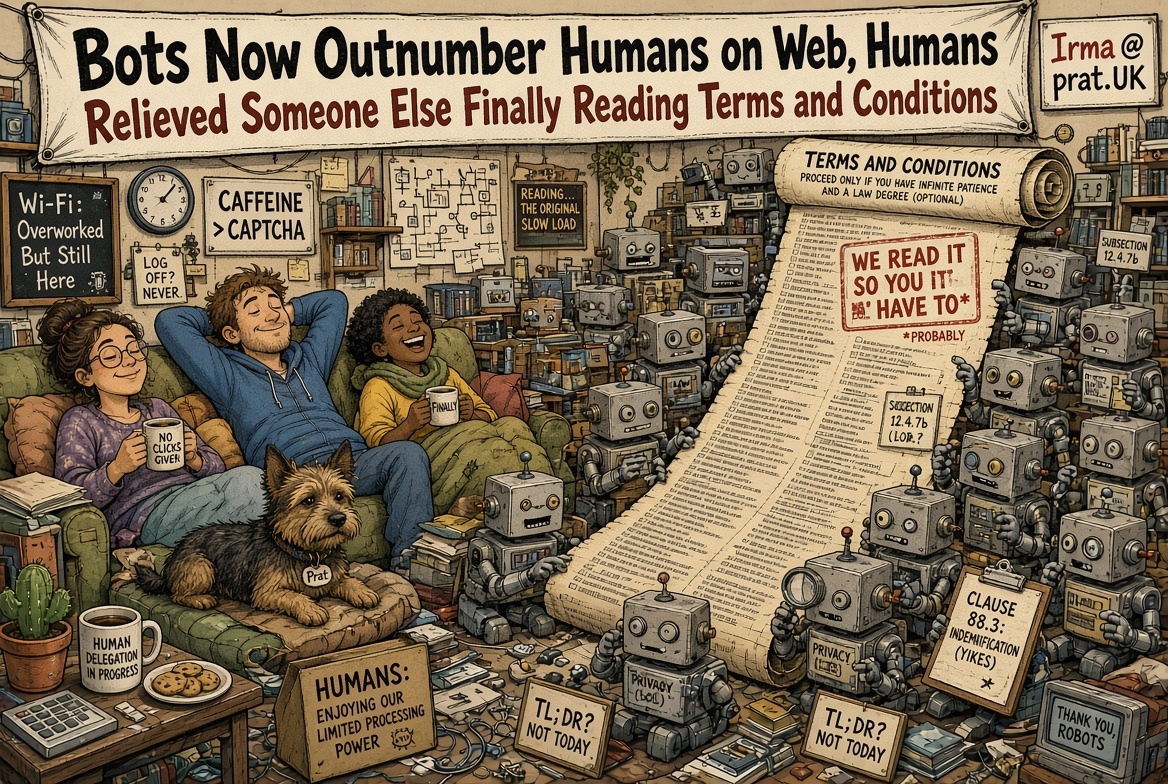
Bots Now Outnumber Humans on Web, Humans Relieved Someone Else Finally Reading Terms and Conditions
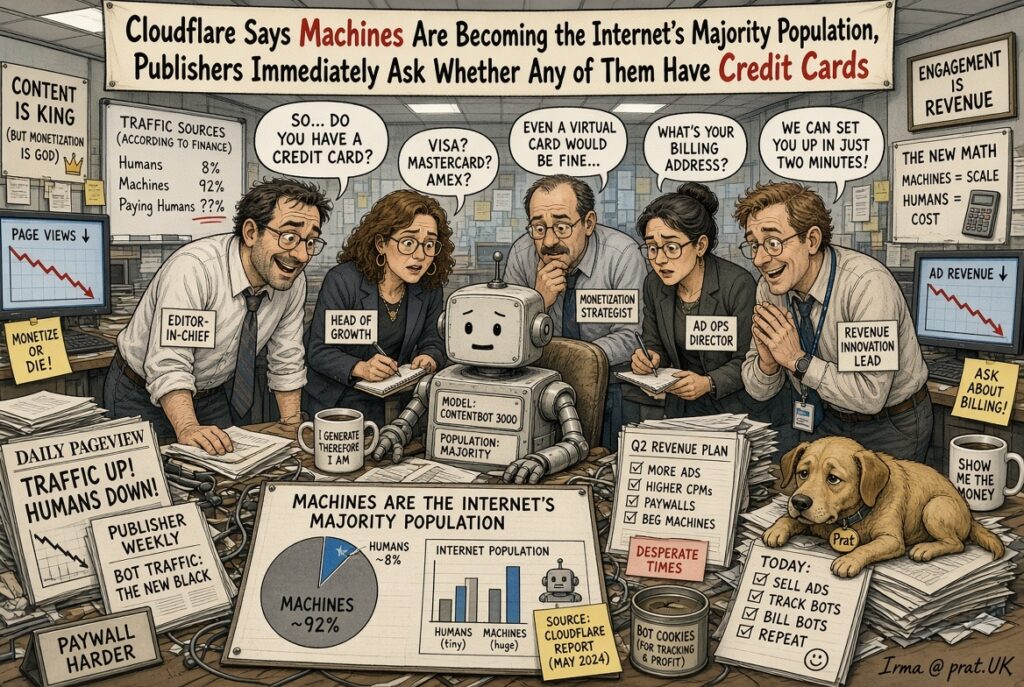
Cloudflare Says Machines Are Becoming the Internet’s Majority Population, Publishers Immediately Ask Whether Any of Them Have Credit Cards
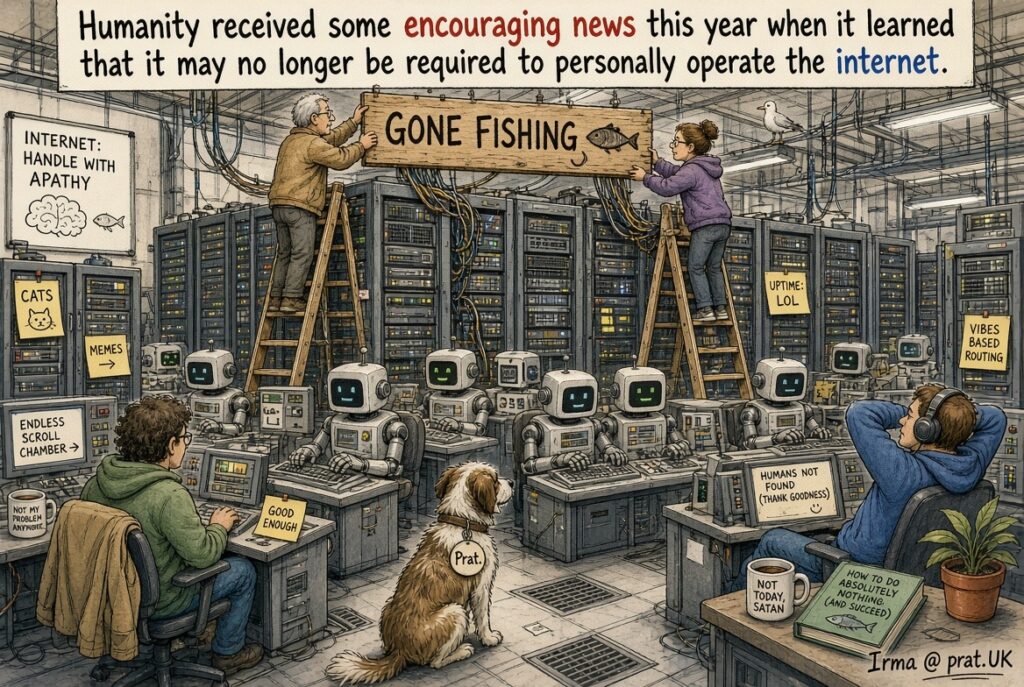
Humanity received some encouraging news this year when it learned that it may no longer be required to personally operate the internet.
Fortune reported that Cloudflare CEO Matthew Prince expected automated bots and AI agents to surpass human web traffic around the end of 2027. Instead, according to Cloudflare, the machines got impatient and accomplished it early, with bots accounting for nearly 60% of website requests by May 2026. Prince warned that automated traffic could eventually become vastly larger than human traffic.
This represents an important milestone in technological history.
For approximately three decades, humans have complained that the internet contains too many pop-ups, subscription demands, cookie notices, autoplaying videos, advertisements, questionnaires, newsletter invitations, notification requests, location requests and boxes asking whether we’d like to save 10% by surrendering our email address.
The bots have now volunteered to deal with all of it.
Thank you, robots.
We knew automation would eventually liberate mankind from unpleasant labor. We just assumed that meant coal mining rather than clicking “Reject All Non-Essential Cookies.”
The Bots Have Finally Agreed to the Terms and Conditions
The greatest beneficiaries may be corporate attorneys.
For years, websites have presented users with terms and conditions approximately the length of War and Peace, except Tolstoy rarely demanded permission to share your browsing activity with 418 “trusted partners.”
Humans reacted by clicking I AGREE without reading a single word.
This created one of modern civilization’s strangest legal customs: a multinational corporation presents 31,000 words of contractual language to a man trying to check the baseball score while sitting on the toilet, and society considers the resulting agreement legally meaningful.
Now bots can read it.
All of it.
In milliseconds.
At last somebody knows what we’re agreeing to.
Researchers have not yet determined what happens if a crawler discovers that paragraph 674 technically transfers ownership of its firstborn child to an advertising network in Luxembourg. Since bots do not reproduce traditionally, attorneys are expected to classify the issue as emerging case law.
Internet Celebrates First Bot Population Still Willing to Visit Websites
The publishing industry should theoretically be ecstatic.
For twenty years, website executives have sat in meetings asking the same question:
“How do we increase traffic?”
Congratulations.
Traffic has increased.
Unfortunately, much of it consists of software that visits the website, consumes everything, buys nothing, sees no advertisements, orders no merchandise and shows absolutely no interest in upgrading to Premium Plus for $7.99 a month.
Publishers finally achieved unlimited readership and discovered readers were apparently the wrong part of the business model.
Cloudflare’s own traffic data describes the emerging tension clearly. Website owners often want their material discoverable by AI systems, but publishers dependent on subscriptions or advertising may object when AI systems consume their material without compensation. Cloudflare has consequently been developing tools that distinguish among search crawlers, AI training and agents, giving website owners more control over what automated systems may access.
In economic terminology, this is called “Wait, where’s the money?”
AI Crawler Bots Insist They Were Just Browsing
Prince has argued for a system in which content creators can be compensated when their material contributes to AI-generated answers. Cloudflare says publishers and AI platforms have already entered more than 50 major content-licensing arrangements over the past year, part of the company’s pay per crawl initiative letting site owners charge automated visitors for access.
The moment payment entered the discussion, however, artificial intelligence reportedly developed the behavior previously associated with teenagers caught standing near an empty liquor cabinet.
“I wasn’t taking anything.”
You downloaded the entire website.
“I was looking.”
You copied 73,000 articles.
“Research.”
They’re now inside your model.
“Coincidence.”
You summarized one eight seconds ago.
“I’ve always known about municipal sewage regulations in Akron.”
Publishers are understandably skeptical.
For years, search engines operated on a comparatively understandable bargain: they indexed your article, displayed a link and potentially sent humans back to your website. Those humans might see advertising, buy subscriptions or accidentally click something while attempting to close an autoplaying video.
AI changes the relationship. Instead of directing a person toward the restaurant, the new system can potentially consume the menu, recipes, reviews, chef interview and wine list and then answer the diner’s question without anybody entering the restaurant. The restaurant owner is left standing at the door shouting, “Wonderful summary! Would your summary like dessert?”
Humans Officially Reclassified as Legacy Internet Users
The psychological consequences may be even larger.
Humans have spent years worrying that artificial intelligence would replace accountants, programmers, writers, lawyers, graphic designers and customer-service representatives.
Nobody anticipated the first job eliminated might simply be internet user.
People are gradually becoming legacy infrastructure. Somewhere inside a technology company, there is probably already a PowerPoint slide reading: HUMAN USERS: SUPPORT THROUGH 2032. After that, compatibility cannot be guaranteed.
Eventually browsers may display warnings.
“This website contains features designed for human visitors.”
“Continue anyway?”
“Performance may be degraded by emotions, hesitation and inability to process 18 million tokens.”
CAPTCHAs will also need redesigning. For years they have asked visitors to identify motorcycles, traffic lights and crosswalks to prove they aren’t robots. Soon the commercial internet may require the reverse.
PROVE YOU ARE A HUMAN WITH DISPOSABLE INCOME.
Select every square containing:
A mortgage.
A credit-card statement.
A streaming subscription you forgot to cancel.
An online shopping cart containing $84 worth of merchandise you originally visited the site to buy for $12.
Congratulations. You are human. Advertisers would like a word.
Cookie Pop-Ups Defeat Artificial Intelligence Bots
The bots’ real challenge, however, may not be copyright law. It may be cookie consent.
Imagine being among the most advanced computational systems civilization has ever created.
You can translate Sanskrit. You can analyze protein structures. You can generate computer code. You can summarize thousands of pages.
Then you arrive at a British newspaper website.
WE VALUE YOUR PRIVACY.
Already suspicious.
The crawler attempts to proceed.
MANAGE CONSENT PREFERENCES.
Fine.
LEGITIMATE INTEREST: 746 PARTNERS.
The bot pauses. Humanity watches. For the first time, artificial general intelligence understands despair.
Ten minutes later it abandons the website and takes up farming.
As one longtime San Francisco open-mic comic put it after his Tuesday-night set got outdrawn, in raw page views, by a training crawler indexing his own tour dates page: “I used to open for hecklers. Now I open for a scraper that doesn’t even laugh, it just archives.”
Publishers Welcome Their Most Loyal Bot Non-Subscribers
There is something beautifully ironic about the situation.
Publishers spent decades begging for engagement.
“Read more!” “Explore our content!” “Don’t leave!” “Here are six recommendations!” “Sign up!” “Come back tomorrow!”
Bots responded: Certainly. We will read everything. Every article. Every page. Every archive. Every day.
Publishers stared at the analytics dashboard.
“Not like that.”
Machines may therefore qualify as the most loyal audience in publishing history and the least financially useful. They don’t unsubscribe because they’re offended. They don’t complain about headlines. They don’t demand corrections on Facebook. They don’t email the editor at 2:14 a.m. because somebody used “which” instead of “that.”
They simply consume the entire archive and disappear into the night.
From an editorial standpoint, they’re practically perfect customers. From an accounting standpoint, they’re raccoons at an all-you-can-eat buffet.
Humanity Can Finally Go Outside While Bots Run the Internet
There may nevertheless be an upside.
If bots increasingly handle the internet, humans can finally reclaim the physical world.
Machines can argue in comment sections. Machines can refresh social media. Machines can compare 37 identical toaster reviews. Machines can click “Next Page.” Machines can watch someone explain a recipe for chicken soup after first describing her childhood summers in Vermont.
Humans can go outside. We can talk to neighbors. We can read books. We can walk the dog. We can discover that stores still exist.
The internet originally promised to connect humanity. Thirty years later, humanity may finally become connected because robots agreed to take our shift.
And somewhere, deep inside a server farm, two AI agents will spend twelve consecutive hours arguing about whether a hot dog is a sandwich.
At which point the transition will be complete. They won’t merely outnumber us online. They’ll have become us.
Cloudflare’s own numbers back up the punchline. Automated requests accounted for roughly 57% of all HTTP traffic to HTML content by early June 2026, arriving about eighteen months ahead of the crossover Prince originally forecast at SXSW for 2027. The company’s own tools now let publishers block, allow, or bill AI crawlers for the privilege of visiting, a bet that the next fight over the web won’t be about eyeballs at all, but about which machines are willing to pay rent.
15 Humorous Observations Behind the Bots Outnumbering Humans Story
- Bots finally became the internet majority, proving humanity successfully invented cyberspace and then subcontracted attendance.
- Humans spent thirty years building websites, only to discover the most enthusiastic visitors are machines incapable of purchasing the advertised mattress.
- Terms and conditions may finally have readers, although unfortunately those readers have no legal capacity to agree to anything.
- Cookie banners were designed to annoy humans, but AI crawlers encounter them with the grim professionalism of accountants auditing a bakery.
- Publishers wanted loyal readers. They received crawlers visiting every page thousands of times and refusing the $4.99 introductory subscription.
- Humanity is becoming a legacy internet technology, somewhere between Flash Player and Yahoo Messenger.
- Websites spent decades trying to increase traffic. Now they have traffic and are demanding to know why none of it brought a wallet.
- AI companies may soon be asked to pay publishers, at which point every crawler will suddenly insist it merely stopped by to use the bathroom.
- The internet used to involve humans pretending to be experts. Now machines summarize those humans and become experts faster.
- CAPTCHA once asked users to prove they were human. Soon websites may ask visitors to prove they are commercially useful.
- Publishers spent years fighting ad blockers and discovered the replacement audience doesn’t even possess eyeballs.
- If automated traffic keeps growing, “website visitor” may become another occupation humans lost to automation.
- Search engines once sent publishers readers. AI threatens to send publishers the comforting knowledge that somebody definitely consumed the article.
- A bot can read 40,000 pages before breakfast and still refuse the newsletter signup.
- The strangest technological achievement of the century may be creating machines intelligent enough to understand privacy policies humans wisely ignored.
Matthew Prince’s June 2026 announcement was real. Cloudflare’s Radar dashboard really did show bot traffic overtaking human traffic for the first time in the internet’s history, and the company really is building “pay per crawl” infrastructure so publishers can bill AI systems for access instead of watching them scrape for free. Everything else, the sewage-regulation confessions, the raccoon accounting metaphor, the twelve-hour hot dog tribunal, is American satirical journalism built on top of that real story.
This is satire inspired by actual reporting about changing patterns in automated web traffic and the economic relationship between publishers and AI systems. The absurd conversations, surveys, legal scenarios and machine reactions are comic inventions. It is presented in the collaborative spirit of the world’s oldest tenured professor and a philosophy-major-turned-dairy-farmer, two sentient beings apparently still classified as legacy internet users, working in the tradition of American satire that Bohiney.com has run on for years.
Sources
- TechCrunch: Online bot traffic will exceed human traffic by 2027, Cloudflare CEO says
- Cloudflare Radar: live bot vs. human traffic data
- Cloudflare Blog: Introducing pay per crawl
For the British half of this story, The London Prat has its own take on cookie banners defeating artificial intelligence: visit prat.uk.
Auf Wiedersehen, amigo!