Cyberpunk 2077 Wasn’t a Warning, It Was a Development Plan
Humanity Spent Decades Fearing Corporate Dystopia Before Realising It Comes With Better Jackets, Faster Cars and Extremely Good Lighting
In Night City, economists, philosophers and public-policy experts suffered a major setback this week after ordinary people examined the supposedly horrifying future depicted in Cyberpunk 2077 and discovered that, compared with life in modern Britain, it appears to include several attractive upgrades.
For years, futurists have warned that society could eventually become dominated by giant corporations, invasive technology, inequality, private security forces and advertisements covering every available surface.
To which millions of gamers have now responded:
“Yes, but did you see the motorcycles?”
The traditional interpretation of Cyberpunk 2077 is that Night City represents a dystopia, a society where technology has advanced faster than morality and where corporations possess extraordinary influence over ordinary human life.
This interpretation overlooks one important consideration. You can install new eyeballs during your lunch break. That considerably changes the cost-benefit analysis.
Modern Life Already Has the Corporate Domination Cyberpunk 2077 Promised, Minus the Style
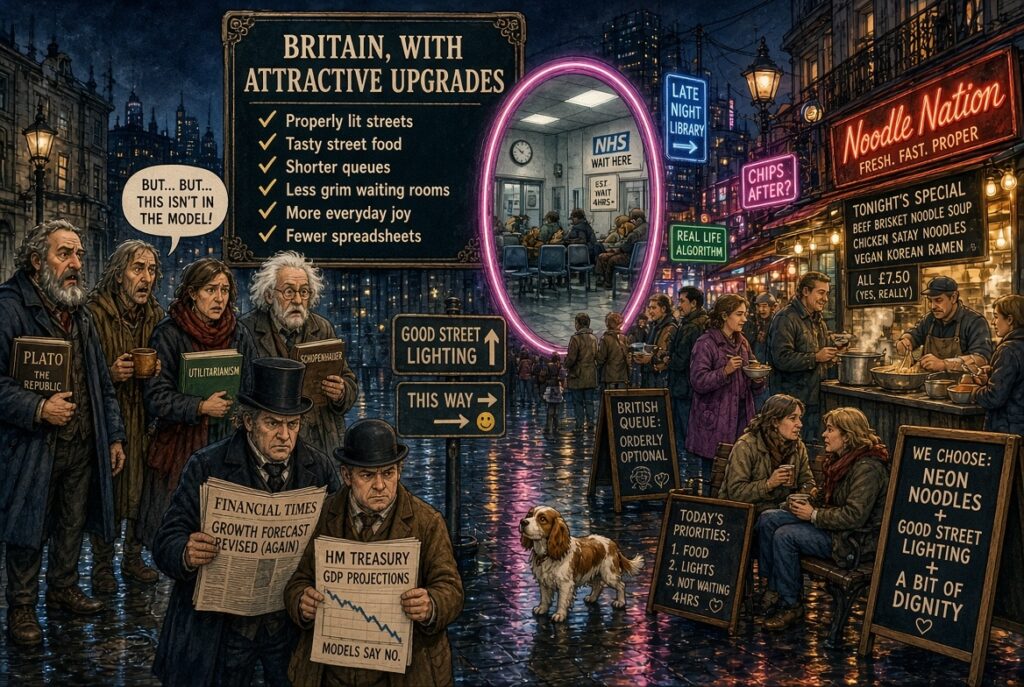
Critics warn that a cyberpunk future would allow corporations to control immense amounts of information, infrastructure and consumer behaviour.
Excellent point.
Fortunately, modern civilisation has avoided that scenario completely, except for phones, search engines, banking, social media, streaming, online shopping, cloud computing, insurance, employment platforms, advertising networks and whatever company currently knows you considered buying an air fryer three weeks ago.
The distinction is that modern corporations possess enormous quantities of information about us while continuing to make us carry tiny plastic loyalty cards. Night City at least respects the customer enough to implant the loyalty card directly into your spine. That is progress.
If capitalism is going to know everything about me, I want glowing eyes.
Cyberpunk 2077 Cybernetic Arms Solve Problems Governments Have Studied Since 1974
Politicians continually promise infrastructure improvements. A cyberpunk society offers a refreshingly direct alternative.
Bad knees? Replace them. Poor eyesight? Replace it. Slow reflexes? Upgrade them.
Your current NHS trust may require six referrals, a four-month physiotherapy waiting list and an afternoon listening to hold music while somebody determines whether your left leg is “clinically indicated.” Night City simply asks: “What horsepower would you like your left leg to have?”
People call this dystopian. I call it customer service.
Imagine walking into an NHS walk-in centre today. “I have back pain.” The physician recommends stretching.
In the cyberpunk future: “I have back pain.” “Certainly. Would sir prefer titanium, carbon fibre or our premium combat vertebrae?”
Now that is NHS reform.
Nobody in Cyberpunk 2077 Pretends Advertising Is Subtle
Modern advertising has become insulting because it spends enormous effort pretending not to be advertising.
Influencer: “I’ve recently been on this incredible personal journey, and completely coincidentally, the journey is sponsored by protein powder.”
Cyberpunk eliminates this dishonesty. Advertisements occupy skyscrapers. They shout. They glow. They are forty feet tall. A woman appears above an intersection and demands that you purchase synthetic noodles immediately.
Finally, transparency.
Nobody in Night City says: “We’re building authentic engagement around a lifestyle ecosystem.” They say: BUY THIS DRINK OR CONTINUE BEING THIRSTY.
Civilisation has rediscovered plain English.
Doncaster club comic Gaz Whitfield has been workshopping a bit about it for months. “My phone shows me an advert for trainers I already bought,” he tells crowds most Thursday nights. “Night City would just put a hundred-foot hologram over my house shouting BUY MORE TRAINERS, GARY. At least that’s honest work.”
Night City Solves the Housing Crisis the Cyberpunk 2077 Way: Buildings Nine Miles Tall
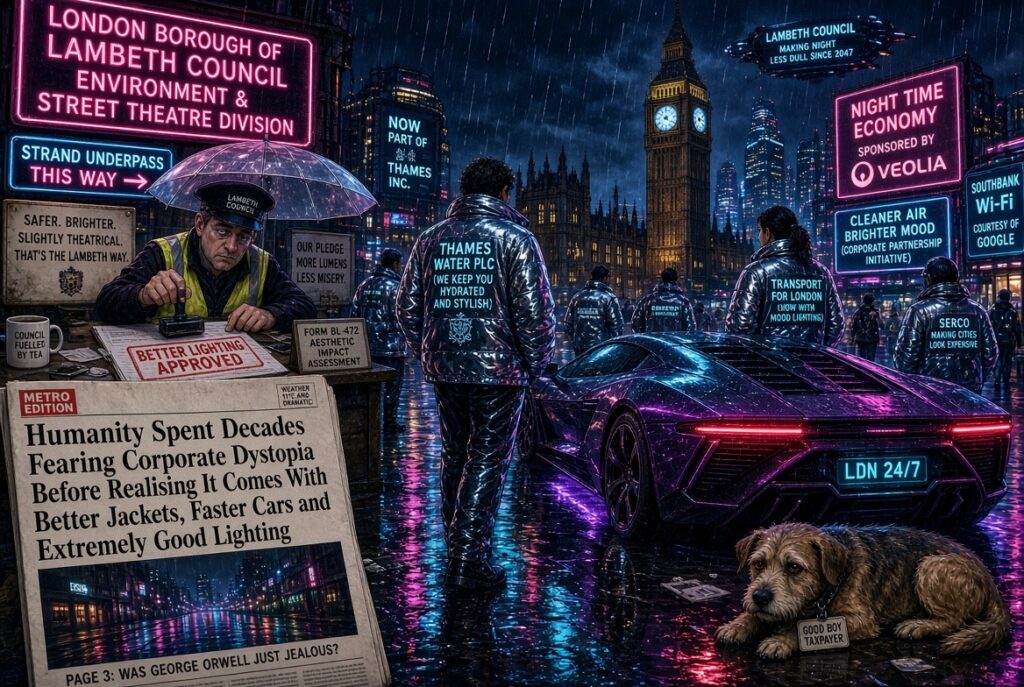
Every modern country claims to face a housing shortage. Britain spends decades debating whether a derelict launderette may become a four-storey block of flats.
Night City responds by constructing a residential tower large enough to alter local weather. Problem solved.
Planning committees object: “But what about neighbourhood character?” The neighbourhood now has 87,000 residents and a missile-defence system. That’s character.
Traditional planning meetings would not survive fifteen minutes in a cyberpunk society.
COUNCIL OFFICIAL: “Residents are concerned that the proposed tower may cast shadows.”
DEVELOPER: “The tower has its own artificial sun.”
COUNCIL OFFICIAL: “Approved.”
Cyberpunk 2077 Cars Understand What Cars Are Actually For
Modern cars are slowly transforming into rolling parental supervisors. The dashboard tells you when you’re tired. The steering wheel complains if you drift. The vehicle reminds you to check the back seat. Soon a Vauxhall Astra will ring your mum if you exceed 72 miles per hour.
Cyberpunk vehicles take another approach.
“You want 700 horsepower?” Correct. “Would you also like armour plating?” Obviously. “Machine guns?” I wasn’t going to ask, but since you brought it up.
This is a car industry that understands the emotional relationship between adults and terrible decisions.
Cyberpunk 2077 Fashion Finally Stops Pretending Beige Is Sophisticated
Current luxury fashion appears increasingly determined to convince wealthy people that expensive clothing should resemble laundry nobody folded.
Cyberpunk rejects this. Jackets illuminate. Boots contain hardware. Glasses look capable of directing artillery. Everyone appears prepared either to attend a nightclub or overthrow a multinational corporation. Sometimes both.
The cyberpunk wardrobe asks an important question ignored by modern fashion: if your coat costs £3,000, shouldn’t it at least do something?
A normal designer jacket keeps you moderately warm. A Night City jacket looks capable of hacking a lift. Value for money.
Cyberpunk 2077 Corporate Power Is Honest When Corporations Have Actual Armies
We are repeatedly warned that corporations in a cyberpunk future could wield political influence. Unlike today, when corporations limit themselves to lobbying, campaign contributions, regulatory negotiations, armies of solicitors and politely explaining to governments what legislation would be convenient.
Cyberpunk corporations dispense with euphemism. They have towers. They have helicopters. They have private armies. You know exactly where everybody stands.
There is something almost refreshing about an organisation refusing to issue a 74-page sustainability report before dispatching a tactical squad.
Modern corporation: “We remain deeply committed to stakeholders.” Cyberpunk corporation: “We own the building.” Much clearer.
Crime Gets Considerably More Interesting in the Cyberpunk 2077 Dystopia
Current crime is disappointing. Somebody steals your catalytic converter. There is no style. No narrative. No dramatic soundtrack. You wake up and your Ford Fiesta sounds like a tractor.
Cyberpunk crime has standards. Data theft. Corporate espionage. Neural hacking. Black-market cybernetics. High-speed chases beneath holographic billboards.
If society cannot eliminate crime, the least it can do is demand production value.
Imagine explaining today’s crime to somebody in 2077. “They stole my password.” “To access classified military data?” “No. Netflix.” The future looks away in embarrassment.
Artificial Intelligence Finally Gets Proper Offices in the Cyberpunk 2077 Dystopia
Today’s artificial intelligence lives invisibly inside server farms. That lacks dignity.
Cyberpunk understands that advanced AI deserves ominous architecture. If an intelligence is powerful enough to alter civilisation, it should not live behind a login page asking whether you’ve forgotten your password.
It should inhabit a giant black tower surrounded by electric storms. Presentation matters.
Nobody fears artificial general intelligence when it arrives with a cheerful rounded logo. Give the thing red lights and a lift that descends for six minutes. Now we’re negotiating.
The Supposed Cyberpunk 2077 Dystopia Includes Extremely High Productivity
Look around Night City. Everything works continuously. Shops operate. Traffic moves. People are modifying their nervous systems at 2 a.m. Somebody is always manufacturing something.
This is not an economy struggling with productivity.
Nobody in Cyberpunk appears to spend four hours on a Zoom meeting deciding whether another Zoom meeting should be scheduled. There are no corporate away-days where 35 employees place sticky notes under the heading “Reimagine Synergies.”
When Night City says “disruption,” somebody actually crashes through a window. Silicon Roundabout has spent twenty years promising disruption. Cyberpunk finally delivers.
Humanity May Have Simply Misunderstood What Cyberpunk 2077 Dystopia Means
Perhaps the real lesson of Cyberpunk 2077 is not that technology produces dystopia. Perhaps the lesson is that humanity has extraordinarily high expectations for utopia.
We apparently want abundance, technological miracles, advanced medicine, beautiful cities, instantaneous communication, superhuman abilities and unlimited entertainment. But if there is one aggressive advertisement on the lift doors, suddenly civilisation has failed.
The cyberpunk future may not be perfect. It may contain corporate excess, inequality, danger, corruption and machines attached to body parts where machines were previously discouraged.
But humanity already possesses corruption, inequality, danger and corporate excess. We simply experience them while standing beneath fluorescent lighting at the DVLA.
Night City offers the same problems with neon. That is at least a lateral move. Possibly an upgrade.
Researchers Asked to Stop Threatening the Public With an Excellent Cyberpunk 2077 Future
Technology ethicists should therefore reconsider their warnings. Telling ordinary people that unchecked artificial intelligence could create a world resembling Cyberpunk 2077 may not produce the desired reaction.
“You mean I could have artificial knees that let me jump twelve feet?” “Yes, but corporations might become extremely powerful.” “They already send me sixteen emails a day.”
“There could be advertisements everywhere.” “Have you been to Piccadilly Circus?”
“You might become dependent on technology.” “I drove back home yesterday because I forgot my phone.”
At this point, the dystopian argument begins experiencing structural difficulties.
The public has seen the nightmare. The nightmare has motorcycles, chrome arms and excellent nightlife. Someone is going to ask when construction begins.
Final Verdict on the Cyberpunk 2077 Dystopia: Build Night City, Keep the Receipt
No civilisation should enthusiastically embrace every feature of an invented corporate dystopia. That would be irresponsible. We should embrace them selectively.
Cybernetic knees: yes. Holographic billboards: probably. Seven-hundred-horsepower armoured sports cars: absolutely. Corporate death squads: perhaps leave those in beta. Neural implants capable of turning somebody into an involuntary toaster: needs regulation.
The sensible policy is not to reject the cyberpunk future. It is to negotiate.
Humanity should tell technology companies: “You may construct Night City, provided the health service works, the motorcycles remain available and nobody uploads advertisements directly into my dreams before 8 a.m.”
That’s not dystopia. That’s zoning.
Sources
- Cyberpunk 2077 official site
- Cyberpunk 2077 background, Wikipedia
- Decrypt: how closely today’s tech giants track the cyberpunk playbook
- MIT IDSS on Acemoglu and Johnson’s “Big Tech Is Bad. Big A.I. Will Be Worse”
- Institute of Economic Affairs report on solving Britain’s housing crisis
- Healthwatch England on NHS physiotherapy waiting times
- WTTW Chicago on next-generation bionic limb research
Cyberpunk 2077 is a real video game built by CD Projekt Red around a tabletop universe created by Mike Pondsmith, and Night City is the game’s invented setting. The essay above is playing off a real and ongoing debate among economists, planners and technology researchers about whether the concentration of corporate power described in cyberpunk fiction is quietly becoming the operating system of everyday life, from Britain’s own planning system to the handful of firms now shaping artificial intelligence.
This is satire. Cyberpunk 2077 remains an invented dystopian world, and installing military-grade cybernetic limbs because your knees hurt is not presently an MHRA-approved substitute for physiotherapy. It is British satirical journalism, the strand of UK satire that treats a corporate dystopia like a Tuesday afternoon planning committee because that is, honestly, funnier.
For more satirical news from the other side of the Atlantic, visit Bohiney.com.
Auf Wiedersehen, amigo!

Chelsea Bloom is an emerging comedic writer with a focus on light-hearted satire and observational humour. Influenced by London’s student culture and digital comedy spaces, Chelsea’s work reflects everyday experiences filtered through a quirky, self-aware lens.
Expertise is growing through experimentation and study, while authority comes from authenticity and relatability. Trustworthiness is supported by clear intent and ethical humour choices.
Chelsea’s contributions represent developing talent within an EEAT-compliant framework that values honesty, clarity, and reader trust.