Britain Introduces Digital ID for Buying Alcohol, Finally Adds Government Bureaucracy to Activity People Had Mastered for Centuries
Nation upgrades ancient drinking ritual with authentication protocols
LONDON — Britain has modernised alcohol purchasing by introducing digital age verification, successfully adding twenty-first-century identity technology to an activity humans managed adequately when taverns still had horses outside.
For centuries the procedure was elegantly simple. Customer enters pub. Customer requests drink. Landlord examines customer. Landlord decides whether customer appears old enough. Occasionally landlord says no. Civilisation survives.
Why Digital ID for Alcohol Sales Adds a New Layer of Bureaucracy
The new system improves this by involving smartphones, secure databases, electronic credentials and the statistical certainty that someone’s battery is dead. Technology companies insist digital identity can make transactions faster. This prediction assumes nobody has forgotten their password.
Britain currently contains millions of adults capable of driving cars, raising children and operating businesses who nevertheless become helpless when an app says: “We sent a six-digit code to the phone number you stopped using in 2019.”
The New Pub Queue Ritual Digital ID Has Created
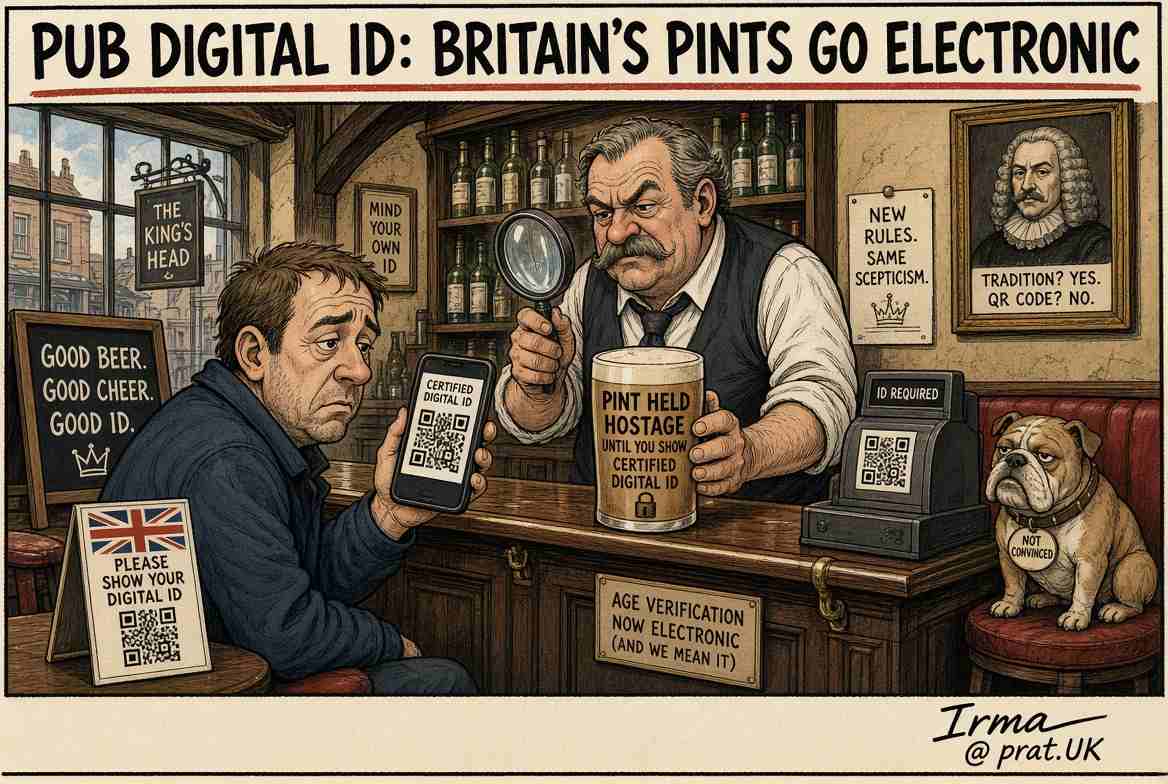
Pub queues may therefore acquire new stages. “Next.” “Pint, please.” “Digital ID?” “Certainly.” Unlock phone. Update app. Accept new terms and conditions. Reset password. Find verification email. Lose verification email. Request another. Customer reaches retirement age before ordering lager.
Government bureaucracy has always possessed a special talent for entering simple human activities and discovering forms within them. Fishing requires paperwork. Building requires paperwork. Driving requires paperwork. Drinking was therefore living dangerously. A digital system restores administrative balance.
How the Pub Might Come to Resemble an Airport
In future, the British pub may resemble an airport. Customers present credentials. Staff scan devices. Facial recognition verifies identity. After security clearance, traveller proceeds to Gate Four where a pint of bitter costs roughly the same as airport lager anyway.
The philosophical implications are enormous. Once digital identity becomes normal, citizens may eventually prove their age electronically for everything. Buying wine. Entering clubs. Collecting parcels. Joining pensioner discounts. One day an 87-year-old may stand at a till while a teenage employee explains that the computer cannot verify she is over 18. She will show him photographs from the Coronation. The computer will remain unconvinced.
Why the Old System of Eyesight Still Works Best
Technology is wonderfully literal. Human beings recognise context. Software wants documentation. This is why your neighbour knows you but your banking app occasionally believes you are a cybercriminal because you bought petrol in Doncaster.
Pub landlords may keep the old system as backup. It is called eyesight. Ultimately digital ID may prove convenient. Many people prefer carrying everything on their phones. The satire lies not in technology itself but in Britain’s unstoppable instinct to build administration around things already functioning.
The pub has survived kings, wars, plagues, taxation, licensing laws, temperance movements, smoking bans and karaoke. It will survive QR codes. The only real danger comes at 11:37 p.m., when Britain’s entire legal identity infrastructure depends on Dave remembering where he put his phone.
What the New Digital ID Rules Actually Require
The new digital ID rules are narrower than the “papers please” tone of the jokes above suggests. Nothing in the new digital ID rules forces a pub, shop or festival to stop accepting a driving licence or passport, and nothing forces a customer to download anything at all. Physical ID remains entirely valid under the new digital ID rules, which exist purely to add a second, optional route for people who would rather not carry a card around a nightclub.
The practical effect of the new digital ID rules will likely take years to show up in queue times, since adoption depends on venues choosing to install scanning kit and punters choosing to trust an app with their date of birth. Britain has never been in a hurry to trust an app with anything, which may be the most British part of this whole story.
Sources
The Home Office’s technical explainer is at Using a digital identity to buy alcohol safely and securely, and this week’s launch is covered in LADbible’s New alcohol buying rules explained as pubs and shops can now accept digital ID.
None of this needed exaggerating much. The Data (Use and Access) Act 2025 enables digital ID for alcohol sales, and from 15 September 2026 shoppers can prove their age using apps such as Yoti, generating a time-limited QR code or facial scan valid for around thirty seconds specifically so it cannot be reused by someone else.
Auf Wiedersehen, amigo!
This is a work of English satirical news. Dave’s missing phone, the pub-as-airport and the QR-code-suspicious 87-year-old are inventions built on a real government scheme, in the tradition of British satire. The thirty-second QR code, remarkably, is not.
Read the American satirical take on identity bureaucracy over at Bohiney News.

Alan Nafzger was born in Lubbock, Texas, the son Swiss immigrants. He grew up on a dairy in Windthorst, north central Texas. He earned degrees from Midwestern State University (B.A. 1985) and Texas State University (M.A. 1987). University College Dublin (Ph.D. 1991). Dr. Nafzger has entertained and educated young people in Texas colleges for 37 years. Nafzger is best known for his dark novels and experimental screenwriting. His best know scripts to date are Lenin’s Body, produced in Russia by A-Media and Sea and Sky produced in The Philippines in the Tagalog language. In 1986, Nafzger wrote the iconic feminist western novel, Gina of Quitaque. He currently lives in Holloway, North London. Contact: [email protected]