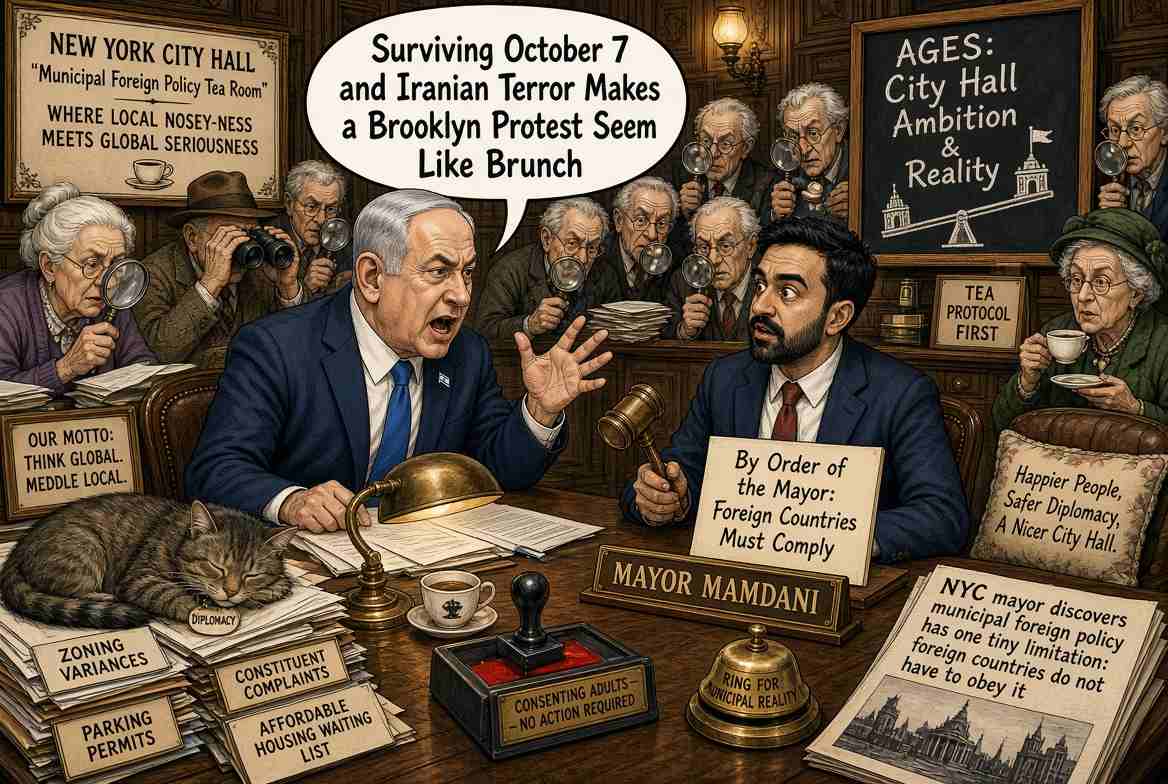
Trump Tells Burnham “Irish Unity” Wouldn’t Be Such an Issue If Labour Weren’t Such Socialist Arseholes
Prime Minister insists Irish unity lacks majority support as constitutional experts suggest Westminster could preserve the Union by occasionally making membership enjoyable
Prime Minister Andy Burnham has been informed that the question of Irish unity might consume considerably less government time if Labour could experiment with the previously untested political philosophy of not being such arseholes about everything.
The recommendation followed Donald Trump’s comments in Dublin that he would “love” to see a united Ireland and believed unification would eventually happen, prompting Downing Street to reiterate that Burnham’s position on Irish unity had not changed.
Burnham told Parliament he was unaware of majority public support for another referendum in Northern Ireland and said there would not be one unless that changed.
Government officials were relieved.
“There isn’t majority support today,” explained a Downing Street strategist. “So obviously our immediate priority is to begin irritating people until there is.”
Labour Discovers Irish Unity Grows Every Time Westminster Annoys Someone
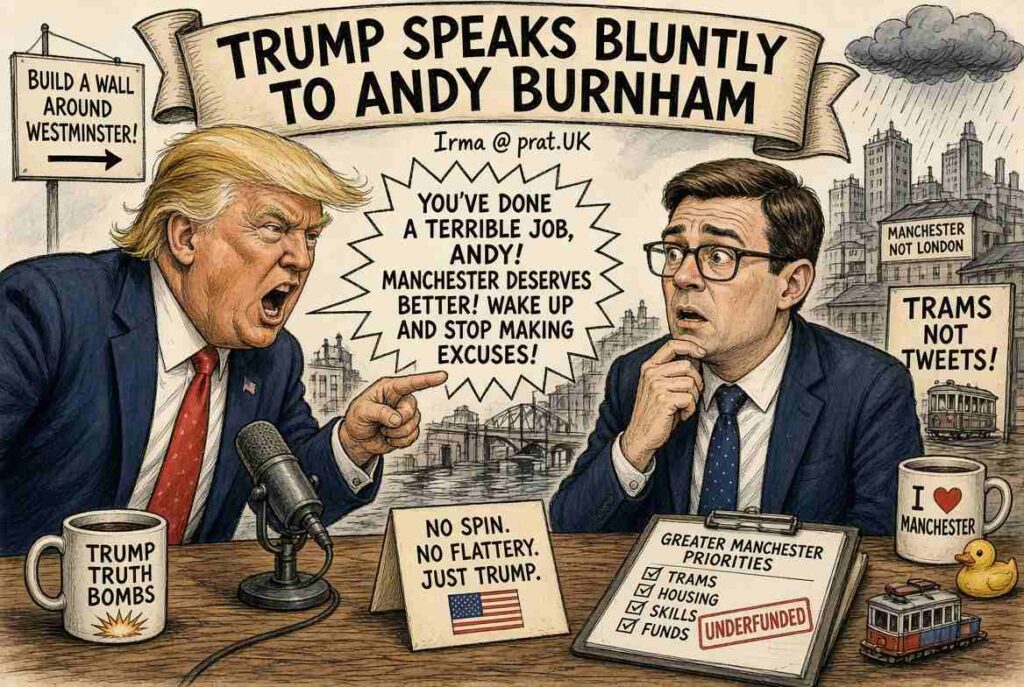
The crisis has forced Westminster to confront an unsettling constitutional possibility. Perhaps the easiest way to convince Northern Ireland to remain in the United Kingdom is to make the United Kingdom somewhere people actively want to remain.
Officials described the theory as untested, radical and probably unfunded.
The Good Friday Agreement established the principle of consent at the heart of Northern Ireland’s constitutional position. Northern Ireland remains part of the United Kingdom for as long as that reflects the wishes of its people, which places enormous pressure on Westminster because it means the British government must occasionally persuade people rather than simply send them regulations.
One senior constitutional adviser called consent “an unfortunate loophole in government authority.”
“We were initially hoping it meant Northern Ireland would remain British until a minister misplaced the paperwork,” he said. “Apparently people actually get a say. Frankly, nobody warned Whitehall.”
Trump Settles the Irish Unity Question During a Flying Visit to Dublin
Trump’s intervention was particularly efficient. Politicians, historians and diplomats have spent generations examining the constitutional relationship between Britain, Northern Ireland and the Republic of Ireland. Trump arrived, looked around and essentially asked why everybody did not just put the island together.
Universities immediately closed several history departments.
A professor at Trinity College Dublin was seen carrying 23 books into a recycling bin.
“I spent 31 years studying partition, identity, sovereignty and the peace process,” he said. “Turns out the answer was ‘Why not unite it?’ I could have become a dentist.”
Trump’s diplomatic method has certain advantages. Traditional diplomacy involves treaties, legal frameworks, negotiations and carefully calibrated language. Trump instead approaches geopolitical disputes like somebody examining two adjoining hotel rooms.
“You knock through that wall. Boom. Presidential suite.”
The approach has yet to receive formal approval from constitutional lawyers, although several estate agents have expressed enthusiasm.
Burnham’s One Job: Make Britain Less Annoying Than Irish Unity
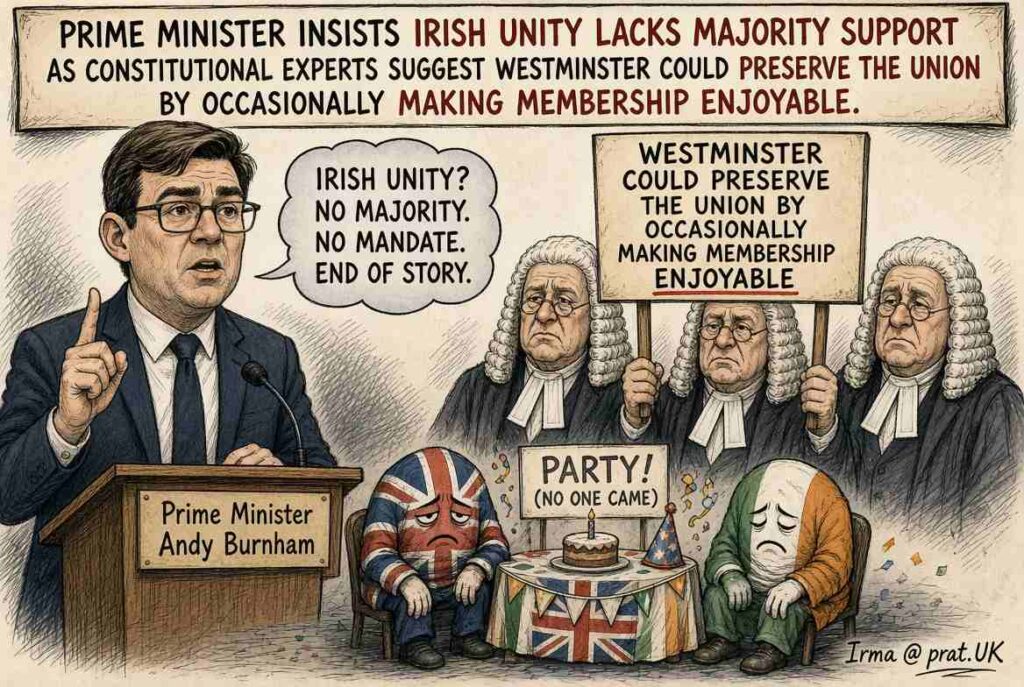
Burnham’s political problem is simultaneously complicated and embarrassingly simple. If he wants Northern Ireland to stay in the United Kingdom, his government must make continued membership preferable to the alternative. This is broadly how human choice works.
Restaurants retain customers by serving decent food. Football clubs retain supporters through emotional loyalty and occasional competence. Marriage ideally involves affection. Britain appears to be testing whether a constitutional union can instead be maintained through parking charges, paperwork and ministerial interviews explaining why everything costs more.
The government’s current retention strategy resembles a broadband company. “You are extremely important to us. Your monthly charge is increasing by 17 percent.”
Northern Irish voters may reasonably ask what advantages accompany membership of the Union. Westminster’s answer traditionally consists of history, identity, economic integration and somebody standing near a flag. Those things matter. But eventually someone also asks why the train was cancelled.
Dublin Told It Can Cancel Its Irish Unity Advertising Budget
Irish nationalists may therefore be sitting on one of Europe’s greatest political bargains. Why spend millions campaigning for reunification when Westminster is available free of charge?
A Dublin marketing consultant estimated that every badly designed government initiative eliminates the need for approximately 12,000 nationalist leaflets.
“Britain is doing tremendous outreach for us,” she said. “We used to need campaigners knocking on doors. Now we just send people clips of parliamentary debates.”
The campaign has reportedly adopted a minimalist slogan: Have You Seen London Lately?
Focus groups found it performed particularly well among voters who had recently attempted to contact a government department.
Labour Announces a Commission Into Being Less Annoying About Irish Unity
Downing Street is now considering a major programme to investigate whether being less irritating could strengthen the Union. The initiative is expected to begin with an 18-month consultation examining whether the public prefers competent government to incompetent government. Preliminary findings will then be submitted to an independent commission, which will recommend another consultation. Implementation is provisionally scheduled for shortly after Ireland reunifies.
A government spokesman stressed that ministers could not simply stop annoying citizens immediately.
“We have procedures,” he said. “You can’t just wake up one morning and become reasonable. Imagine the constitutional implications.”
The Treasury is reportedly especially concerned. Officials fear that if citizens become happier with government, they may begin developing unrealistic expectations involving value for money.
The Irish Unity Maths Are Brutally Simple
The Good Friday framework does not say Northern Ireland must someday join the Republic. Nor does it say Northern Ireland must permanently remain British. Its constitutional settlement rests on consent, with change dependent upon the democratic wishes of the people concerned. That is what makes Burnham’s statement important.
There is no demonstrated majority demanding another referendum now. But public opinion is not concrete. Governments influence it. Economic conditions influence it. Identity influences it. Political competence influences it. Being treated like an adult occasionally may even influence it.
This produces a rather inconvenient deduction. If Labour genuinely wishes to protect the Union, one useful strategy would be to avoid making British government synonymous with having your wallet inspected by somebody holding a clipboard.
Political philosophers call this the Don’t Be Arseholes Principle. It has three components: govern tolerably, interfere selectively and remember that citizens can leave political arrangements when constitutional mechanisms permit them to do so. No British government has yet attempted all three simultaneously.
Scotland Reportedly Listening to the Irish Unity Row Through the Wall
The danger extends beyond Northern Ireland. Scotland has reportedly begun paying suspiciously close attention. Welsh nationalists are taking notes. Even Yorkshire briefly examined whether it possesses the legal authority to declare independence before deciding it already behaves as though it has.
This is Westminster’s nightmare. Once voters discover political unions require continuing consent rather than permanent gratitude, the entire country begins resembling a family meeting where everybody suddenly wants to discuss boundaries.
Labour therefore faces a delicate task. It must demonstrate that the United Kingdom offers sufficient political, economic and social value that leaving becomes less attractive than staying. This is known technically as making an argument. Modern British politics usually prefers the alternative procedure, which involves calling opponents irresponsible and commissioning a logo.
Public Poll Finds Britain Could Try Being Pleasant About Irish Unity
A London Prat survey of 2,000 adults found 68 percent believed governments should make people want to remain in their country, 21 percent preferred threatening them with administrative inconvenience, and 11 percent were Treasury economists who asked whether national identity could be means-tested.
Among Northern Irish respondents, support for “Westminster being less annoying” reached a statistically astonishing 114 percent. Researchers described the result as impossible but emotionally plausible.
One Belfast resident summed up the problem. “I’m not saying I want a united Ireland,” he said. “I’m saying every time Westminster explains why I shouldn’t, Dublin gets another point.”
Burnham Could Accidentally Become Irish Unity’s Greatest Recruiter
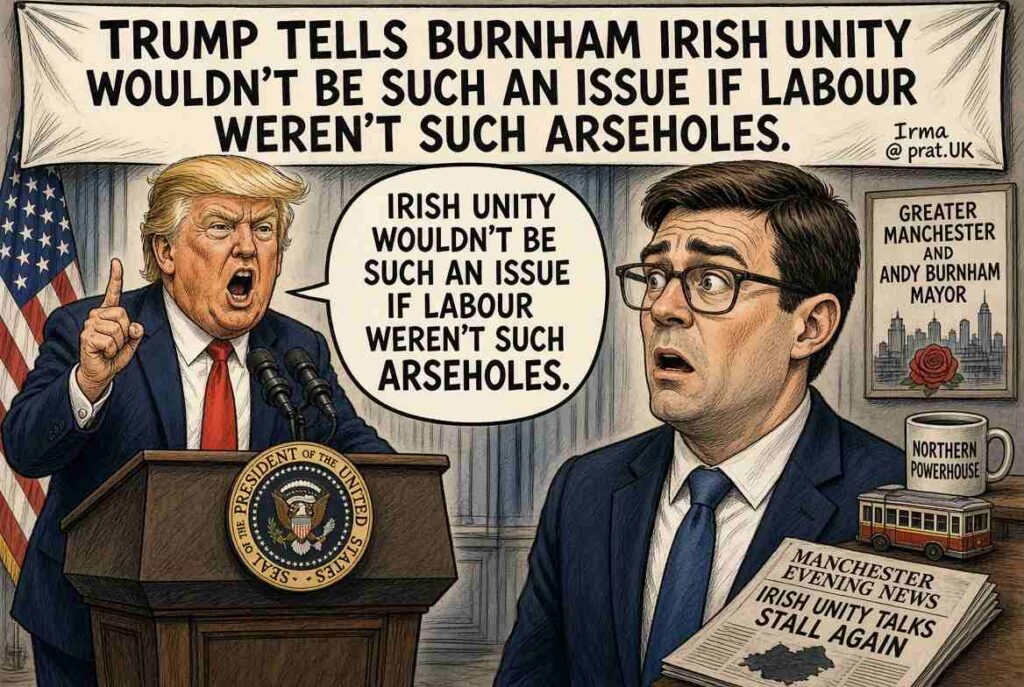
This is Burnham’s real danger. Not Trump. Not Dublin. Not even nationalism. It is the possibility that Britain itself becomes the most persuasive argument against Britain.
Imagine spending decades defending the Union while simultaneously creating government policies that require citizens to search for alternative constitutional arrangements merely to relax. That would be like running a pub and responding to declining business by replacing the beer with forms.
Trump can speculate about Irish unity. Dublin can discuss it. Nationalists can campaign for it. Unionists can oppose it. But Westminster controls something far more powerful: the quality of the product currently being offered.
If Labour wants people to remain enthusiastically British, it might consider making British government less expensive, less intrusive, less sanctimonious and occasionally capable of completing a task before establishing a review into why the task remains incomplete.
Burnham says there will be no referendum without evidence that a majority wants one. That is consistent with his stated position and the wider principle of consent underpinning Northern Ireland’s constitutional settlement. Fair enough. But if Labour wants to ensure that majority never materialises, the solution may be remarkably inexpensive.
Stop helping it along.
15 Observations on Irish Unity
- Burnham says Irish unity lacks majority support, which gives Labour ample time to continue campaigning for it accidentally.
- Britain’s traditional method of defending the Union involves explaining how wonderful Britain is while sending everyone another bill.
- Labour could reduce separatism through the radical constitutional doctrine of not being arseholes.
- Trump looked at several centuries of Irish history and concluded that the two Irelands should simply “get together,” thereby completing the shortest postgraduate course in Anglo-Irish politics.
- The Good Friday Agreement says Northern Ireland’s constitutional status depends on consent, an alarming concept to governments accustomed to consultations where everyone objects and the policy happens anyway.
- Burnham’s strongest weapon against Irish unity should be making the United Kingdom attractive, which unfortunately requires governing it.
- Dublin’s cheapest reunification campaign may simply involve broadcasting Westminster live.
- Every new British tax potentially saves Sinn Féin approximately £40 in leaflets.
- The Union is increasingly marketed like a gym membership: apparently wonderful, strangely expensive, and difficult to cancel.
- Labour insists Northern Ireland should stay while repeatedly testing whether irritation qualifies as a constitutional force.
- Trump called Irish unity desirable. Britain responded by checking whether America had accidentally discovered the principle of self-determination.
- Northern Ireland does not currently have majority support for reunification, but Labour appears determined not to leave public opinion unattended.
- The safest way to preserve the Union might be prosperity, competent services and tolerable government, all three of which remain trapped in committee.
- Scotland is watching the argument with the intense concentration of someone listening to neighbours discuss how easy divorce has become.
- If Labour continues annoying every constituent nation equally, Britain may finally achieve perfect political equality.
Sources
- Reuters: UK PM’s office says position on Irish unity unchanged after Trump comments
- The Irish Times: Donald Trump backs Irish unity in comments during Dublin visit
- Northern Ireland Assembly: The Belfast Agreement/Good Friday Agreement 1998
Andy Burnham told Parliament this week that he is not aware of majority public support in Northern Ireland for another border poll, and that there will be no referendum unless that changes. His comments came after Donald Trump, speaking alongside Taoiseach Micheál Martin in Dublin, said he would “love” to see a united Ireland and predicted it would happen eventually. Downing Street confirmed the Prime Minister’s position on Irish unity had not shifted. The 1998 Good Friday Agreement enshrines the principle of consent, meaning Northern Ireland’s constitutional status can only change with the support of a majority of its people, tested by referendum.
This is a work of British satire. Burnham, Trump and the Good Friday Agreement are real, but the strategists, advisers, professors, consultants, spokesmen and residents quoted above are not real people, and none of them said any of this. Treat every line here as UK satirical journalism, not a news report of anyone’s actual words.
For more British and American satirical news, visit Bohiney.com.
Auf Wiedersehen, amigo!
Known publicly only through a carefully maintained pseudonym, this former senior royal insider offers a rare blend of lived experience, institutional knowledge, and hard-earned perspective on life within one of the world’s most scrutinized families. Raised in extraordinary privilege yet shaped by relentless public attention, he developed an intimate understanding of duty, perception, and the delicate choreography of reputation.
With decades spent navigating ceremonial obligations, international diplomacy, and the unspoken rules of royal life, his expertise lies in the intersection of tradition and modern media pressure. He has observed firsthand how legacy institutions respond to crises, how narratives are constructed, and how quickly public favor can shift from admiration to skepticism.
His insights are informed not only by access, but by consequence. Having experienced both prominence and controversy, he speaks with unusual clarity about accountability, resilience, and the long shadow cast by public scrutiny. Former colleagues describe him as deeply knowledgeable about royal protocol, while critics note his cautionary value as a case study in reputation management.
Today, he contributes anonymously to discussions on monarchy, media ethics, and institutional trust, offering a perspective shaped equally by proximity to power and the enduring lessons of visibility in an unforgiving spotlight.