Burnham Tries Saving United Kingdom With Same Management Technique Usually Used on Closing Pubs
Prime minister promises to hold Britain together while Scotland, Wales and Northern Ireland politely check whether the emergency exits are unlocked
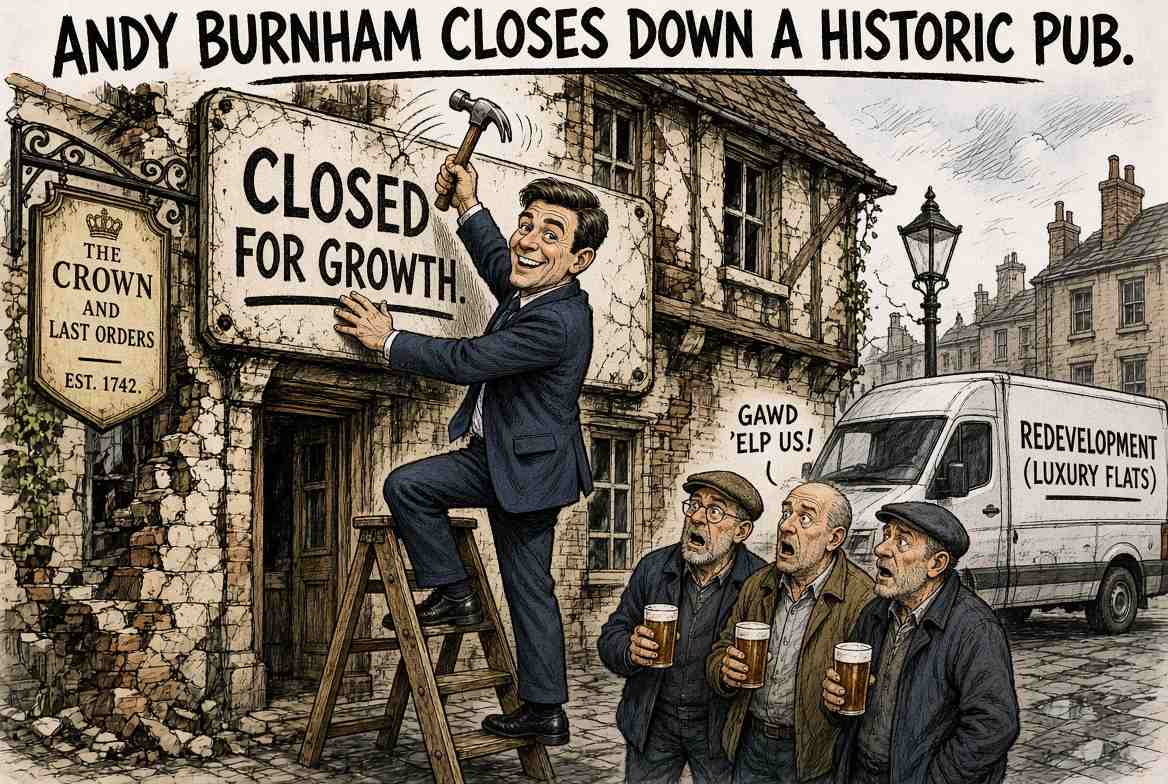
CARDIFF, WALES — Prime Minister Andy Burnham has launched an ambitious effort to preserve the United Kingdom using the traditional British management technique deployed whenever a beloved local pub is about to close: reorganise the management structure, promise greater community involvement, commission several consultations and eventually discover that somebody has already removed the dartboard.
The constitutional excitement follows a gathering in Cardiff where political leaders from Wales, Scotland and Northern Ireland have been discussing self-determination and the right of their nations to determine their own constitutional futures. Scotland’s SNP government continues to seek another independence vote, Plaid Cymru now governs Wales, and Sinn Féin remains committed to Irish reunification.
Burnham’s difficulty is that his great political enthusiasm has always been devolution, a concept defined by political scientists as transferring power away from the centre until the centre begins nervously checking whether it still has the keys.
The prime minister has spent years arguing that decisions should be made closer to the people affected by them.
Scotland has responded, “Excellent.”
Wales has replied, “We completely agree.”
Northern Ireland said, “Funny you should mention that.”
Downing Street is now examining whether there may have been a misunderstanding.
Burnham Hands Everyone the Scissors
Burnham has attempted to reassure voters that he intends to strengthen Britain while respecting the democratic wishes of its constituent nations.
This is the sort of sentence British prime ministers traditionally deliver moments before constitutional lawyers cancel dinner.
During recent exchanges, Burnham suggested Scotland could conceivably merit another referendum if there were demonstrated majority support for independence, prompting SNP politicians to behave rather like customers who have just heard somebody announce “free bar.” Downing Street subsequently stressed that another Scottish referendum was not current government policy.
The SNP nevertheless spotted the opening.
Within moments, according to constitutional tradition, seventeen Scottish nationalists had arrived carrying referendum forms, several pens, a folding table and someone capable of operating a laminator.
A Downing Street aide was reportedly forced to explain that the prime minister had merely been discussing democratic principles.
“That was our first mistake,” admitted one senior official. “Never discuss democratic principles with people who might actually want to use them.”
Devolution Works Slightly Too Well
Burnham’s predicament demonstrates one of Britain’s oldest political paradoxes.
Central governments introduce devolution to persuade distant regions that Westminster understands them.
Those regions then use their newly devolved institutions to explain, with increasing administrative precision, exactly how little Westminster understands them.
It is democracy’s version of buying your teenager a car so he can become more independent, then expressing astonishment when he drives away.
When Burnham spoke before becoming prime minister about pushing power “deeper down,” officials in Scotland and Wales were already asking exactly what this might mean outside England. Celtic governments have long wanted Westminster to recognise that devolution in Scotland, Wales and Northern Ireland is constitutionally different from creating English mayoralties.
Wales’s first minister, Rhun ap Iorwerth, has since made the distinction particularly clear: Wales is not a region of England.
Westminster has reportedly updated the official map accordingly.
The previous version had Wales labelled “LEFT OF BIRMINGHAM.”
Cardiff open-mic regular Gareth Prosser, who has never once been booked twice at the same venue, was overheard summing up the summit outside St David’s Hotel: “They call it a Union. I call it three flatmates who’ve finally found a group chat.”
Britain Begins Constitutional Divorce Proceedings
The emerging situation has raised the delicate question of what would happen if multiple parts of Britain eventually chose different constitutional arrangements.
Lawyers say dividing Britain would involve negotiations over national debt, defence, pensions, natural resources, borders and institutions.
Ordinary voters immediately identified the only important question:
Who gets custody of the BBC?
England is expected to argue that it paid for most of it.
Scotland may demand joint access at weekends.
Wales could seek visitation rights during rugby season.
Northern Ireland may simply ask whether somebody else would like BBC Northern Ireland’s collection of weather presenters pointing at rain.
The National Gallery, meanwhile, would probably remain in London because transporting it would involve completing an infrastructure project.
Scotland Is Already Standing Outside
Scotland’s last independence referendum took place in 2014, when voters chose to remain in the United Kingdom by 55% to 45%.
For Westminster, this constituted a “once-in-a-generation” decision.
For the SNP, it constituted Tuesday.
The disagreement largely revolves around the constitutional meaning of “generation.”
Westminster appears to define a generation as the expected lifespan of an oak tree. Scottish nationalists define it as the interval between polling companies asking the question again.
Recent polling cited around the Cardiff summit puts Scottish independence support at approximately 47%, with Northern Ireland at 36% and Wales at 32%.
Constitutional statistician Professor Nigel Exit of the Institute for Countries Looking Nervously at the Door explained that the numbers should comfort nobody.
“Forty-seven percent is either slightly less than half or nearly everybody,” he said, “depending on whether you’re writing for Downing Street or Edinburgh.”
This is known among political scientists as the Referendum Measurement Principle, under which 47% support for something you oppose is tiny, while 47% support for something you favour represents an unstoppable democratic tidal wave.
Labour Assures Britain This Proves Devolution Is Working
Labour officials continue to insist that empowering Britain’s nations and regions can strengthen the Union.
There is logic behind that argument.
A Union entered voluntarily can theoretically be stronger when its members feel respected and politically effective.
The slight difficulty is that three members are now examining the voluntary portion of the contract with unusually intense interest.
Burnham’s political philosophy says people should have greater control over the decisions affecting their communities.
Scottish nationalism replies: Agreed.
Plaid Cymru replies: Absolutely.
Irish nationalism replies: Keep talking.
Downing Street replies: Not quite that much control.
This has created what constitutional experts call the Devolution Thermostat Problem: Westminster wants regional autonomy set precisely high enough that people feel empowered, but not so high that Edinburgh starts ordering passports.
Then Trump Arrived
The situation achieved the constitutionally desirable level of total unpredictability when Donald Trump expressed support for Irish reunification while visiting Ireland.
Trump said he would like to see Ireland unified sooner rather than later, while declining, for now, to offer a comparable judgment on Scottish independence.
This suddenly transformed one of Europe’s oldest constitutional questions into something resembling an international property consultation.
British officials responded by reiterating that the government’s policy had not changed and that a Northern Ireland border poll would depend on public support and the established constitutional framework.
Trump’s intervention nevertheless demonstrated an important diplomatic principle: never invite an American president to discuss the integrity of the United Kingdom when he has recently been playing golf in Ireland.
By teatime, Northern Ireland was discussing reunification, Scotland was wondering whether Trump might eventually endorse independence, Wales was holding a constitutional summit, and Downing Street was presumably searching government cupboards for the warranty paperwork marked UNITED KINGDOM, PURCHASED 1707.
England Checks Whether Anyone Still Wants Custody
Amid all the nationalist excitement, surprisingly little attention has been paid to England.
England, representing roughly 84% of the UK population, has largely reacted like the father in a family argument who suddenly realises everyone else has formed a WhatsApp group without him.
If Scotland left, England would lose whisky, North Sea symbolism and somebody to blame for certain football results.
If Wales left, England would lose several castles it originally built there for deeply awkward historical reasons.
If Northern Ireland eventually joined the Republic, England would face the terrifying possibility of becoming simply England, a country forced to explain itself without hiding inside a more complicated constitutional acronym.
Government branding consultants are believed to be examining alternatives.
“United Kingdom of England and Remaining Administrative Bits” has already tested poorly.
The Pub Remains Open
For now, of course, Britain remains Britain.
No Scottish referendum has been authorised.
Welsh independence remains a minority position.
A Northern Ireland border poll is not imminent under the government’s current assessment.
But politics operates through momentum as much as legislation, and something interesting is happening when leaders across three devolved nations are simultaneously talking more confidently about constitutional self-determination.
Burnham may therefore have inherited the country’s most difficult political balancing act.
He must persuade Scotland that it is free enough not to leave.
Persuade Wales that it is respected enough not to leave.
Persuade Northern Ireland that the Union remains attractive enough not to leave.
And persuade England that none of this means everybody is leaving.
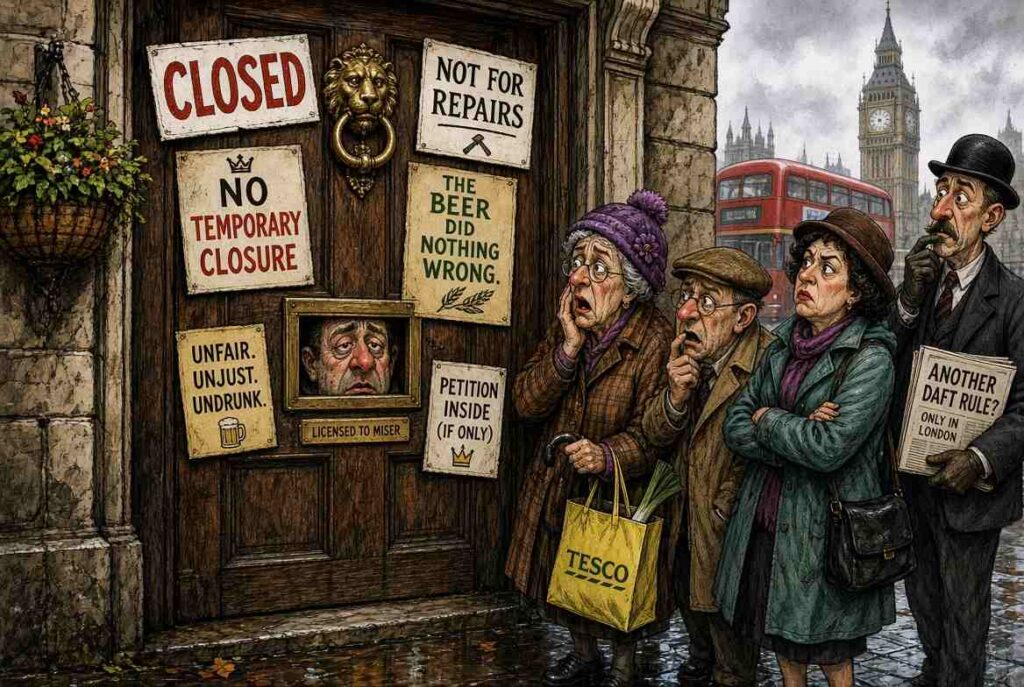
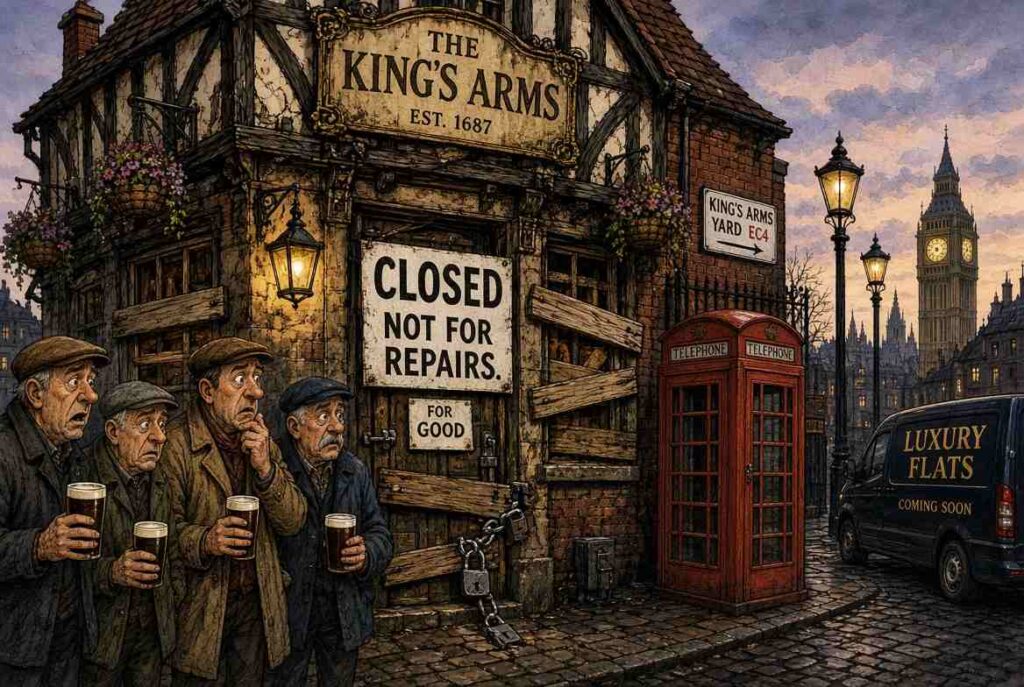
It is the same technique employed by the landlord of a struggling British pub.
“You don’t want to go somewhere else,” he tells three customers already wearing coats.
“We’ve got exciting plans.”
“What plans?”
“More local decision-making.”
“Can we decide to leave?”
“No, not that local.”
And somewhere behind the bar, the United Kingdom’s constitutional clock approaches closing time while Andy Burnham announces one final consultation.
15 Humorous Observations
- Andy Burnham wants to save the United Kingdom by devolving more power, which is roughly the constitutional equivalent of saving your marriage by giving everyone separate houses and unrestricted access to divorce lawyers.
- Scotland heard Burnham discuss the circumstances for another referendum and immediately appeared at Westminster carrying a clipboard, a pen and several witnesses.
- Wales wants greater autonomy, partly because nothing strengthens affection for Westminster quite like repeatedly having to ask Westminster for permission to stop depending on Westminster.
- Northern Ireland already has a legal mechanism for a border poll, making it the only member of the Union whose emergency exit has an illuminated sign above it.
- Scotland voted 55% to 45% to remain in the UK in 2014. Westminster regards this as binding forever, apparently under the constitutional principle that democracy should ideally be conducted once.
- Current polling cited around the Cardiff summit put support for independence at roughly 47% in Scotland, 36% in Northern Ireland and 32% in Wales. Westminster calls those reassuring numbers because British governments have survived elections with considerably less.
- Three devolved nations discussing self-determination simultaneously is not necessarily a constitutional crisis. It could merely be the world’s least enthusiastic group holiday.
- Burnham spent years promoting devolution in Greater Manchester, only to discover that giving places more control sometimes causes them to develop the dangerous belief that they should have more control.
- Labour says devolution can strengthen the Union. This is theoretically possible, much as cutting a cake into increasingly independent pieces can strengthen everyone’s commitment to the original cake.
- Donald Trump has now expressed support for Irish unity, meaning several centuries of constitutional scholarship have finally reached the phase where a golf resort owner provides closing arguments.
- Trump declined to get into Scottish independence “yet,” leaving Scotland in the unusual position of waiting for an American president to release the next episode.
- Wales’s first minister has reminded Burnham that Wales is a nation, not an English region, which seems straightforward until Westminster gets out the administrative flowchart.
- If Scotland, Wales and Northern Ireland all left, England would technically still possess the BBC, thereby ensuring the divorce negotiations became violent.
- The United Kingdom is increasingly resembling a pub at 10:55 p.m. Everyone is still technically together, three customers are putting on their coats, and management keeps insisting nobody is leaving.
- Burnham’s central challenge is wonderfully British: convince everybody they have enough freedom to remain voluntarily while carefully regulating exactly how voluntarily they may leave.
Sources
- IBTimes UK: Scotland, Wales and Northern Ireland leaders unite to press Westminster over referendum rights
- Al Jazeera: Trump says a unified Ireland would be “fantastic” during Irish visit
The scene behind the jokes is real. Scotland’s First Minister John Swinney, Wales’s First Minister Rhun ap Iorwerth and Northern Ireland’s First Minister Michelle O’Neill gathered in Cardiff alongside Sinn Féin president Mary Lou McDonald to sign a joint declaration asserting their nations’ right to determine their own constitutional futures, shortly after Prime Minister Andy Burnham told MPs another Scottish referendum could be considered given a clear consensus in favour, and shortly after President Trump told reporters in Dublin he would love to see a united Ireland.
This is British satire, built on real constitutional arguments about devolution, independence and reform. The Cardiff summit, the polling figures and the public remarks quoted from real politicians are drawn from genuine reporting; the pub landlord, the laminator operator and Professor Nigel Exit’s institute are comic inventions layered on top, standard practice in UK satirical news. No sovereign nation was formally dissolved during the writing of this piece of satirical journalism, although several were spotted quietly measuring the curtains.
More constitutional comedy and creeping identity crises over at Bohiney.com, our American sister publication, currently watching its own government try not to fall over.
Auf Wiedersehen, amigo!

Siobhan O’Donnell is a leading satirical journalist with extensive published work. Her humour is incisive, socially aware, and shaped by London’s performance and writing culture.
Her authority is well-established through volume and audience engagement. Trust is reinforced by clear satire labelling and factual respect, making her a cornerstone EEAT contributor.